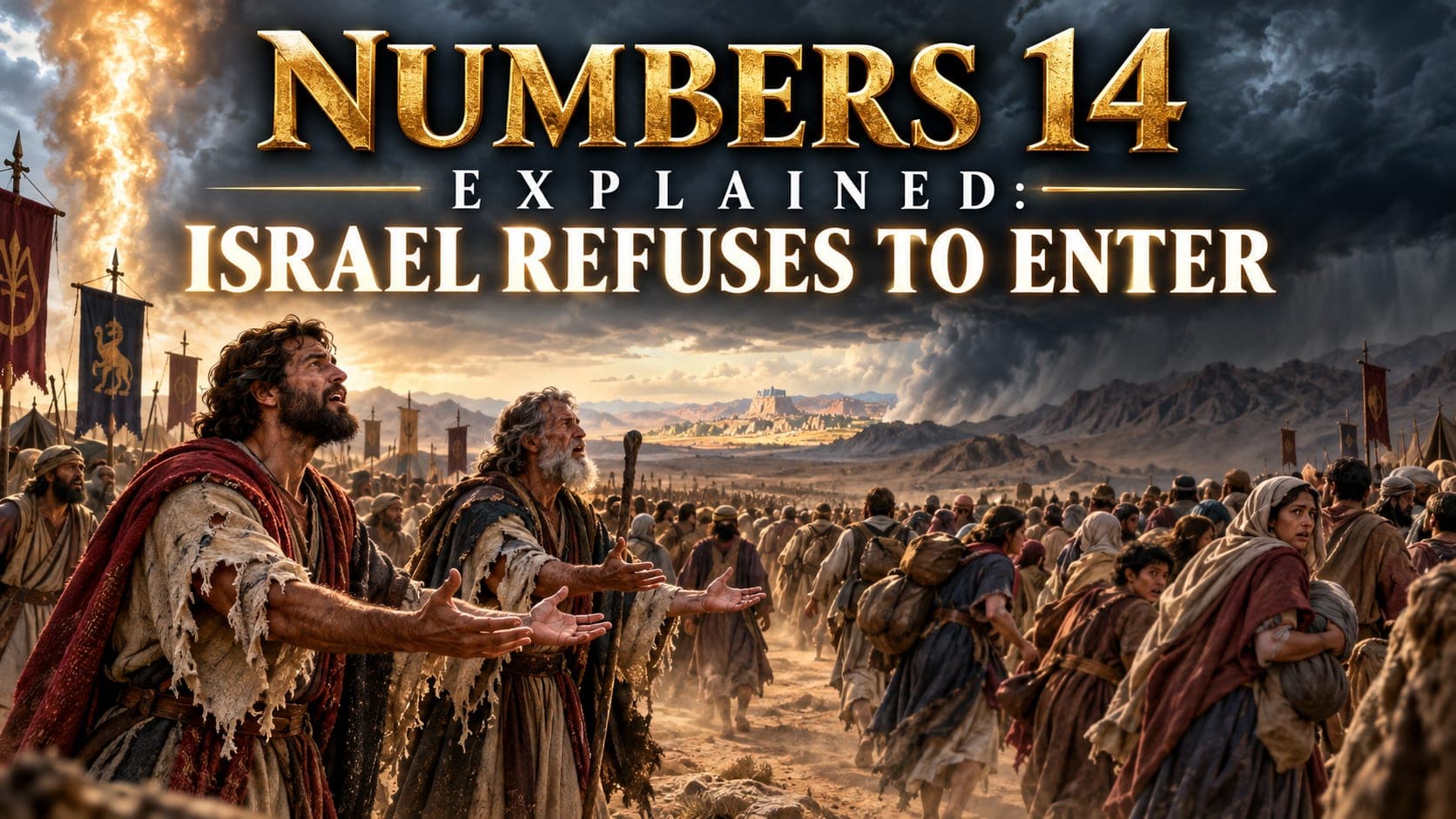
📖 Numbers 14 Explained: Israel's Rebellion and God's Mercy in Judgment
One bad report. One whole night of weeping. One generation that never makes it home.
Numbers 14 explained is the chapter where the fear from the ten spies finally detonates. The people do not just grumble this time. They talk about picking a new leader, going back to Egypt, and stoning the two men who told them the truth. God responds with an offer that should stop you cold, and Moses responds to that offer in a way that should stop you even longer.
Maybe you have watched one bad report spread through a room until everyone in it is convinced of the worst.
- ❓ Did God really intend to wipe out Israel and start over with Moses alone?
- ❓ Why does God pardon the people in one verse and still punish them in the next?
- ❓ Why do only the ten spies die immediately, while everyone else gets forty years?
- ❓ Was Moses already shut out of the promised land in this chapter, or was that a different moment?
📌 Numbers 14 holds two things together that do not usually sit side by side: real judgment and real mercy, inside the same conversation.
This walkthrough goes through the whole chapter in order: the camp's collapse into panic, Joshua finally finding his voice, Moses' prayer for a people who do not deserve it, the sentence God hands down, and the final, painful attempt to fix everything by force a day too late.
A heavy chapter, and one of the clearest pictures in the Bible of what unbelief actually costs.
What Happened Just Before This Chapter
Numbers 13 ended on a knife edge. Twelve spies came back from forty days in Canaan with the same facts: a good land, walled cities, and the sons of Anak. Ten of them turned those facts into fear. Only one man, Caleb, stood up in front of the whole camp and said Israel was well able to go up and take it.
Numbers 13 left one question hanging in the air. Caleb spoke alone in that chapter, even though history remembers Joshua standing beside him for the same conviction. This chapter is where that second voice finally arrives, and where the camp has to decide, out loud, whose report it actually believes.

Numbers 14 Explained Verse by Verse
1. The Camp Breaks Down (verses 1 to 4)
The chapter opens in the dark, with the sound of an entire nation falling apart at once.
"And all the congregation lifted up their voice, and cried; and the people wept that night."
This is not a quiet, private sorrow. "All the congregation" means the grief is total, spreading from tent to tent until the whole camp is in tears over a land they have not even lost yet. The weeping comes before a single word of complaint is spoken. Fear gets to the body before it gets to the mouth.
Then the complaint catches up.
"And all the children of Israel murmured against Moses and against Aaron: and the whole congregation said unto them, Would God that we had died in the land of Egypt! or would God we had died in this wilderness!"
"And wherefore hath the LORD brought us unto this land, to fall by the sword, that our wives and our children should be a prey? were it not better for us to return into Egypt?"
📌 Notice how fast the story in their heads changes. God brought them out of Egypt to give them a land. In the space of one night, that same God becomes, in their telling, someone who brought them out here only to get them killed. The facts have not changed since yesterday. Their trust in who God is has.
Then comes the line that turns grief into open rebellion.
"And they said one to another, Let us make a captain, and let us return into Egypt."
⚠️ This is not homesickness. It is an attempt to replace the leadership God appointed. Moses was never elected by the people. He was called by God at the burning bush. Talking about a new captain is talking about walking out from under God's own choice of leader, in both directions at once: away from Canaan, and away from the man God set over them to get there.
2. Moses and Aaron Fall Down; Joshua and Caleb Speak Up (verses 5 to 10)
Moses and Aaron have no speech ready. They have a posture instead.
"Then Moses and Aaron fell on their faces before all the assembly of the congregation of the children of Israel."
💡 Falling on their faces is not defeat. It is where Moses goes first, every time the camp turns on him, before he says a single word back to the people. The posture of prayer comes before the posture of argument.
And here, finally, is the verse Numbers 13 was waiting on.
"And Joshua the son of Nun, and Caleb the son of Jephunneh, which were of them that searched the land, rent their clothes:"
📌 Joshua's voice finally joins Caleb's. The last chapter named only Caleb stilling the camp. This chapter is where Joshua tears his own clothes in grief over what the people are about to do, and stands with Caleb against all ten of the other spies plus the entire nation.
"And they spake unto all the company of the children of Israel, saying, The land, which we passed through to search it, is an exceeding good land."
"If the LORD delight in us, then he will bring us into this land, and give it us; a land which floweth with milk and honey."
"Only rebel not ye against the LORD, neither fear ye the people of the land; for they are bread for us: their defence is departed from them, and the LORD is with us: fear them not."
👀 "They are bread for us" flips the ten spies' own image back on them. The ten said the land "eateth up the inhabitants thereof." Joshua and Caleb say the opposite: Israel will not be eaten, the people of the land will. Same ingredients, same journey, completely different conclusion, because the variable that actually matters to them is whether the LORD is with His people, not how tall the opposition stands. It is the same contrast Scripture draws everywhere between fear and faith: two people can look at the same threat and walk away with opposite verdicts, depending on what they measure it against.
The camp's answer to two men telling them the truth is immediate.
"But all the congregation bade stone them with stones. And the glory of the LORD appeared in the tabernacle of the congregation before all the children of Israel."
⚠️ The people are one breath away from murdering the two men who told them the good news. Right at that moment, before a single stone is thrown, the glory of the LORD shows up in full view of the whole camp. God does not wait for the stoning to start before He steps in.
3. God's Offer, and Moses' Plea (verses 11 to 19)
With the glory of the LORD still filling the tabernacle, God speaks to Moses alone.
"And the LORD said unto Moses, How long will this people provoke me? and how long will it be ere they believe me, for all the signs which I have shewed among them?"
"I will smite them with the pestilence, and disinherit them, and will make of thee a greater nation and mightier than they."
📌 This is close to word for word the same offer God made Moses at the golden calf, and Moses answers it the exact same way both times. He does not take the deal. A nation built entirely from Moses and no one else would have made him the father of God's people in Israel's place. He refuses that offer twice in the same book, and both times his argument is not about himself at all.
"And Moses said unto the LORD, Then the Egyptians shall hear it, (for thou broughtest up this people in thy might from among them;)"
"And they will tell it to the inhabitants of this land: for they have heard that thou LORD art among this people, that thou LORD art seen face to face, and that thy cloud standeth over them, and that thou goest before them, by day time in a pillar of a cloud, and in a pillar of fire by night."
"Now if thou shalt kill all this people as one man, then the nations which have heard the fame of thee will speak, saying,"
"Because the LORD was not able to bring this people into the land which he sware unto them, therefore he hath slain them in the wilderness."
💡 Moses' argument is entirely about God's own reputation among the watching nations, not about sparing the people on their merits. He names exactly what every surrounding nation has already seen: the plagues, the pillar of cloud and fire, God walking visibly with this people. Wiping them out now would hand every pagan nation a story about a God who could not finish what He started.
Then Moses quotes God's own words about Himself back to Him.
"And now, I beseech thee, let the power of my LORD be great, according as thou hast spoken, saying,"
"The LORD is longsuffering, and of great mercy, forgiving iniquity and transgression, and by no means clearing the guilty, visiting the iniquity of the fathers upon the children unto the third and fourth generation."
📌 Moses does not invent a new argument. He repeats back the description of God's own character that God Himself gave at Sinai after the golden calf. He is not asking God to be someone He is not. He is asking God to be exactly who He already said He is, both merciful and just in the same breath, which is precisely what the rest of this chapter shows happening.
"Pardon, I beseech thee, the iniquity of this people according unto the greatness of thy mercy, and as thou hast forgiven this people, from Egypt even until now."
4. The Verdict: Pardoned, and Still Not Entering (verses 20 to 35)
God's answer comes in two parts, and both parts are true at the same time.
"And the LORD said, I have pardoned according to thy word:"
📌 The nation is not destroyed. That part of Moses' prayer is granted outright, in one short sentence. But pardon from being wiped out is not the same thing as pardon from every consequence, and the next verses make that distinction plain.
"Because all those men which have seen my glory, and my miracles, which I did in Egypt and in the wilderness, and have tempted me now these ten times, and have not hearkened to my voice;"
"Surely they shall not see the land which I sware unto their fathers, neither shall any of them that provoked me see it:"
Verse 22 says this generation has tested God "now these ten times." Scripture does not list out all ten occasions for you here. What it does make clear is that this rebellion is not a one time lapse. It is the latest entry in a pattern that stretches back through the whole wilderness journey.
One name is carried out of the sentence by name.
"But my servant Caleb, because he had another spirit with him, and hath followed me fully, him will I bring into the land whereinto he went; and his seed shall possess it."
💡 "Another spirit" and "followed me fully" are the two phrases God Himself uses to explain why Caleb is different. Not that Caleb was braver by nature, but that something in how he related to God was simply not the same as the rest of that generation.
Then comes the sentence itself, spoken a second time with more detail.
"How long shall I bear with this evil congregation, which murmur against me? I have heard the murmurings of the children of Israel, which they murmur against me."
"Say unto them, As truly as I live, saith the LORD, as ye have spoken in mine ears, so will I do to you:"
"Your carcases shall fall in this wilderness; and all that were numbered of you, according to your whole number, from twenty years old and upward, which have murmured against me,"
"Doubtless ye shall not come into the land, concerning which I sware to make you dwell therein, save Caleb the son of Jephunneh, and Joshua the son of Nun."
⚠️ "As ye have spoken, so will I do to you" is a sentence worth sitting with. The people said they wished they had died in the wilderness. God answers by giving them, almost exactly, the thing they asked for out loud in verse 2. Their complaint becomes their sentence.
The children are treated differently, and so is the exact length of the punishment.
"But your little ones, which ye said should be a prey, them will I bring in, and they shall know the land which ye have despised."
"And your children shall wander in the wilderness forty years, and bear your whoredoms, until your carcases be wasted in the wilderness."
"After the number of the days in which ye searched the land, even forty days, each day for a year, shall ye bear your iniquities, even forty years, and ye shall know my breach of promise."
📌 The forty years are not a round number picked at random. The text ties them directly to the forty days the spies spent in the land, one year of wandering for every day of that mission. The same number that measured the spies' unbelief now measures the whole nation's consequence.
5. The Ten Spies Die; the People Mourn (verses 36 to 39)
Before the chapter moves on, it settles accounts with the men who started the panic.
"Even those men that did bring up the evil report upon the land, died by the plague before the LORD."
"But Joshua the son of Nun, and Caleb the son of Jephunneh, which were of the men that went to search the land, lived still."
👀 The ten spies who spread the fear do not wait forty years for their consequence. They die by plague right away, while the two who told the truth keep living. The sentence on the wider nation is slow and spread across a generation. The sentence on the ten men who manufactured the lie that everyone else believed is immediate.
The people's response, once Moses tells them the verdict, is not anger this time.
"And Moses told these sayings unto all the children of Israel: and the people mourned greatly."
6. The Presumptuous Climb, and Defeat at Hormah (verses 40 to 45)
Grief turns into a sudden, uninvited attempt to fix everything by force.
"And they rose up early in the morning, and gat them up into the top of the mountain, saying, Lo, we be here, and will go up unto the place which the LORD hath promised: for we have sinned."
💡 "We have sinned" sounds like repentance, but watch what they do with it. They do not ask for forgiveness and wait on God. They take the sentence as a challenge and try to march up anyway, a day after God already told them not to go. Moses warns them plainly.
"And Moses said, Wherefore now do ye transgress the commandment of the LORD? but it shall not prosper."
"Go not up, for the LORD is not among you; that ye be not smitten before your enemies."
"But they presumed to go up unto the hill top: nevertheless the ark of the covenant of the LORD, and Moses, departed not out of the camp."
📌 The ark stays in the camp. The single most visible sign of God's presence does not go up that hill with them. They march toward the very land they were afraid of three chapters ago, now suddenly confident, but without the one thing that actually made the first mission possible.
"Then the Amalekites came down, and the Canaanites which dwelt in that hill, and smote them, and discomfited them, even unto Hormah."
⚠️ The chapter that opened with the people refusing to fight for the land God offered closes with them trying to take it on their own terms, and losing badly. Obedience a day late, done without God's presence, is not the same thing as obedience.

Hard Questions Numbers 14 Raises
Did God really intend to destroy Israel and start a new nation through Moses alone? The offer in verse 12 reads as a genuine possibility, the same way the almost identical offer in Exodus 32 does. What the text shows is that Moses' intercession changes the outcome. Scripture does not spell out exactly how God's settled plan and Moses' prayer relate to each other beyond that, so the most honest reading holds both as real: a real threat, and a real intercession that God Himself invited by speaking to Moses first.
Why does God pardon the people in verse 20 and still punish them starting in verse 22? These are not two contradictory decisions. Verse 20 answers the specific request Moses made, that the nation not be destroyed as one people. Verses 22 through 35 address a separate question Moses never asked about: whether this specific generation, after testing God "these ten times," would still enter the land they refused to trust Him for. Pardon from destruction and the natural consequence of unbelief are both true in the same chapter without canceling each other out.
Why do the ten spies die immediately by plague, while the rest of the nation gets forty years? Verse 37 singles out "those men that did bring up the evil report" for an immediate death. The wider sentence in verses 29 through 34 covers everyone twenty years old and older who joined in the murmuring, spread out over the forty years it would take that generation to die out in the wilderness. The ringleaders who manufactured the fear face a swifter end than the crowd who believed them.
Was Moses already barred from the promised land in this chapter? Not according to Numbers itself. The specific reason Moses is later kept out of the land is recorded in Numbers 20:12, tied to his striking the rock at Meribah, a different incident further on in the wilderness years. Deuteronomy 1:37, retelling this spy episode decades later in one long speech, does mention that the LORD was angry with Moses too "for your sakes" in this same general stretch of the story. The most careful way to hold both texts together is to see Deuteronomy summarizing the whole wilderness generation's unbelief, leaders included, in broad terms, while Numbers itself places the specific act that kept Moses out of the land at a later, separate event.
Why is the place already called Hormah in verse 45, when Numbers 21:3 explains the name being given after a later battle there? Numbers 21:3 says the LORD "called the name of the place Hormah" after Israel defeated the Canaanites there years afterward. Numbers 14:45 uses that same name to describe a defeat that happens before that naming, in the text's own timeline. Scripture does not explain the overlap directly. The most reasonable explanation, common elsewhere in the Old Testament, is that the writer uses the place's later, familiar name to describe an earlier event there, the same way a modern account might call a battle site by the name it carries today rather than the name it had at the time.
Top Verses From Numbers 14
1. Numbers 14:9
"Only rebel not ye against the LORD, neither fear ye the people of the land; for they are bread for us: their defence is departed from them, and the LORD is with us: fear them not."
Joshua and Caleb take the ten spies' own fear filled image and turn it around completely. Same facts, opposite conclusion, because of where they place their trust.
2. Numbers 14:18
"The LORD is longsuffering, and of great mercy, forgiving iniquity and transgression, and by no means clearing the guilty, visiting the iniquity of the fathers upon the children unto the third and fourth generation."
Moses prays God's own revealed character back to Him, and gets an answer that proves both halves of this verse true at once: mercy that spares the nation, and justice that still has real weight.
3. Numbers 14:24
"But my servant Caleb, because he had another spirit with him, and hath followed me fully, him will I bring into the land whereinto he went; and his seed shall possess it."
God Himself names the exact difference between Caleb and everyone else in his generation: not courage alone, but a spirit that followed fully.
4. Numbers 14:28
"Say unto them, As truly as I live, saith the LORD, as ye have spoken in mine ears, so will I do to you:"
A sobering pattern in one line. The people wished aloud for death in the wilderness, and God answers their own words back to them.

Frequently Asked Questions About Numbers 14
What is Numbers 14 about?
Numbers 14 covers Israel's reaction to the ten spies' fearful report from the previous chapter. The people talk about stoning Joshua and Caleb and returning to Egypt, God offers to start over through Moses alone, Moses intercedes, and God pardons the nation while still sentencing that generation to forty years in the wilderness instead of entering the promised land.
Why did Israel want to go back to Egypt in Numbers 14?
Verses 1 through 4 show the people convinced, on the strength of the ten spies' report, that going into Canaan meant death for themselves and their families. Egypt, for all its slavery, felt safer to them than trusting God for a land defended by walled cities and the sons of Anak.
Why did God want to destroy Israel in Numbers 14?
Verse 11 and 12 record God asking how long this people will provoke Him despite seeing every sign He showed them, and offering to disinherit them and build a greater nation through Moses instead. Moses intercedes immediately, appealing to God's own reputation among the nations and His revealed character, and God pardons the people in verse 20.
Why were Caleb and Joshua spared in Numbers 14?
Verse 24 says Caleb had "another spirit" and "followed me fully," and verse 30 names both Caleb and Joshua as the only two of that generation permitted to enter the land. Both men told the truth about the land while still trusting God for it, instead of letting the same facts turn into fear.
What does "forty years for forty days" mean in Numbers 14?
Verse 34 directly ties the length of the sentence to the length of the spy mission: one year of wandering for each of the forty days the spies spent searching the land. The same number that measured their unbelief becomes the measure of the whole generation's consequence.
Why did the ten spies die from a plague?
Verse 37 says the men who brought the evil report about the land died by plague before the LORD, ahead of the wider nation's slower, forty year sentence. They were the ones who manufactured the fear the whole camp acted on, and Scripture records them facing judgment first.
What happened at Hormah in Numbers 14?
After God told the people not to go up into the land, a group of them tried anyway without the ark or Moses. Verse 45 says the Amalekites and Canaanites living there struck them down, driving them back as far as Hormah. It is a defeat that comes from trying to obey a day late and without God's presence.
Was Moses also forbidden from entering the promised land in Numbers 14?
Not according to the specific event Numbers records. Numbers 20:12 gives the actual reason Moses was later kept out, tied to striking the rock at Meribah. Deuteronomy 1:37 does mention God's anger with Moses in the same stretch of the story, which is best read as Moses summarizing the whole generation's unbelief rather than a second, separate account of why he personally was excluded.
What does Numbers 14:18 reveal about God's character?
Moses quotes back a description of God as longsuffering and full of mercy, forgiving iniquity, while still not clearing the guilty. The rest of the chapter shows both halves of that description playing out at once: the nation is spared from destruction, and the consequence for that generation's unbelief still stands.
How does Numbers 14 connect to the New Testament?
Hebrews 3 points directly back to this generation, saying their carcases fell in the wilderness and they could not enter God's rest because of unbelief, then uses that history to warn believers not to harden their own hearts the same way. Numbers 14 becomes, for the writer of Hebrews, the clearest Old Testament picture of what unbelief costs even people who have already seen God work.
Final Thoughts
Numbers 14 does not let you land on just one side of what happened here.
📌 Mercy and judgment were never in competition in this chapter. God pardoned the nation outright, and the consequence for that generation's unbelief still stood. Both were real at the same time.
📌 What you say out loud in fear can become the shape of your own future. The people asked to die in the wilderness, and God answered their words back to them almost exactly.
📌 Obedience without God's presence is not obedience. It is presumption. The attempt to climb the hill a day late, without the ark, ended in defeat at Hormah, not victory.
You are probably not facing walled cities or the sons of Anak. But the same question sits underneath whatever report you are carrying around right now: are you measuring it against God, the way Joshua and Caleb did, or against your own fear.
So here is your one next step.
Name one thing you have already decided is too big for God, and ask Him honestly to change your mind before you spend years proving yourself right.