📖 Numbers 13 Explained: The Twelve Spies and the Giants of Canaan
Twelve men walk into the same land. They come back with the same facts and two completely different conclusions.
Numbers 13 explained is the chapter where Israel finally reaches the edge of the promised land after a year and a half of waiting, and sends twelve of its own leaders in to look at it first. What they find is real: good fruit, real cities, and real giants. What they do with what they find is where this chapter actually turns.
Maybe you have stood at the edge of something good and let one honest look at the obstacle talk you out of it.
- ❓ Whose idea was it to send spies in the first place, God's or the people's?
- ❓ Were the ten spies lying, or just telling the truth badly?
- ❓ Who were the sons of Anak, and why did they terrify grown men?
- ❓ Why does Caleb speak up alone in this chapter, when Joshua gets just as much credit later?
📌 Numbers 13 is not a story about bad information. Every spy saw the same land, the same grapes, and the same giants. The split happens over what those facts were allowed to mean.
This walk through covers the whole chapter in the order it happens: who was sent and why, the exact instructions Moses gave them, the ground they actually covered, the cluster of grapes that took two men to carry, the report that came back in two very different voices, and the one man who stood up before the chapter even ends.
A short, tense chapter, and the hinge the entire book of Numbers turns on.
What Happened Just Before This Chapter
Numbers 12 closed with the camp waiting seven full days at Hazeroth for Miriam to be healed and brought back in, then moving on to the wilderness of Paran. That is exactly where this chapter opens. Paran was the staging ground, the last stop before Israel could actually see the land God had promised their fathers.
It is worth noticing what the camp has already been through by this point in the book. Numbers 11 was a craving for Egypt's food that ended in a plague. Numbers 12 was a jealousy over authority that ended in leprosy. Numbers 13 is the third test in a row, and this one is not about hunger or status. It is about whether the people will trust God with the one thing He actually promised them: the land itself.

Numbers 13 Explained Verse by Verse
1. Twelve Men, One From Every Tribe (verses 1 to 16)
The chapter opens with a direct command, not a suggestion.
"And the LORD spake unto Moses, saying, Send thou men, that they may search the land of Canaan, which I give unto the children of Israel: of every tribe of their fathers shall ye send a man, every one a ruler among them."
📌 Notice who God tells Moses to send. Not volunteers, not scouts picked for being athletic or brave, but a ruler from each tribe, a man already carrying real responsibility for his own people. These were not strangers to leadership walking into something new. They were leaders being asked to do, on a bigger scale, exactly the kind of job they already held at home.
"And Moses by the commandment of the LORD sent them from the wilderness of Paran: all those men were heads of the children of Israel."
The chapter then lists all twelve names and tribes, one at a time, verses 4 through 15. Two of them matter for the rest of the story: Caleb the son of Jephunneh from the tribe of Judah, and Oshea the son of Nun from the tribe of Ephraim. The list ends with a small but important detail.
"These are the names of the men which Moses sent to spy out the land. And Moses called Oshea the son of Nun Jehoshua."
💡 Oshea becomes Jehoshua here, the name you know as Joshua. "Jehoshua" means "the LORD is salvation," and Moses gives him this name right before sending him into the one mission in this whole book that will test exactly that. Scripture does not explain why Moses changed it at this specific moment, only that he did, and the timing is hard to read as a coincidence.
2. The Mission Moses Gave Them (verses 17 to 20)
Moses does not send them off with vague instructions. He tells them exactly what to look for.
"And see the land, what it is; and the people that dwelleth therein, whether they be strong or weak, few or many; And what the land is that they dwell in, whether it be good or bad; and what cities they be that they dwell in, whether in tents, or in strong holds; And what the land is, whether it be fat or lean, whether there be wood therein, or not. And be ye of good courage, and bring of the fruit of the land."
⚠️ Every single question Moses asks is about facts, not feelings. How many people, how strong, what kind of cities, what kind of soil. He does not ask them to decide whether Israel should go in. That decision was never theirs to make. Their job was to bring back an accurate picture, and "be ye of good courage" is tucked into the middle of the instructions as a command, not a wish.
The chapter also notes exactly when this happened.
"Now the time was the time of the firstripe grapes."
👀 Late summer, the start of the grape harvest in that region. That one small detail sets up exactly what the spies will carry back with them a few verses later.
3. From the Wilderness of Zin to Hebron (verses 21 and 22)
The route the spies actually walked covers real, specific ground.
"So they went up, and searched the land from the wilderness of Zin unto Rehob, as men come to Hamath. And they ascended by the south, and came unto Hebron; where Ahiman, Sheshai, and Talmai, the children of Anak, were. (Now Hebron was built seven years before Zoan in Egypt.)"
📌 Hebron is not a random stop. This is the same ground where Abraham had already pitched his tent and built an altar, and where he later bought a cave as a family burial place, the ground where Abraham and Sarah are buried. The spies were not walking into unfamiliar territory. They were walking into land their own ancestor already owned a piece of, generations earlier.
That same verse names the children of Anak living there now, the first mention in the chapter of the people who will dominate the rest of the report. The parenthetical note about Hebron being older than Zoan in Egypt is a small detail easy to skip past, but it tells you this land was already an old, settled place long before Israel ever showed up at its border.
4. The Cluster of Eshcol (verses 23 and 24)
Of everything the spies could have brought back, the text focuses on one specific piece of evidence.
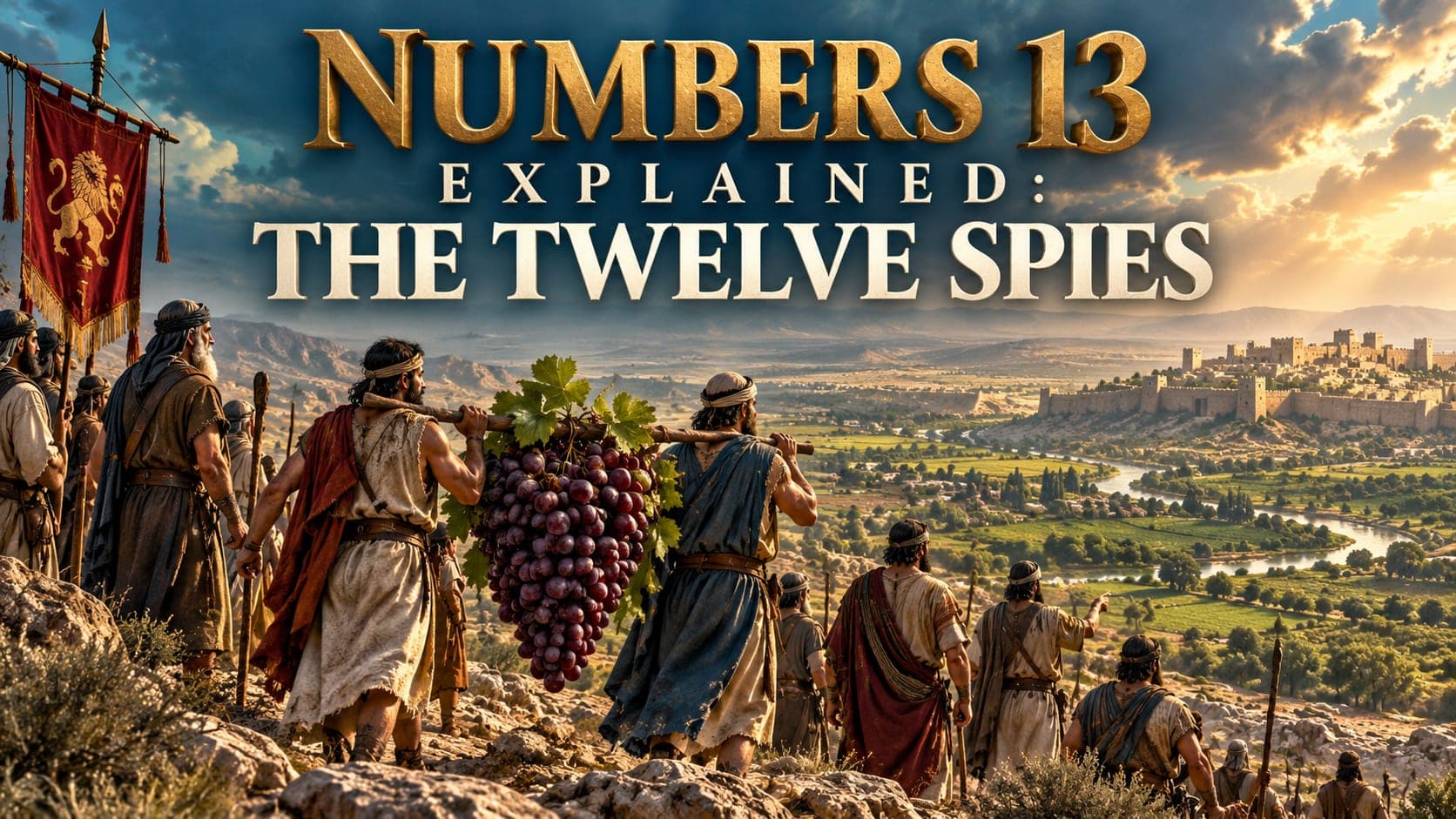
"And they came unto the brook of Eshcol, and cut down from thence a branch with one cluster of grapes, and they bare it between two upon a staff; and they brought of the pomegranates, and of the figs. The place was called the brook Eshcol, because of the cluster of grapes which the children of Israel cut down from thence."
💡 "Eshcol" means cluster, and the place keeps that name because of this one grape cluster. It took two men carrying it on a staff between them. That is not a detail added for color. It is physical proof, something the whole camp could see and touch, that the land was exactly as fertile as God had promised. The spies did not have to take anyone's word for the good part of the report. They could hold it.
5. Forty Days, and Two Ways to Tell the Same Story (verses 25 to 29)
The search takes forty days before the spies finally turn back toward the camp.
"And they returned from searching of the land after forty days. And they went and came to Moses, and to Aaron, and to all the congregation of the children of Israel, unto the wilderness of Paran, to Kadesh; and brought back word unto them, and unto all the congregation, and shewed them the fruit of the land."
Verse 27 opens the report, and for one sentence, it is good news.
"And they told him, and said, We came unto the land whither thou sentest us, and surely it floweth with milk and honey; and this is the fruit of it."
Then, in the very next breath, the report turns.
"Nevertheless the people be strong that dwell in the land, and the cities are walled, and very great: and moreover we saw the children of Anak there. The Amalekites dwell in the land of the south: and the Hittites, and the Jebusites, and the Amorites, dwell in the mountains: and the Canaanites dwell by the sea, and by the coast of Jordan."
📌 "Nevertheless" is doing all the work in verse 28. One word, and the report pivots from a promise kept to a list of threats. Everything stated here is accurate. The land really did flow with milk and honey. The people living there really were strong, and the cities really were walled. Nothing in verses 27 through 29 is a lie. What is missing is any mention of the God who sent them to look in the first place.
6. Caleb's Minority Report (verse 30)
Before the ten can finish shaping the mood of the whole camp, one man interrupts them.
"And Caleb stilled the people before Moses, and said, Let us go up at once, and possess it; for we are well able to overcome it."
⚠️ Caleb does not dispute a single fact in the report. He does not claim the cities are weaker than reported or that the children of Anak are smaller than they looked. He agrees on every detail and still says go up. The disagreement was never about what was out there. It was about what was true about God compared to what was true about the obstacle.
It is worth being precise about who speaks here. This verse names only Caleb. Joshua, despite being just as convinced, is not recorded saying a word in this chapter. His objection, standing alongside Caleb's, comes in the next chapter, after the ten spies have already turned the whole camp against going up. Numbers 13 ends with one voice raised. The second voice joins the story later.
7. The Evil Report: Grasshoppers in Giants' Eyes (verses 31 to 33)
Caleb's single voice is immediately answered by the other ten.
"But the men that went up with him said, We be not able to go up against the people; for they are stronger than we. And they brought up an evil report of the land which they had searched unto the children of Israel, saying, The land, through which we have gone to search it, is a land that eateth up the inhabitants thereof; and all the people that we saw in it are men of a great stature."
💡 "A land that eateth up the inhabitants thereof" is not something the spies actually saw. It is their own fear talking, a conclusion dressed up as an observation. Nobody showed them a land that devours people. They saw strong cities and tall men and decided the land itself must be dangerous in some deeper, almost cursed way. The last verse of the chapter makes the real issue plain.
"And there we saw the giants, the sons of Anak, which come of the giants: and we were in our own sight as grasshoppers, and so we were in their sight."
📌 "In our own sight" is the phrase worth stopping on. The ten spies are not reporting a measurement. They are reporting how small they felt standing in front of what they saw. That feeling is real. It is just not the same thing as a fact about who is actually able to win. Caleb stood in front of the exact same men and came away with a different conclusion, because he was measuring the obstacle against God rather than against himself.

Hard Questions Numbers 13 Raises
Whose idea was it to send spies, God's or the people's? Numbers 13:1 and 2 read as a direct command from the LORD to Moses, with no mention of anyone asking first. Years later, Moses retells the same event differently.
"And ye came near unto me every one of you, and said, We will send men before us, and they shall search us out the land, and bring us word again by what way we must go up, and into what cities we shall come. And the saying pleased me well: and I took twelve men of you, one of a tribe."
The most honest way to hold both texts together is to read them as two stages of the same event rather than two different stories. The people asked Moses for spies. Moses brought that request to the LORD. The LORD answered by giving him the exact instructions Numbers 13:1 and 2 record. Numbers 13 tells you the command that came out of that process. Deuteronomy 1 tells you where the request started. Neither account contradicts the other, though Scripture never states the connecting step outright, so this is a reasonable harmony rather than something the text spells out in full.
Were the ten spies lying? No. Every detail in verses 28, 29, 32, and 33 matches what Caleb himself does not dispute in verse 30. The cities were walled. The people were strong. The children of Anak were there. The sin was never in the facts. It was in the conclusion drawn from them, "we be not able," a verdict about God's power dressed up as a verdict about the enemy's size.
Were the sons of Anak the same as the Nephilim, the "giants" of Genesis 6? Numbers 13:33 uses the same underlying Hebrew word, Nephilim, translated "giants" here, and says the sons of Anak "come of" them. Genesis 6:4 already said this kind of "mighty men of renown" appeared both before the flood and "also after that," so Scripture itself does not treat this as a one time, pre flood only phenomenon. What it does not do is explain the exact line between the two groups, or settle how a population wiped out in the flood relates to a nation of walled cities centuries later. Beyond the shared name and the shared description of extraordinary size, this connection is as far as the text will confidently take you.
Why does only Caleb speak up in this chapter, if Joshua is remembered just as strongly for the same stand? The text is specific about this. Verse 30 names Caleb alone stilling the people. Joshua's recorded objection does not appear until the next chapter, standing beside Caleb once the ten spies have already turned the camp's mood. Numbers 13 credits one man with the first word of faith. The second man's stand belongs to the next chapter's account, not this one.
Top Verses From Numbers 13
1. Numbers 13:30
"And Caleb stilled the people before Moses, and said, Let us go up at once, and possess it; for we are well able to overcome it."
One voice against ten, agreeing on every fact and still reaching the opposite conclusion. The difference was never the evidence.
2. Numbers 13:33
"And there we saw the giants, the sons of Anak, which come of the giants: and we were in our own sight as grasshoppers, and so we were in their sight."
A report about how small the spies felt, written as if it were a report about how big the enemy actually was. Fear rarely announces itself as fear.
3. Numbers 13:23
"And they came unto the brook of Eshcol, and cut down from thence a branch with one cluster of grapes, and they bare it between two upon a staff."
Proof you could hold in your hands, carried for forty days, that God's promise about the land was not an exaggeration.
4. Deuteronomy 1:22
"And ye came near unto me every one of you, and said, We will send men before us, and they shall search us out the land, and bring us word again by what way we must go up, and into what cities we shall come."
Moses, decades later, filling in where the request for spies actually started. Scripture often tells the same event twice, from two different angles, without either angle contradicting the other.
5. Hebrews 3:19
"So we see that they could not enter in because of unbelief."
The New Testament's own verdict on what actually kept this generation out of the land. Not the giants. Not the walls. Unbelief.

Frequently Asked Questions About Numbers 13
What is Numbers 13 about?
Numbers 13 covers the twelve men Moses sends to search the land of Canaan, one ruler from each tribe, the forty days they spend covering the land from the wilderness of Zin to Hebron, the cluster of grapes they bring back from Eshcol, and the report that follows, true in every fact but split into two conclusions: Caleb's call to go up, and the other ten spies' fear of the people living there.
Who were the twelve spies in Numbers 13?
Verses 4 through 15 name one man from each of the twelve tribes, chosen because they were already rulers among their people. The two whose names matter for the rest of the story are Caleb of Judah and Oshea of Ephraim, renamed Joshua by Moses in verse 16.
Why did Moses rename Oshea to Joshua?
Verse 16 records the new name without explaining the reason. "Jehoshua," shortened to Joshua, means "the LORD is salvation." Moses gives him this name right before sending him into a mission that will test exactly whether Israel believes that is true.
Who were the sons of Anak?
Verse 22 names three of them, Ahiman, Sheshai, and Talmai, living at Hebron. Verse 33 calls them giants, Nephilim in the underlying Hebrew, the same word Genesis 6:4 uses, and says they were known for unusual size.
Was the report of the ten spies a lie?
No. The land, the walled cities, and the sons of Anak were all real, and Caleb never disputes any of it in verse 30. The problem was the conclusion the ten spies drew from true facts, not the facts themselves.
What does "we were in our own sight as grasshoppers" mean?
It is the ten spies describing how small they felt next to the people they saw, not an actual measurement. Verse 33 reports a feeling of being overwhelmed, written as though it settled the question of what Israel was able to do.
Why did only Caleb speak up in Numbers 13?
Verse 30 names only Caleb stilling the people and calling for them to go up. Joshua, though remembered alongside him for the same conviction, is not recorded speaking until the next chapter, after the ten spies have already spread their fear through the camp.
What was the cluster of grapes from Eshcol?
Verses 23 and 24 describe a single cluster of grapes so large it took two men to carry it on a staff between them. The brook where they cut it kept the name Eshcol, meaning cluster, because of this moment.
Why does the chapter mention Hebron was older than Zoan in Egypt?
Verse 22 adds this detail almost in passing, showing Hebron was already an old, established city long before the spies arrived. It is also the same ground where Abraham had already settled and bought a family burial site generations earlier.
Did God command the spies to be sent, or did the people ask for them?
Numbers 13:1 and 2 record a direct command from the LORD to Moses. Deuteronomy 1:22, told decades later, has the people asking Moses first. The most honest reading holds both together: the people asked, Moses brought the request to God, and God answered with the instructions Numbers 13 records.
Final Thoughts
Numbers 13 never asks you to doubt what the spies saw. It asks you to notice what they did with it.
📌 Facts and faith were never in competition in this chapter. Caleb agreed with every detail the other ten spies reported and still reached the opposite conclusion, because he weighed those facts against God instead of against himself.
📌 "We were in our own sight as grasshoppers" is a report about fear, not a report about size. The ten spies described a feeling as if it were a fact, and the whole camp believed them.
📌 One honest voice spoke up before the chapter ended. Caleb did not wait for the room to agree with him first.
You probably are not measuring yourself against the sons of Anak. But the same question still sits underneath whatever you are facing right now: are you reporting what is actually true, or are you reporting how small it makes you feel.
So here is your one next step.
Name one thing in front of you right now that feels too big, and ask honestly whether you have been measuring it against the obstacle or against God.