📖 Genesis 25 Explained: Abraham's Death and Esau's Traded Birthright
One verse buries the man Genesis has followed since chapter twelve. A few verses later, his grandson gives away his whole future for a bowl of soup.
Genesis 25 explained is the hinge chapter where the book quietly changes hands. Abraham marries again, fathers more sons, dies at a good old age, and is buried by two brothers who were never supposed to stand at the same grave together. Then the story jumps forward to a new generation, twins wrestling before they are even born, and a birthright traded away by the one who should have wanted it most.
Maybe you know what it feels like to watch a season of your life end in one sentence, while a much smaller decision quietly sets the course for everything after it.
- ❓ Why does Ishmael show up to help bury Abraham after being sent away years earlier?
- ❓ Why does the Bible pause to list twelve sons nobody remembers, right after Abraham's death?
- ❓ What did God mean telling Rebekah "the elder shall serve the younger" before either son had done anything?
- ❓ Was one bowl of stew really worth more to Esau than his entire inheritance?
📌 Everything in this chapter is either a life ending well or a future being decided carelessly, and Genesis puts both right next to each other on purpose.
This walkthrough goes through the whole chapter in order: Abraham's last marriage, his death and burial, the genealogies of both his sons, the prayer that finally breaks Rebekah's barrenness, the birth of two very different twins, and the afternoon Esau decided a bowl of stew mattered more than his birthright.
Watch how much of your own story gets decided the same way Esau's was, one tired, hungry, thirty second choice at a time.
What Happened Just Before This Chapter
Genesis 24 ended with a servant's prayer answered in full: Isaac married Rebekah, brought her into his mother's tent, and was comforted after Sarah's death. That chapter closed the last piece of unfinished business from Genesis 23, where Abraham buried Sarah in a cave he had to buy from strangers because he still owned nothing else in the land God had promised him.
Genesis 25 opens with Abraham still alive, still active, and still capable of starting a whole new branch of his family. But the chapter's real business is closing out his story. The man who left his own country at God's call back in Genesis 12, who fathered Ishmael through Hagar, who argued with God over Sodom, who nearly offered Isaac on a mountain in Genesis 22, finally comes to the end of his life here.
📌 This chapter carries two generations at once: it finishes Abraham's story and opens Isaac's in the same thirty four verses. Read slowly, because the transfer happens fast and Genesis does not stop to explain it before moving on.
Genesis 25 Explained Verse by Verse
1. Abraham's Last Marriage and Last Sons (verses 1 to 6)
The chapter opens with something the reader does not expect from a man already old enough to have buried his wife.
"Then again Abraham took a wife, and her name was Keturah."
"And she bare him Zimran, and Jokshan, and Medan, and Midian, and Ishbak, and Shuah."
💡 Genesis never explains when this marriage happens relative to Sarah's death or Isaac's wedding. Keturah gives Abraham six more sons, and the text keeps going, listing grandsons through Jokshan and Midian, a level of genealogical detail Genesis rarely spends on a family line it is about to leave behind for good.
Whatever this second family means to Abraham personally, the text is careful about where the inheritance actually goes.
"And Abraham gave all that he had unto Isaac."
"But unto the sons of the concubines, which Abraham had, Abraham gave gifts, and sent them away from Isaac his son, while he yet lived, eastward, unto the east country."
📌 Abraham settles his estate himself, while he is still alive, and he settles it in exactly one direction. Isaac gets everything. Keturah's sons, along with Ishmael before them in Genesis 21, get gifts and are sent east, away from the son the covenant runs through. Nothing here is left for a later argument. Abraham makes the division clear on his own terms, before anyone has reason to dispute it.
2. Abraham's Death, and a Grave Two Brothers Share (verses 7 to 10)
A life this large gets four short verses.
"And these are the days of the years of Abraham's life which he lived, an hundred threescore and fifteen years."
"Then Abraham gave up the ghost, and died in a good old age, an old man, and full of years; and was gathered to his people."
💡 "Gave up the ghost" simply means he breathed his last, not anything more mysterious than that. "Gathered to his people" is a phrase Genesis uses for death that treats it as rejoining family who died before, not vanishing. Abraham dies at one hundred seventy five, a good old age even by the long lifespans of this part of Genesis.
Then comes the detail that stops most readers cold.
"And his sons Isaac and Ishmael buried him in the cave of Machpelah, in the field of Ephron the son of Zohar the Hittite, which is before Mamre;"
"The field which Abraham purchased of the sons of Heth: there was Abraham buried, and Sarah his wife."
📌 Isaac and Ishmael stand at the same grave together. Genesis 21 sent Ishmael and his mother Hagar away into the wilderness, and nothing in the text records the brothers meeting again after that. Yet here, whatever distance the years put between them, both sons show up to bury their father in the same cave Abraham bought to bury Sarah in Genesis 23. Genesis does not comment on the reunion. It simply records that it happened.
3. Isaac Blessed, and Ishmael's Line Fulfilled (verses 11 to 18)
With Abraham gone, the text moves immediately to who carries the blessing forward.
"And it came to pass after the death of Abraham, that God blessed his son Isaac; and Isaac dwelt by the well Lahairoi."
💡 Lahairoi is the well where Hagar met the LORD years earlier while fleeing Sarah, the well she named after seeing the God who sees her. Isaac settling there is a quiet detail linking the two half brothers' stories to the same ground, without Genesis ever drawing attention to it directly.
Before the text follows Isaac any further, it stops to account for the son who was sent away.
"Now these are the generations of Ishmael, Abraham's son, whom Hagar the Egyptian, Sarah's handmaid, bare unto Abraham:"
"These are the sons of Ishmael, and these are their names, by their towns, and by their castles; twelve princes according to their nations."
📌 Twelve princes is not a random number. Back in Genesis 17, God told Abraham exactly what Ishmael would receive:
"And as for Ishmael, I have heard thee: Behold, I have blessed him, and will make him fruitful, and will multiply him exceedingly; twelve princes shall he beget, and I will make him a great nation."
Genesis 25 counts out the twelve names one by one, verse by verse, so the reader can check the promise against the fulfillment directly. Ishmael was never the son the covenant ran through, but God still kept every word spoken over him.
"And these are the years of the life of Ishmael, an hundred and thirty and seven years: and he gave up the ghost and died; and was gathered unto his people."
⚠️ Ishmael dies using the same phrase, "gathered unto his people," that closed his father's life eight verses earlier. Genesis gives the son sent away the same dignity in death that it gives the son who inherited everything.
4. Two Nations Struggling Inside One Womb (verses 19 to 23)
Genesis now turns fully to Isaac, and the same barrenness that shaped Sarah's story repeats itself in the next generation.
"And Isaac was forty years old when he took Rebekah to wife, the daughter of Bethuel the Syrian of Padanaram, the sister to Laban the Syrian."
"And Isaac intreated the LORD for his wife, because she was barren: and the LORD was intreated of him, and Rebekah his wife conceived."
📌 Twenty years pass between this marriage and this pregnancy. Genesis 25:20 says Isaac married at forty; Genesis 25:26 will say he was sixty when the twins were born. The text does not dwell on those two decades of waiting. It moves straight from the prayer to the answer, but the wait behind that one sentence was real and long.
What Rebekah feels once she does conceive is not simple relief.
"And the children struggled together within her; and she said, If it be so, why am I thus? And she went to enquire of the LORD."
⚠️ Rebekah does not go to Isaac or to a midwife with this. She takes it straight to the LORD. Whatever is happening inside her is violent enough that she asks, in effect, whether life is even worth living if this is what it costs. This is the first time in Genesis a woman is recorded going directly to God with a question this raw.
The answer she receives explains the struggle, and sets the course for the rest of the Bible.
"And the LORD said unto her, Two nations are in thy womb, and two manner of people shall be separated from thy bowels; and the one people shall be stronger than the other people; and the elder shall serve the younger."
📌 God names the outcome before either child is born, before either has done a single thing good or bad. Not two brothers only, but two nations. The custom of the ancient world gave the firstborn a double inheritance and the family's leadership. This oracle overturns that custom before the twins even draw their first breath.
5. Esau and Jacob, Different From the Start (verses 24 to 28)
The birth itself matches the struggle Rebekah already felt.
"And the first came out red, all over like an hairy garment; and they called his name Esau."
"And after that came his brother out, and his hand took hold on Esau's heel; and his name was called Jacob: and Isaac was threescore years old when she bare them."
💡 Esau's name connects to his reddish, hairy appearance. Jacob's name comes from the Hebrew word for heel, tied to grabbing his brother's heel on the way out, and it carries a second sense in Hebrew closer to "he grasps" or "he supplants," a meaning Esau himself will throw back at Jacob with real bitterness many chapters later.
The boys grow into two different lives, and their parents do not respond to that difference the same way.
"And the boys grew: and Esau was a cunning hunter, a man of the field; and Jacob was a plain man, dwelling in tents."
"And Isaac loved Esau, because he did eat of his venison: but Rebekah loved Jacob."
⚠️ One verse gives Isaac a reason for his love. Rebekah's love for Jacob is stated flatly, with no reason attached at all. Genesis does not soften this. A father who loves the son who feeds him well, and a mother who loves the other son outright, is a household already divided before anything else in the story happens. That division does not stay quiet for long once Genesis keeps telling this family's story.
6. The Birthright Sold for a Bowl of Stew (verses 29 to 34)
The chapter that opened with a great man's careful, deliberate estate planning ends with the opposite: a decision made in about thirty seconds.
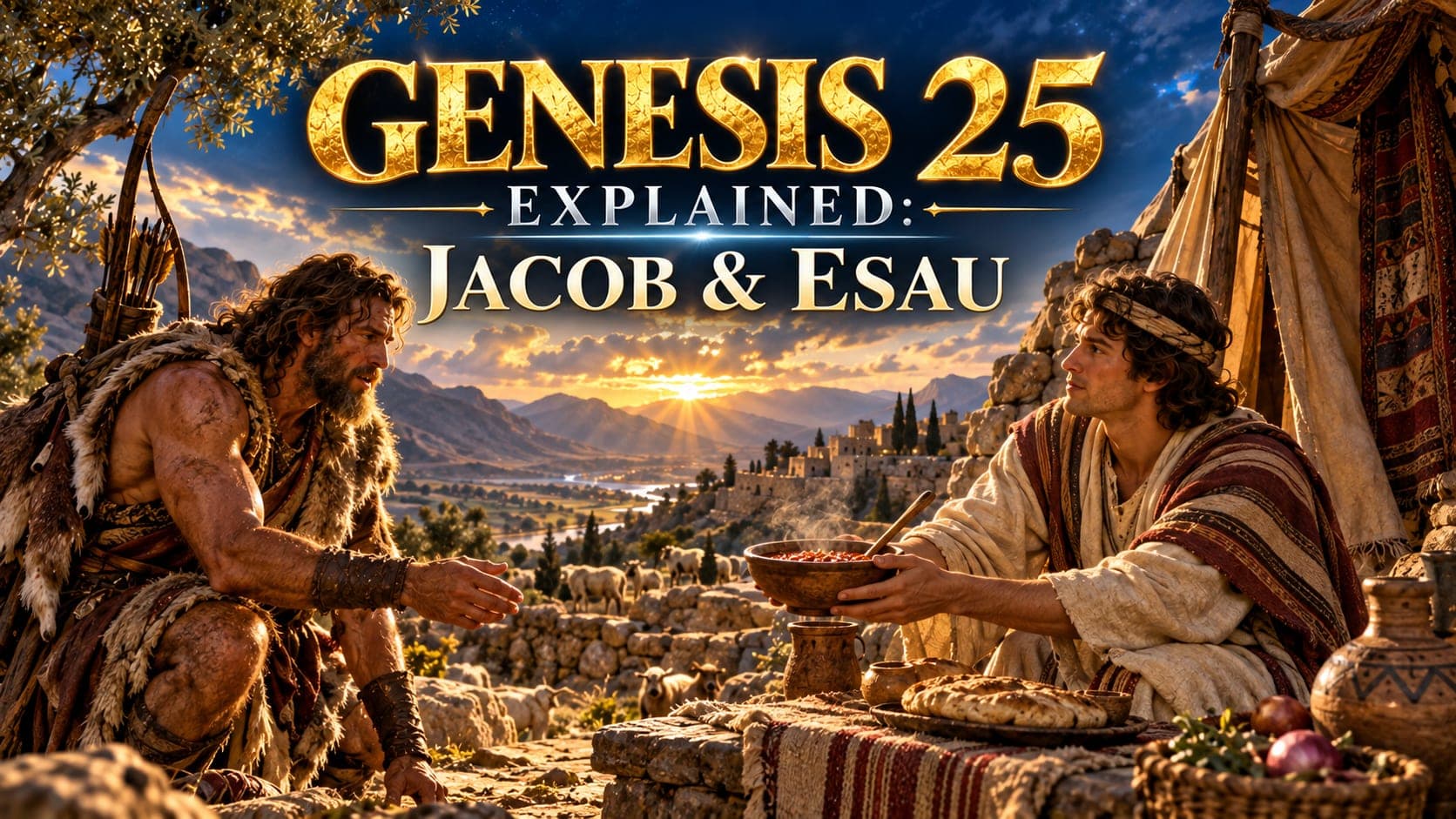
"And Jacob sod pottage: and Esau came from the field, and he was faint:"
"And Esau said to Jacob, Feed me, I pray thee, with that same red pottage; for I am faint: therefore was his name called Edom."
💡 "Sod pottage" means Jacob had boiled a stew, likely made from lentils, red in color. Esau cannot even name it in the moment, calling it only "that same red" food, and the episode earns him a second name, Edom, meaning red, that sticks to his descendants for the rest of the Old Testament.
Jacob does not simply share a meal with his hungry brother. He names a price.
"And Jacob said, Sell me this day thy birthright."
"And Esau said, Behold, I am at the point to die: and what profit shall this birthright do to me?"
⚠️ Esau is hungry, not actually dying. He has just come from the field, tired and wanting food fast, and he talks as if he is minutes from death. The birthright he is weighing against one bowl of stew was the double inheritance and the family leadership passed down from Abraham through Isaac. He treats a lifelong inheritance as worthless next to an immediate appetite.
"And Jacob said, Swear to me this day; and he sware unto him: and he sold his birthright unto Jacob."
"Then Jacob gave Esau bread and pottage of lentiles; and he did eat and drink, and rose up, and went his way: thus Esau despised his birthright."
📌 Jacob will not simply hand over food. He makes Esau swear an oath first, turning a moment of hunger into a binding, legal transaction. The last line of the chapter is Genesis's own verdict on what happened: Esau did not just lose his birthright, he despised it. He ate, drank, got up, and walked away as if nothing important had happened at all.

Hard Questions Genesis 25 Raises
Why does the Bible pause for a full genealogy of Ishmael, a son who was already sent away? The list of twelve princes exists to show God keeping a specific promise made back in Genesis 17:20, not to suggest Ishmael was ever meant to carry the covenant forward. Genesis treats faithfulness to every promise it records as worth documenting, even the ones that run alongside the main story rather than through it.
Was it wrong for Rebekah to love Jacob more than Esau? The text states the favoritism plainly, on both sides, without excusing either parent. It does not moralize about Isaac's or Rebekah's motives in this chapter, but the rest of Genesis shows this unequal love shaping real deception and real damage between the brothers in the chapters that follow.
Does "the elder shall serve the younger," spoken before either twin had done anything, mean God overrides human choice entirely? Romans 9:10 to 13 quotes this exact oracle centuries later, tying it to God's purpose rather than either brother's earned merit. Christians read this question differently: some emphasize God's sovereign choice stated ahead of time, others emphasize that the oracle describes a coming reality without erasing Esau's own responsibility for despising his birthright in verse 34. Genesis 25 itself holds both together without resolving the tension for the reader.
Was Esau really at risk of dying from hunger, or was that an excuse? Genesis 25:29 says he was "faint," tired and hungry from the field, not on the edge of starvation. His own words, "I am at the point to die," sound more like the exaggeration of a hungry man wanting his way than a real medical emergency, and the text's closing verdict, that he "despised" the birthright, reads as Genesis siding against his excuse.
Why would Ishmael show up to bury the father whose household had sent him and his mother away years earlier? Genesis never explains the reconciliation, if there was one, or how the brothers' relationship stood by that point. It simply records both sons standing at the same grave, letting the fact itself carry whatever weight the reader wants to give it.
Practical Tips From Genesis 25
This chapter moves fast, but it is full of decisions worth slowing down and learning from.
- Settle what matters while you still can. Abraham divided his inheritance himself, clearly, before his death. Do not leave the important things unsaid or undecided for someone else to sort out later.
- Bring your real questions straight to God. Rebekah did not hide her confusion or soften it for anyone. She went and asked the LORD directly, and He answered her.
- Notice when you are loving one person for what they give you. Isaac's love for Esau is tied to venison in the very same verse. Love that depends on what someone provides you is worth examining honestly.
- Do not trade a lasting inheritance for an immediate craving. Esau's hunger was real, but it passed within the hour. The birthright he gave up for it did not come back.
- Watch what you say when you are exhausted. "I am at the point to die" was an exaggeration that talked Esau into a decision he could never undo. Tired words still carry real weight.
- Let old promises get honored, even the ones that are not about you. Genesis spends real space confirming God kept His word to Ishmael. Faithfulness to a promise made to someone else still matters and is still worth noticing.
Top 5 Bible Verses From Genesis 25
1. Genesis 25:8
"Then Abraham gave up the ghost, and died in a good old age, an old man, and full of years; and was gathered to his people."
The death of the man the whole book of Genesis has followed since chapter twelve, summed up in one calm, complete sentence.
2. Genesis 25:23
"And the LORD said unto her, Two nations are in thy womb, and two manner of people shall be separated from thy bowels; and the one people shall be stronger than the other people; and the elder shall serve the younger."
The outcome named before either twin has done a single thing, good or bad, overturning the custom that normally favored the firstborn.
3. Genesis 25:32
"And Esau said, Behold, I am at the point to die: and what profit shall this birthright do to me?"
Hunger talking louder than a lifetime of inheritance, in words that sound urgent but do not hold up against what he actually gave away.
4. Genesis 25:34
"Then Jacob gave Esau bread and pottage of lentiles; and he did eat and drink, and rose up, and went his way: thus Esau despised his birthright."
Genesis's own verdict on the trade, stated plainly at the very end of the transaction: this was not a small mistake, it was contempt for what he had.
5. Hebrews 12:16 and 17
"Lest there be any fornicator, or profane person, as Esau, who for one morsel of meat sold his birthright. For ye know how that afterward, when he would have inherited the blessing, he was rejected: for he found no place of repentance, though he sought it carefully with tears."
The New Testament's own reading of this chapter, centuries later, used as a direct warning against trading something lasting for something that only satisfies for a moment.

Frequently Asked Questions About Genesis 25
What does Genesis 25 mean?
It records Abraham's last marriage and death, the genealogies of both Ishmael and Isaac, Rebekah's difficult pregnancy with twins after an oracle from God, the births of Esau and Jacob, and Esau selling his birthright to Jacob for a bowl of stew.
Who was Keturah?
Genesis 25:1 names her as the wife Abraham took after Sarah's death. She bore him six more sons, who received gifts from Abraham and were sent away east, while Isaac alone received the full inheritance.
How old was Abraham when he died?
Genesis 25:7 states he was one hundred seventy five years old, described in the next verse as dying "in a good old age, an old man, and full of years."
Why did both Isaac and Ishmael bury Abraham together?
Genesis 25:9 simply records that both sons buried him in the cave of Machpelah, the same cave where Sarah was already buried. The text does not explain the state of the brothers' relationship by that point, only that they stood at the same grave.
Why does Genesis list Ishmael's twelve sons in this chapter?
Genesis 25:12 to 16 fulfills the exact promise God made in Genesis 17:20, that Ishmael would father twelve princes and become a great nation. The list shows God keeping His word even to the son who was not the child of promise.
What does "the elder shall serve the younger" mean?
Genesis 25:23 records God telling Rebekah this before Esau and Jacob were even born, meaning Jacob, the younger twin, would end up in the position of leadership normally reserved for the firstborn. Romans 9:10 to 13 later quotes this same oracle.
Why was Jacob's name connected to grabbing Esau's heel?
Genesis 25:26 says Jacob's hand took hold of Esau's heel as he was born. His name relates to the Hebrew word for heel and also carries a sense closer to "he grasps" or "he supplants," a meaning that fits how the rest of his early story plays out.
What exactly is a birthright, and why did it matter so much?
In this culture, the birthright normally gave the firstborn son a double portion of the inheritance and the position of family leadership after the father's death. Esau traded that lasting, lifelong standing for one bowl of stew that satisfied him for an afternoon.
Why is Esau also called Edom?
Genesis 25:30 says the name came from that exact moment, tied to the red stew he begged for. Edom later becomes the name of the nation descended from him, carrying the memory of this trade forward for generations.
Did Esau have a legal right to sell his birthright?
Genesis 25:33 shows Jacob requiring an oath before handing over the food, making the sale a real, binding transaction rather than an impulsive joke. Genesis 25:34 then states plainly that Esau despised what he had given away, placing the responsibility for the choice on Esau himself.
Final Thoughts
Genesis 25 covers more ground than almost any chapter before it, and still knows exactly what it wants you to notice.
📌 A life well finished and a future given away carelessly sit side by side in the same chapter. Abraham settles his affairs with real care before he dies. Esau throws away his inheritance in about thirty seconds, tired and hungry, without weighing what it actually cost him.
📌 God keeps every promise He makes, not only the ones that carry the main story forward. Ishmael was never the child of the covenant, and Genesis still spends real space confirming his twelve princes exactly as promised.
📌 What you treat as worthless when you are exhausted may be the very thing you needed most. Esau's hunger passed within the hour. His birthright never came back.
You will have your own version of that bowl of stew, a moment when something lasting looks small next to something that feels urgent right now.
So here is your one next step.
Before you trade away anything that actually matters for relief that will not last past today, ask yourself honestly whether you are really at the point of dying, or just tired and wanting your way, the way Esau was.