📖 Exodus 35 Explained: The Offering for the Tabernacle Begins
Two chapters ago, Israel tore the gold off their own bodies to melt a calf. In this chapter, they tear the gold off their own bodies again, and this time nobody has to ask twice.
Exodus 35 explained is the chapter where Moses comes down from his third trip up the mountain, his face still carrying the glow nobody could explain, and does something he has not done in a while. He gathers the whole congregation and gives them something to build.
Maybe you remember the golden calf and the shining face, but skipped straight past what happens right after.
- ❓ Why does Moses repeat the sabbath law again, with one detail added that was never said before?
- ❓ Why does God ask for the exact same materials He already asked for back in Exodus 25?
- ❓ Why does the text go out of its way to name women's skill at spinning?
- ❓ Why did the people have to be told to stop giving, instead of being begged to start?
📌 Exodus 35 is the chapter where the same gold that built an idol gets handed over again, this time for the right reason, by people nobody forced.
This walkthrough goes through the whole chapter in order: the sabbath renewed with a new detail, Moses repeating word for word what God had told him alone on the mountain, the people's offering pouring in faster than anyone expected, the specific mention of women's needlework, and Bezaleel and Aholiab named publicly for a job God had already given them before the golden calf ever happened.
Read slowly. This chapter is quiet, but it answers a question Exodus 32 never fully settled.
What Happened Just Before This Chapter
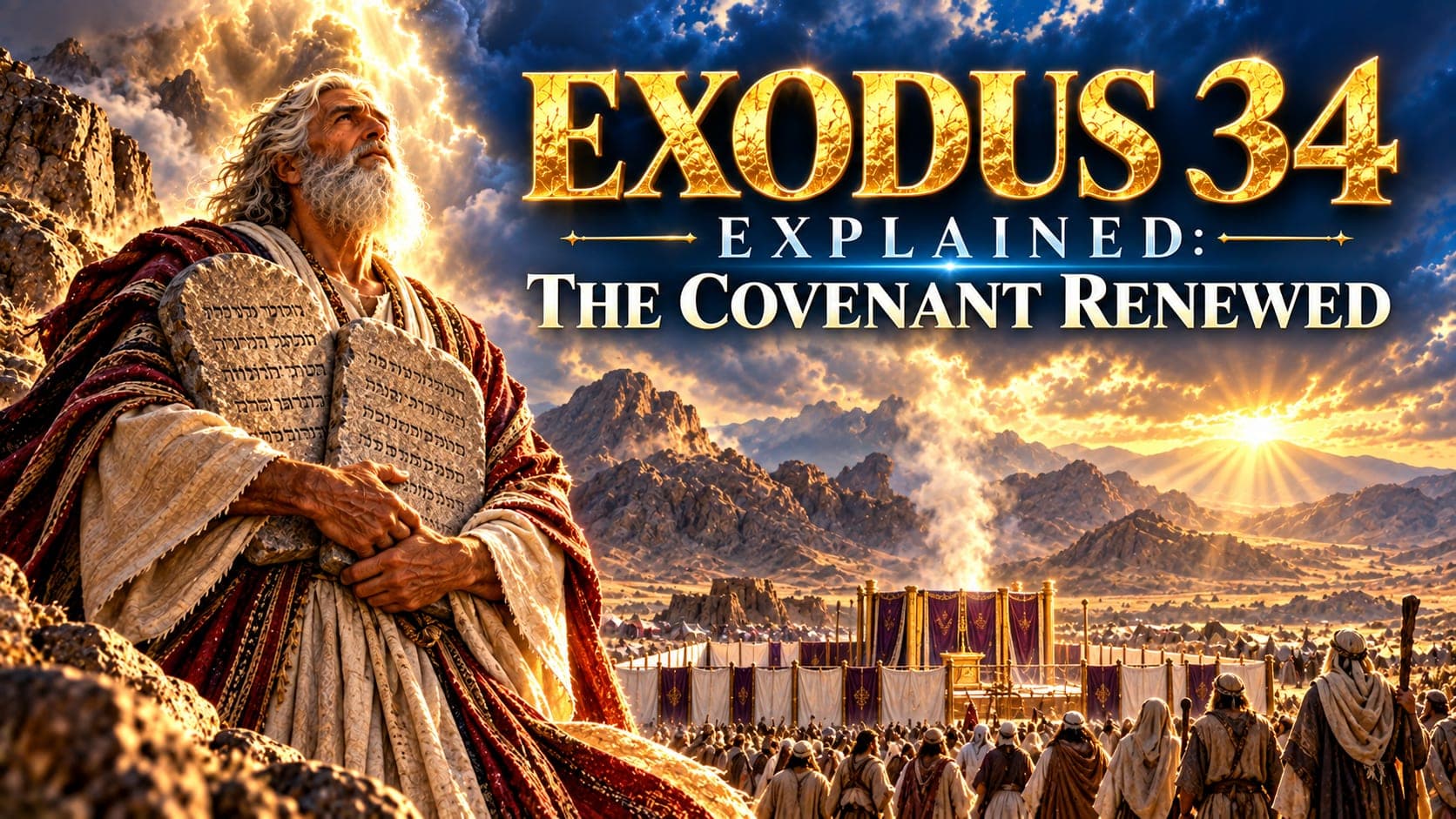
Exodus 34 ended with Moses coming down the mountain a third time, carrying tables of stone he had to cut himself, a covenant renewed, and a face that shone from being near God without his own knowledge. He had started wearing a veil, taking it off only when he spoke with the LORD or delivered God's words to the people, then covering his face again until the next time.
That scene closed Exodus 34 on something personal, one man's changed face. Exodus 35 opens on something communal. Moses gathers the whole congregation, the same word used for the crowd that once surrounded Aaron demanding a calf in Exodus 32. This time what he hands them is not a crisis. It is a plan God had already given him, back before the calf, that the camp never got the chance to hear.
Exodus 35 Explained Verse by Verse
1. The Sabbath, Repeated With One New Detail (verses 1 to 3)
Moses opens with a law the camp has already heard, and then adds something it has not.
"And Moses gathered all the congregation of the children of Israel together, and said unto them, These are the words which the LORD hath commanded, that ye should do them."
"Six days shall work be done, but on the seventh day there shall be to you an holy day, a sabbath of rest to the LORD: whosoever doeth work therein shall be put to death."
📌 None of this is new. The six and seven day pattern, and the death penalty for working on the sabbath, had already been given to Moses alone on the mountain in Exodus 31. What follows in the very next verse had not.
"Ye shall kindle no fire throughout your habitations upon the sabbath day."
💡 Not lighting a cooking fire or a hearth fire is a specific, practical detail no earlier sabbath command in Exodus had spelled out. Rest here is not just an idea. It reaches into the smallest daily task, keeping a home warm or a meal cooking, and says that counts as work too.
2. Moses Repeats, Almost Word for Word, What God Told Him Alone (verses 4 to 19)
The sabbath took three verses. The building project takes the rest of the chapter, starting with a request Moses had already heard once before, privately.
"And Moses spake unto all the congregation of the children of Israel, saying, This is the thing which the LORD commanded, saying, Take ye from among you an offering unto the LORD: whosoever is of a willing heart, let him bring it, an offering of the LORD; gold, and silver, and brass,"
📌 Compare this to what God told Moses on the mountain, long before the golden calf. God had already named almost this exact list to Moses alone at the start of Exodus 25: gold, silver, brass, blue and purple and scarlet thread, fine linen, goats' hair, rams' skins, badgers' skins, shittim wood, oil, spices, onyx stones. Moses is not announcing something new here. He is finally relaying, to the people who need to actually bring it, instructions God gave him before the calf ever interrupted the plan.
Shittim wood is acacia, a hard desert wood suited to furniture that has to survive decades of travel. The list continues into the furniture itself.
"The tabernacle, his tent, and his covering, his taches, and his boards, his bars, his pillars, and his sockets, The ark, and the staves thereof, with the mercy seat, and the vail of the covering, The table, and his staves, and all his vessels, and the shewbread,"
Taches are clasps or hooks, used to fasten the tabernacle's curtains together. Shewbread was bread kept continually on the table inside the holy place, a visible sign that the LORD provided for His people. The list keeps going through the lampstand, the incense altar, the bronze altar, the court hangings, the priestly garments for Aaron and his sons, right down to the tent pegs and their cords.
💡 Nothing here is decoration for its own sake. Every item on this list had already been described in careful detail across Exodus 25 through 30. Moses is handing the people a construction list for a building whose blueprint was already finished.
3. The Same Gold, Given a Different Way (verses 20 to 24)
What happens next is the chapter's quiet answer to a question the golden calf story left hanging.
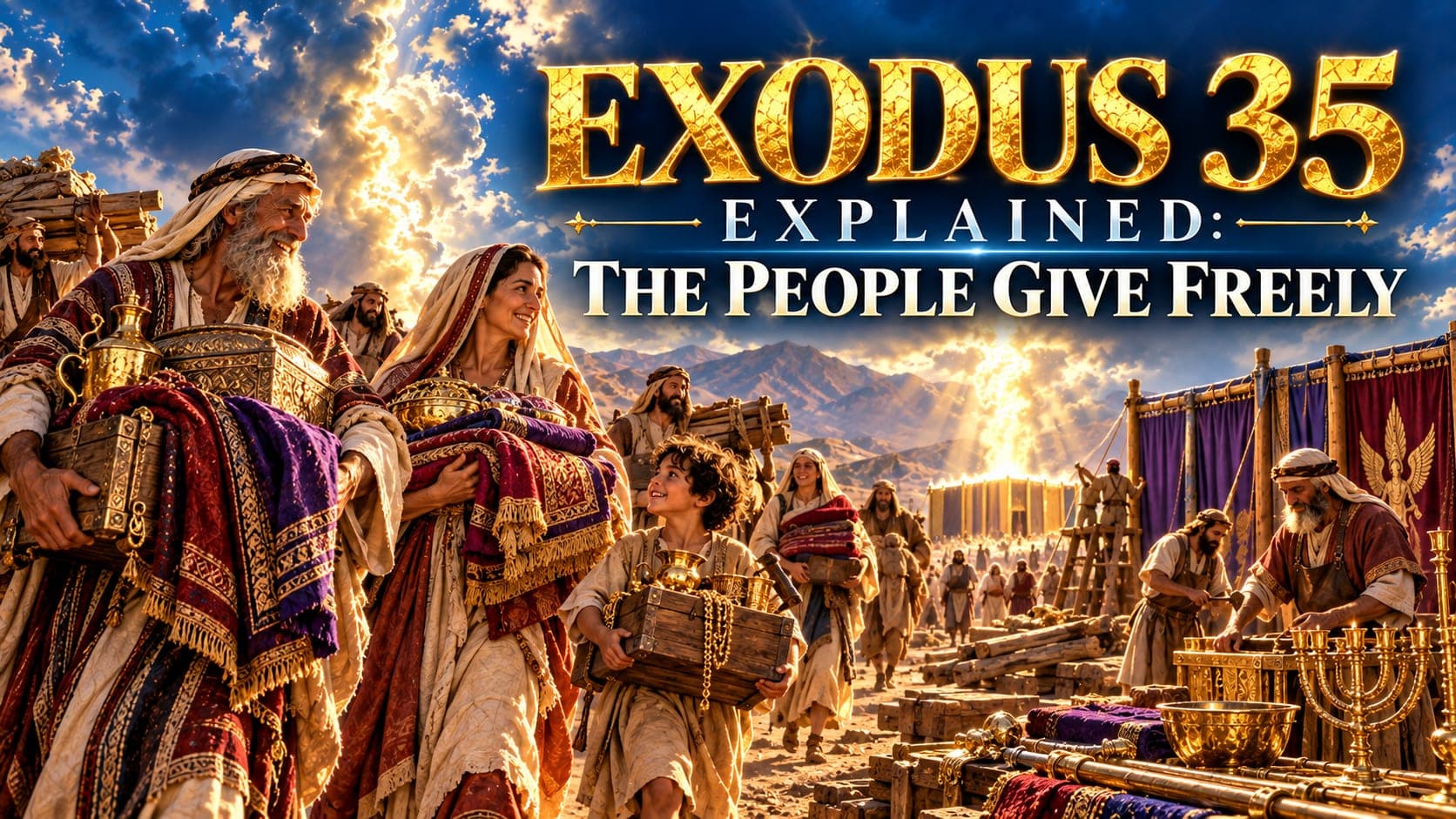
"And all the congregation of the children of Israel departed from the presence of Moses. And they came, every one whose heart stirred him up, and every one whom his spirit made willing, and they brought the LORD's offering to the work of the tabernacle of the congregation, and for all his service, and for the holy garments."
"And they came, both men and women, as many as were willing hearted, and brought bracelets, and earrings, and rings, and tablets, all jewels of gold: and every man that offered offered an offering of gold unto the LORD."
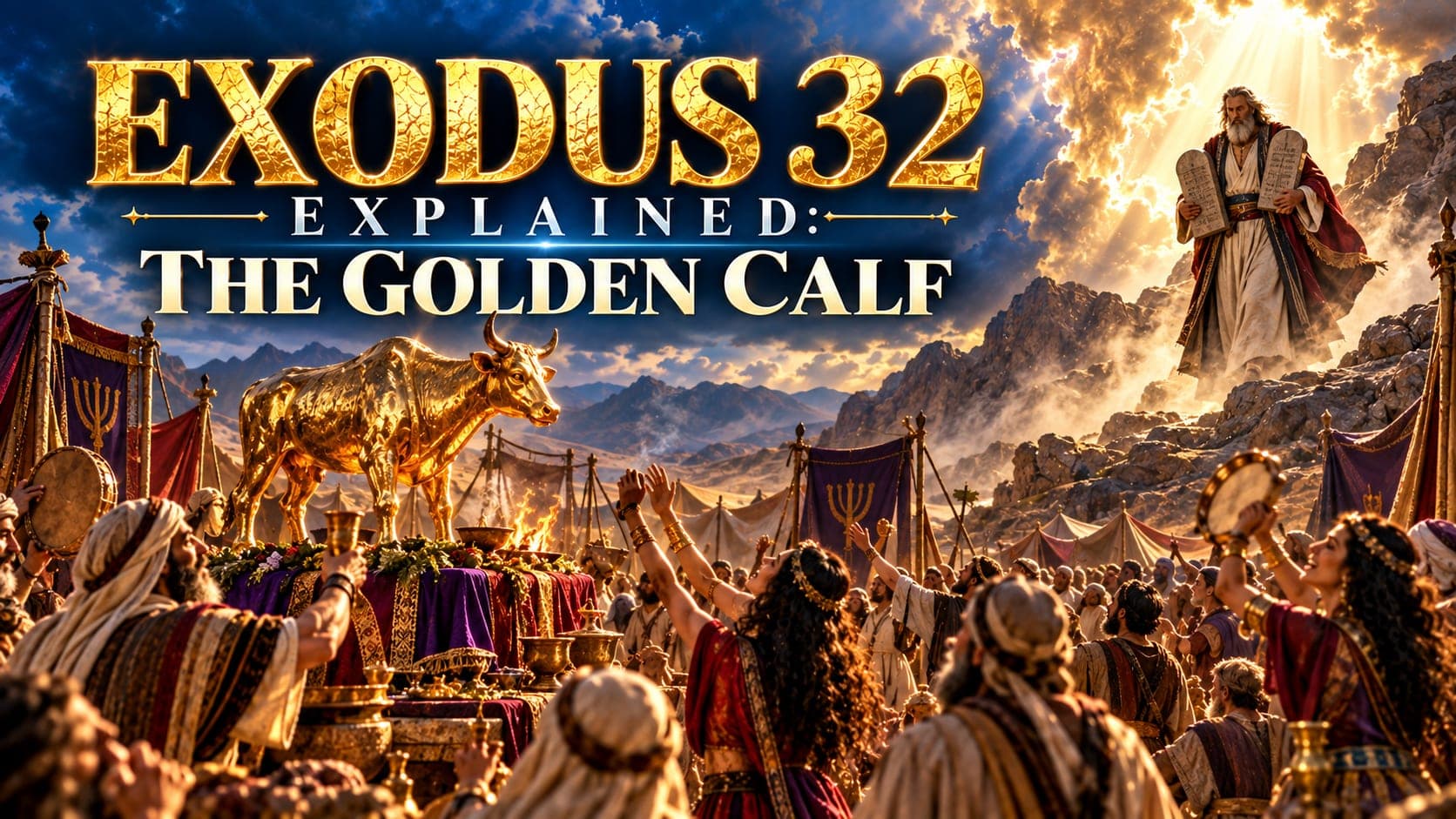
⚠️ Bracelets, earrings, rings, the same kind of gold ornament Aaron collected in Exodus 32:2 and 3 to build the calf, and the same category of jewelry Israel stripped off in mourning when Exodus 33:4 to 6 told them God would not travel in their midst. This is the third time gold jewelry moves in this story. First it built an idol. Then it came off in grief. Now it is handed over again, and this time no one has to ask twice.
📌 The difference was never the gold. It was what the heart behind it was reaching for. Verse 21 uses "willing" and "stirred" in the same breath, language Exodus 32 never once used for the crowd demanding a calf.
4. Every Willing Heart, Not Just a Few (verses 25 to 29)
The offering was not limited to whoever happened to own gold. The text makes a point of naming skill, not just wealth.
"And all the women that were wise hearted did spin with their hands, and brought that which they had spun, both of blue, and of purple, and of scarlet, and of fine linen. And all the women whose heart stirred them up in wisdom spun goats' hair."
📌 Scripture names this work specifically and calls it wisdom, twice in two verses. Spinning thread by hand was skilled, essential labor, and the text credits the women who did it by name of trade, not as an afterthought folded into "the people." Without their thread, there is no blue or purple or scarlet for a single curtain in the tabernacle.
Rulers contribute what ordinary households would not have on hand.
"And the rulers brought onyx stones, and stones to be set, for the ephod, and for the breastplate; And spice, and oil for the light, and for the anointing oil, and for the sweet incense."
"The children of Israel brought a willing offering unto the LORD, every man and woman, whose heart made them willing to bring for all manner of work, which the LORD had commanded to be made by the hand of Moses."
💡 Verse 29 sums up the whole offering in one line: every man and woman, each contributing according to what they actually had to give. Nobody is named as holding back, and nobody is named as giving more than their own willingness.
5. Bezaleel and Aholiab, Named to the People at Last (verses 30 to 35)
The chapter closes by naming the two men who will turn all this material into an actual building.
"And Moses said unto the children of Israel, See, the LORD hath called by name Bezaleel the son of Uri, the son of Hur, of the tribe of Judah; And he hath filled him with the spirit of God, in wisdom, in understanding, and in knowledge, and in all manner of workmanship;"
📌 These words are not new either. God spoke almost this exact description of Bezaleel to Moses privately at the start of Exodus 31, before the golden calf, before the broken tables, before any of it. The appointment never changed. What changed is that the people are finally hearing about it, after a covenant crisis delayed the announcement by several chapters.
"And he hath put in his heart that he may teach, both he, and Aholiab, the son of Ahisamach, of the tribe of Dan. Them hath he filled with wisdom of heart, to work all manner of work, of the engraver, and of the cunning workman, and of the embroiderer, in blue, and in purple, in scarlet, and in fine linen, and of the weaver, even of them that do any work, and of those that devise cunning work."
⚠️ Notice that Bezaleel is not only gifted to build. He is gifted to teach. The tabernacle was never meant to rest on two men's hands alone. Verse 34 says God put teaching itself into Bezaleel's heart, so the skill needed for this work could spread to everyone whose heart had just been stirred to give material for it.

Hard Questions Exodus 35 Raises
Why does this chapter repeat material already given in Exodus 25 and Exodus 31 almost word for word? The text itself explains the gap in timing, not the content. God gave the materials list and named Bezaleel and Aholiab to Moses privately, on the mountain, before the golden calf. The people below never heard any of it, because the covenant broke and had to be rebuilt before the tabernacle work could resume. Exodus 35 is Moses finally delivering, to the whole congregation, instructions that had been waiting since before the crisis. The repetition is not padding. It is catching the people up on a plan that was already finished, just never announced.
Is the death penalty for breaking the sabbath in Exodus 35:2 still a command for Christians today? Exodus 35:2 states the penalty plainly as part of Israel's covenant law at Sinai. The New Testament treats the sabbath differently than the rest of the Ten Commandments in several places.
"Let no man therefore judge you in meat, or in drink, or in respect of an holyday, or of the new moon, or of the sabbath days: Which are a shadow of things to come; but the body is of Christ."
Christians read this differently. Some hold that the moral principle of regular rest and worship continues even though the specific Mosaic penalty does not apply outside Israel's covenant law. Others see the sabbath itself as part of the ceremonial law fulfilled in Christ, no longer binding in its Old Testament form at all. What Exodus 35:2 and 3 record is not in dispute: within Israel's covenant, sabbath rest was treated with the same seriousness as any other command God had just renewed.
Why does Exodus 35:3 add a command against kindling fire that no earlier sabbath passage in Exodus mentions? Exodus 20:8 to 11, 23:12, and 31:14 and 15 all command sabbath rest and state the death penalty, but none of them name fire specifically. Exodus 35:3 is the first place in the book this detail appears. The text does not explain why it surfaces here rather than earlier. What it does show is that rest was never meant to stay a general idea. It was specific enough to reach into whether a cooking fire stayed lit.
Why does the text specifically credit women's skill at spinning, when so much of Exodus names only men? Exodus 35:25 and 26 are direct: "all the women that were wise hearted did spin with their hands," and their skill is called wisdom twice. The tabernacle could not have been built without the thread they produced. The text does not elaborate further than that, but it does not need to. It simply records, without comment, that the work these women did was essential and skilled, not incidental.
Top Verses From Exodus 35
1. Exodus 35:2 and 3
"Six days shall work be done, but on the seventh day there shall be to you an holy day, a sabbath of rest to the LORD: whosoever doeth work therein shall be put to death. Ye shall kindle no fire throughout your habitations upon the sabbath day."
The sabbath law reaches into the smallest daily task, a fire for cooking or warmth, with a detail no earlier passage in Exodus had spelled out.
2. Exodus 35:5
"Take ye from among you an offering unto the LORD: whosoever is of a willing heart, let him bring it, an offering of the LORD; gold, and silver, and brass,"
A request God had already given Moses alone, back before the golden calf, finally reaching the people it was always meant for.
3. Exodus 35:21
"And they came, every one whose heart stirred him up, and every one whom his spirit made willing, and they brought the LORD's offering to the work of the tabernacle of the congregation, and for all his service, and for the holy garments."
The same bracelets and earrings that built a calf two chapters ago, handed over again, this time because nobody had to ask.
4. Exodus 35:25 and 26
"And all the women that were wise hearted did spin with their hands, and brought that which they had spun, both of blue, and of purple, and of scarlet, and of fine linen. And all the women whose heart stirred them up in wisdom spun goats' hair."
Skilled handwork named directly and called wisdom, work the tabernacle could not exist without.
5. Exodus 35:30 and 31
"And Moses said unto the children of Israel, See, the LORD hath called by name Bezaleel the son of Uri, the son of Hur, of the tribe of Judah; And he hath filled him with the spirit of God, in wisdom, in understanding, and in knowledge, and in all manner of workmanship;"
An appointment made before the golden calf ever happened, finally announced to the people it affects, once the covenant that had broken was whole again.

Frequently Asked Questions About Exodus 35
What is Exodus 35 about?
Exodus 35 records Moses gathering the whole congregation after the covenant was renewed, repeating the sabbath law with a new detail against kindling fire, relaying God's earlier instructions for a tabernacle offering, the people giving willingly, skilled women spinning thread, and Bezaleel and Aholiab named publicly as the craftsmen God had already chosen to build it.
Why does Exodus 35 repeat so much from earlier chapters?
God had already given Moses the materials list in Exodus 25 and named Bezaleel and Aholiab in Exodus 31, but only to Moses privately on the mountain. The golden calf and the covenant's renewal interrupted everything before the people ever heard any of it. Exodus 35 is Moses finally announcing a plan that was already finished.
Why does Exodus 35:3 forbid kindling a fire on the sabbath?
No earlier sabbath command in Exodus names fire specifically. Exodus 35:3 is the first place this detail appears, making sabbath rest reach into an ordinary daily task rather than staying a general principle.
Why does the same gold jewelry show up again in this chapter?
Bracelets, earrings, and rings had already been broken off to build the golden calf in Exodus 32, then stripped off in mourning in Exodus 33. Exodus 35:22 shows the same category of jewelry given a third time, now freely, for the tabernacle instead of an idol.
Who were Bezaleel and Aholiab?
Bezaleel, of the tribe of Judah, and Aholiab, of the tribe of Dan, were the two craftsmen Exodus 35:30 to 35 names as filled with God's Spirit for skilled work in metal, stone, and cloth, and also gifted to teach others the same skills.
Why does Exodus 35 mention women spinning thread specifically?
Exodus 35:25 and 26 call the women's spinning "wisdom" twice in two verses. Their handmade thread supplied the blue, purple, and scarlet material the tabernacle's curtains and garments required, work the text credits directly rather than folding into a general mention of "the people."
What is shittim wood in the Bible?
Shittim wood is acacia, a hard wood native to the desert regions Israel traveled through, strong enough for furniture meant to survive decades of travel through the wilderness.
What does "taches" mean in Exodus 35?
Taches are clasps or hooks, used in the tabernacle's construction to fasten its curtains and coverings together at the seams.
Were the Israelites forced to give toward the tabernacle?
No. Exodus 35:5, 21, and 29 each describe the offering using the word "willing." Verse 29 sums it up directly: every man and woman gave according to what their own heart made them willing to bring, not a required amount.
How does Exodus 35 connect to the rest of the Bible?
The willing offering in Exodus 35 becomes the pattern Paul later points back to when he teaches about giving: not under compulsion, but from a heart that wants to. The chapter also sets up the next two chapters, where Bezaleel and the people's gifts actually become the tabernacle.
Final Thoughts
Exodus 35 does not undo the golden calf. It answers it.
📌 The same gold that built an idol built a dwelling for God two chapters later. What changed was never the material. It was whether the heart behind it was forced or willing.
📌 A delayed plan is not a cancelled plan. Everything Moses announces in this chapter had already been settled on the mountain before the calf. The covenant crisis delayed the announcement. It never changed what God had already decided to build, or who He had already chosen to build it.
📌 Skill counted as worship here, not just gold. The women who spun thread and the men Bezaleel would go on to teach gave something just as real as a bracelet, and the text names it just as clearly.
You are probably not bringing onyx stones to a tabernacle. But you likely have something, time, a skill, an ordinary craft, that could be given the same way Exodus 35 describes: willingly, not because someone had to ask twice.
So here is your one next step.
Read Exodus 35:29 again today, and ask what you actually have that your own heart would be willing to give, without being pressured into it.