📖 Genesis 14 Explained: The War of the Kings and Melchizedek
Four kings against five. A nephew dragged off in chains. A shepherd turned soldier.
Genesis 14 explained is the first war recorded in the Bible, and it happens because a coalition of eastern kings crushes a rebellion near the Dead Sea and hauls off everything Sodom owns, including Abram's nephew Lot. Abram had already let Lot pick the better land in the last chapter. Now that choice comes with a price neither man expected.
Maybe you have had to go rescue someone whose own choices helped put them in danger.
- ❓ How does one man with a household army beat four kings?
- ❓ Who is Melchizedek, and why does he show up out of nowhere?
- ❓ Why does Abram refuse a reward from one king but accept a blessing from another?
- ❓ And what does bread, wine, and a tenth of everything have to do with you?
📌 Genesis 14 is the chapter where Abram stops being only a man who receives promises and becomes a man who acts on them, rescuing a captive and refusing a bribe in the same day.
This walkthrough goes through the whole chapter in order: the war between the kings, Lot's capture, Abram's rescue, the strange priest who meets him on the way home, and the oath Abram swears rather than let a pagan king take credit for his blessing.
One chapter, and Abram goes from vineyard to battlefield to altar.
What Happened Just Before This Chapter
Genesis 13 ended with two men going separate directions. Abram let Lot choose first, and Lot chose the well watered plain of Jordan, pitching his tent toward Sodom. Abram stayed in Canaan, and God renewed the promise of land and descendants the moment Abram had less ground to stand on.
That chapter already warned the reader what kind of place Lot had moved toward: "the men of Sodom were wicked and sinners before the LORD exceedingly." Genesis 14 does not open with that wickedness directly. It opens with a war neither Abram nor Lot started, one that sweeps through the whole region and lands right on Lot's doorstep, in the very land God had already promised to Abram back in Genesis 12.
📌 Genesis 13 showed Lot choosing the plain by sight. Genesis 14 shows what that plain actually cost him.
Genesis 14 Explained Verse by Verse
1. Four Kings, Five Kings, and a Rebellion (verses 1 to 9)
The chapter opens with a list of names most readers skip past. Slow down here, because the numbers matter.
"And it came to pass in the days of Amraphel king of Shinar, Arioch king of Ellasar, Chedorlaomer king of Elam, and Tidal king of nations; That these made war with Bera king of Sodom, and with Birsha king of Gomorrah, Shinab king of Admah, and Shemeber king of Zeboiim, and the king of Bela, which is Zoar."
💡 Nine kings are named in two verses, four from the east against five from the plain where Sodom and Gomorrah sit. This is not a border skirmish. It is a coalition war.
"Twelve years they served Chedorlaomer, and in the thirteenth year they rebelled. And in the fourteenth year came Chedorlaomer, and the kings that were with him, and smote the Rephaims in Ashteroth Karnaim, and the Zuzims in Ham, and the Emims in Shaveh Kiriathaim, And the Horites in their mount Seir, unto Elparan, which is by the wilderness."
📌 The five kings had been paying tribute to Chedorlaomer for twelve years before they ever rebelled. This was not a sudden attack on innocent cities. Sodom and its allies broke an existing arrangement, and Chedorlaomer came back a year later with a full campaign, crushing several peoples along the way before he even reaches the rebels themselves.
The Rephaims and Emims show up elsewhere in the Old Testament associated with unusually large people; Deuteronomy later calls Og of Bashan the last of the Rephaims and describes the Emims as tall, like the Anakims. Chedorlaomer's army was not only putting down one rebellion. It was sweeping through the whole region before turning toward the vale of Siddim.
"And they returned, and came to Enmishpat, which is Kadesh, and smote all the country of the Amalekites, and also the Amorites, that dwelt in Hazezontamar. And there went out the king of Sodom, and the king of Gomorrah, and the king of Admah, and the king of Zeboiim, and the king of Bela (the same is Zoar;) and they joined battle with them in the vale of Siddim; With Chedorlaomer the king of Elam, and with Tidal king of nations, and Amraphel king of Shinar, and Arioch king of Ellasar; four kings with five."
The text spells out the mismatch plainly: "four kings with five." Numbers were not the deciding factor. Chedorlaomer's coalition had already proven itself on a long campaign before Sodom's kings ever met them on the field.
2. The Vale of Siddim and Lot Taken Captive (verses 10 to 12)
The battle does not last long, and the terrain itself turns against the losing side.
"And the vale of Siddim was full of slimepits; and the kings of Sodom and Gomorrah fled, and fell there; and they that remained fled to the mountain."
⚠️ The kings of Sodom and Gomorrah do not die in combat. They fall into pits of tar while running away. The same ground that made the plain look so fertile and well watered back in Genesis 13 turns out to be full of natural hazards once the fighting starts.
"And they took all the goods of Sodom and Gomorrah, and all their victuals, and went their way. And they took Lot, Abram's brother's son, who dwelt in Sodom, and his goods, and departed."
📌 Notice exactly where the text says Lot was living: inside Sodom itself. Back in Genesis 13 he only pitched his tent toward the city. Some amount of time has passed, and Lot has moved from the outskirts to living inside the gates. That move is the reason the invading army sweeps him up along with everything else Sodom owns.
3. Abram the Hebrew Musters an Army (verses 13 to 16)
Word travels fast, and it reaches the one man with both the motive and the household to do something about it.
"And there came one that had escaped, and told Abram the Hebrew; for he dwelt in the plain of Mamre the Amorite, brother of Eshcol, and brother of Aner: and these were confederate with Abram."
💡 This is the first time the word "Hebrew" appears anywhere in the Bible, attached directly to Abram's name. The verse also quietly introduces three allies, Mamre, Eshcol, and Aner, Amorite neighbors who have formed an alliance with Abram. He is not an isolated wanderer. He has built real relationships in the land God promised him, and those relationships are about to matter.
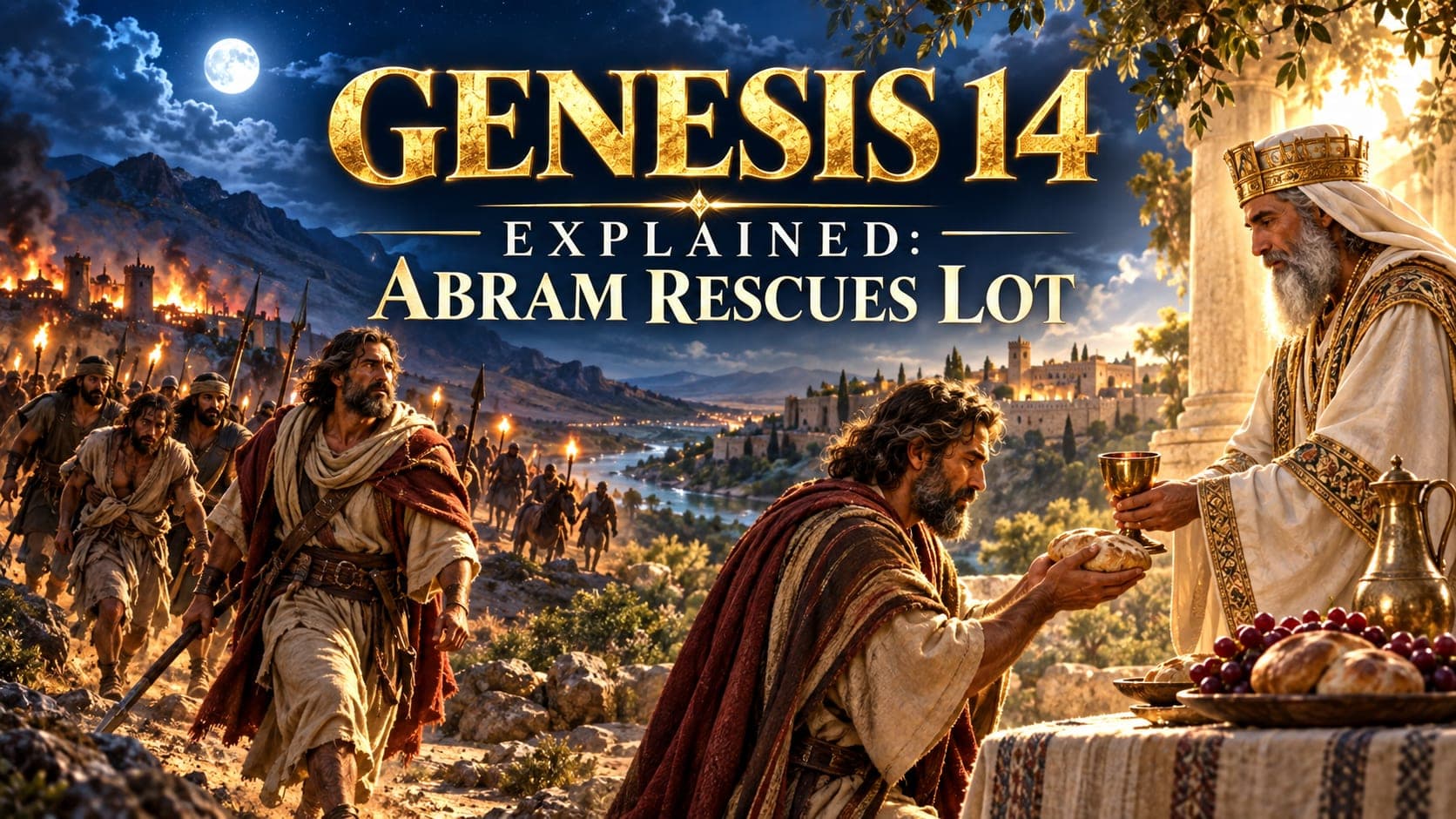
"And when Abram heard that his brother was taken captive, he armed his trained servants, born in his own house, three hundred and eighteen, and pursued them unto Dan."
📌 Three hundred and eighteen men, all born and trained inside Abram's own household, not a hired mercenary force. That single, specific number in Scripture gives a picture of how large Abram's camp had already grown. He calls Lot "his brother" here, the same broad family language the text used for Haran back in Genesis 11. Lot is his nephew, but the bond the text describes is closer than a technical family chart.
"And he divided himself against them, he and his servants, by night, and smote them, and pursued them unto Hobah, which is on the left hand of Damascus. And he brought back all the goods, and also brought again his brother Lot, and his goods, and the women also, and the people."
💡 A night attack, splitting his forces, chasing a victorious army far north past Damascus. Abram wins by strategy against a coalition that had just defeated five kings. The text does not explain the tactics in detail, but the outcome is complete: goods, people, and Lot himself, all recovered.
4. Melchizedek, King of Salem (verses 17 to 20)
Two kings come out to meet Abram on his way home, and only one of them gets named first.
"And the king of Sodom went out to meet him after his return from the slaughter of Chedorlaomer, and of the kings that were with him, at the valley of Shaveh, which is the king's dale."
"And Melchizedek king of Salem brought forth bread and wine: and he was the priest of the most high God."
📌 Melchizedek appears with no introduction, no genealogy, and no explanation of where he came from. He is simply king of Salem, a city most readers connect to Jerusalem, since Psalm 76:2 later places God's dwelling "in Salem" and "in Zion." He is also called "priest of the most high God," one of the earliest names of God in Scripture, used for the same God Abram already worships, centuries before Israel has a temple, a priesthood, or a law telling anyone how to serve God at all.
"And he blessed him, and said, Blessed be Abram of the most high God, possessor of heaven and earth: And blessed be the most high God, which hath delivered thine enemies into thy hand. And he gave him tithes of all."
💡 Melchizedek blesses Abram, credits the victory to God rather than to Abram's three hundred and eighteen men, and Abram responds by giving him a tenth of everything recovered. This is the first tithe recorded anywhere in the Bible, given by Abram himself, hundreds of years before the law of Moses ever mentions tithing.
📌 Abram gives away a tenth of the spoils to a priest he has no prior recorded relationship with, immediately after winning a war most men would use to enrich themselves.
5. Abram Refuses the King of Sodom (verses 21 to 24)
The king of Sodom, who has been standing there the whole time, finally makes his own offer.
"And the king of Sodom said unto Abram, Give me the persons, and take the goods to thyself."
⚠️ It is a generous sounding offer on the surface. By the customs of ancient warfare, whoever won the battle had every right to keep the recovered goods. Abram earned it. The king of Sodom is only asking for the people back.
Abram turns it down, and explains exactly why in an oath.
"And Abram said to the king of Sodom, I have lift up mine hand unto the LORD, the most high God, the possessor of heaven and earth, That I will not take from a thread even to a shoelatchet, and that I will not take any thing that is thine, lest thou shouldest say, I have made Abram rich:"
📌 Abram borrows Melchizedek's own words, "the most high God, the possessor of heaven and earth," and swears by them. He will not let anyone on earth take credit for what God has already promised to give him. A thread and a shoelatchet are about as small as a possession gets. Abram names the smallest items on purpose, refusing even the tiniest claim the king of Sodom could later make.
"Save only that which the young men have eaten, and the portion of the men which went with me, Aner, Eshcol, and Mamre; let them take their portion."
💡 Abram's refusal is personal, not a rule for everyone. His three allies from verse 13, Aner, Eshcol, and Mamre, fought in the same rescue and are free to take their own share. Abram only binds his own oath, and lets the men who followed him keep what they earned.

Hard Questions Genesis 14 Raises
Who was Melchizedek? Genesis 14 says only that he was king of Salem and priest of the most high God. Hebrews 7:3 later describes him as "without father, without mother, without descent, having neither beginning of days, nor end of life; but made like unto the Son of God," language many Christians read as pointing to a real historical king and priest whose lack of any recorded genealogy in the text makes him a fitting picture, or type, of Christ's eternal priesthood. Others read Hebrews more simply, that the silence of Scripture about his origins is itself the point being made, without Melchizedek being anything more than a real Canaanite king who worshiped the true God. Genesis 14 itself gives no more detail than his title and his actions.
Was Melchizedek an appearance of Christ before His birth? Some Christians hold this view, called a Christophany, pointing to how closely Melchizedek's priesthood is tied to Jesus in Hebrews 7 and Psalm 110:4, which says, "Thou art a priest for ever after the order of Melchizedek." Others hold that he was a human king and priest whose office simply foreshadowed Christ's, the same way a sacrifice or a Passover lamb points forward without being a literal appearance of Jesus. Both views take the text seriously, and Genesis 14 does not settle which one is correct.
Does the bread and wine point to communion? Genesis 14 records Melchizedek bringing out bread and wine as a meal for Abram after the battle, without explaining any deeper meaning at the time. Many Christians later see it as an early picture that anticipates the Lord's Supper, especially given Melchizedek's connection to Christ's priesthood in Hebrews. That reading is a later theological connection drawn from the whole of Scripture, not something Genesis 14 states outright.
How could Abram pursue the enemy "unto Dan" if the tribe of Dan did not exist yet? Dan was one of Jacob's sons, born generations after Abram, and the territory named for the tribe of Dan is described later in Joshua and Judges. Most readers understand "Dan" in Genesis 14:14 as a later scribal update, where a copyist replaced an older place name with the name readers of that later time would recognize, the same way a modern map might label an ancient site by its current name for clarity. It does not change what happened, only how the location is labeled in the text we have.
Why did Abram tithe to Melchizedek but refuse anything from the king of Sodom? The text does not explain Abram's reasoning directly, but the contrast is plain from what each man represents. Melchizedek blesses Abram in the name of the most high God and credits the victory to Him. The king of Sodom offers a deal that would let him later claim some credit for Abram's wealth. Abram gives freely to the one who points to God, and refuses anything from the one who might point to himself.
Top 5 Bible Verses From Genesis 14
1. Genesis 14:14
"And when Abram heard that his brother was taken captive, he armed his trained servants, born in his own house, three hundred and eighteen, and pursued them unto Dan."
The moment Abram stops being only a man who receives promises and becomes a man who acts, gathering a household army to go rescue his nephew.
2. Genesis 14:18
"And Melchizedek king of Salem brought forth bread and wine: and he was the priest of the most high God."
One of the most debated figures in the Bible, introduced in a single quiet sentence with no explanation of where he came from.
3. Genesis 14:19 and 20
"And he blessed him, and said, Blessed be Abram of the most high God, possessor of heaven and earth: And blessed be the most high God, which hath delivered thine enemies into thy hand. And he gave him tithes of all."
The first tithe in the Bible, given freely by Abram himself, centuries before the law of Moses ever commands one.
4. Genesis 14:22 and 23
"And Abram said to the king of Sodom, I have lift up mine hand unto the LORD, the most high God, the possessor of heaven and earth, That I will not take from a thread even to a shoelatchet, and that I will not take any thing that is thine, lest thou shouldest say, I have made Abram rich:"
Abram refuses even the smallest possible claim, unwilling to let anyone but God take credit for his blessing.
5. Genesis 14:16
"And he brought back all the goods, and also brought again his brother Lot, and his goods, and the women also, and the people."
The rescue completed in full, nothing left behind, after a night attack against a coalition that had just defeated five kings.

Frequently Asked Questions About Genesis 14
What does Genesis 14 mean?
It records the first war in the Bible, a coalition of four eastern kings defeating five kings near the Dead Sea and capturing Lot along with Sodom's goods. Abram rescues Lot with a household army of three hundred and eighteen men, then meets Melchizedek, king of Salem, and refuses a reward from the king of Sodom.
Who was Melchizedek in the Bible?
Genesis 14:18 calls him king of Salem and priest of the most high God, with no genealogy or backstory given. He blesses Abram, receives a tenth of the recovered spoils, and later becomes central to Hebrews 7's argument about Christ's priesthood.
Was Melchizedek Jesus?
Christians disagree. Some see Melchizedek as a pre incarnate appearance of Christ himself. Others see him as a real human king and priest whose office and lack of recorded genealogy simply foreshadow Jesus, the way many Old Testament figures and rituals do. Genesis 14 does not state which view is correct.
Where is Salem in the Bible?
Most readers identify it with Jerusalem. Psalm 76:2 places God's dwelling "in Salem" and "in Zion" in the same verse, tying the two names to the same location.
Why did Abram rescue Lot after Lot chose the better land for himself?
Genesis 14 does not record any hesitation or resentment on Abram's part. The moment he hears his relative is taken captive, he arms his household and goes. The text presents it as loyalty to family, not a settling of accounts from the land split in Genesis 13.
How many men did Abram have when he rescued Lot?
Three hundred and eighteen, all trained servants born inside his own household, according to Genesis 14:14. That number alone shows how large Abram's camp had grown by this point in Genesis.
What does "the most high God" mean?
It is the title Melchizedek uses for God in Genesis 14:18 to 20, and Abram repeats it back in his own oath in verse 22. It identifies the LORD as supreme over every other claimed god or power, fitting for a chapter about kings and kingdoms colliding.
Why did Abram refuse the king of Sodom's offer?
Genesis 14:23 gives his own reason: so the king of Sodom could never say, "I have made Abram rich." Abram had already sworn an oath by the most high God and would not let a pagan king claim any credit for a blessing that belonged to God alone.
Is Genesis 14 the first war in the Bible?
Yes. It is the first recorded military conflict in Scripture, complete with named kings, alliances, and a described battle, making it the earliest war account in the Bible.
Why is Abram called "the Hebrew" in this chapter?
Genesis 14:13 is the first time the word "Hebrew" appears in the Bible, attached to Abram by name. The chapter does not explain the origin of the term, only that it already identifies him among the people of the land.
Final Thoughts
Genesis 14 takes Abram from vineyard to battlefield to altar in the space of one chapter.
📌 Loyalty acted on a promise is not the same as loyalty that waits to feel deserved. Abram rescues Lot without a word of blame for the choice that put him in Sodom in the first place.
📌 A blessing worth having is not one you let someone else take credit for. Abram tithes freely to a priest who points to God, and refuses even a thread from a king who might later point to himself.
📌 God can put the right person in your path before you even know you need him. Melchizedek meets Abram once, blesses him, and disappears from Genesis as quickly as he arrived, yet Scripture never stops talking about him.
You may have someone in your life whose own choices helped lead them into trouble. Genesis 14 does not ask Abram to decide whether Lot deserved rescuing. It only shows him going.
So here is your one next step.
Think of who God may be calling you to go after, whatever led them into their own trouble, and go anyway.