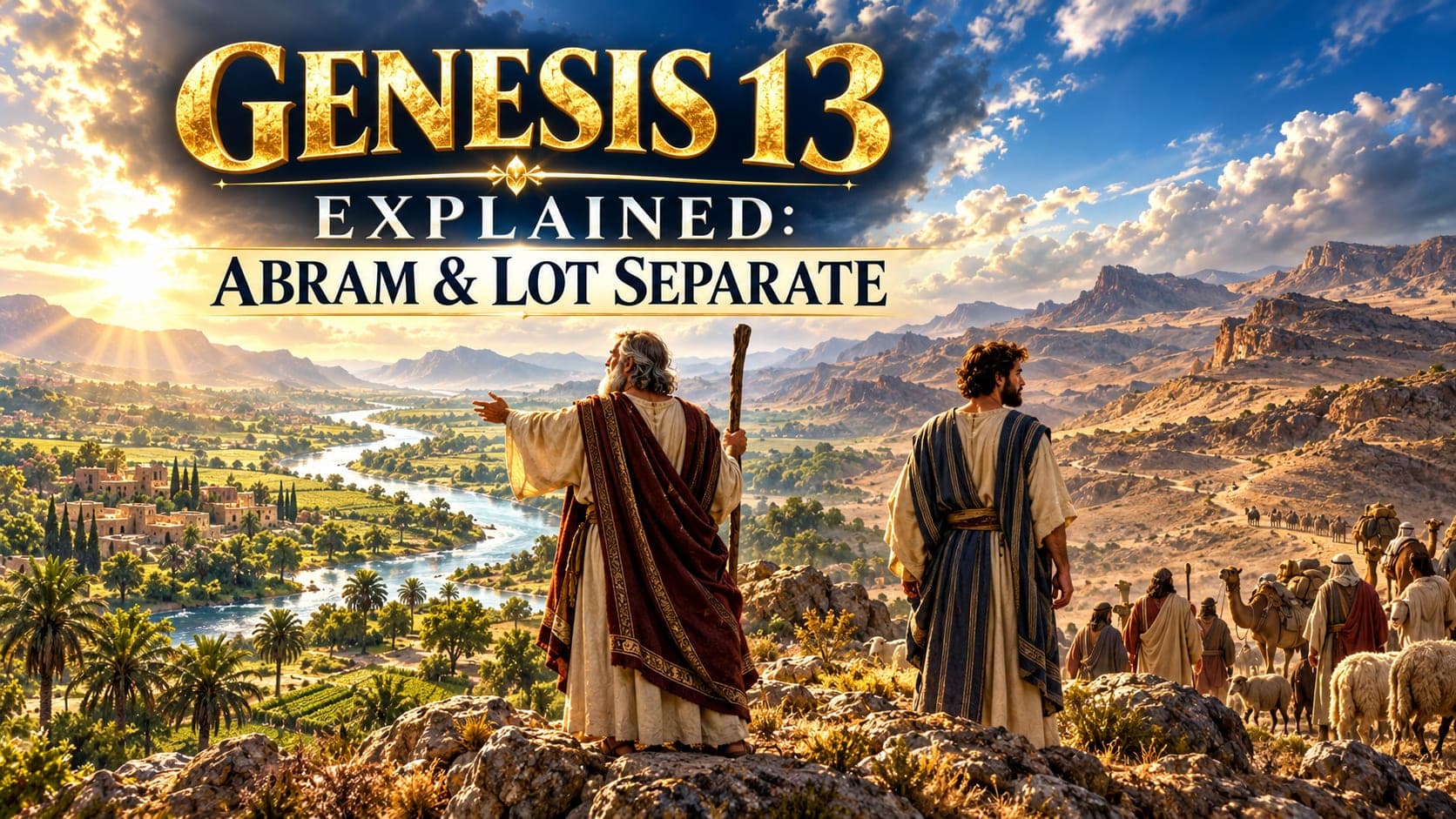
📖 Genesis 13 Explained: Abram, Lot, and the Land Promise Renewed
Two men, one family, and not enough land to hold them both.
Genesis 13 explained is the chapter where Abram walks back into Canaan wealthier than he left it, and almost immediately has to give something up to keep the peace. His herdmen and his nephew Lot's herdmen are fighting over grass and water, and Abram has to decide what kind of man he is going to be with everything he just brought back from Egypt.
Maybe you have had to choose between being right and being at peace.
- ❓ Why does Abram let Lot pick first, when the land was promised to Abram?
- ❓ Was Lot wrong to choose the plain toward Sodom?
- ❓ Why does the text mention Sodom's wickedness the exact moment Lot moves there?
- ❓ And what does God say to Abram the moment he is left with less?
📌 The man who gives up his first pick is the one who ends up with the whole land. The man who chooses by sight ends up pitching his tent toward a city about to be judged.
This walkthrough goes through the whole chapter in order: the return from Egypt, the strife between the herdmen, the split, Lot's choice, and the promise God renews to Abram once he is standing on less ground than before.
What you give up for peace and what you grab for yourself rarely turn out the way you expect.
What Happened Just Before This Chapter
Genesis 12 ended with Abram in Egypt, caught in a lie he told to save himself. Afraid the Egyptians would kill him for Sarai, his beautiful wife, he told Pharaoh she was only his sister. Pharaoh took her into his household, God struck Pharaoh's house with plagues, and Pharaoh sent Abram away, exposed as a liar by a pagan king.
Abram left Egypt richer than he arrived, but he also left it having managed a crisis on his own terms instead of trusting the God who had already spoken to him twice. Genesis 13 opens with him walking back into the land God promised him, carrying both the wealth and the aftertaste of that failure.
📌 Genesis 12 ended with Abram being corrected by a foreign king. Genesis 13 opens with Abram acting like a man who took the correction seriously.
Genesis 13 Explained Verse by Verse
1. Abram Returns From Egypt, Wealthier and Sobered (verses 1 to 4)
The chapter opens with a homecoming, not a fresh start somewhere new.
"And Abram went up out of Egypt, he, and his wife, and all that he had, and Lot with him, into the south."
"And Abram was very rich in cattle, in silver, and in gold."
📌 Notice what Abram carries back with him: his wife, his nephew, and wealth in cattle, silver, and gold. Every bit of that came from the very scheme in Egypt that nearly cost him Sarai. God let him keep what the deception bought, even while correcting the deception itself.
Abram does not settle in the south. He retraces his own steps.
"And he went on his journeys from the south even to Bethel, unto the place where his tent had been at the beginning, between Bethel and Hai;"
"Unto the place of the altar, which he had made there at the first: and there Abram called on the name of the LORD."
💡 Abram does not build a new altar here. He walks back to the exact one he built before Egypt and calls on the LORD there again. After a chapter of managing his own fear instead of asking God, the very first thing Abram does back in Canaan is return to the place where he used to talk to God, and start doing it again.
2. Too Much Wealth to Stay Together (verses 5 to 7)
Abram is not the only one who came back from Egypt wealthy.
"And Lot also, which went with Abram, had flocks, and herds, and tents."
"And the land was not able to bear them, that they might dwell together: for their substance was great, so that they could not dwell together."
⚠️ The problem is not a shortage. It is an abundance. Both men have grown too prosperous for the same stretch of pasture and wells to support two large households at once. Blessing, left unmanaged, can create exactly the kind of pressure that used to come from scarcity.
"And there was a strife between the herdmen of Abram's cattle and the herdmen of Lot's cattle: and the Canaanite and the Perizzite dwelled then in the land."
The fight itself is between the hired herdmen, not Abram and Lot directly. But the last line of the verse is easy to miss and important: the Canaanite and the Perizzite are already living in this land. Two related households squabbling over grazing rights is not a private matter. It is happening in full view of the very people God has promised this land to Abram's descendants instead of.
3. Abram Lets Lot Choose First (verses 8 and 9)
Abram steps in before the strife between the herdmen turns into something worse between the family.
"And Abram said unto Lot, Let there be no strife, I pray thee, between me and thee, and between my herdmen and thy herdmen; for we be brethren."
"Is not the whole land before thee? separate thyself, I pray thee, from me: if thou wilt take the left hand, then I will go to the right; or if thou depart to the right hand, then I will go to the left."
📌 Read the math of this offer carefully. This is Abram's land. God already promised it to him by name back in Genesis 12, not to Lot. And Abram is the older man, the head of the household Lot has been traveling under since they left Ur. By every custom of the ancient world, Abram had the right to choose first and take the best of it.
He gives that right away instead. "For we be brethren" is the whole reason he states. Not a promise he is quoting, not a strategy he explains, just family, and a refusal to let land become the thing that breaks it.
4. Lot Chooses by Sight (verses 10 to 13)
Lot does not hesitate, and the text tells you exactly how he made the decision.
"And Lot lifted up his eyes, and beheld all the plain of Jordan, that it was well watered every where, before the LORD destroyed Sodom and Gomorrah, even as the garden of the LORD, like the land of Egypt, as thou comest unto Zoar."
💡 "Lot lifted up his eyes" is a deliberate echo. It is the same kind of language used back in Genesis 3 for Eve seeing that the fruit was "pleasant to the eyes." Lot is not consulting God, or even weighing the risk of the neighbors. He is picking the view that looks the most comfortable, compared here to the garden of Eden itself and to the fertile land of Egypt he had just left.
The comparison to the plain being "well watered every where" matters more than it sounds. Canaan's hill country, where Abram is about to stay, depends on rain and hard work. The Jordan plain near the Dead Sea looked like it required neither.
"Then Lot chose him all the plain of Jordan; and Lot journeyed east: and they separated themselves the one from the other."
"Abram dwelled in the land of Canaan, and Lot dwelled in the cities of the plain, and pitched his tent toward Sodom."
📌 Notice the direction of Lot's tent, not just his destination. He does not settle in Sodom yet. He pitches toward it, one small move at a time. The next time Lot appears in Genesis, he is living inside the city gates of Sodom itself. This verse is the first quiet step of a slide the text never says he intended.
Then comes the sentence that explains why this choice was more dangerous than Lot realized.
"But the men of Sodom were wicked and sinners before the LORD exceedingly."
⚠️ The text places this verse right after Lot makes his choice, not before. Lot chose the plain for its water and its ease. He did not choose it knowing exactly how wicked the city on it already was, but the narrator makes sure the reader does, immediately, before the story moves on. What looked like the better land came with a neighbor Lot had not weighed at all.
5. God Renews the Promise the Moment Abram Has Less (verses 14 to 17)
Lot leaves with the land that looked better. God speaks to Abram the moment Lot is gone.
"And the LORD said unto Abram, after that Lot was separated from him, Lift up now thine eyes, and look from the place where thou art northward, and southward, and eastward, and westward:"
📌 God tells Abram to lift up his eyes too, on purpose. Lot already lifted his eyes in verse 10 and picked one plain based on what looked best. Now God gives Abram the same instruction, and hands him something Lot never asked for: all of it, in every direction, not just the part that looks good from where he is standing.
"For all the land which thou seest, to thee will I give it, and to thy seed for ever."
"And I will make thy seed as the dust of the earth: so that if a man can number the dust of the earth, then shall thy seed also be numbered."
"Arise, walk through the land in the length of it and in the breadth of it; for I will give it unto thee."
💡 This is the same promise from Genesis 12, but it grows here. God adds a comparison for Abram's future descendants, the dust of the earth, and tells him to physically walk the length and width of a land he still does not own a single deed to. Abram gave up his pick of the land and ends up being told to walk the whole thing as if it is already his.
📌 Abram let go of his first choice, and God responds by giving him everything Lot did not take, and more than either of them could have divided. Nothing in the text says this is a reward Abram earned by being generous. It reads simply as what was already promised, spoken again right when Abram had the least reason to expect it.
6. Abram Settles at Mamre and Builds Another Altar (verse 18)
The chapter closes with one more move, and one more act of worship.
"Then Abram removed his tent, and came and dwelt in the plain of Mamre, which is in Hebron, and built there an altar unto the LORD."
📌 Count the altars so far, and this is the third one Abram has built, not a repeat. He built one at Shechem and one at Bethel in Genesis 12, returned to the Bethel altar earlier in this very chapter, and now builds a brand new one at Mamre, in Hebron. Wherever Abram lands, worship follows within the same chapter. Hebron becomes the place most associated with Abram for the rest of his life, and later the site of the only piece of this land he will ever legally purchase, the burial cave for his family.

Hard Questions Genesis 13 Raises
Was it foolish for Abram to let Lot choose first? By the property customs of the ancient Near East, yes, the older relative and head of household normally chose first and took the better share. Genesis 13 never criticizes Abram for giving that right away, and the very next verses show God expanding the promise to him, not shrinking it. The text presents the offer as costly, real generosity, not a miscalculation.
Was Lot's choice sinful, or just a bad judgment call? Genesis 13 does not say Lot sinned by choosing the plain of Jordan. It says he chose based on what looked best to him, echoing the same "lifted up his eyes" language used elsewhere in Genesis for choices driven by appearance rather than counsel from God. The chapter lets the consequences, not a direct verdict, do the teaching. 2 Peter 2:7 and 8 later calls Lot "righteous" and describes him as vexed by the wickedness around him in Sodom, which suggests his choice of location was a lapse in judgment more than a rejection of God.
Why does the text mention Sodom's wickedness immediately after Lot chooses it? The placement is deliberate narration, not something Lot could have known in the moment. Genesis 13:13 functions as a warning aimed at the reader, showing that the most comfortable looking option came with a cost Lot had not accounted for at all. The consequences of that choice do not appear until later chapters, but the text plants the warning here, right where the decision is made.
Does "to thy seed for ever" in verse 15 mean an unconditional, permanent land claim? Christians read this differently. Some understand the promise as a literal, enduring grant to Abram's physical descendants, tied to God's ongoing purposes for the nation of Israel. Others read Old Testament land promises as finding their larger fulfillment in the New Testament's wider picture of God's people and a coming new creation, following passages like Hebrews 11:10 and 16, where Abram himself is described as looking for a better country than any physical territory. Genesis 13 alone states the promise; it does not settle every detail of how it plays out across the rest of Scripture, and sincere believers land in different places on it.
Did Abram lose out by giving Lot the better looking land? Not by the end of the story. Lot gains fertile ground immediately, but it is Abram who receives the expanded promise, the descendants like the dust of the earth, and the land Lot passed over. Genesis lets the outcome answer the question rather than stating a moral directly: what looked like the weaker deal became the one carrying the lasting promise.
Top 5 Bible Verses From Genesis 13
1. Genesis 13:8 and 9
"And Abram said unto Lot, Let there be no strife, I pray thee, between me and thee, and between my herdmen and thy herdmen; for we be brethren. Is not the whole land before thee? separate thyself, I pray thee, from me: if thou wilt take the left hand, then I will go to the right; or if thou depart to the right hand, then I will go to the left."
The man with the right to choose first gives that right away for the sake of family peace, before he knows how the story will end.
2. Genesis 13:10
"And Lot lifted up his eyes, and beheld all the plain of Jordan, that it was well watered every where, before the LORD destroyed Sodom and Gomorrah, even as the garden of the LORD, like the land of Egypt, as thou comest unto Zoar."
A choice made entirely by appearance, using the same kind of language Genesis already used once for a decision that went badly.
3. Genesis 13:13
"But the men of Sodom were wicked and sinners before the LORD exceedingly."
A warning dropped right after the decision is made, showing that the best looking land carried a danger Lot never priced in.
4. Genesis 13:14 to 16
"And the LORD said unto Abram, after that Lot was separated from him, Lift up now thine eyes, and look from the place where thou art northward, and southward, and eastward, and westward: For all the land which thou seest, to thee will I give it, and to thy seed for ever. And I will make thy seed as the dust of the earth: so that if a man can number the dust of the earth, then shall thy seed also be numbered."
The promise from Genesis 12 grows the moment Abram has less land in his hand, not more.
5. Genesis 13:18
"Then Abram removed his tent, and came and dwelt in the plain of Mamre, which is in Hebron, and built there an altar unto the LORD."
A third altar in two chapters, marking Hebron as the place that becomes home base for the rest of Abram's story.

Frequently Asked Questions About Genesis 13
What does Genesis 13 mean?
It records Abram returning from Egypt with great wealth, a dispute breaking out between his herdmen and Lot's over land for their growing flocks, and Abram letting Lot choose which direction to settle first. Lot picks the fertile plain toward Sodom, and God responds by renewing and expanding His land promise to Abram.
Why did Abram let Lot choose the land first?
Genesis 13:8 gives Abram's own reason: "for we be brethren." He wanted to end the strife between their herdmen rather than assert his right, as the elder relative, to choose first and take the better share of the land.
Why did Lot choose the plain of Jordan?
Genesis 13:10 says he saw that it was well watered, comparing it to the garden of the LORD and to the land of Egypt. He chose based on what looked most fertile and easiest to live on, without any mention of asking God for direction.
Was Lot wrong to move near Sodom?
Genesis 13 does not directly call the choice sinful, but it places the note about Sodom's extreme wickedness immediately after Lot picks that direction. The placement shows the reader a danger Lot himself does not yet seem to have weighed.
Did Lot move into Sodom right away?
No. Genesis 13:12 says he pitched his tent toward Sodom, not inside it. The move into the city itself happens gradually across later chapters, where he is eventually found living within its gates.
What did God promise Abram in Genesis 13?
After Lot leaves, God tells Abram to look in every direction and promises to give him and his descendants all the land he can see, forever, and to make his descendants as countless as the dust of the earth. It is an expansion of the promise first given in Genesis 12.
Why does Abram keep building altars?
Genesis 13:18 records the third altar Abram builds since arriving in Canaan, after Shechem and Bethel in Genesis 12. Each one marks a place where he specifically worships and calls on the LORD, even while still owning none of the land the altars stand on.
Where is Hebron, and why does it matter here?
Hebron sits in the hill country south of Jerusalem, and the plain of Mamre near it becomes Abram's main dwelling place for the rest of Genesis. It is later the site of the only land in Canaan Abram ever legally purchases, a burial cave for his family.
Why does the Bible bring up Sodom and Gomorrah here, before their destruction happens?
Genesis 13:10 already refers to Sodom and Gomorrah being destroyed as something the original readers would recognize, since Genesis was written well after that judgment took place in the story's own timeline. The mention sets up the danger of the location before the destruction is actually narrated in a later chapter.
How does Genesis 13 connect to the rest of Abram's story?
It sets up two paths that keep intersecting for the rest of Genesis: Abram settled in Canaan under a growing promise, and Lot drawn closer and closer to Sodom's coming judgment. Abram's decision to walk by faith rather than by sight here foreshadows the much larger test of faith he faces later with his son Isaac.
Final Thoughts
Genesis 13 puts two ways of choosing side by side, in the same short chapter.
📌 What looks best is not the same as what is best. Lot picked the plain that looked the most fertile and comfortable, and it put him within sight of a city already marked for judgment.
📌 Giving up your first pick is not the same as losing. Abram let Lot choose first, and walked away with a promise that only grew once he had less land in his own hand.
📌 Worship is not something Abram waits to feel like doing. Three altars in two chapters, in three different places, none of them on land he legally owned yet.
You will face your own version of this choice more than once. The easier, better looking option and the one worth trusting God with are not always the same one.
So here is your one next step.
Before your next hard decision, ask whether you are choosing by what looks well watered, or by what you have actually heard from God.