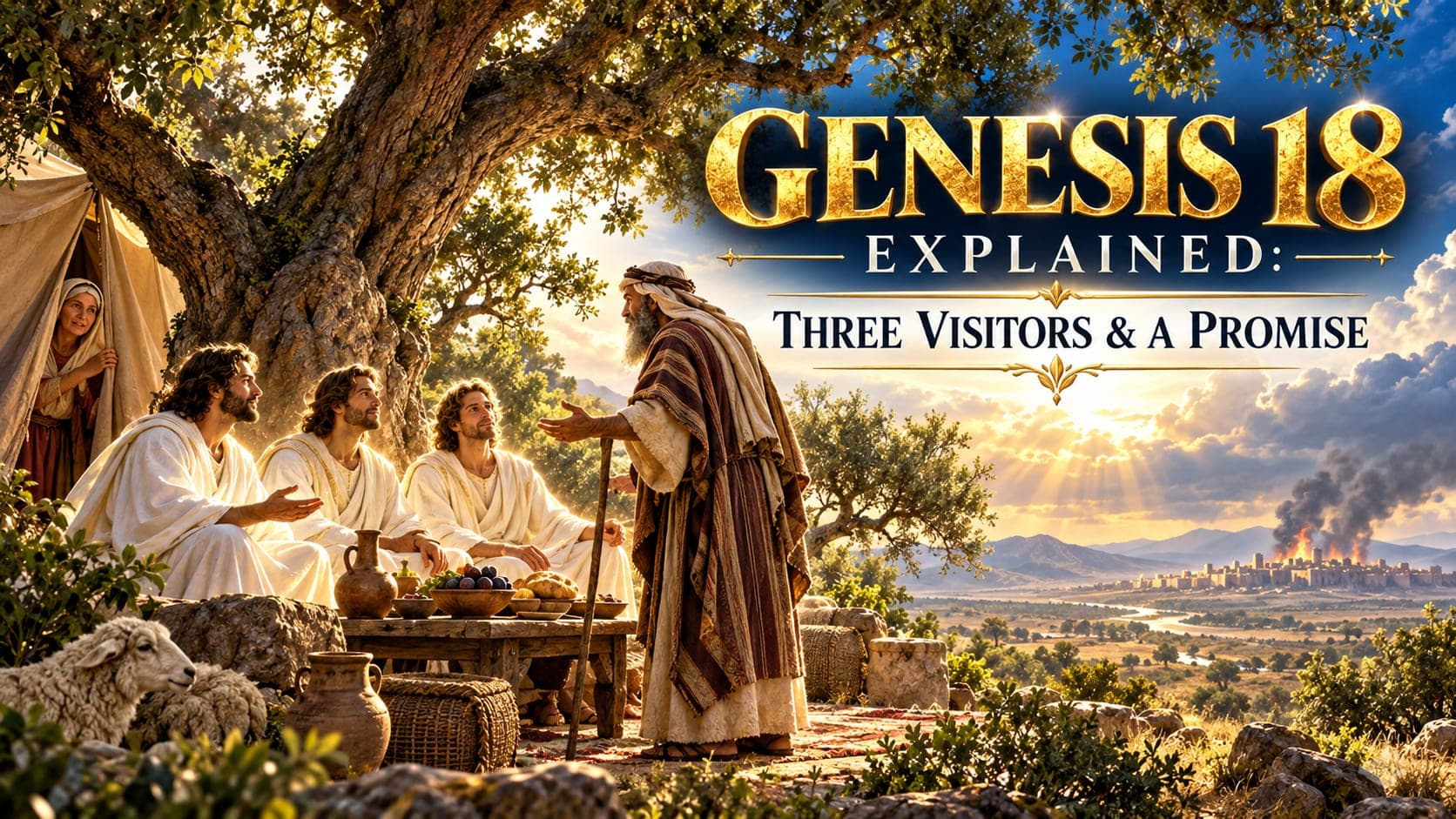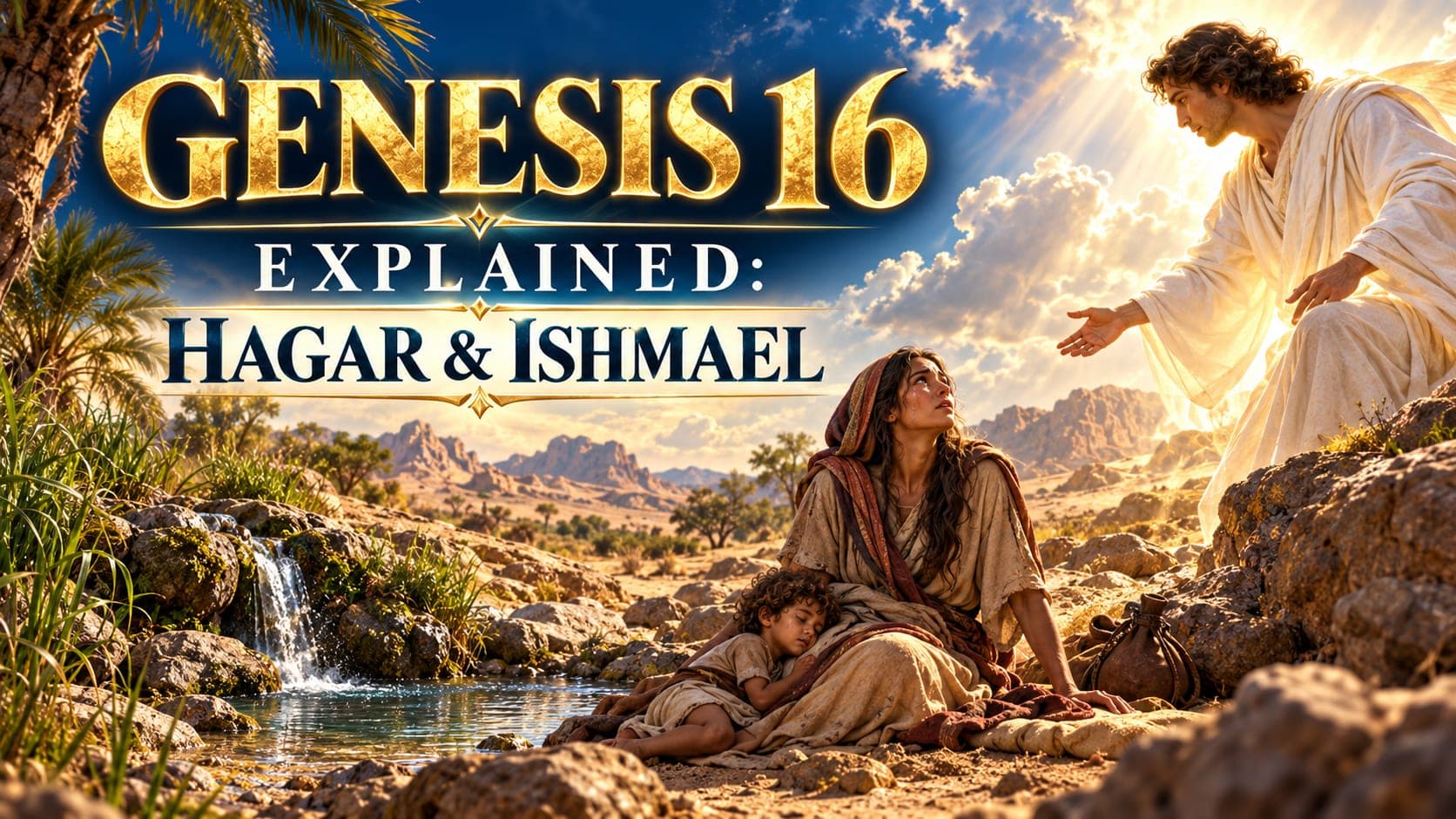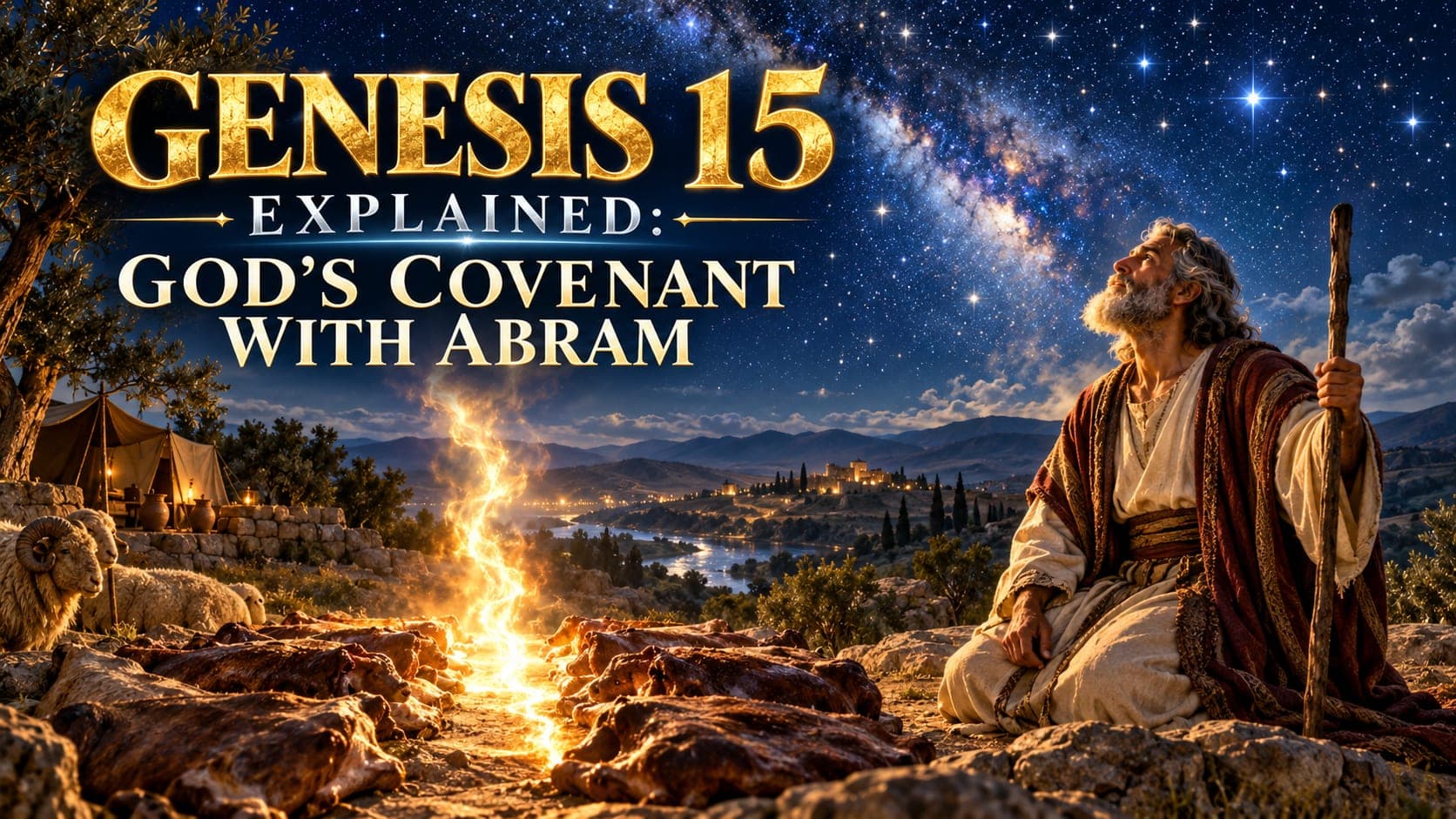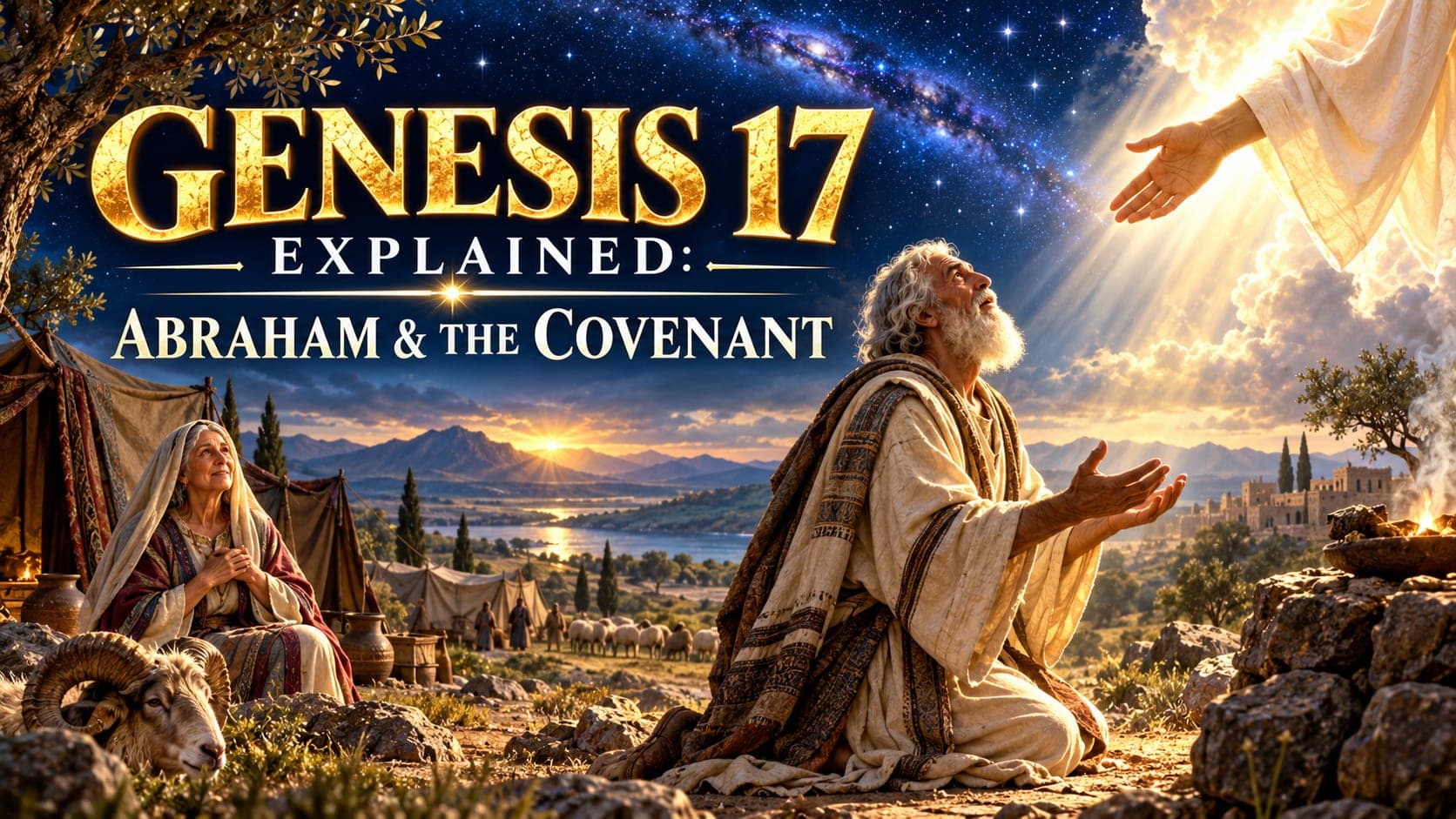
📖 Genesis 17 Explained: A New Name and the Sign of Circumcision
Thirteen years of silence from God. Then He shows up and changes a man's name, a woman's name, and the flesh of every male in the household.
Genesis 17 explained is the chapter where Abram becomes Abraham and Sarai becomes Sarah, and where God attaches a permanent, physical sign to a promise He had already spoken twice before. Abraham is ninety nine years old here, still without the son God keeps promising, and this time the covenant comes with a knife instead of just words.
Maybe you have carried a promise so long that the waiting itself started to feel like the answer.
- ❓ Why does God change Abram's name after ninety nine years?
- ❓ Why circumcision specifically, out of everything God could have chosen as a sign?
- ❓ Why does Abraham laugh at God's own promise, and get away with it?
- ❓ And what happens to the promise God already gave Ishmael in the last chapter?
📌 This is the chapter where God stops speaking the covenant and starts cutting it into the bodies of everyone who belongs to it, starting with a ninety nine year old man.
This walkthrough goes through the whole chapter in order: the new name, the everlasting covenant, the sign God chooses to seal it, Sarah's new name and the son she is finally promised by name, Abraham's laughter, Ishmael's place in all of it, and the same day obedience that closes the chapter.
Two names change in this chapter. What each one means says more than most readers expect.
What Happened Just Before This Chapter
Genesis 16 ended with Hagar back in Abram's household and a son born through her, Ishmael, named by the angel of the LORD who found her fleeing into the wilderness. Abram was eighty six when Ishmael was born. Genesis 17 opens with Abram at ninety nine, a thirteen year gap the text passes over in total silence. No new revelation, no recorded word from God, nothing.
For thirteen years, Ishmael was almost certainly raised as the only son in the house, the heir everyone assumed the promise pointed to. Sarai's plan from Genesis 16 had not just produced a child. It had quietly settled into the accepted answer to a promise God had not actually finished keeping.
📌 Thirteen years of silence end with God speaking again, and the first thing He does is change the man's name.
Genesis 17 Explained Verse by Verse
1. Almighty God, and a Command to Walk Uprightly (verses 1 and 2)
God breaks thirteen years of silence with a new title for Himself and a direct command.
"And when Abram was ninety years old and nine, the LORD appeared to Abram, and said unto him, I am the Almighty God; walk before me, and be thou perfect."
📌 "I am the Almighty God" is the first time this exact title, El Shaddai in Hebrew, appears in the Bible. It carries the sense of a God with more than enough power to do what He is about to promise, which matters for a man about to hear that his hundred year old body will father a nation.
"Walk before me, and be thou perfect" does not mean sinless. The Hebrew word behind "perfect" carries the sense of complete or whole hearted, the same direction God gave Noah's life before the flood. It is a call to wholehearted loyalty, not moral flawlessness.
"And I will make my covenant between me and thee, and will multiply thee exceedingly."
💡 God had already promised Abram descendants in Genesis 15, sealed by a covenant ceremony Abram slept through. Here the same promise is repeated, but this time Abram is wide awake and about to be given something to do.
2. A Father of Many Nations, and a New Name (verses 3 to 8)
Abram responds the only way anyone can respond to Almighty God appearing in person.
"And Abram fell on his face: and God talked with him, saying, As for me, behold, my covenant is with thee, and thou shalt be a father of many nations."
"Neither shall thy name any more be called Abram, but thy name shall be Abraham; for a father of many nations have I made thee."
📌 Abram means "exalted father." Abraham means "father of a multitude." The change is one added syllable, but it turns a description of status into a description of scale. God renames him before there is a single visible sign the name is true. Abraham is ninety nine, still childless by Sarah, when he starts answering to a name that means father of many nations.
Names carried real weight in the ancient world, closer to identity than to a label. Every time someone in the household said "Abraham" from this point on, they were repeating God's promise back to him, whether they meant to or not.
"And I will make thee exceeding fruitful, and I will make nations of thee, and kings shall come out of thee."
"And I will establish my covenant between me and thee and thy seed after thee in their generations for an everlasting covenant, to be a God unto thee, and to thy seed after thee."
💡 "Everlasting covenant" is stated three times in this chapter, here, again in verse 13 over the sign of circumcision, and once more in verse 19 over Isaac by name. This is not a one generation arrangement between God and one man. God is binding Himself to Abraham's descendants across time, calling Himself their God specifically, not just a God who helped their ancestor once.
"And I will give unto thee, and to thy seed after thee, the land wherein thou art a stranger, all the land of Canaan, for an everlasting possession; and I will be their God."
The land promise from Genesis 15 gets repeated here too, tied to the same everlasting covenant. Abraham is still living in Canaan as a stranger, owning none of it outright, when God calls it his family's everlasting possession.
3. The Sign of the Covenant (verses 9 to 14)
A covenant this size gets a sign, and God chooses one that cannot be hidden, forgotten, or performed halfway.
"And God said unto Abraham, Thou shalt keep my covenant therefore, thou, and thy seed after thee in their generations."
"This is my covenant, which ye shall keep, between me and you and thy seed after thee; Every man child among you shall be circumcised."
"And ye shall circumcise the flesh of your foreskin; and it shall be a token of the covenant betwixt me and you."
📌 Out of every possible sign God could have chosen, He picks one that marks the organ of reproduction itself. The covenant is about descendants, land, and a future nation, and the sign gets cut into the very part of the body that produces the next generation. It is impossible to separate the sign from what it points to.
⚠️ This is also a private sign, not a public one like an altar or a pillar. No one outside the family would see it unless told. The mark was between a man and God, and between a man and the covenant, before it was ever between a man and anyone watching.
"And he that is eight days old shall be circumcised among you, every man child in your generations, he that is born in the house, or bought with money of any stranger, which is not of thy seed."
"He that is born in thy house, and he that is bought with thy money, must needs be circumcised: and my covenant shall be in your flesh for an everlasting covenant."
💡 Eight days old, not eight years or eighteen. The sign is applied before a child can understand it, agree to it, or earn it. It also covers everyone in the household, family born and servants bought, blood relation or not. Belonging to Abraham's household was enough to require the sign, the same way belonging to a family today comes with obligations a person did not personally choose.
"And the uncircumcised man child whose flesh of his foreskin is not circumcised, that soul shall be cut off from his people; he hath broken my covenant."
⚠️ Refusing the sign is treated as breaking the covenant itself, not a minor oversight. The seriousness of the penalty matches the seriousness God places on the sign. This was never presented as optional for anyone under Abraham's roof.
4. Sarah's New Name and a Son by Name (verses 15 and 16)
God turns from Abraham's name and body to Sarah's, and this time the promise gets specific in a way it never has before.
"And God said unto Abraham, As for Sarai thy wife, thou shalt not call her name Sarai, but Sarah shall her name be."
📌 Sarai and Sarah both mean something close to "princess." The change is smaller than Abram to Abraham, but it still marks her out for something new. This is the first time in Genesis that Sarah gets named and blessed by God in her own right within the same breath as the covenant, not only as Abraham's wife.
"And I will bless her, and give thee a son also of her: yea, I will bless her, and she shall be a mother of nations; kings of people shall be of her."
💡 Up to this point, God had promised Abraham countless descendants without ever naming Sarah as the mother by explicit statement. Ishmael already existed as one answer to whose son would carry the promise. Here God rules that answer out directly: this son will come of Sarah, not just of Abraham.
5. Abraham Laughs, and Prays for Ishmael (verses 17 and 18)
Abraham's reaction to the news is not what most readers expect from the father of faith.
"Then Abraham fell upon his face, and laughed, and said in his heart, Shall a child be born unto him that is an hundred years old? and shall Sarah, that is ninety years old, bear?"
📌 Abraham laughs at the exact promise he is about to obey. The text does not read this as rebellion the way it treats Sarah's later laugh in Genesis 18. There is no rebuke here, no consequence, no correction from God at all. Abraham falls on his face in worship and laughs in the same breath, doing the math on his own body and his wife's age out loud, before God, without hiding it.
⚠️ Belief and disbelief showing up in the same moment is not new in this family's story. Abraham believed God's word about the stars in Genesis 15 and is counted righteous for it, and two chapters later he laughs at a specific version of that same promise. Faith in Scripture is rarely presented as a feeling with no doubt mixed in.
"And Abraham said unto God, O that Ishmael might live before thee!"
💡 After thirteen years of watching Ishmael grow as his only son, Abraham's honest request is not for the miracle to happen a different way. It is that the son he already has and loves would still matter to God. This is a father speaking, not just a patriarch negotiating a covenant.
6. Isaac Named, and Ishmael Blessed (verses 19 to 22)
God answers both the promise and the prayer, refusing to let one erase the other.
"And God said, Sarah thy wife shall bear thee a son indeed; and thou shalt call his name Isaac: and I will establish my covenant with him for an everlasting covenant, and with his seed after him."
📌 Isaac means "he laughs," and God names him that Himself, directly after Abraham's laughter in verse 17. Instead of correcting the laugh, God builds it permanently into the boy's name. Every time anyone says Isaac's name for the rest of his life, they repeat the moment his father could not quite believe the math and God did not hold it against him.
"And as for Ishmael, I have heard thee: Behold, I have blessed him, and will make him fruitful, and will multiply him exceedingly; twelve princes shall he beget, and I will make him a great nation."
💡 God answers Abraham's prayer for Ishmael specifically and generously, promising twelve princes and a great nation, language that echoes what He has already promised Abraham himself. Ishmael is genuinely blessed. He is just not the son the everlasting covenant runs through.
"But my covenant will I establish with Isaac, which Sarah shall bear unto thee at this set time in the next year."
📌 God draws a clear line between being blessed and carrying the covenant. Ishmael gets the first without the second. The distinction matters for reading the rest of Genesis, where both sons receive real love from Abraham but only one carries the specific promise forward.
"At this set time in the next year" also removes any doubt about the timeline. This is not a vague future hope. God names the year.
"And he left off talking with him, and God went up from Abraham."
7. Obedience the Very Same Day (verses 23 to 27)
Abraham does not wait, negotiate, or ask for time to think it over.
"And Abraham took Ishmael his son, and all that were born in his house, and all that were bought with his money, every male among the men of Abraham's house; and circumcised the flesh of their foreskin in the selfsame day, as God had said unto him."
📌 "In the selfsame day" is stated twice in the closing verses. Whatever Abraham privately thought or laughed at moments earlier, his obedience does not wait for his feelings to catch up. He circumcises himself, Ishmael, and every male in the household the same day the command was given.
"And Abraham was ninety years old and nine, when he was circumcised in the flesh of his foreskin. And Ishmael his son was thirteen years old, when he was circumcised in the flesh of his foreskin."
"In the selfsame day was Abraham circumcised, and Ishmael his son. And all the men of his house, born in the house, and bought with money of the stranger, were circumcised with him."
💡 The chapter closes on a household, not just a patriarch. Everyone under Abraham's roof carries the same sign by the end of one day, a covenant that started as words between God and one man and ends stamped into an entire community.

Hard Questions Genesis 17 Raises
Why did God choose circumcision as the sign of the covenant? Genesis 17 does not explain the choice directly. What the text does show is a sign attached to the organ of reproduction itself, fitting for a covenant centered on descendants and a future nation. Circumcision was also practiced by some other ancient peoples for different reasons, but Scripture gives it a specific meaning here: not a cultural custom, but a personal token between God and Abraham's household.
Is circumcision still required for Christians today? The New Testament addresses this directly, not Genesis 17 itself. Acts 15 and Galatians 5 both record the early church deciding that Gentile believers do not need physical circumcision to belong to God's people, with Paul describing a "circumcision of the heart" through faith as the reality the physical sign always pointed toward. Genesis 17 records the sign being given; the rest of the Bible traces what happens to it once Christ comes.
Was Abraham sinning when he laughed at God's promise? The text gives no rebuke, no punishment, and no correction anywhere in the chapter, which is a notable contrast to Sarah's laugh in Genesis 18, which God does address directly. Many readers take this as an honest, unguarded reaction rather than defiant unbelief, especially since Abraham immediately follows it with prayer for Ishmael and same day obedience. Scripture does not always treat every instance of doubt or disbelief identically, and this chapter simply does not label the laugh a sin.
Why does God bless Ishmael generously but still exclude him from the covenant? Genesis 17:20 and 21 hold both truths side by side without resolving the tension for the reader: real blessing, twelve princes and a great nation, and still a covenant established with Isaac specifically. The chapter treats being loved and blessed by God as something distinct from carrying a specific covenant line, a distinction the rest of Genesis keeps returning to with other siblings and other choices.
Why the name change from Abram to Abraham specifically, and not something else? Genesis 17:5 gives the reason inside the text itself: "for a father of many nations have I made thee." The new name matches the new scale of the promise. Scripture does not explain why God chose this particular grammatical expansion of the name rather than a wholly different word, only that the new name states what Abram's old name could not yet claim.
Top 5 Bible Verses From Genesis 17
1. Genesis 17:5
"Neither shall thy name any more be called Abram, but thy name shall be Abraham; for a father of many nations have I made thee."
A new name spoken over a still childless ninety nine year old man, matching the size of a promise that has not yet come true.
2. Genesis 17:7
"And I will establish my covenant between me and thee and thy seed after thee in their generations for an everlasting covenant, to be a God unto thee, and to thy seed after thee."
God binds Himself to generations that do not exist yet, calling Himself their God before a single one of them is born.
3. Genesis 17:17
"Then Abraham fell upon his face, and laughed, and said in his heart, Shall a child be born unto him that is an hundred years old? and shall Sarah, that is ninety years old, bear?"
Worship and disbelief in the very same posture, with no rebuke from God recorded anywhere in the chapter.
4. Genesis 17:19
"And God said, Sarah thy wife shall bear thee a son indeed; and thou shalt call his name Isaac: and I will establish my covenant with him for an everlasting covenant, and with his seed after him."
The son named directly after his father's laughter, so the name Isaac carries that whole moment forward permanently.
5. Genesis 17:23
"And Abraham took Ishmael his son, and all that were born in his house, and all that were bought with his money, every male among the men of Abraham's house; and circumcised the flesh of their foreskin in the selfsame day, as God had said unto him."
Obedience that does not wait for feelings to line up first, carried out the same day the command was given.
Frequently Asked Questions About Genesis 17
What does Genesis 17 mean?
It records God renaming Abram to Abraham and Sarai to Sarah, establishing circumcision as the sign of an everlasting covenant, promising Abraham a son through Sarah named Isaac, and blessing Ishmael without making him the covenant heir. Abraham and every male in his household are circumcised the same day.
Why did God change Abram's name to Abraham?
Genesis 17:5 gives the reason directly: "for a father of many nations have I made thee." Abram means exalted father; Abraham means father of a multitude. The new name matches the larger promise God is confirming.
What does the name Sarah mean, and why was it changed from Sarai?
Both names carry the sense of princess. Genesis 17:15 and 16 changes it while naming her directly, for the first time in the text, as the mother of the promised son and of kings of people who will come from her.
Why did God command circumcision as the sign of the covenant?
Genesis 17:11 calls it a token of the covenant without explaining the choice further. It marks the part of the body connected to descendants, fitting a covenant centered on multiplying Abraham's family into a nation.
Do Christians still need to be circumcised?
No. Acts 15 records the early church ruling that Gentile believers are not required to be physically circumcised, and Paul teaches in Galatians and Romans that a circumcised heart through faith is what the physical sign always pointed toward.
Why did Abraham laugh when God promised him a son?
Genesis 17:17 says he questioned, in his heart, whether a hundred year old man and a ninety year old woman could really have a child. The text records no rebuke for it, unlike Sarah's later laugh in Genesis 18, which God addresses directly.
What does the name Isaac mean?
It means "he laughs." God names him that Himself in Genesis 17:19, right after Abraham's own laughter at the promise in the verse before it.
What happened to Ishmael after Isaac was promised?
Genesis 17:20 says God heard Abraham's prayer for him and blessed him with fruitfulness, twelve princes, and a great nation. Verse 21 still establishes the specific covenant with Isaac, not Ishmael.
How old was Abraham when he was circumcised?
Ninety nine, according to Genesis 17:24. Ishmael was thirteen at the same time, per verse 25, and every other male in the household was circumcised that same day as well.
Why does the covenant only apply to males if it involves the whole family?
Genesis 17 does not address this question directly. The sign itself, being physical, applies to males, while the covenant blessing and identity is described elsewhere in Scripture as extending to the whole household, women included, through their place in that family and later through their own faith.
How does Genesis 17 connect to the rest of Abraham's story?
It sets up the specific expectation, Sarah as mother, Isaac as the name, next year as the timeline, that carries forward from the promises first spoken in Genesis 15 and gets tested against Ishmael's already established place in the family from Genesis 16.
Final Thoughts
Genesis 17 turns a spoken promise into something you could see on a man's own body.
📌 God can rename you before the promise looks true. Abraham carried a name that meant father of many nations for years before he had the son that made it real.
📌 Doubt spoken honestly to God is not the same as rejecting Him. Abraham laughs at the very promise he is about to obey, and God answers with a name for the child instead of a rebuke for the father.
📌 Being blessed and carrying a specific calling are not always the same thing. Ishmael receives real blessing from God without becoming the one the covenant runs through, a distinction Genesis keeps returning to.
You may be holding a promise God gave you that still has no visible proof attached to it.
So here is your one next step.
Obey the next thing God has clearly told you, the selfsame day, the way Abraham did, even while the doubt is still sitting right next to the obedience.