📖 Genesis 19 Explained: Sodom's Destruction and Lot's Escape
Two visitors walk into a city at evening. By the next morning, that city no longer exists.
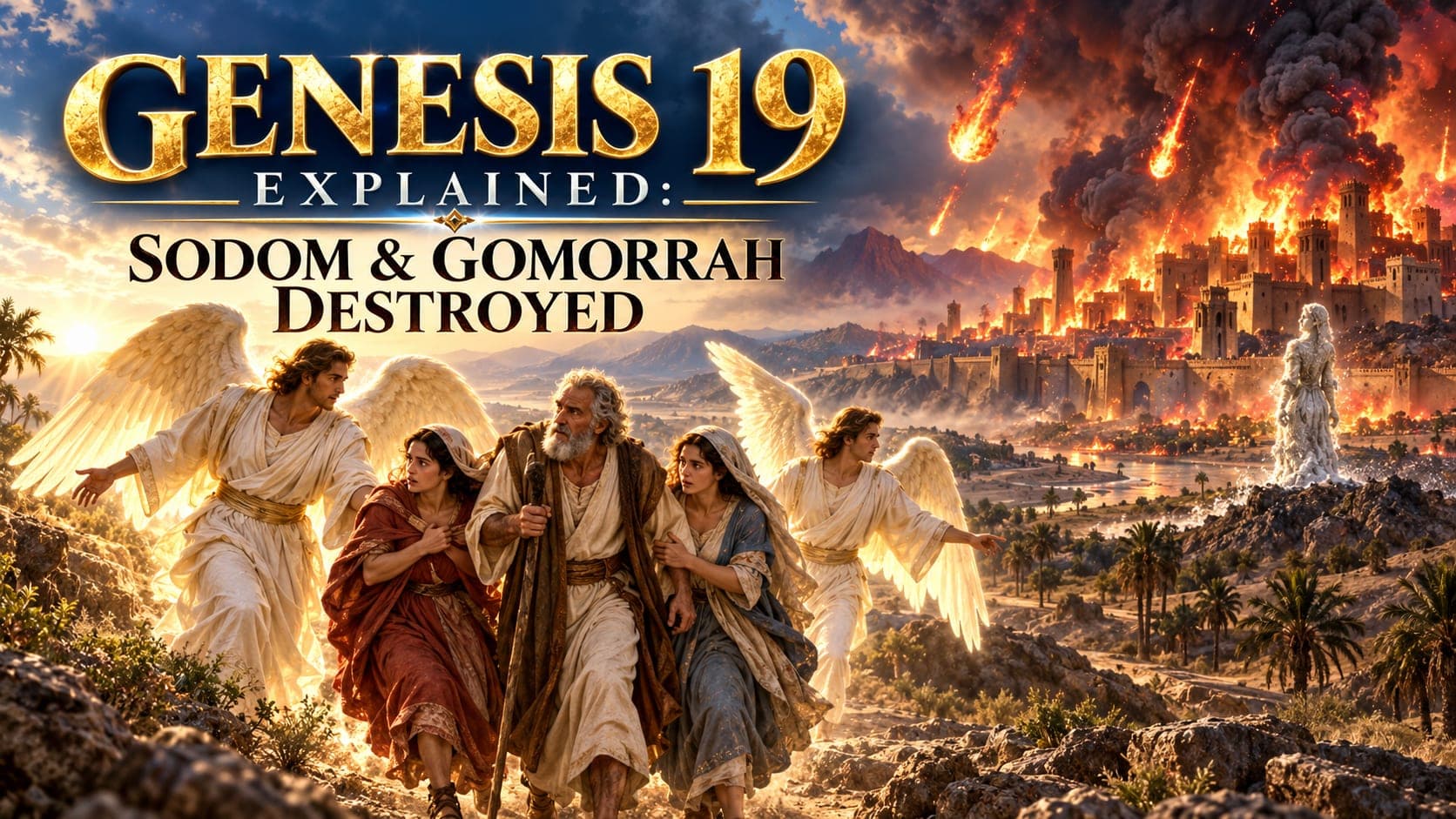
Genesis 19 explained is the chapter where the bargain Abraham made in the previous chapter gets tested against an actual city, and the city fails every test. A mob surrounds a house. A father makes an offer no father should make. Two angels drag a family out by the hand while fire is already falling behind them.
Maybe you have watched a place, a relationship, or a habit go further and further past the point of no return.
- ❓ What was Sodom's sin, exactly?
- ❓ Why does Lot offer his own daughters to a mob at the door?
- ❓ Why does his wife turn into a pillar of salt for one glance back?
- ❓ And what happened to Abraham's ten righteous people from Genesis 18?
📌 Not one of Abraham's ten was found. Lot got out anyway, and Genesis says plainly why.
This walkthrough goes through the whole chapter in order: the angels arriving at the gate, the mob and the blindness that stops it, the warning Lot's own sons in law laugh off, the rescue that has to be forced, the fire, the wife who looks back, and the dark ending in the cave above Zoar.
Some chapters of the Bible comfort you. This one is meant to wake you up.
What Happened Just Before This Chapter
Genesis 18 ended with Abraham standing before the LORD, asking again and again whether God would spare Sodom for the sake of a shrinking number of righteous people inside it. Fifty. Forty five. Forty. Thirty. Twenty. Ten. Each time, God agreed. The conversation stopped at ten, and Abraham went home without knowing whether even that many could be found.
Lot had been living in Sodom a long time by this point. He first chose that direction back in Genesis 13, when he and Abram split their land and Lot picked the well watered plain toward Sodom, a city the text already warned was wicked before Lot ever moved in. By Genesis 14, Sodom had already been overrun once, in a regional war, and Abram had already ridden out with his own men to rescue Lot and bring him back. Lot went right back to living there afterward.
📌 Genesis 18 asked whether Sodom had ten righteous people in it. Genesis 19 answers the question without ever stating the number out loud.
Genesis 19 Explained Verse by Verse
1. Two Angels at the Gate (verses 1 to 3)
The chapter opens with a headcount that matters.
"And there came two angels to Sodom at even; and Lot sat in the gate of Sodom: and Lot seeing them rose up to meet them; and he bowed himself with his face toward the ground;"
📌 Three men visited Abraham at Mamre. Only two arrive at Sodom. The one who stayed behind speaking with Abraham was called the LORD. These two are now called angels outright, the first time this chapter of the story uses that word.
Lot "sat in the gate," which was not idle waiting. Sitting at the city gate was where elders and officials conducted business and settled disputes in that world. Whatever else has happened to Lot since choosing this city, he has become a man with some standing in it.
💡 The way Lot greets these strangers echoes Abraham almost exactly. He rises, he bows to the ground, he presses them to stay. Some of what Lot learned in Abraham's household clearly stuck, even after years living somewhere that did not reward it.
"And he said, Behold now, my lords, turn in, I pray you, into your servant's house, and tarry all night, and wash your feet, and ye shall rise up early, and go on your ways. And they said, Nay; but we will abide in the street all night."
⚠️ The angels first say they will sleep in the street. In this city, that answer is not politeness. It is a real risk, and Lot seems to know it.
"And he pressed upon them greatly; and they turned in unto him, and entered into his house; and he made them a feast, and did bake unleavened bread, and they did eat."
Lot does not let up until they agree to come inside. Whatever is about to happen outside that door, it does not happen because Lot failed to offer shelter.
2. The Mob and the Terrible Offer (verses 4 to 11)
Before anyone lies down for the night, the house is surrounded.
"But before they lay down, the men of the city, even the men of Sodom, compassed the house round, both old and young, all the people from every quarter:"
📌 "Both old and young, all the people from every quarter." This is not a handful of troublemakers. The text goes out of its way to say the whole city turned out.
"And they called unto Lot, and said unto him, Where are the men which came in to thee this night? bring them out unto us, that we may know them."
💡 "Know" is the same Hebrew word Genesis already used for sexual relations, earlier calling Lot's daughters women "which have not known man." The crowd is demanding to rape two guests under Lot's roof, by force, as a group. Whatever else is true about this city, the demand at the door is violent, not romantic.
Lot goes outside to face the crowd himself, and what he says next is hard to read.
"And Lot went out at the door unto them, and shut the door after him, And said, I pray you, brethren, do not so wickedly. Behold now, I have two daughters which have not known man; let me, I pray you, bring them out unto you, and do ye to them as is good in your eyes: only unto these men do nothing; for therefore came they under the shadow of my roof."
⚠️ Genesis records this offer. It does not defend it. Nothing in the chapter or anywhere else in Scripture praises Lot for protecting his guests by handing over his daughters. The ancient world placed enormous weight on the safety of a guest under a host's roof, weight that helps explain why Lot thought this trade was thinkable at all, but the text never calls it right. It simply shows a man under pressure making a choice no father should have to make, and making the worst version of it.
The crowd is not interested in a substitute.
"And they said, Stand back. And they said again, This one fellow came in to sojourn, and he will needs be a judge: now will we deal worse with thee, than with them. And they pressed sore upon the man, even Lot, and came near to break the door."
📌 "This one fellow came in to sojourn, and he will needs be a judge." After however many years in Sodom, sitting at its gate, Lot is still an outsider to the crowd the moment he tells them no. Standing for anything right in this city gets him nearly torn apart on his own doorstep.
"But the men put forth their hand, and pulled Lot into the house to them, and shut to the door. And they smote the men that were at the door of the house with blindness, both small and great: so that they wearied themselves to find the door."
💡 The angels save Lot themselves, pulling him back inside before the mob can, then striking the whole crowd blind. This exact rare word for blindness shows up again only once more in the Old Testament, when Elisha blinds an invading army in 2 Kings. Even blind, the crowd keeps groping for the door. Judgment has already started, and it has not slowed them down at all.
3. A Warning the Family Laughs Off (verses 12 to 14)
Once the door is safe, the angels tell Lot exactly what is coming.
"And the men said unto Lot, Hast thou here any besides? son in law, and thy sons, and thy daughters, and whatsoever thou hast in the city, bring them out of this place: For we will destroy this place, because the cry of them is waxen great before the face of the LORD; and the LORD hath sent us to destroy it."
📌 "The cry of them is waxen great" is the exact charge God named to Abraham back in Genesis 18: a cry rising up because of real harm done to real people. This is not a vague verdict handed down from a distance. It is the same complaint, now confirmed at Lot's own front door by the mob's own behavior that same night.
Notice the family the angels list: sons in law, sons, and daughters. Only two daughters and some sons in law ever actually appear in the rest of the chapter. Whether Lot had other sons who simply are not mentioned again, or the wording covers extended household in general, the text does not explain. What is clear is that the warning goes out to everyone attached to Lot's house, not to Lot alone.
"And Lot went out, and spake unto his sons in law, which married his daughters, and said, Up, get you out of this place; for the LORD will destroy this city. But he seemed as one that mocked unto his sons in law."
⚠️ Lot warns his own family, and they hear a joke. These sons in law had just watched the same night unfold, the mob, the blindness, all of it, and still treated Lot's warning as a punchline. A man can carry real news and still not be believed by the people closest to him.
4. Dragged Out by the Hand (verses 15 and 16)
Morning comes, and Lot still has not left.
"And when the morning arose, then the angels hastened Lot, saying, Arise, take thy wife, and thy two daughters, which are here; lest thou be consumed in the iniquity of the city."
"And while he lingered, the men laid hold upon his hand, and upon the hand of his wife, and upon the hand of his two daughters; the LORD being merciful unto him: and they brought him forth, and set him without the city."
📌 "While he lingered" and "the LORD being merciful unto him" sit in the very same sentence. Lot does not walk out on his own resolve. He is physically pulled out by the hand, wife and daughters with him, while he is still dragging his feet. Whatever gets this family out of Sodom, it is not Lot's own urgency. It is mercy that will not wait for him to catch up to it.
5. Bargaining for Zoar (verses 17 to 22)
Even outside the city, Lot is not finished negotiating.
"And it came to pass, when they had brought them forth abroad, that he said, Escape for thy life; look not behind thee, neither stay thou in all the plain; escape to the mountain, lest thou be consumed."
"And Lot said unto them, Oh, not so, my LORD: Behold now, thy servant hath found grace in thy sight, and thou hast magnified thy mercy, which thou hast shewed unto me in saving my life; and I cannot escape to the mountain, lest some evil take me, and I die: Behold now, this city is near to flee unto, and it is a little one: Oh, let me escape thither, (is it not a little one?) and my soul shall live."
💡 Abraham bargained with God for a whole city of strangers, six times over, and never once asked for anything for himself. Lot, given a straightforward order to escape to the mountain, argues instead for an easier option nearby. It is a smaller kind of faith than his uncle's, asking for less risk rather than more mercy for others, and God grants it anyway.
"And he said unto him, See, I have accepted thee concerning this thing also, that I will not overthrow this city, for the which thou hast spoken. Haste thee, escape thither; for I cannot do anything till thou be come thither. Therefore the name of the city was called Zoar."
📌 Zoar means little, the same word Lot uses twice to describe it. The destruction is held back, waiting on one hesitant man to reach a small town he talked his way into, before judgment can fall on everything around it.
6. Fire From Heaven, and a Look Back (verses 23 to 26)
Lot reaches Zoar, and the sky over the plain changes.
"The sun was risen upon the earth when Lot entered into Zoar. Then the LORD rained upon Sodom and upon Gomorrah brimstone and fire from the LORD out of heaven; And he overthrew those cities, and all the plain, and all the inhabitants of the cities, and that which grew upon the ground."
⚠️ Everything is named in that sentence: the cities, the whole plain, everyone in them, and everything growing on the ground. This is not a strike against one building or one crowd. The land itself is undone.
"But his wife looked back from behind him, and she became a pillar of salt."
📌 One clause. One glance back. That is the whole account of Lot's wife's death. The angels had already told this family plainly, look not behind thee. She is the one member of the household who had already made it out safely, and the one thing she is told not to do is the thing she does. Jesus later points back to this exact moment with two words: remember Lot's wife.
7. Abraham Sees the Smoke, and God Remembers (verses 27 to 29)
The scene cuts back to the man who bargained for this city the night before.
"And Abraham gat up early in the morning to the place where he stood before the LORD: And he looked toward Sodom and Gomorrah, and toward all the land of the plain, and beheld, and, lo, the smoke of the country went up as the smoke of a furnace."
📌 Abraham returns to the exact spot where he stood arguing for ten righteous people. Now he sees smoke rising like a furnace over the whole plain. Genesis never says whether ten righteous people were ever found. The smoke answers the question without using the number at all.
"And it came to pass, when God destroyed the cities of the plain, that God remembered Abraham, and sent Lot out of the midst of the overthrow, when he overthrew the cities in the which Lot dwelt."
💡 God remembered Abraham, not Lot, and Lot is the one who walks out alive. Abraham's six requests never got the city spared. They still worked, just not the way he asked. The prayer that could not save Sodom is the reason his nephew got a warning, an escort, and a small city waiting for him at the end of the road.
8. The Cave Above Zoar (verses 30 to 38)
The chapter does not end with the fire. It ends somewhere darker.
"And Lot went up out of Zoar, and dwelt in the mountain, and his two daughters with him; for he feared to dwell in Zoar: and he dwelt in a cave, he and his two daughters."
⚠️ Lot fought hard to avoid the mountain in verse 19. He ends up there anyway, afraid of the very town he talked God into sparing for him.
"And the firstborn said unto the younger, Our father is old, and there is not a man in the earth to come in unto us after the manner of all the earth: Come, let us make our father drink wine, and we will lie with him, that we may preserve seed of our father."
"And they made their father drink wine that night: and the firstborn went in, and lay with her father; and he perceived not when she lay down, nor when she arose."
📌 Two nights, two daughters, the same plan carried out twice. Genesis states what happened without a word of commentary attached, the same flat, reporting tone it used for Lot's offer at the door. The text describes; it does not applaud.
"Thus were both the daughters of Lot with child by their father. And the first born bare a son, and called his name Moab: the same is the father of the Moabites unto this day. And the younger, she also bare a son, and called his name Benammi: the same is the father of the children of Ammon unto this day."
💡 Moab and Ammon grow into nations that spend generations in conflict with Israel, Lot's own extended family through Abraham. And yet one Moabite woman, Ruth, becomes an ancestor of David and of Jesus. Even a story that starts in a cave like this one is not outside the reach of what God does later with a descendant named Ruth.

Hard Questions Genesis 19 Raises
What was Sodom's sin? Genesis 19 shows one specific night: a mob demanding to rape two male guests by force. That is what the text records happening. Later Scripture widens the picture. Ezekiel names pride, excess, and refusing to help the poor and needy as Sodom's iniquity, and calls the result abomination. Jude describes the surrounding cities as giving themselves over to sexual immorality and going after strange flesh. Both are true at once in Scripture's own reading: a city marked by arrogant comfort and cruelty toward the vulnerable, whose corruption showed itself that particular night as violent sexual assault against strangers under a roof.
"Behold, this was the iniquity of thy sister Sodom, pride, fulness of bread, and abundance of idleness was in her and in her daughters, neither did she strengthen the hand of the poor and needy. And they were haughty, and committed abomination before me: therefore I took them away as I saw good."
Was Lot really a righteous man? Genesis 19 itself never calls him righteous. It shows him offering his daughters to a mob, stalling to leave a doomed city, bargaining down God's instructions, and ending the chapter drunk and unaware in a cave. The New Testament still calls him just and righteous, twice, in the same short passage, saying his righteous soul was tormented daily by the wickedness around him.
"And delivered just Lot, vexed with the filthy conversation of the wicked: (For that righteous man dwelling among them, in seeing and hearing, vexed his righteous soul from day to day with their unlawful deeds;)"
Both descriptions come from Scripture. Genesis shows a flawed, compromised man making bad choices under pressure. Peter shows a man whose conscience never made peace with the evil around him, even while he kept living in the middle of it. Righteous does not mean sinless here. It means a heart that stayed troubled by wickedness instead of numb to it, which is a lower bar than most readers expect and a real one all the same.
Was it right for Lot to offer his daughters? No verse anywhere in Scripture defends this. The ancient world's hospitality codes placed extreme weight on protecting a guest, which explains why the option occurred to Lot at all, but explaining a choice is not the same as excusing it. Genesis reports it exactly the way it reports the mob's demand: plainly, without a verdict attached, letting the reader see a man badly failing the people who depended on him even while trying to protect strangers.
Why did Lot's wife die for looking back? The text gives the instruction, look not behind thee, and the consequence, without further explanation of what the glance itself meant. Many readers connect it to attachment, a heart still turned toward the life and the city being left behind rather than toward the rescue in front of her. Jesus treats the moment as a lasting warning rather than an isolated tragedy.
"Likewise also as it was in the days of Lot; they did eat, they drank, they bought, they sold, they planted, they builded; But the same day that Lot went out of Sodom it rained fire and brimstone from heaven, and destroyed them all."
Why does the chapter end with Lot's daughters and not with the fire? Genesis rarely closes a major event without showing what it cost the people who survived it. The daughters grew up in Sodom, watched their whole world burn behind them, lost their mother in the same hour, and ended up afraid and isolated in a cave with a father who had already shown he would sacrifice them under pressure. None of that explains away what they did. It places it inside a story about what trauma and fear can produce, without Scripture ever approving the outcome.
Top 5 Bible Verses From Genesis 19
1. Genesis 19:16
"And while he lingered, the men laid hold upon his hand, and upon the hand of his wife, and upon the hand of his two daughters; the LORD being merciful unto him: and they brought him forth, and set him without the city."
Rescue that does not wait for Lot to be ready for it. Mercy pulls him out by the hand while he is still dragging his feet toward the city he should already have left.
2. Genesis 19:24 and 25
"Then the LORD rained upon Sodom and upon Gomorrah brimstone and fire from the LORD out of heaven; And he overthrew those cities, and all the plain, and all the inhabitants of the cities, and that which grew upon the ground."
Total judgment on a whole plain, named in full: the cities, the people, and everything growing on the ground.
3. Genesis 19:26
"But his wife looked back from behind him, and she became a pillar of salt."
One clause covering one glance and one death, a warning short enough that Jesus later summed it up in two words of His own.
4. Genesis 19:29
"And it came to pass, when God destroyed the cities of the plain, that God remembered Abraham, and sent Lot out of the midst of the overthrow, when he overthrew the cities in the which Lot dwelt."
The quiet answer to Genesis 18's bargain. Abraham's prayer never saved the city, and it still saved the one person he was really praying for.
5. Genesis 19:14
"And Lot went out, and spake unto his sons in law, which married his daughters, and said, Up, get you out of this place; for the LORD will destroy this city. But he seemed as one that mocked unto his sons in law."
A real warning, delivered honestly, heard as a joke by the very people closest to the man giving it.

Frequently Asked Questions About Genesis 19
What does Genesis 19 mean?
It records the destruction of Sodom and Gomorrah. Two angels arrive at Lot's house, a mob surrounds it demanding to assault them, the angels strike the crowd blind, and the next morning they force Lot, his wife, and his two daughters out of the city before God rains fire and brimstone down on the whole plain. Lot's wife looks back and becomes a pillar of salt, and the chapter ends with Lot's daughters and the births of Moab and Ammon.
Why did God destroy Sodom and Gomorrah?
Genesis 18:20 and Genesis 19:13 both point to a great outcry reaching God because of real harm done in that city, confirmed that same night by the mob's attempted assault on Lot's guests. Ezekiel 16:49 and 50 adds pride, excess, and refusing to help the poor and needy to the picture of Sodom's sin.
Why did Lot offer his daughters to the mob?
Genesis 19:8 records the offer without explaining or defending it. Ancient hospitality customs placed extreme weight on protecting a guest under one's roof, which likely shaped Lot's thinking, but nothing in Scripture treats the offer as right. It stands as one of the chapter's clearest examples of a man failing the people who depended on him.
Why did Lot's wife turn into a pillar of salt?
Genesis 19:26 says simply that she looked back after being told not to, and became a pillar of salt. The text does not explain the mechanics, only the disobedience and the consequence. Jesus references the moment directly in Luke 17:32 as a lasting warning.
Was Lot a righteous man?
Genesis 19 itself never calls him righteous, and shows several serious failures. 2 Peter 2:7 and 8 calls him just and righteous twice, saying his righteous soul was tormented daily by the wickedness around him. Both descriptions are accurate to how Scripture presents him: flawed in his choices, but never at ease with the evil surrounding him.
What happened to Abraham's bargain for ten righteous people?
Genesis 19 never states the number found. Verse 25 records the total destruction of the cities and the plain, and verse 29 says God remembered Abraham and rescued Lot specifically, which together strongly suggest ten righteous people were never found there.
Why did Lot ask to go to Zoar instead of the mountain?
Genesis 19:19 and 20 records Lot's own fear that he would not survive reaching the mountain, and his request for a smaller, nearer city instead. God grants the request in verse 21, and the city is named Zoar, meaning little, after Lot's own description of it.
What happened with Lot and his daughters in the cave?
Genesis 19:31 to 36 records Lot's daughters getting him drunk on two separate nights and each becoming pregnant by him, believing there were no other men left to continue their family line. The sons born, Moab and Benammi, become the ancestors of the Moabites and Ammonites.
Were Moab and Ammon punished for how they began?
Genesis 19 does not say so directly. Both nations do become long standing adversaries of Israel in later books. Even so, Ruth, a Moabite woman, later becomes an ancestor of King David and of Jesus, showing that a difficult beginning did not permanently close the door on what God would later do through that family line.
How does Genesis 19 connect to the rest of the Bible?
Jesus points back to this exact chapter twice in Luke 17, warning His listeners to remember Lot's wife and comparing the sudden judgment of His own coming to the suddenness of Sodom's destruction. Sodom and Gomorrah also become a standing biblical shorthand for total, deserved judgment, referenced by name from Deuteronomy through Revelation.
Final Thoughts
Genesis 19 does not soften anything, and it does not need to.
📌 Mercy rescued Lot while he was still lingering, not after he finally got serious. The angels pulled him out by the hand. He did not walk out on his own urgency.
📌 A prayer that fails to get the answer you asked for can still be the reason someone you love survives. Abraham never got Sodom spared. He still got Lot out.
📌 Nobody in this chapter is offered as a hero to imitate. Lot compromises under pressure and bargains for an easier way out. His wife looks back at exactly the wrong moment. The chapter is honest about all of it, and honest enough to still call Lot righteous elsewhere in Scripture, torment and all.
You may be living somewhere, or holding onto something, that has gone further past the line than you meant it to.
So here is your one next step.
Do not wait for the last possible morning to leave what mercy is already telling you to leave.