📖 Genesis 22 Explained: The Binding of Isaac
Abraham gets one sentence, and it undoes everything the last six chapters just gave him.
Genesis 22 explained is the chapter where God tells Abraham to take the son he waited a hundred years for, the son every promise ran through, and offer him as a burnt sacrifice on a mountain three days away. No explanation comes with it. No warning first. Just a name, and a command.
Maybe you have heard God ask you for something that made no sense next to what He already promised you.
- ❓ Did God really not know how Abraham would respond?
- ❓ How is this different from the child sacrifice God condemns everywhere else in Scripture?
- ❓ What was Isaac thinking, carrying the wood up his own altar?
- ❓ And why does the chapter end with a list of Abraham's relatives back home?
📌 Abraham raises the knife before God ever raises His voice to stop him.
This walkthrough goes through the whole chapter in order: the command itself, the silent three day journey, the question Isaac asks on the way up, the altar, the voice that stops everything, and the oath God swears over a father who did not hold anything back.
Watch how much of this chapter is answered before Abraham ever asks a question out loud.
What Happened Just Before This Chapter
Genesis 21 closed on a rare quiet note. Isaac was born and weaned, Hagar and Ishmael were sent into the wilderness and cared for by God anyway, and Abraham made a peace covenant with a foreign king at Beersheba, planting a grove there and calling on the LORD as the everlasting God. For the first time in years, nothing in Abraham's story was unresolved.
That peace is exactly what makes Genesis 22 land so hard. Back in Genesis 17, God named the coming son Isaac and said His covenant would run through him specifically, not Ishmael. In Genesis 18, Sarah laughed at the very idea of having a son at her age. Every chapter since has been building toward Isaac as the proof that God keeps His word. Genesis 22 opens with that same son on an altar.
📌 The chapter's first word is "and," tying it directly to what just happened. This test does not come out of nowhere. It comes right after the one thing in Abraham's life that finally felt settled.
Genesis 22 Explained Verse by Verse
1. God's Test Begins (verses 1 and 2)
The chapter opens by telling the reader exactly what kind of event is about to happen, before Abraham himself knows it.
"And it came to pass after these things, that God did tempt Abraham, and said unto him, Abraham: and he said, Behold, here I am."
📌 The King James word "tempt" means test or prove here, not entice to sin. James 1:13 says God tempts no man with evil. Genesis 22:1 is a different kind of testing, a proving of what is already true, the same word used when Israel later tests whether they will keep God's law in the wilderness.
Abraham answers with a short readiness, "here I am," the same words he and Isaac will use two more times before the chapter ends.
"And he said, Take now thy son, thine only son Isaac, whom thou lovest, and get thee into the land of Moriah; and offer him there for a burnt offering upon one of the mountains which I will tell thee of."
⚠️ Four descriptions of Isaac are stacked into one sentence: thy son, thine only son, whom thou lovest, Isaac. Ishmael has already been sent away in the previous chapter, so in the household's eyes Isaac is now the only son left. God names exactly what is being asked for before Abraham can soften it in his own mind.
💡 Moriah is not named again in Genesis, but 2 Chronicles 3:1 places Solomon's temple on "mount Moriah" in Jerusalem. If that is the same location, the ram dies on ground that later becomes the site of Israel's entire sacrificial system.
2. Three Days of Silence (verses 3 to 5)
Abraham does not argue, delay, or ask why. He gets up and starts walking toward it.
"And Abraham rose up early in the morning, and saddled his ass, and took two of his young men with him, and Isaac his son, and clave the wood for the burnt offering, and rose up, and went unto the place of which God had told him."
📌 Abraham splits the wood himself, before he even leaves home. This is not a man stalling. Genesis 21 showed Abraham rising early once already to send Hagar and Ishmael away with bread and water. Here he rises early again, this time to prepare wood for his other son's sacrifice.
"Then on the third day Abraham lifted up his eyes, and saw the place afar off. And Abraham said unto his young men, Abide ye here with the ass; and I and the lad will go yonder and worship, and come again to you."
⚠️ Three full days of walking, with nothing in the text about what Abraham thought or felt along the way. That silence is not an accident. It leaves three days for Abraham to change his mind, and Genesis records that he did not.
💡 Abraham tells his servants "we will come again to you," plural, including Isaac in the return. Hebrews 11:19 later explains the logic behind that plural: Abraham expected God could raise Isaac from the dead if it came to that. He is not hiding his plan from the servants. He is stating what he actually believes will happen.
3. "Where Is the Lamb?" (verses 6 to 8)
Father and son climb the mountain alone, carrying two very different loads.
"And Abraham took the wood of the burnt offering, and laid it upon Isaac his son; and he took the fire in his hand, and a knife; and they went both of them together."
📌 Isaac carries the wood he will be laid on. Abraham carries the fire and the knife that will be used on him. The text does not give Isaac's age, but carrying a load of wood up a mountain suggests a boy well past infancy, not a small child.
"And Isaac spake unto Abraham his father, and said, My father: and he said, Here am I, my son. And he said, Behold the fire and the wood: but where is the lamb for a burnt offering?"
"And Abraham said, My son, God will provide himself a lamb for a burnt offering: so they went both of them together."
📌 Isaac asks the one question the whole chapter is built around, and Abraham answers with more truth than he probably realizes. "God will provide himself a lamb" turns out to be exactly right, and exactly wrong, in the same sentence: God does provide, but the animal caught minutes later is a ram, not a lamb. Centuries later John the Baptist points at Jesus and uses the very picture Abraham reached for on this mountain, calling him the Lamb of God.
"So they went both of them together" closes this section the same way verse 6 opened it. Father and son are still walking side by side, neither one alone in what is about to happen.
4. The Altar, the Wood, and the Knife (verses 9 and 10)
The climb ends, and Abraham does exactly what he was told, in exact order.
"And they came to the place which God had told him of; and Abraham built an altar there, and laid the wood in order, and bound Isaac his son, and laid him on the altar upon the wood."
"And Abraham stretched forth his hand, and took the knife to slay his son."
⚠️ The text records no struggle from Isaac. He is old enough to have asked a sharp question on the way up and old enough to have overpowered an old man if he wanted to. Jewish tradition, not the biblical text itself, sometimes places his age near thirty seven, reasoning backward from Sarah's death at a hundred and twenty seven in the very next chapter against her age of ninety when Isaac was born. Genesis itself never states a number.
📌 Whatever his age, Isaac is bound, not just laid down. Every step, the altar, the wood in order, the binding, is done with the same care Abraham brought to splitting the wood three days earlier. Nothing here reads as rushed or reckless.
5. The Angel Stops His Hand (verses 11 to 14)
The knife is already moving when the voice comes.
"And the angel of the LORD called unto him out of heaven, and said, Abraham, Abraham: and he said, Here am I."
"And he said, Lay not thine hand upon the lad, neither do thou any thing unto him: for now I know that thou fearest God, seeing thou hast not withheld thy son, thine only son from me."
📌 Abraham's name is called twice, urgently, the same doubled pattern God later uses calling Moses and Samuel. "Now I know" does not mean God learned something new about Himself. It means Abraham's fear of God, already real, has now been proven out in real history, in front of Isaac, and in front of every reader since.
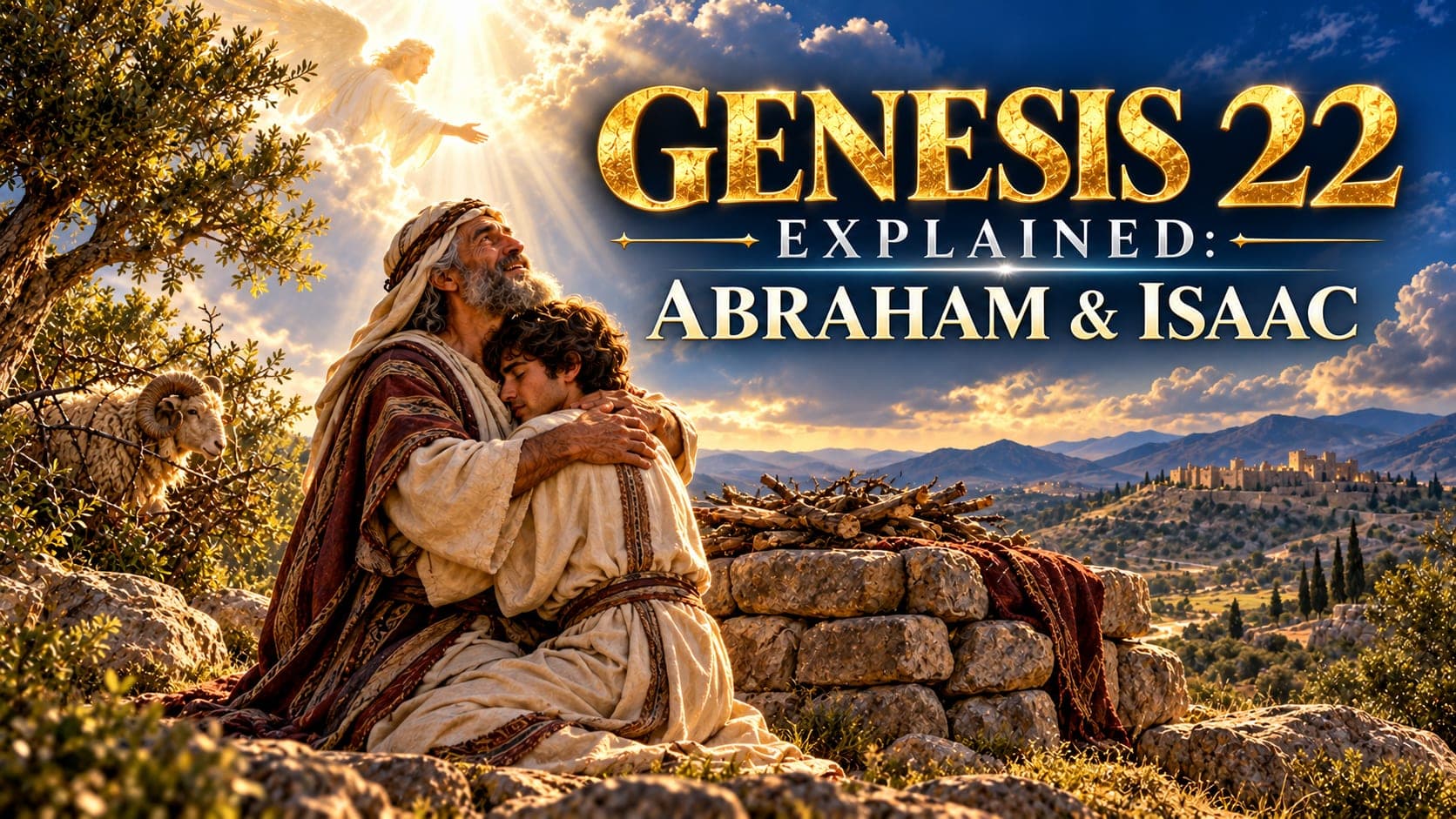
"And Abraham lifted up his eyes, and looked, and behold behind him a ram caught in a thicket by his horns: and Abraham went and took the ram, and offered him up for a burnt offering in the stead of his son."
"And Abraham called the name of that place Jehovahjireh: as it is said to this day, In the mount of the LORD it shall be seen."
📌 Isaac asked where the lamb was. God's answer was a ram, already caught, already waiting. Jehovahjireh means "the LORD will provide," the very words Abraham spoke back in verse 8. He names the place after the promise it just kept.
💡 The ram dies "in the stead of his son," a substitute taking the place the son was standing in. This is the first time Genesis uses that exact pattern, one life given so another does not have to die.
6. The Covenant Oath Renewed (verses 15 to 18)
The angel speaks a second time, and this time it is not an instruction. It is an oath.
"And the angel of the LORD called unto Abraham out of heaven the second time, And said, By myself have I sworn, saith the LORD, for because thou hast done this thing, and hast not withheld thy son, thine only son:"
📌 "By myself have I sworn" is God swearing on His own name, because there is nothing greater to swear by. Every earlier promise to Abraham was a statement. This one is an oath, tied directly to the moment Abraham did not hold Isaac back.
"That in blessing I will bless thee, and in multiplying I will multiply thy seed as the stars of the heaven, and as the sand which is upon the sea shore; and thy seed shall possess the gate of his enemies; And in thy seed shall all the nations of the earth be blessed; because thou hast obeyed my voice."
💡 Stars and sand were already promised in earlier chapters. What is new here is the last line: all nations blessed through Abraham's seed, tied specifically to this act of obedience. The promise that started with a call to leave his homeland now reaches every nation on earth, confirmed on a mountain where a father did not withhold his son.
7. Home to Beersheba, and a Family Tree Pointing Ahead (verses 19 to 24)
The mountain scene ends abruptly, and Genesis moves straight to a report from back home.
"So Abraham returned unto his young men, and they rose up and went together to Beersheba; and Abraham dwelt at Beersheba."
"And it came to pass after these things, that it was told Abraham, saying, Behold, Milcah, she hath also born children unto thy brother Nahor; Huz his firstborn, and Buz his brother, and Kemuel the father of Aram, And Chesed, and Hazo, and Pildash, and Jidlaph, and Bethuel. And Bethuel begat Rebekah: these eight Milcah did bear to Nahor, Abraham's brother."
📌 The chapter that almost ended Isaac's life closes with the birth announcement of the woman he will marry. Rebekah is named here for the first time, years before Genesis 24 sends a servant to find her. A list of names that looks like filler is actually Genesis planting the next major character before the reader even knows to look for her.
Interestingly, Isaac is completely silent for the rest of the chapter. He walked down the mountain, and the text moves on without a single recorded word from him.
Hard Questions Genesis 22 Raises
Did God not already know how Abraham would respond? The text says God tested Abraham, then says "now I know" once the knife was in the air. Most readers understand this the same way Scripture treats testing elsewhere: the test does not give God new information about Himself, it proves out, in real events, what was already true of Abraham. The phrase reads as real, historical, experiential knowledge, made public for Isaac and for every later reader, not a gap in God's own understanding.
How is this different from the child sacrifice God condemns elsewhere? Scripture elsewhere forbids offering children to false gods, a practice tied to nations Israel is warned away from. Genesis 22 differs from that pattern in the details the text itself gives: it is called a test from the start, it is stopped before any harm happens, and God provides a substitute animal in Isaac's place. The chapter does not celebrate child sacrifice. It stages a near sacrifice and then interrupts it, with the substitution as the actual point.
Was Isaac a willing participant, or was he overpowered? The text gives no struggle, no resistance, and an exchange on the way up the mountain that shows Isaac thinking clearly and asking a direct question. Hebrews 11:17 to 19 credits the faith in this scene to Abraham specifically, reasoning that God was able to raise Isaac from the dead if needed. The text is written from Abraham's side of the test, but nothing in it suggests Isaac was deceived or forced.
How does James 2:21 to 23 saying Abraham was "justified by works" fit with Genesis 15:6, where his faith was already counted as righteousness years before this chapter? James is not describing how Abraham first became righteous before God. He is describing how that already existing faith was proven, completed, and made visible through what Abraham actually did on this mountain. The counting happened back in Genesis 15. Genesis 22 is where that faith gets tested and shown to be real.
Where is Mount Moriah, and does it matter later? 2 Chronicles 3:1 places Solomon's temple "in mount Moriah," in Jerusalem, which many readers take as the same location named in Genesis 22:2. If that identification is right, the mountain where a ram died in Isaac's place became, generations later, the site of Israel's entire sacrificial system.
Top 5 Bible Verses From Genesis 22
1. Genesis 22:2
"Take now thy son, thine only son Isaac, whom thou lovest, and get thee into the land of Moriah; and offer him there for a burnt offering upon one of the mountains which I will tell thee of."
Four descriptions of Isaac stacked into one command, naming exactly what is being asked for before Abraham can soften it in his own mind.
2. Genesis 22:8
"And Abraham said, My son, God will provide himself a lamb for a burnt offering: so they went both of them together."
Abraham's answer to Isaac's question turns out truer than he likely knew, an answer that still echoes centuries later at the words "behold the Lamb of God."
3. Genesis 22:12
"Lay not thine hand upon the lad, neither do thou any thing unto him: for now I know that thou fearest God, seeing thou hast not withheld thy son, thine only son from me."
The command stops the instant it has done what it was sent to prove. Nothing about this test was designed to end with Isaac's death.
4. Genesis 22:14
"And Abraham called the name of that place Jehovahjireh: as it is said to this day, In the mount of the LORD it shall be seen."
The LORD will provide, named on the exact spot where He just did, with a ram standing in for the son who was bound on the altar.
5. Genesis 22:17 and 18
"That in blessing I will bless thee, and in multiplying I will multiply thy seed as the stars of the heaven, and as the sand which is upon the sea shore... and in thy seed shall all the nations of the earth be blessed; because thou hast obeyed my voice."
An oath sworn on God's own name, reaching all the way to every nation on earth, confirmed because a father did not hold back the son he loved.

Frequently Asked Questions About Genesis 22
What does Genesis 22 mean?
It records God testing Abraham by telling him to offer his son Isaac as a burnt offering, Abraham's obedience all the way to the altar, God stopping him and providing a ram instead, and a renewed covenant oath sworn over Abraham because he did not withhold his son.
Why did God test Abraham by asking him to sacrifice Isaac?
Genesis 22:1 says plainly that God did this to test Abraham. Genesis 22:12 gives the result: the test proved, in real history, that Abraham feared God enough to hold nothing back from Him, even the son every promise depended on.
Did Abraham actually kill Isaac?
No. Genesis 22:10 to 12 says Abraham had already taken the knife to slay his son when the angel of the LORD stopped him. God provided a ram caught in a thicket as a substitute offering instead.
How old was Isaac when Abraham offered him?
Genesis never states his age. He is old enough to carry a load of wood up a mountain and ask a direct question, so most readers place him well past early childhood. Jewish tradition sometimes suggests an age near thirty seven, reasoning from Sarah's death in the next chapter, but that number comes from tradition, not the biblical text itself.
What does Jehovahjireh mean?
Genesis 22:14 names the place Jehovahjireh, meaning "the LORD will provide," the exact words Abraham spoke to Isaac in verse 8 right before God did.
Why does the Bible call this a test if God already knows everything?
The test is not for God's information. Genesis 22:12 says "now I know," language that describes something proved out in real history rather than new information God lacked. Abraham's fear of God becomes visible and provable through the test, not before it.
Is Genesis 22 about child sacrifice?
It is a test involving a near sacrifice, stopped before it happens, with a substitute animal provided in Isaac's place. The chapter itself frames the event as a test from its first verse and ends with God explicitly forbidding Abraham from harming Isaac.
What does the ram in the thicket represent?
Genesis 22:13 says the ram was offered "in the stead of his son," a substitute dying in the place the son was standing. Many Christians read this as an early picture of substitution that later Scripture develops more fully.
Where is Mount Moriah today?
2 Chronicles 3:1 places Solomon's temple "in mount Moriah" at Jerusalem. If this is the same location Genesis 22:2 names, it puts the temple mount in Jerusalem as the traditional site of Abraham's test.
How does Genesis 22 point to Jesus?
Abraham tells Isaac "God will provide himself a lamb," language John the Baptist later echoes when he calls Jesus the Lamb of God. Romans 8:32 draws a direct parallel: God, who spared Abraham's son, did not spare His own.
Why does the chapter end with a list of Nahor's children?
Genesis 22:23 names Rebekah for the first time, years before Genesis 24 sends a servant to find her as Isaac's wife. The list quietly introduces the next major character right after the mountain scene ends.
Final Thoughts
Genesis 22 does not explain itself. It just shows a father walking, and a God who stops him in time.
📌 Obedience that holds nothing back is what God calls faith. Abraham did not negotiate for a smaller version of the command. He got up early and started walking toward the whole thing.
📌 God provides the substitute Himself. Abraham named the mountain after the provision he watched happen, not after his own obedience. The ram was not something Abraham found. It was something God had waiting.
📌 An oath sworn on God's own name does not get revoked. Every later promise to Israel traces back to the covenant confirmed on this mountain, over a son who was given back instead of taken.
You may be holding something you are afraid God will actually ask for.
So here is your one next step.
Name that thing honestly before God today, the way Abraham named Isaac out loud in verse 2 instead of pretending the ask was smaller than it was. If you want to sit longer with that question, Could You Sacrifice Your Isaac? goes deeper into what it means for you.