📖 Why Do Some Christians Celebrate Christmas on January 7?
Your coworker wishes you a happy new year on January 1, then tells you her own Christmas is still two weeks away.
Or maybe you saw the headlines every January about Russian, Serbian, or Ethiopian Christians celebrating Christmas on January 7, and it never quite made sense.
Did the early church lose track of the actual date? Is one group simply wrong?
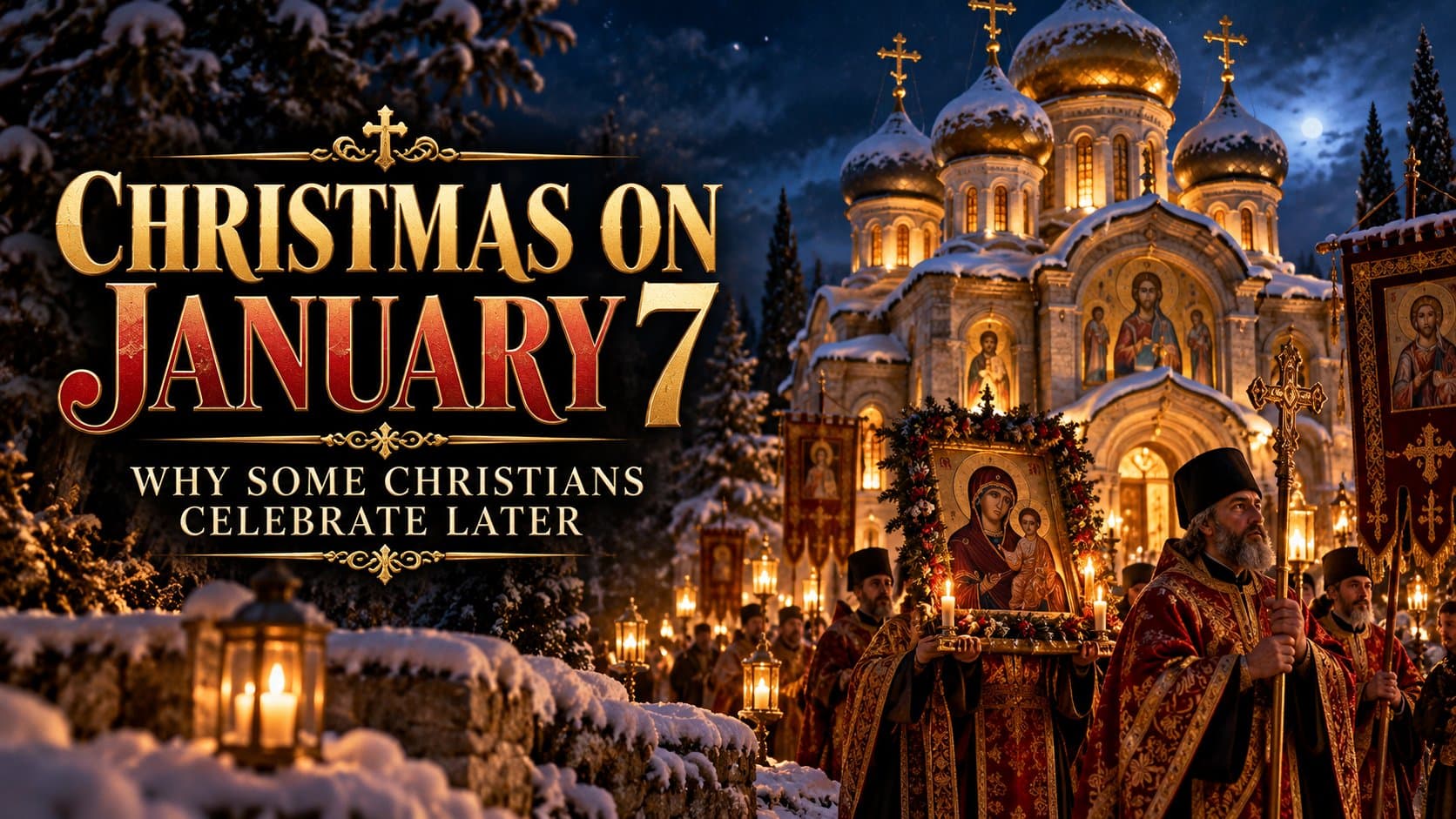
📌 Here is the plain answer. Every Christian who keeps Christmas on January 7 is still celebrating December 25. They are just reading that date off an older calendar, one that now runs thirteen days behind the calendar hanging on your own wall.
No one is arguing that Jesus was born on a different day. The disagreement is about which calendar gets to name the day, not when the day actually falls.
This guide walks through where that older calendar came from, how a tiny yearly error turned into a thirteen day gap, which churches still use it, which ones moved away from it, and why Ukraine just changed its own answer to this question in the middle of a war.
Every historical claim below links back to a named source, so you can go check it yourself.
Why This Matters for Your Faith
It is tempting to treat this as a trivia question. A fun fact for a party.
But underneath the calendar math sits a real question worth asking yourself.
⚠️ Does the date on a calendar change what actually happened?
Scripture says the God behind Christmas existed long before any calendar did.
"Before the mountains were brought forth, or ever thou hadst formed the earth and the world, even from everlasting to everlasting, thou art God."
Calendars are a human tool for marking time. God is not bound by the tool.
He is the one who set the whole system of days and years in motion in the first place.
"And God said, Let there be lights in the firmament of the heaven to divide the day from the night; and let them be for signs, and for seasons, and for days, and years:"
💡 The sun and the stars keep the actual time. Caesar's calendar and Pope Gregory's calendar were both just human attempts to track what God had already set in motion.
Christmas is not really about hitting a precise square on a grid. It is about the truth Paul names in a single phrase, that God acted at exactly the right moment in history.
"But when the fulness of the time was come, God sent forth his Son, made of a woman, made under the law,"
📌 The fulness of the time was never about a calendar square. It was about God's own timing.
So the stakes here are not whether your Orthodox neighbor or your own church has the right date. The stakes are whether a surface level disagreement over a calendar gets to divide people who both kneel at the same manger.

Why Christmas Lands on Two Different Days
1. The Short Answer: Same Birthday, Different Calendar
Start with the plain fact underneath everything else in this guide.
📌 Every church that celebrates Christmas on January 7 still calls it December 25 on its own calendar.
That calendar is the Julian calendar, named for Julius Caesar, who introduced it around 46 BC on the advice of the Egyptian astronomer Sosigenes, according to National Geographic.
Western churches, including the Catholic Church and nearly every Protestant denomination, use the newer Gregorian calendar instead. Right now the two calendars sit thirteen days apart.
December 25 on the Julian calendar simply lands on January 7 on the Gregorian calendar you probably use every day. Nothing about the birth of Jesus moved. The ruler used to measure the date changed instead.
2. Julius Caesar's Calendar Had a Small Math Problem
To understand the gap, you have to understand the small flaw Caesar's calendar carried from the very start.
NASA's Glenn Research Center explains the real length of a year, the time it actually takes the earth to circle the sun, as 365 days, 5 hours, 48 minutes, and 46 seconds. Close to 365 and a quarter days, but not exactly.
Caesar's calendar rounded that figure to an even 365.25 days, adding one extra day every fourth year to absorb the quarter day. Simple, and almost right.
📌 Almost right is the whole problem. According to NASA, the Julian year ran about 0.0078 of a day too long every single year. That is roughly eleven minutes and fourteen seconds.
Eleven minutes sounds like nothing. It is nothing, for one year.
3. How Eleven Minutes a Year Turned Into Thirteen Days
Stretch eleven minutes across sixteen centuries and the small error stops being small.
NASA puts the accumulated drift between Caesar's calendar in 46 BC and the year 1582 at about 12.7 days. The seasons were slowly sliding away from the dates meant to mark them.
Pope Gregory XIII addressed the drift in 1582 with a new calendar bearing his name. The Gregorian calendar keeps Caesar's basic leap year idea, but drops the leap day in century years that do not divide evenly by 400, such as 1700, 1800, and 1900.
NASA's figures show that correction brings the average Gregorian year to 365.2425 days, leaving an error of only about one day every 3,333 years. Catholic countries adopted it that October, skipping ten days outright so that Thursday, October 4 was followed immediately by Friday, October 15.
Britain and its colonies did not adopt the new calendar until 1752, by which point an extra day of drift had built up, which is part of why the gap between the two calendars kept growing after 1582 instead of staying fixed at ten days. Today, after the missed leap years of 1700, 1800, and 1900, the gap stands at thirteen days. It will grow to fourteen in the year 2100.
4. Rome Corrected the Drift. The East Did Not Follow.
Here is where the story stops being pure math and becomes church history.
National Geographic explains that the Orthodox Church rejected Pope Gregory's new calendar when Rome introduced it, partly for a reason tied directly to the date of Easter. The Orthodox Church had followed rules set at the First Council of Nicaea in AD 325 for calculating Easter, built on the Julian calendar, and the Gregorian switch would sometimes put Easter on the same day as the Jewish Passover, which Orthodox tradition holds should never happen.
Add to that a basic fact of church authority. Orthodox Christians do not recognize the pope as head of their church, so a calendar reform ordered from Rome carried no weight for them regardless of its math.
📌 The Orthodox world simply kept using the calendar it already had. Christmas stayed fixed on December 25, Julian style, while the civil world around it slowly moved over to the Gregorian date. By 1923, that gap between the two calendars had widened to the thirteen days it still sits at today.
5. Who Still Keeps the Old Date, and Who Moved Back to December 25
In May 1923, a Pan Orthodox Congress met in Constantinople to consider a fix. National Geographic reports that a Serbian scientist named Milutin Milankovic proposed a revised version of the Julian calendar, one that lines up with the Gregorian dates for fixed feasts like Christmas without fully adopting the Gregorian system Rome used.
The churches of Constantinople, Cyprus, Greece, and Romania adopted that revised calendar and moved their fixed feasts, Christmas included, onto the Gregorian date of December 25.
Russia and Egypt refused the change, according to National Geographic, and kept the older Julian calendar in place. That single decision is why the Russian Orthodox Church still keeps Christmas on January 7 today.
- 🟢 The Russian, Serbian, Georgian, and Jerusalem Orthodox Churches use the old Julian calendar and keep Christmas on January 7.
- 🟢 The Coptic Orthodox Church of Egypt and the Ethiopian Orthodox Tewahedo Church also keep January 7, following their own historic calendars.
- 🟢 The Greek, Cypriot, Romanian, and Constantinople Orthodox Churches, along with the Orthodox Church in America and most Antiochian parishes, use the revised calendar and keep Christmas on December 25.
💡 Historian Aram Sarkisian, quoted by National Geographic, notes that for Orthodox churches living under Communist governments in the twentieth century, the calendar question became tangled up with politics and survival, not just astronomy. Soviet Russia had already abandoned the Julian calendar for civil life after the 1917 revolution, which made the Russian church's decision to keep it for worship carry extra weight as a mark of identity.
That same tangle of calendar and politics is still playing out right now. In 2023, Ukraine's government officially moved its national Christmas holiday from January 7 to December 25, and Ukraine's independent Orthodox Church announced it would switch its own religious calendar to match, starting that September. Ukrainian officials described the change as a deliberate break from what they called a Russian imposed tradition, a reminder that this calendar question has never been purely academic for the people living inside it.
The Ukrainian Greek Catholic Church, in union with Rome, had traditionally kept January 7 alongside its Orthodox neighbors in Ukraine. It moved its own observance to December 25 around the same time as Ukraine's government and its independent Orthodox Church did, which is why whether Jesus was actually born on December 25 at all is really a separate question from which calendar a church uses to mark the date it already settled on.
6. The Armenian Exception: One Feast for Two Events
One more date belongs in this guide, even though it has a different explanation entirely.
The Armenian Apostolic Church celebrates Christmas on January 6, not January 7. That is not a calendar drift question at all.
⚠️ The Armenian Church never split Christmas away from Epiphany in the first place. Several sources on Armenian church history describe a single combined feast, celebrating both Christ's birth and His baptism together, as the practice of the early church broadly before December 25 became the separate Western date for the Nativity. The Armenian Church kept that older combined observance rather than adopting the later split.
Historians give differing accounts of exactly how and when the wider church moved toward keeping the two events on separate days, so treat any single tidy date for that shift with caution. What is well attested is the result still visible today. Armenian Christians greet each other with the phrase Christ is born and revealed, naming both events in one sentence, on one day, every January 6.
That is a genuinely different reason than the Julian calendar story everywhere else in this guide, which is exactly why it is worth telling separately rather than folding it into the same explanation.

Practical Tips for Christians Who Keep Two Calendars in One Family or Friend Group
Maybe you have an Orthodox, Coptic, or Armenian friend. Maybe you married into one of those traditions. Here is how to actually live this out well.
- Say the right date out loud, both of them. If a friend tells you their Christmas is January 7, do not correct them. You are both talking about December 25. You just mean two different calendars.
- Do not treat the later date as a lesser celebration. A January 7 Christmas carries the same weight in its own tradition as a December 25 one does in yours. The calendar is different. The event being honored is not.
- Ask instead of assuming. Fasting practices, feast foods, and church services vary a great deal between traditions that share this same date. A simple question honors the difference better than a guess.
- Resist turning this into a which church is right debate. This is a calendar disagreement, not a disagreement about who Jesus is or when He was born. Keep it that size.
- Remember this is still unfolding in places like Ukraine. For some believers, the date carries real political and historical weight right now, not just tradition. Ask with that in mind before you joke about it.
- Celebrate twice if you want to. Plenty of mixed families simply keep both days, a smaller gathering in December and a larger one in January, or the other way around. There is no rule against it.
- Let the actual point stay the point. Whichever date you keep, the birth of Christ is the reason for either calendar square, not the calendar itself.
Top 5 Bible Verses About God's Timing and the Birth of Christ
None of these verses mention a calendar. All five say something true about the timing behind the day two calendars are arguing over.
1. Galatians 4:4 and 5
"But when the fulness of the time was come, God sent forth his Son, made of a woman, made under the law, To redeem them that were under the law, that we might receive the adoption of sons."
Paul does not say God sent Jesus on a specific numbered date. He says God sent Him in the fulness of time.
📌 God's timing was never measured by Caesar's calendar or Pope Gregory's calendar. It was measured by His own purpose.
2. Genesis 1:14
"And God said, Let there be lights in the firmament of the heaven to divide the day from the night; and let them be for signs, and for seasons, and for days, and years:"
Every calendar humans have ever built, Julian, Gregorian, or any other, is an attempt to track what this verse describes God already setting in motion.
The tool changes. What it is trying to measure does not.
3. Luke 2:10 and 11
"And the angel said unto them, Fear not: for, behold, I bring you good tidings of great joy, which shall be to all people. For unto you is born this day in the city of David a Saviour, which is Christ the Lord."
Notice the phrase to all people. Not to one calendar's worth of people.
💡 The good news the angel announced was never addressed only to readers of the Gregorian calendar.
4. Matthew 2:9 and 10
"When they had heard the king, they departed; and, lo, the star, which they saw in the east, went before them, till it came and stood over where the young child was. When they saw the star, they rejoiced with exceeding great joy."
The wise men did not consult a calendar to know they had arrived at the right moment. They followed a sign in the sky instead, the same kind of sign Genesis 1:14 says God built into creation on purpose.
Their story is really the origin of the separate feast of Epiphany, which is where this whole question of fixed dates on the church calendar began in the first place.
5. Romans 14:5 and 6
"One man esteemeth one day above another: another esteemeth every day alike. Let every man be fully persuaded in his own mind. He that regardeth the day, regardeth it unto the Lord; and he that regardeth not the day, to the Lord he doth not regard it."
Paul was not writing about calendars at all here. He was writing about Christians disagreeing honestly over practices neither side was commanded to settle the same way.
⚠️ That principle fits this whole question better than almost any other verse in Scripture. A Christian who keeps December 25 and a Christian who keeps January 7 can both be regarding the day unto the Lord, in Paul's own words, without either one owing the other an apology.

Frequently Asked Questions About Christmas on January 7
Why do Orthodox Christians celebrate Christmas on January 7?
Because churches like the Russian, Serbian, Georgian, and Jerusalem Orthodox Churches still use the Julian calendar for their church year. December 25 on that calendar currently falls on January 7 on the Gregorian calendar most of the world uses day to day.
Is January 7 actually Jesus's real birthday?
No church claims that. Every tradition celebrating on January 7 is marking December 25 by its own calendar, the same date Western churches mark in December. The Bible never records an exact calendar date for the birth of Jesus either way.
What is the difference between the Julian and Gregorian calendars?
The Julian calendar, introduced around 46 BC, adds a leap day every fourth year with no exceptions, which overestimates the solar year by about eleven minutes annually. The Gregorian calendar, introduced in 1582, corrects that by skipping leap years in most century years, which is why the two calendars now sit thirteen days apart.
Which Christian churches still celebrate Christmas on January 7?
The Russian, Serbian, Georgian, and Jerusalem Orthodox Churches, along with the Coptic Orthodox Church of Egypt and the Ethiopian Orthodox Tewahedo Church, all keep Christmas on January 7. Many of their Eastern Catholic counterparts follow the same date.
Why do some Orthodox churches celebrate Christmas on December 25 instead?
After a 1923 church congress in Constantinople, the Greek, Cypriot, Romanian, and Constantinople Orthodox Churches adopted a revised calendar that lines up fixed feasts like Christmas with the Gregorian date, while keeping their own calculation for Easter. The Orthodox Church in America and most Antiochian Orthodox parishes also follow December 25.
Why does Armenia celebrate Christmas on January 6?
That is a separate question from the calendar drift behind January 7. The Armenian Apostolic Church kept an older combined feast of Christ's birth and His baptism together on one day, rather than splitting Christmas and Epiphany into two separate dates the way most other churches eventually did.
Did Ukraine change its Christmas date?
Yes. In 2023, Ukraine's government moved its official Christmas holiday from January 7 to December 25, and the country's independent Orthodox Church switched its religious calendar to match that September. Officials described the move as a break from what they called a Russian imposed tradition.
Will the gap between the calendars ever change?
Yes. Because the Julian calendar keeps adding a leap day every single century year with no exceptions, while the Gregorian calendar skips most of them, the gap grows over time. It is set to widen from thirteen days to fourteen in the year 2100.
Is it wrong to wish an Orthodox Christian a merry Christmas in December?
No, though many will simply explain their own Christmas still has not arrived yet. A cheerful merry Christmas on January 7 itself is always the safer bet if you know a friend keeps that date.
Do Catholics ever celebrate Christmas on January 7?
Most Catholics follow the Gregorian calendar and keep December 25, the same as the rest of the Western liturgical calendar. Some Eastern Catholic churches in union with Rome follow the older Julian calendar instead, the same as their Orthodox neighbors, and keep January 7.
Final Thoughts
Strip away the astronomy and the church politics, and one simple fact survives everything else in this guide.
📌 No Christian tradition disagrees about what happened. They disagree about which calendar gets to name the day it happened on.
A small rounding error in a calendar written under Julius Caesar grew into thirteen days over sixteen centuries. One pope corrected it in the West. Much of the East, for reasons both theological and political, did not follow. That split has nothing to do with where Christmas itself came from, and everything to do with which clock the church next to you happens to be running on.
Whichever date sits on your own calendar, the point was never the square on the grid. The watching, the waiting, and the night itself matter more than which January or December morning you wake up to them on.
So here is one way to carry this.
The next time December 25 or January 7 rolls around, and you hear a believer from a different tradition say Christ is born, do not hear a different claim than your own.
Hear the same one, read off a different calendar.
📚 Sources
Every claim in this article traces back to one of these. All links checked 30 October 2026.
- Calendar Calculations
NASA Glenn Research Center
The source for the tropical year's exact length, Julius Caesar's 46 BC calendar and its average year of 365.25 days, the 0.0078 day (eleven minute) annual error, the 12.7 day drift by 1582, and the Gregorian correction's leap year rule and remaining error.
- Why Orthodox Christians celebrate Christmas in January
National Geographic · 2022
The source for the Orthodox Church's rejection of the Gregorian calendar over the dating of Easter and papal authority, the 1923 Pan Orthodox Congress, Milutin Milankovic's revised calendar, which churches adopted it, Russia and Egypt's refusal, and historian Aram Sarkisian's comment on calendar politics under Communist rule.
- Zelenskyy signs law moving Christmas in Ukraine to Dec. 25
Associated Press, via Word&Way · 2023
The source for Ukraine's 2023 law moving its national Christmas holiday to December 25 and the independent Orthodox Church of Ukraine's switch to the revised calendar that September.
- Why do 250 million Christians celebrate Christmas on January 7?
Al Jazeera · 2026
The source for the current list of churches keeping January 7, including the Coptic Orthodox and Ethiopian Orthodox Tewahedo Churches, and the Armenian Apostolic Church's separate January 6 observance.
- Why January 6th? Why Do Armenians Celebrate Christmas on a Different Date?
St. Mary Armenian Apostolic Church
The source for the Armenian Church's combined observance of Christ's Nativity and His baptism on one feast day, January 6, rather than the calendar drift explanation that applies to the January 7 date elsewhere.
- On January 7 Christians celebrate Christmas according to Julian calendar
Religious Information Service of Ukraine (RISU) · 2019
The source for the Ukrainian Greek Catholic Church's traditional January 7 observance alongside Ukraine's Orthodox churches, before its later move to December 25.