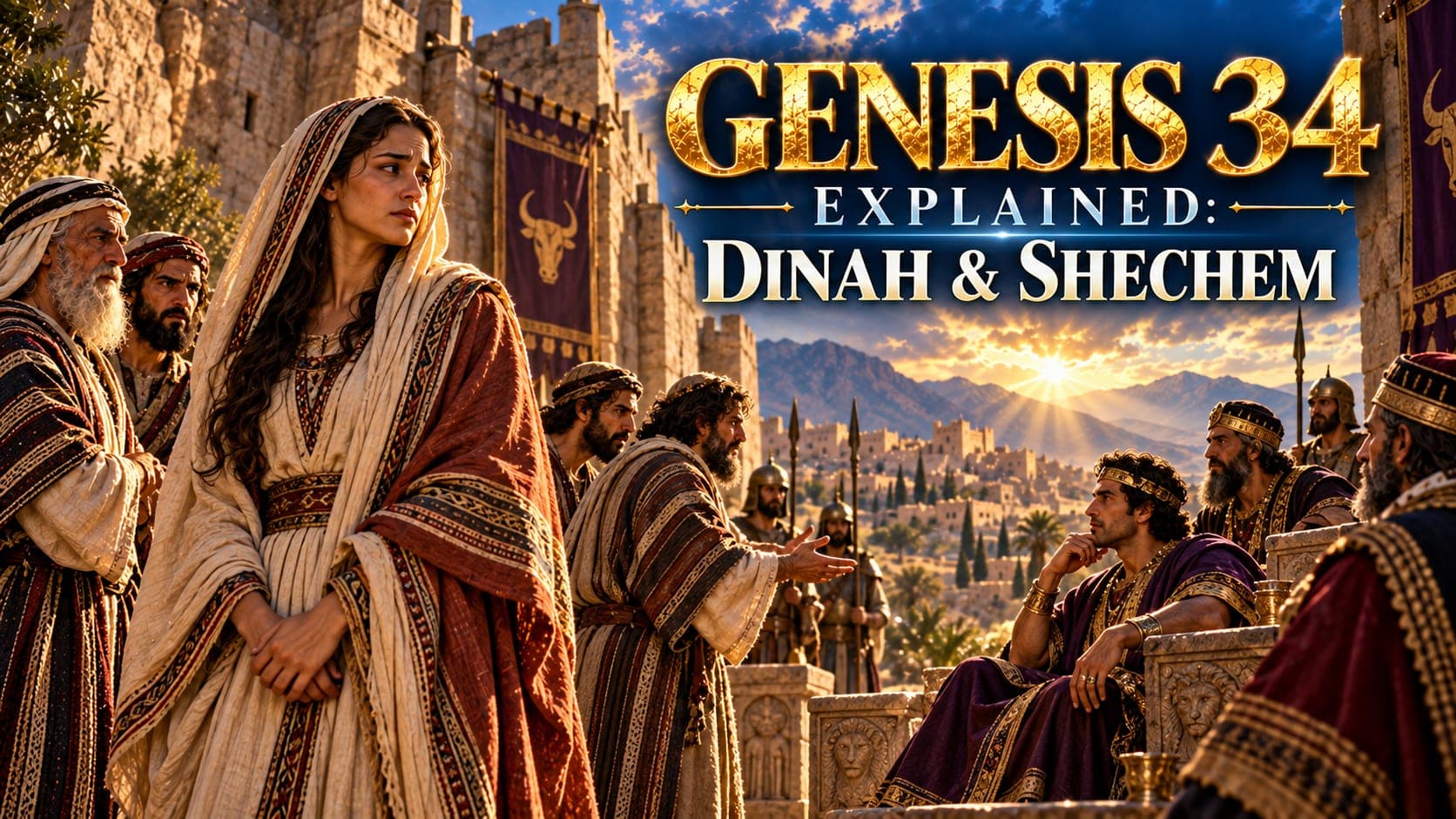
📖 Genesis 34 Explained: Dinah, Shechem, and the Massacre
One young woman walks out to visit some local girls. By the end of the chapter, a whole city is dead.
Genesis 34 explained is one of the darkest, most uncomfortable chapters in Genesis. Jacob's daughter Dinah is violated by a young prince named Shechem. His father proposes a marriage, and a full alliance between two peoples. Jacob's sons answer with a plan that sounds like reconciliation and is actually a trap, and it ends with two of them slaughtering an entire city while the men there are still recovering from surgery the brothers themselves demanded.
Maybe you have watched a family respond to real harm with something that made everything worse instead of better.
- ❓ Was what happened to Dinah an assault, or something gentler than that word suggests?
- ❓ Why does Jacob stay completely silent when he first hears the news?
- ❓ Why circumcision, of all things, as the condition for peace?
- ❓ Does Genesis actually approve of what Simeon and Levi do?
📌 Genesis states the brothers' answer was deceitful in plain words, before a single sword is drawn. This chapter does not need you to guess where the text stands.
This walkthrough goes through the whole chapter in order: what Shechem does to Dinah, Jacob's silence, Hamor's proposal, the brothers' deceitful demand, the pitch that actually convinces the city, the massacre itself, and the unresolved argument between Jacob and his sons that closes the chapter.
Watch how many people in this chapter treat Dinah as a problem to solve rather than a person who was harmed.
What Happened Just Before This Chapter
Genesis 33 ended with Jacob settling near Shechem instead of continuing home to his father Isaac or returning to Bethel, where he had vowed years earlier to build an altar once God brought him home safely. He bought a parcel of land from the sons of Hamor, pitched his tent, and built an altar there called El-elohe-Israel.
📌 Genesis 34 opens in the exact place Jacob chose to settle instead of finishing his journey. Dinah, Leah's daughter, was born back in Genesis 30, during the years Jacob still worked for Laban. By now she is old enough to go out among the young women of the region on her own, living as a neighbor to the very family Jacob had just done business with.
Genesis 34 Explained Verse by Verse
1. Dinah Goes Out, and Shechem Defiles Her (verses 1 to 4)
The chapter opens with an ordinary errand that turns violent in a single verse.
"And Dinah the daughter of Leah, which she bare unto Jacob, went out to see the daughters of the land."
"And when Shechem the son of Hamor the Hivite, prince of the country, saw her, he took her, and lay with her, and defiled her."
⚠️ Read the order of those three verbs carefully. Took, lay with, defiled. Nothing in the text suggests Dinah agreed to any of this or was even consulted. Shechem is named as the son of the local ruler, a man with power over the very town Jacob had just settled beside, and he uses that power against a young woman with no standing to refuse him. This is the plain reading most translations and most commentators take from the Hebrew: an assault carried out by a man used to getting what he wants.
What comes next is where the chapter gets uncomfortable in a different way.
"And his soul clave unto Dinah the daughter of Jacob, and he loved the damsel, and spake kindly unto the damsel."
"And Shechem spake unto his father Hamor, saying, Get me this damsel to wife."
💡 Genesis records Shechem's feelings only after the harm is already done, not before it. Affection that shows up after a violation does not undo the violation. And notice how he asks for her: not a proposal made to Dinah, but an order given to his father, "get me this damsel." Even his attempt to make things right treats Dinah as something to be acquired rather than a person to be asked.
2. Jacob's Silence, and His Sons' Fury (verses 5 to 7)
Word reaches Jacob before it reaches his sons, and the two reactions could not look more different.
"And Jacob heard that he had defiled Dinah his daughter: now his sons were with his cattle in the field: and Jacob held his peace until they were come."
"And the sons of Jacob came out of the field when they heard it: and the men were grieved, and they were very wroth, because he had wrought folly in Israel in lying with Jacob's daughter; which thing ought not to be done."
📌 Jacob says nothing. His sons are grieved and very wroth the moment they hear it. Genesis does not explain Jacob's silence. It may have been caution, since Hamor was already on his way to negotiate. It may have been a father unsure how to respond. The text simply lets the silence sit there, uncommented on, next to his sons' open outrage.
"Wrought folly in Israel" is a phrase Scripture later uses for sexual sin serious enough to shame an entire family or nation. Israel is not yet a nation here, only Jacob's new name from the wrestling match at Peniel, so the brothers are already speaking as if the family's whole honor is at stake, not just Dinah's.
3. Hamor's Proposal, and Shechem's Blank Check (verses 8 to 12)
Hamor arrives with something far bigger than an apology.
"And Hamor communed with them, saying, The soul of my son Shechem longeth for your daughter: I pray you give her him to wife."
"And make ye marriages with us, and give your daughters unto us, and take our daughters unto you."
"And ye shall dwell with us: and the land shall be before you; dwell and trade ye therein, and get you possessions therein."
⚠️ Hamor is not only asking for one marriage. He is proposing a full merger between two peoples. Intermarriage both directions, shared land, shared trade rights. Whatever happened to Dinah, Hamor treats it as an opening for his son's family to absorb Jacob's wealth and household into his own city.
Shechem himself speaks up next, and he does not hold anything back.
"And Shechem said unto her father and unto her brethren, Let me find grace in your eyes, and what ye shall say unto me I will give."
"Ask me never so much dowry and gift, and I will give according as ye shall say unto me: but give me the damsel to wife."
💡 A blank check for whatever price Jacob's family names. Shechem clearly has the wealth and the standing to back it up. What he does not offer, because it does not occur to him to offer it, is anything to Dinah herself. Every word in this negotiation passes between the men.
4. The Brothers' Deceitful Demand (verses 13 to 19)
Genesis tells you exactly what kind of answer is coming before it even records the words.
"And the sons of Jacob answered Shechem and Hamor his father deceitfully, and said, because he had defiled Dinah their sister:"
📌 "Deceitfully" is the narrator's own word, stated before the brothers speak a single line. Nothing in this chapter requires you to guess whether what follows is a trap. Genesis has already told you.
"And they said unto them, We cannot do this thing, to give our sister to one that is uncircumcised; for that were a reproach unto us:"
"But in this will we consent unto you: If ye will be as we be, that every male of you be circumcised;"
"Then will we give our daughters unto you, and we will take your daughters to us, and we will dwell with you, and we will become one people."
⚠️ Circumcision was the sign of God's own covenant with Abraham, given for worship, and the brothers turn it into bait. They dress the demand up in the language of shared faith and shared identity, and it works because it sounds reasonable on the surface. Underneath it, the plan only needs one thing: every fighting man in the city disabled at the same time.
Shechem and Hamor accept immediately, and Shechem moves faster than anyone.
"And their words pleased Hamor, and Shechem Hamor's son."
"And the young man deferred not to do the thing, because he had delight in Jacob's daughter: and he was more honourable than all the house of his father."
💡 Genesis even calls Shechem more honorable than the rest of his father's house, right in the middle of a chapter about the harm he caused. His hurry to comply comes from real affection for Dinah, and it walks him and every man he leads straight into a trap he never suspects.
5. The Pitch That Actually Convinces the City (verses 20 to 24)
Hamor and Shechem take the proposal to the city gate, the place where public and legal business was settled, and they sell it to their own people.
"These men are peaceable with us; therefore let them dwell in the land, and trade therein; for the land, behold, it is large enough for them; let us take their daughters to us for wives, and let us give them our daughters."
"Only herein will the men consent unto us for to dwell with us, to be one people, if every male among us be circumcised, as they are circumcised."
"Shall not their cattle and their substance and every beast of theirs be ours? only let us consent unto them, and they will dwell with us."
📌 Notice what Hamor never mentions to his own townsmen: Dinah. To Jacob's family, this was framed around a marriage. To the men of the city, it is framed as a straightforward business deal, their livestock and wealth for the mild inconvenience of a surgery. Nobody in this negotiation, on either side, is being fully honest with everyone involved.
"And unto Hamor and unto Shechem his son hearkened all that went out of the gate of his city; and every male was circumcised, all that went out of the gate of his city."
6. Simeon and Levi Massacre the City (verses 25 to 29)
The trap closes exactly on schedule, at the moment the men of the city are least able to defend themselves.
"And it came to pass on the third day, when they were sore, that two of the sons of Jacob, Simeon and Levi, Dinah's brethren, took each man his sword, and came upon the city boldly, and slew all the males."
⚠️ Only two brothers are named as the ones who actually swing a sword, Simeon and Levi, both Dinah's full brothers through Leah. The text notes the timing on purpose. The third day after circumcision is when the pain and swelling are typically at their worst, which is exactly why the brothers waited. This was not a fight. It was a planned execution of men who could barely stand.
"And they slew Hamor and Shechem his son with the edge of the sword, and took Dinah out of Shechem's house, and went out."
"The sons of Jacob came upon the slain, and spoiled the city, because they had defiled their sister."
"They took their sheep, and their oxen, and their asses, and that which was in the city, and that which was in the field, And all their wealth, and all their little ones, and their wives took they captive, and spoiled even all that was in the house."
💡 Verse 27 widens the circle from two brothers to "the sons of Jacob," who arrive once the killing is finished to plunder everything the city owns, including women and children taken captive. Whatever grief drove Simeon and Levi to draw their swords, the plundering that follows looks far less like justice and far more like conquest.
7. Jacob's Rebuke, and His Sons' Last Word (verses 30 and 31)
The chapter ends with father and sons talking past each other, and neither one gets the last word settled.
"And Jacob said to Simeon and Levi, Ye have troubled me to make me to stink among the inhabitants of the land, among the Canaanites and the Perizzites: and I being few in number, they shall gather themselves together against me, and slay me; and I shall be destroyed, I and my house."
📌 Read closely what Jacob does and does not say. He never calls the killing wrong. He says it makes him smell bad to the neighbors and puts his household in danger of retaliation. His objection is entirely about consequences to himself, not about the morality of what his sons did.
His sons answer with the one line that closes the chapter.
"And they said, Should he deal with our sister as with an harlot?"
⚠️ Genesis lets that question hang in the air. Jacob does not answer it, not here, and not for decades. His actual verdict on what Simeon and Levi did does not come until his dying words, far later in the book, and it is not the answer either son was hoping for.

Hard Questions Genesis 34 Raises
Was what happened to Dinah an assault? The Hebrew verbs in verse 2, took, lay with, defiled, describe Shechem acting on Dinah without her consent being recorded anywhere in the text. Most modern translations and commentators read this as a sexual assault carried out by a powerful man against a woman with no power to refuse him, not a romance that simply started badly.
Does Genesis approve of the brothers using circumcision as a trap? No. Verse 13 calls their answer deceitful in the narrator's own voice, before the plan is even carried out. Genesis frequently records deception in this family without praising it, going back to Jacob's own deception of Isaac, and this is no exception.
Was the massacre of the city justified as justice for Dinah? The chapter itself does not say so. Jacob's only recorded response is fear for his household's safety, not moral approval. Decades later, on his deathbed, Jacob gives his real verdict:
"Simeon and Levi are brethren; instruments of cruelty are in their habitations. O my soul, come not thou into their secret; unto their assembly, mine honour, be not thou united: for in their anger they slew a man, and in their selfwill they digged down a wall. Cursed be their anger, for it was fierce; and their wrath, for it was cruel: I will divide them in Jacob, and scatter them in Israel."
That is the closest Scripture comes to a final judgment on this chapter, and it is a curse, not a commendation. Genesis is capable of recording real harm done to Dinah and still condemning the way her brothers answered it.
Why does Jacob stay silent instead of acting right away? Genesis never explains it. Some readers see caution, since Hamor was already approaching to negotiate. Others see a father too passive to protect his own daughter in the moment. The text does not settle which one it is, and Jacob's later rebuke in verse 30, focused entirely on his own safety, does not make him look decisive either way.
Practical Tips From Genesis 34
This chapter is hard to read, and it still has real weight for how you handle harm and anger today.
- Do not let a person become a problem to manage. Nearly everyone in this chapter, Shechem, Hamor, even Jacob's own sons in their plan, treats Dinah as something to be settled rather than someone who was harmed. Notice when you start doing the same to a person in pain in front of you.
- Silence is not neutral. Jacob's quiet, unexplained response left a vacuum his sons filled with their own plan. If you lead a family or a group, your silence after real harm still communicates something, whether you intend it to or not.
- Do not dress up revenge in the language of faith. The brothers used circumcision, a sign of worship, to disable an entire city. Watch for the moment your own anger starts borrowing religious language to justify something it should not.
- Grief and cruelty can come from the same wound. Simeon and Levi's outrage at their sister's treatment was not manufactured. What they did with it still earned a curse, not a blessing, from their own father.
- Watch for who benefits when a compromise sounds too easy. The men of Shechem accepted circumcision because Hamor promised them Jacob's wealth, not because they cared about unity. Ask what is actually motivating an agreement before you sign onto it.
- Consequences you fear are not the same as conviction. Jacob objected to the danger his sons created, never to the killing itself. Check whether your own regret over something is really about right and wrong, or only about what it might cost you.
Top 5 Bible Verses From Genesis 34
1. Genesis 34:2
"And when Shechem the son of Hamor the Hivite, prince of the country, saw her, he took her, and lay with her, and defiled her."
The verse the whole chapter turns on, stating plainly what was done to Dinah before anyone in the story reacts to it.
2. Genesis 34:13
"And the sons of Jacob answered Shechem and Hamor his father deceitfully, and said, because he had defiled Dinah their sister:"
Genesis names the deception before it happens, so no reader has to guess where the narrator stands on the plan that follows.
3. Genesis 34:25
"And it came to pass on the third day, when they were sore, that two of the sons of Jacob, Simeon and Levi, Dinah's brethren, took each man his sword, and came upon the city boldly, and slew all the males."
The moment the trap closes, timed precisely for when the men of the city could least defend themselves.
4. Genesis 34:31
"And they said, Should he deal with our sister as with an harlot?"
The last line of the chapter, a question Jacob never answers, left hanging until his dying words decades later.
5. Genesis 49:7
"Cursed be their anger, for it was fierce; and their wrath, for it was cruel: I will divide them in Jacob, and scatter them in Israel."
Jacob's real verdict on Simeon and Levi, given decades later, and it is a curse rather than approval of what they did at Shechem.

Frequently Asked Questions About Genesis 34
What does Genesis 34 mean?
It records Shechem's assault of Jacob's daughter Dinah, Hamor's proposal of a marriage and alliance between the two families, Jacob's sons demanding the men of Shechem be circumcised as a condition that is actually a trap, and Simeon and Levi killing every man in the city while they are still recovering.
Was Dinah raped in Genesis 34?
The Hebrew verbs in verse 2, took, lay with, defiled, show Shechem acting against Dinah without any indication of her consent. Most translations and commentators read this as a sexual assault, not a mutual relationship that began badly.
Why did Jacob stay silent when he first heard the news?
Genesis 34:5 states the fact of his silence without explaining it. Readers have proposed caution, since Hamor was already coming to negotiate, or passivity on Jacob's part. Scripture leaves the reason unstated.
Why did Jacob's sons demand circumcision as a condition for peace?
Genesis 34:13 to 15 shows the demand dressed in the language of shared worship and shared identity, but the narrator calls it deceitful outright. Circumcising every man in the city left them unable to fight back three days later.
Did all of Jacob's sons take part in the massacre?
Genesis 34:25 names only Simeon and Levi as the two who drew swords and killed the men of the city. Verse 27 says the wider group of "sons of Jacob" arrived afterward to plunder the city.
Why did the men of Shechem agree to be circumcised?
Genesis 34:23 records Hamor telling his own townsmen that Jacob's livestock and wealth would effectively become theirs. He never mentions Dinah to the wider city, framing the deal as a profitable business arrangement instead.
Was the massacre of Shechem justified?
Genesis 34 itself gives no approval, only Jacob's fear of retaliation in verse 30. Jacob's later words in Genesis 49:5 to 7 call Simeon and Levi's anger cursed, the clearest verdict Scripture gives on what they did.
What happened to Dinah after this chapter?
Genesis 34:26 says her brothers took her out of Shechem's house. Scripture does not describe her life afterward in detail, though Genesis 46:15 lists her by name among Jacob's household when the family later moves to Egypt.
Why does Jacob only rebuke his sons for the danger, not the killing?
Genesis 34:30 records Jacob's complaint entirely in terms of his household's safety among the surrounding Canaanites and Perizzites. He never calls the act itself wrong in this chapter. That judgment does not come until his final words in Genesis 49.
How does Genesis 34 connect to the rest of the Bible?
It explains why Jacob's deathbed judgment in Genesis 49:5 to 7 strips Simeon and Levi of any special standing among their brothers, scattering their descendants instead of giving them a united inheritance. It also sits directly before God calling Jacob's family away from Shechem toward Bethel in the very next chapter.
Final Thoughts
Genesis 34 does not hand you a clean lesson, and it is not supposed to.
📌 Real harm deserves a real response, and this chapter shows what happens when that response becomes about something else entirely. Shechem tried to fix an assault with a marriage proposal. Jacob's sons answered it with a massacre dressed up as a covenant. Neither one actually served Dinah.
📌 Scripture can record something honestly without endorsing it. Genesis never calls the deception clever or the killing righteous. It states what happened and lets Jacob's own later words, decades on, deliver the verdict.
📌 Silence and cruelty are not the only two options. Jacob said nothing. Simeon and Levi said everything with a sword. This chapter leaves you looking for a third way neither one of them found.
You may know exactly what it feels like to watch a family answer real pain with something that only multiplied it.
So here is your one next step.
The next time you are angry on behalf of someone you love, ask what would actually serve them, not just what would satisfy you.