📖 Joshua 2 Explained: Rahab, the Spies, and the Scarlet Cord
Two spies slip into enemy territory. The one house that saves them belongs to a woman the text will not let you ignore.
Joshua 2 explained is the chapter where Israel's invasion of Canaan starts with a secret, a lie, and an unlikely ally. Before a single sword is drawn, before a single wall falls, the whole conquest hinges on whether a Canaanite woman named Rahab decides to protect two strangers or hand them over.
Maybe you have skipped this chapter because of who it is about.
- ❓ Why did the spies go straight to a harlot's house of all places?
- ❓ Did God actually approve of Rahab lying to the king of Jericho?
- ❓ What was the scarlet cord, and why did it matter so much?
- ❓ How does a woman like Rahab end up in the story of Jesus at all?
📌 Rahab says more about who God is in one speech than most of the men in this book say in a whole chapter.
This walkthrough goes through the whole chapter: the two spies sent out in secret, the king's soldiers pounding on Rahab's door, her confession about who the LORD really is, the oath she extracts, and the report that sends Israel toward the Jordan.
Read slowly. The most unexpected person in the Bible is often the one holding the plan together.
What Happened Just Before This Chapter
Joshua 1 ended with Joshua giving his very first order as Israel's new leader: pack food, because in three days the nation would cross the Jordan. The two and a half tribes already settled east of the river had just renewed the promise they first made to Moses in Deuteronomy 31, agreeing to fight alongside everyone else, and the whole camp had answered Joshua with one voice, promising to obey him the way they once obeyed Moses.
Joshua 2 is what happens in those same three days, away from the camp, where nobody back at Shittim can see it. Before Israel moves one step toward the river, Joshua needs to know what is actually waiting for them on the other side. That means sending men into the one city that stands directly in Israel's path: Jericho.

Joshua 2 Explained Verse by Verse
1. Two Spies Sent Out in Secret (verse 1)
The chapter opens with a quiet decision that will determine the shape of everything that follows.
"And Joshua the son of Nun sent out of Shittim two men to spy secretly, saying, Go view the land, even Jericho. And they went, and came into an harlot's house, named Rahab, and lodged there."
Shittim was Israel's camp east of the Jordan, the same staging ground Joshua had just ordered the nation to prepare food in. Sending spies was not a new idea for this generation. Their parents had sent twelve men into this same land forty years earlier, and ten of them came back with a report that kept the whole nation out of Canaan for a generation. Joshua himself had been one of the two who did not.
📌 Joshua only sends two men this time, not twelve, and he never tells the nation what they find out until the whole mission is finished. Whatever he learned from the first disaster, keeping the report small and quiet looks like part of it.
A harlot's house was not a strange place for two foreign strangers to end up unnoticed. An inn built into the business of a woman already used to visitors coming and going at odd hours was exactly the kind of place two spies could disappear into without drawing attention, at least at first.
2. The King's Men at the Door (verses 2 to 7)
The spies are not as hidden as they hoped. Word reaches the king of Jericho almost immediately.
"And it was told the king of Jericho, saying, Behold, there came men in hither to night of the children of Israel to search out the country."
"And the king of Jericho sent unto Rahab, saying, Bring forth the men that are come to thee, which are entered into thine house: for they be come to search out all the country."
Jericho already knows exactly who is camped across the river. Rahab now has a direct order from the king himself, and a houseful of men who have not done anything yet to earn her loyalty. What she does next is the hinge the whole chapter turns on.
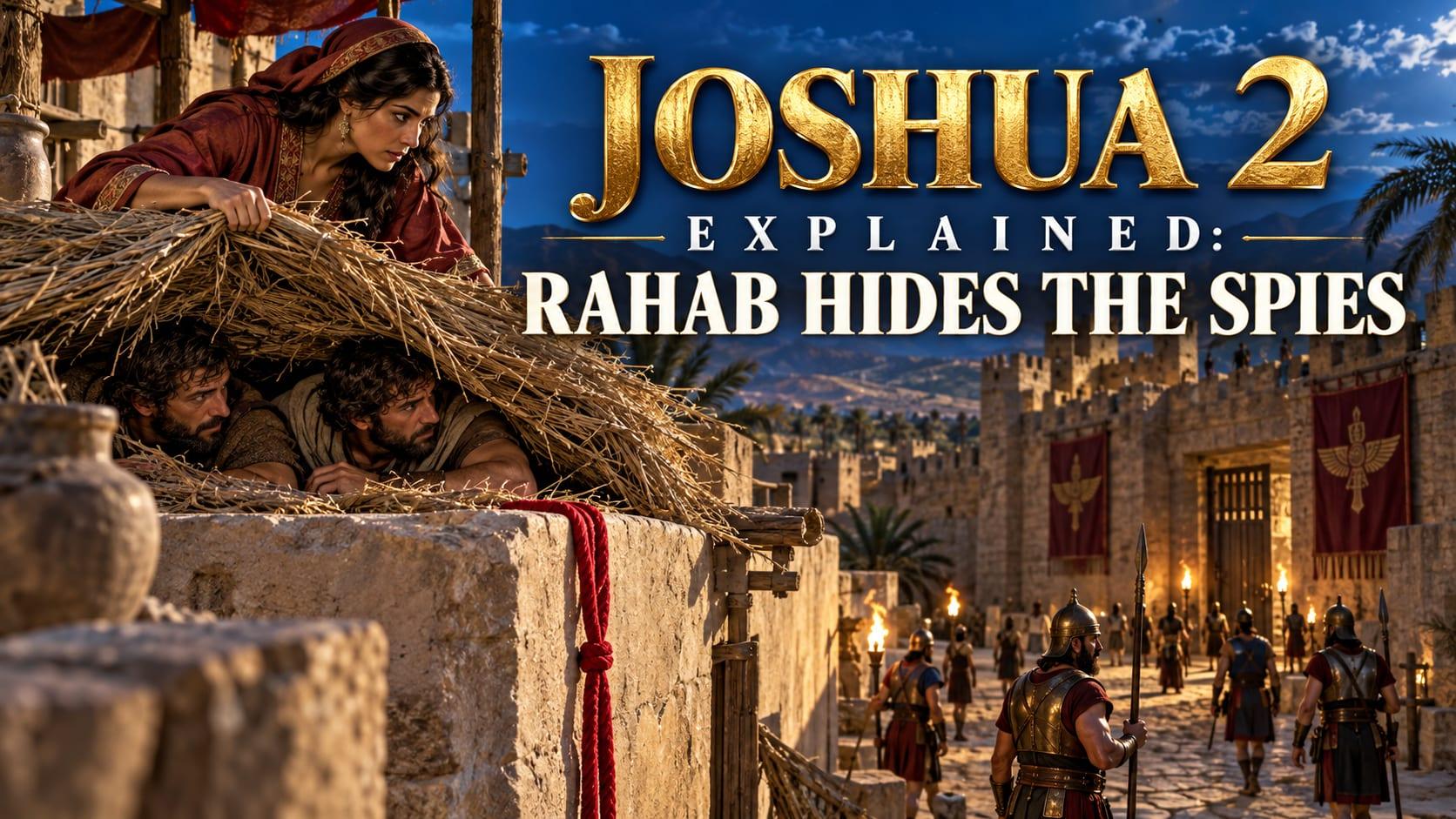
"And the woman took the two men, and hid them, and said thus, There came men unto me, but I wist not whence they were: And it came to pass about the time of shutting of the gate, when it was dark, that the men went out: whither the men went I wot not: pursue after them quickly; for ye shall overtake them."
"Wist not" and "wot not" are both old forms of the verb "to wit," meaning to know. Rahab is not being vague. She is flatly denying knowledge she clearly has, sending the king's men chasing after spies who are, at that exact moment, hidden somewhere in her own house.
"But she had brought them up to the roof of the house, and hid them with the stalks of flax, which she had laid in order upon the roof. And the men pursued after them the way to Jordan unto the fords: and as soon as they which pursued after them were gone out, they shut the gate."
⚠️ Notice the order of events. She hides the men first, then answers the king's messengers. The decision to protect them was already made before she ever opened her mouth to lie about it. The lie was not the moment she chose a side. It only covered a choice she had already settled in her own house, alone, with everything to lose.

3. Rahab's Confession: "The LORD Your God, He Is God" (verses 8 to 11)
With the king's men gone and the gate shut behind them, Rahab climbs back up to the men she just risked everything for, and says something far bigger than a simple rescue plan. The fuller story of who she was before this night, and what became of her afterward, is worth its own read in who Rahab was in the Bible.
"And before they were laid down, she came up unto them upon the roof; And she said unto the men, I know that the LORD hath given you the land, and that your terror is fallen upon us, and that all the inhabitants of the land faint because of you."
📌 "I know" is not a guess. Rahab states, as settled fact, that the LORD has already given Israel this land, before Israel has crossed the river or fought a single battle. No Israelite has told her this. She has worked it out herself, from reports an entire city is already terrified of.
She explains exactly what convinced her.
"For we have heard how the LORD dried up the water of the Red sea for you, when ye came out of Egypt; and what ye did unto the two kings of the Amorites, that were on the other side Jordan, Sihon and Og, whom ye utterly destroyed."
The Red Sea crossing was forty years old news by this point. Sihon and Og were far more recent, two Amorite kings Israel had defeated east of the Jordan on the way to Shittim. Both stories had traveled across the river and settled into Jericho as common knowledge, with a very specific effect on the people who heard them.
"And as soon as we had heard these things, our hearts did melt, neither did there remain any more courage in any man, because of you: for the LORD your God, he is God in heaven above, and in earth beneath."
💡 This is the theological center of the whole chapter, and it comes from a Canaanite woman inside Canaan's own walls, not from anyone in Israel's camp. Rahab reaches, through nothing but secondhand reports and her own conclusion, the exact confession Israel's own law had been trying to teach Israel directly for forty years: that the LORD is not one god among many, but God over everything, above and below at once. The spies never have to argue her into faith. She arrives there before they say a single word back to her.
4. The Oath, the Request, and the Scarlet Cord (verses 12 to 21)
Rahab's confession is not where she stops. She has a request, and she wants it in writing, in a manner of speaking.
"Now therefore, I pray you, swear unto me by the LORD, since I have shewed you kindness, that ye will also shew kindness unto my father's house, and give me a true token: And that ye will save alive my father, and my mother, and my brethren, and my sisters, and all that they have, and deliver our lives from death."
📌 She does not ask the spies to swear by their own word. She asks them to swear by the LORD, the very God she just named as ruler of heaven and earth. Rahab is not negotiating with two frightened foreigners. She is holding Israel's own God to His own character, the same way she just heard He treated Sihon and Og, and asking Him to treat her household differently because she chose differently.
Notice too who she asks for. Not herself alone, but her whole family, named one by one.
"And the men answered her, Our life for yours, if ye utter not this our business. And it shall be, when the LORD hath given us the land, that we will deal kindly and truly with thee."
The spies put their own lives on the line as the collateral for the promise. If Rahab exposes them later, their lives answer for it. The arrangement only works because both sides are now equally exposed to each other.
"Then she let them down by a cord through the window: for her house was upon the town wall, and she dwelt upon the wall."
Rahab's house being built into the wall itself is not incidental detail. It is the reason the whole escape is even possible, and it will matter again later in the book, once the wall itself comes down.
"And she said unto them, Get you to the mountain, lest the pursuers meet you; and hide yourselves there three days, until the pursuers be returned: and afterward may ye go your way."
A Canaanite woman is now giving two Israelite spies tactical advice about how to survive inside her own country, and they take it without argument. Before they go, the men lay out exactly what will keep Rahab's family safe once the attack actually comes.
"And the men said unto her, We will be blameless of this thine oath which thou hast made us swear. Behold, when we come into the land, thou shalt bind this line of scarlet thread in the window which thou didst let us down by: and thou shalt bring thy father, and thy mother, and thy brethren, and all thy father's household, home unto thee."
"And it shall be, that whosoever shall go out of the doors of thy house into the street, his blood shall be upon his head, and we will be guiltless: and whosoever shall be with thee in the house, his blood shall be on our head, if any hand be upon him."
📌 Safety has one clear condition: stay inside the house marked by the cord. The scarlet line is not a charm or a magic sign. It is a location marker, telling the soldiers coming later exactly which house to leave untouched, and it only protects the people who do not leave it.
"And if thou utter this our business, then we will be quit of thine oath which thou hast made us to swear."
"And she said, According unto your words, so be it. And she sent them away, and they departed: and she bound the scarlet line in the window."
💡 Rahab ties the cord in the window the moment the men are gone, long before any army is anywhere near Jericho. She is not waiting to see if Israel actually wins before she commits. The cord goes up while the outcome is still completely unproven.

5. The Spies Return With Their Report (verses 22 to 24)
The two men follow Rahab's advice to the letter, and it works exactly as she said it would.
"And they went, and came unto the mountain, and abode there three days, until the pursuers were returned: and the pursuers sought them throughout all the way, but found them not."
"So the two men returned, and descended from the mountain, and passed over, and came to Joshua the son of Nun, and told him all things that befell them: And they said unto Joshua, Truly the LORD hath delivered into our hands all the land; for even all the inhabitants of the country do faint because of us."
📌 Compare this report to the one Israel's parents brought back from this same land a generation earlier. That report was full of giants, walled cities, and fear. This one comes back with the exact words Rahab already said to them on her roof, now repeated as Israel's own official intelligence: the land is theirs, and the people in it are already faint with fear.
Two spies went in quietly, and the only solid thing they bring back is not a map or a troop count. It is a Canaanite woman's testimony about the God of Israel, confirmed by everything they just saw with their own eyes.
Hard Questions Joshua 2 Raises
Did God approve of Rahab lying to the king of Jericho? What the text says: Joshua 2 records the lie without commenting on it, and nowhere does it say God told her to say it. What the rest of Scripture says: Hebrews 11:31 and James 2:25 both praise Rahab by name, but what they name is her faith and the kindness of receiving and hiding the spies, not the specific words she used doing it. Christians have read this two ways. Some say Scripture simply does not pass verdict on the lie itself, only on the loyalty behind it. Others argue that in a moment of genuine war and deception already underway on both sides, hiding enemies of her own king from men actively hunting to kill them carries a different weight than an ordinary lie. Neither view treats the lie as the reason Rahab is commended. Her faith is.
Was Rahab really a prostitute? What the text says: the Hebrew word behind "harlot" is zonah, the standard Old Testament word for a prostitute, and both Hebrews 11:31 and James 2:25 repeat the exact same description centuries later with no softening. How it has sometimes been read: a few have suggested "innkeeper" instead, since her house clearly functioned as a place travelers stayed. The text itself gives no reason to replace the plain meaning, and the New Testament had every chance to correct it if it were wrong. What makes Rahab's story land is not that the title is softened. It is that it is not.
Why did the spies end up in a harlot's house at all? What the text says: Joshua 2:1 states it plainly, with no explanation for why that house specifically. What is reasoned rather than stated: a house used to housing travelers at all hours was one of the few places two foreign men could come and go without immediately drawing a crowd's attention, at least for a while. Whatever the spies' reasoning, the chapter spends far more time on what Rahab did once they arrived than on why they picked her house in the first place.

Top Verses From Joshua 2
1. Joshua 2:11
"And as soon as we had heard these things, our hearts did melt, neither did there remain any more courage in any man, because of you: for the LORD your God, he is God in heaven above, and in earth beneath."
A Canaanite woman states the whole point of the book of Deuteronomy back to Israel, in her own words, before Israel has fought a single battle to prove it.
2. Joshua 2:9
"And she said unto the men, I know that the LORD hath given you the land, and that your terror is fallen upon us, and that all the inhabitants of the land faint because of you."
Rahab speaks about Israel's victory in the past tense before it happens. Faith this certain, from someone with every reason to side against Israel, is the real shock of the chapter.
3. Joshua 2:14
"And the men answered her, Our life for yours, if ye utter not this our business. And it shall be, when the LORD hath given us the land, that we will deal kindly and truly with thee."
A covenant sealed between two frightened spies and a woman risking everything for them, with both sides putting their own lives on the table as the guarantee.
4. Hebrews 11:31
"By faith the harlot Rahab perished not with them that believed not, when she had received the spies with peace."
Centuries later, Rahab stands in the same list of heroes as Abraham, Moses, and Joshua himself. Her title never changes. Her outcome does.
5. Joshua 2:24
"And they said unto Joshua, Truly the LORD hath delivered into our hands all the land; for even all the inhabitants of the country do faint because of us."
The exact opposite of the report Israel's parents brought back a generation before. This time the fear belongs to the people already living in the land.
Frequently Asked Questions About Joshua 2
What does Joshua 2 mean?
Joshua 2 tells how two Israelite spies, sent into Jericho before the conquest of Canaan begins, are hidden and protected by a Canaanite woman named Rahab. She confesses faith in the God of Israel, secures a promise of safety for her family, and marks her house with a scarlet cord so it can be identified and spared later.
Who was Rahab in the Bible?
Rahab was a Canaanite woman living in Jericho, described in Joshua 2 as a harlot whose house was built into the city wall. She hid two Israelite spies from the king's soldiers, confessed faith in the LORD, and was later named in the genealogy of Jesus and praised in both Hebrews and James as an example of faith.
Was Rahab really a prostitute?
The Hebrew word used for Rahab, zonah, is the standard Old Testament term for a prostitute, and the New Testament repeats the same description without softening it in either Hebrews 11:31 or James 2:25. Nothing in the text supports replacing that plain meaning with a different occupation.
Did God bless Rahab for lying to the king?
Scripture never specifically commends the lie itself. Hebrews 11:31 and James 2:25 both praise Rahab for her faith and for the kindness of receiving and protecting the spies, not for the exact words she used to cover for them. Christians continue to debate how to weigh the lie, but her faith is what both New Testament writers name directly.
What is the significance of the scarlet cord in Joshua 2?
The cord was a practical marker, telling Israel's soldiers exactly which house to spare once the attack on Jericho began. Rahab had to stay inside that house with her family for the promise to protect them, since anyone who left it was no longer covered by the agreement.
Why did the spies go into a harlot's house of all places?
The text does not explain the choice directly, but a house used to travelers coming and going at all hours was one of the few places two strangers could stay without immediately drawing suspicion. Whatever drew them there, the chapter's real focus is on what Rahab chose to do with them once they arrived.
Is the Rahab in Joshua 2 the same Rahab in Jesus' genealogy?
Yes. Matthew 1:5 lists Rachab, an alternate spelling of the same name, as the mother of Boaz, who later married Ruth. The woman who hid two spies in Jericho's wall became a direct ancestor of King David and, through him, of Jesus.
Why does James say Rahab was justified by works, while Hebrews says by faith?
The two books are not contradicting each other. Hebrews 11:31 points to the inward faith that made Rahab act the way she did. James 2:25 points to the outward action, hiding and protecting the spies, as proof that her faith was real rather than empty words. Both writers are describing the same event from two angles.
What happened to Rahab and her family after Jericho fell?
Joshua 2 only records the promise made to her. The rest of her story, including whether Israel kept its word once Jericho's walls actually came down, belongs to the chapters that follow later in the book.
Why does Joshua 2 spend so much time on one Canaanite woman?
Because her confession carries the theological weight the whole conquest rests on. Before Israel crosses the Jordan or fights a single battle, a woman with every reason to oppose them states plainly that the LORD has already given them the land, and that He alone is God over heaven and earth.
Final Thoughts
Joshua 2 is a quiet chapter, and it still manages to settle the outcome of the book before the fighting even starts.
📌 Faith showed up first in the last place Israel expected it. A Canaanite woman inside Jericho's own walls said out loud what it would take Israel chapters of battles to prove: the LORD is God over heaven and earth, and this land is already His to give.
📌 Rahab's choice came before her safety, not after it. She hid the spies, then lied to cover it, then tied the cord in her window long before anyone knew whether Israel would win. Faith acted while the outcome was still unproven.
📌 One decision in one house reached further than anyone in that house could have guessed. The woman who protected two spies in secret became an ancestor of David, and of Jesus.
You will probably never hide spies on a rooftop. You will almost certainly face a moment where choosing the right side costs you something before it proves itself right.
So here is your one next step.
Read Joshua 2:11 again, and ask whether you believe what Rahab believed before she ever saw Israel win a single battle.