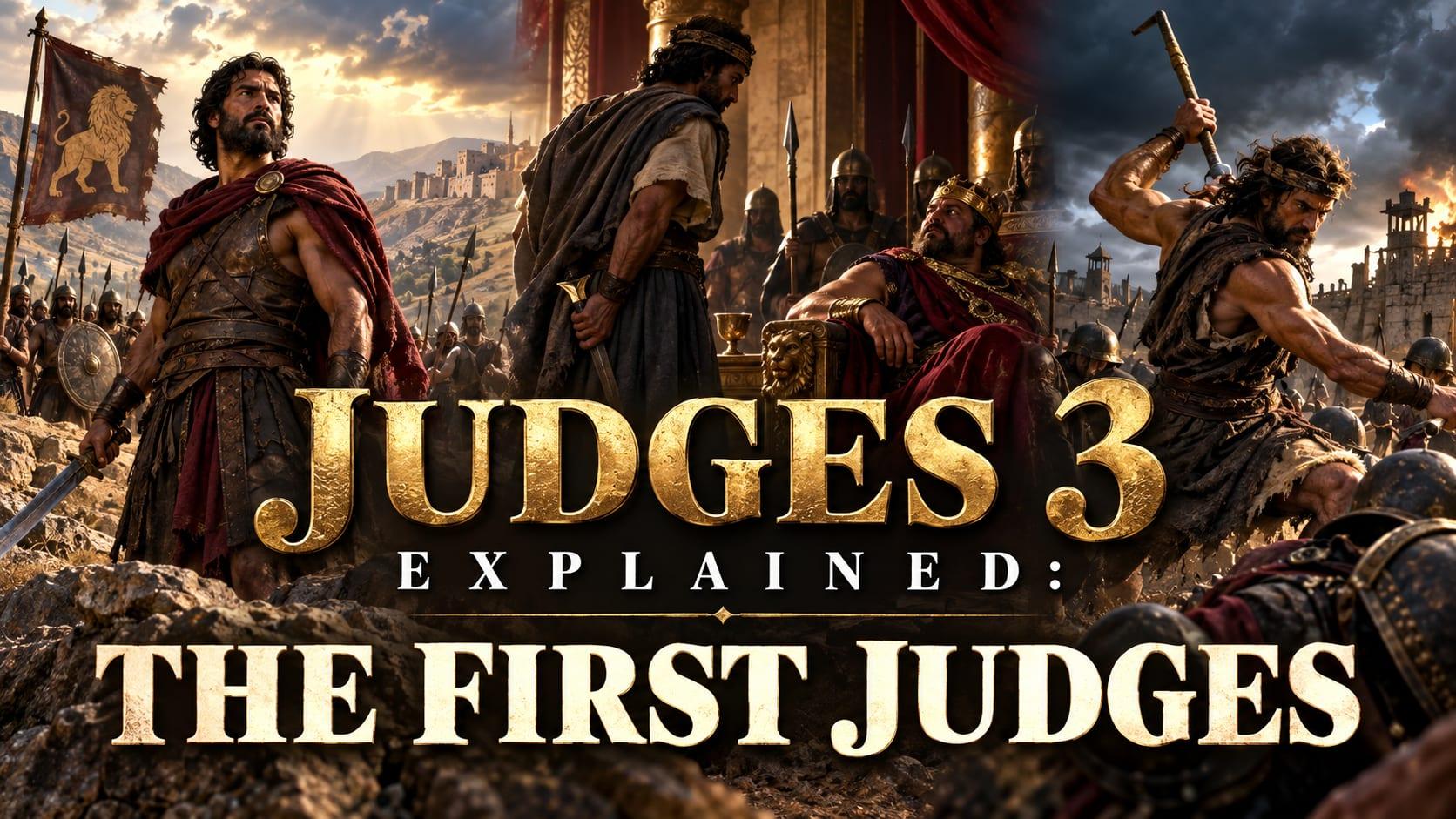
📖 Judges 3 Explained: Othniel, Ehud, and the Left-Handed Assassin
A king so fat a dagger disappears inside him. A judge who gets four verses. A man remembered for one line about an ox goad.
Judges 3 explained is where the cycle named in the previous chapter stops being a description and starts being a story. Israel marries into the nations it never finished driving out, forgets the LORD, and gets sold to an oppressor. Then, exactly as promised, a deliverer shows up. This chapter gives you three of them, back to back, each one stranger than the last.
Maybe you have watched the same failure repeat in your own life and wondered if rescue ever actually shows up the second time.
- ❓ Why does God deliberately leave enemies in the land, by name, as a test?
- ❓ Who was Othniel, and why does his whole story fit in four verses?
- ❓ Was it right for Ehud to lie his way into a king's private room?
- ❓ Why does Shamgar get only one sentence in the entire book?
📌 Every deliverer in this chapter is unlikely. A relative of an old conqueror, a left-handed man from a tribe not known for warriors, a man armed with a farm tool.
This walkthrough goes through the whole chapter in order: the exact nations named as Israel's test, the first full turn of the cycle, Othniel's brief rescue, Eglon's eighteen year oppression, Ehud's assassination in a locked room, the battle at the Jordan, and Shamgar's one verse.
Thirty one verses, three deliverers, and over a century of Israel's history compressed into one chapter.
What Happened Just Before This Chapter
Judges 2 stepped outside the story to explain the shape every story after it would take. A generation that never personally saw the LORD's works served Baalim instead. God handed them to oppressors, then raised up judges to deliver them, then watched the people relapse further each time a judge died. The chapter closed by stating plainly why the remaining nations were still in the land at all: to prove Israel, to test whether they would keep walking in the LORD's way without a miracle forcing the issue.
Judges 3 opens by naming exactly which nations that test involved, then gives the test its first three results.

Judges 3 Explained Verse by Verse
1. The Nations Named as Israel's Test (verses 1 to 4)
The chapter opens by putting names to the test Judges 2 had only described in general terms.
"Now these are the nations which the LORD left, to prove Israel by them, even as many of Israel as had not known all the wars of Canaan; Only that the generations of the children of Israel might know, to teach them war, at the least such as before knew nothing thereof;"
"Namely, five lords of the Philistines, and all the Canaanites, and the Sidonians, and the Hivites that dwelt in mount Lebanon, from mount Baalhermon unto the entering in of Hamath."
💡 Four groups, by this count: the five Philistine city lords on the coast, the Canaanites, the Sidonians to the north, and the Hivites up in Lebanon. Two verses later, the chapter names a different list of who Israel actually lived among day to day.
"And the children of Israel dwelt among the Canaanites, Hittites, and Amorites, and Perizzites, and Hivites, and Jebusites:"
⚠️ The two lists only partly overlap. Verse 3 names the Philistines and Sidonians as the outside test, the border pressure Israel had to live next to. Verse 5 names the Hittites, Amorites, Perizzites, and Jebusites, the inland peoples Israel actually settled down beside. The test was not one threat. It was two different kinds of neighbor at once, pressing in from the border and sitting right inside the territory.
Verse 2 adds a reason for the test that Judges 2 had not mentioned: so a generation too young to remember the conquest would learn how to fight at all. The test was never only moral. It was also practical.
2. The First Full Turn of the Cycle (verses 5 to 8)
Living among these nations did not stay neutral for long.
"And they took their daughters to be their wives, and gave their daughters to their sons, and served their gods."
📌 This is the exact danger Joshua named by name before he died. Joshua 24 had Israel swear to put away every foreign god and serve the LORD alone. One generation later, the marriages Joshua warned about are happening on both sides, sons and daughters both, and the gods come into the family along with the in laws.
Scripture does not soften what follows.
"And the children of Israel did evil in the sight of the LORD, and forgat the LORD their God, and served Baalim and the groves."
"Therefore the anger of the LORD was hot against Israel, and he sold them into the hand of Chushanrishathaim king of Mesopotamia: and the children of Israel served Chushanrishathaim eight years."
💡 Chushanrishathaim's own name is doing some of the chapter's work. It is built from a Hebrew root meaning double wickedness, which matches exactly what an oppressor from Mesopotamia, hundreds of miles east, would have looked like to a nation that had just forgotten the God who freed them from an empire. Eight years under him is the first bill for the marriages in verse 6.
3. Othniel: A Rescue Told in Four Verses (verses 9 to 11)
Judges 2 had promised that crying out would bring a deliverer. Here is the first time that promise gets tested in a real story.
"And when the children of Israel cried unto the LORD, the LORD raised up a deliverer to the children of Israel, who delivered them, even Othniel the son of Kenaz, Caleb's younger brother."
📌 Othniel is not a stranger to readers of this library. He already appeared in Judges 1, winning Achsah's hand by conquering Kirjathsepher, the same Caleb who had stood alone in faith at Kadeshbarnea decades earlier in Numbers 14 now has a younger brother leading the whole nation. The family that trusted God when ten other tribal leaders would not produces Israel's first judge.
"And the Spirit of the LORD came upon him, and he judged Israel, and went out to war: and the LORD delivered Chushanrishathaim king of Mesopotamia into his hand; and his hand prevailed against Chushanrishathaim."
"And the land had rest forty years. And Othniel the son of Kenaz died."
⚠️ Three verses cover the entire rescue: the Spirit comes on him, he fights, he wins, the land rests forty years, he dies. No battle details, no dialogue, nothing about how he actually defeated a Mesopotamian king. Othniel's story is the shortest of any judge in this book, and the chapter does not treat that as a lesser victory. It treats it as the pattern working exactly the way Judges 2 said it would.

4. Eglon of Moab, and a Left-Handed Man Named Ehud (verses 12 to 15)
Forty years of rest ends the same way the last period of peace did.
"And the children of Israel did evil again in the sight of the LORD: and the LORD strengthened Eglon the king of Moab against Israel, because they had done evil in the sight of the LORD."
"And he gathered unto him the children of Ammon and Amalek, and went and smote Israel, and possessed the city of palm trees. So the children of Israel served Eglon the king of Moab eighteen years."
💡 Eighteen years under Eglon is more than double what Chushanrishathaim cost Israel. "The city of palm trees" is Jericho, the very city Israel had once marched around with trumpets. An enemy king is now sitting inside the first prize Israel ever won in the land.
Relief comes from an unlikely direction.
"But when the children of Israel cried unto the LORD, the LORD raised them up a deliverer, Ehud the son of Gera, a Benjamite, a man lefthanded: and by him the children of Israel sent a present unto Eglon the king of Moab."
📌 Being lefthanded is stated as a plain fact about Ehud, not a flaw to overcome. It turns out to matter directly in a few verses, when a detail that sounds like trivia becomes the whole reason his plan works. Ehud is sent, officially, carrying Israel's tribute payment to the king who is oppressing them.
5. The Assassination in the Summer Parlour (verses 16 to 26)
Before Ehud ever reaches the king, he prepares a weapon no one is looking for.
"But Ehud made him a dagger which had two edges, of a cubit length; and he did gird it under his raiment upon his right thigh."
⚠️ A right-handed man's weapon sits on his left side, where his drawing hand can reach it. Ehud straps his dagger to his right thigh, exactly where a guard searching a right-handed visitor would not think to check. His lefthandedness from verse 15 was never a side note. It is the entire plan.
The tribute is delivered in full view. Then Ehud sends everyone else away and comes back alone.
"And when he had made an end to offer the present, he sent away the people that bare the present. But he himself turned again from the quarries that were by Gilgal, and said, I have a secret errand unto thee, O king: who said, Keep silence. And all that stood by him went out from him."
"And Ehud came unto him; and he was sitting in a summer parlour, which he had for himself alone. And Ehud said, I have a message from God unto thee. And he arose out of his seat."
💡 Eglon stands up out of respect for what he thinks is a word from heaven. The text calls Eglon "a very fat man" back in verse 17, a detail that is not mockery for its own sake. It explains why the king cannot react in time, and why the next verse ends the way it does.
"And Ehud put forth his left hand, and took the dagger from his right thigh, and thrust it into his belly: And the haft also went in after the blade; and the fat closed upon the blade, so that he could not draw the dagger out of his belly; and the dirt came out."
Ehud does not retrieve the weapon. He locks the room from the outside and walks out past the king's own servants.
"Then Ehud went forth through the porch, and shut the doors of the parlour upon him, and locked them."
"And they tarried till they were ashamed: and, behold, he opened not the doors of the parlour; therefore they took a key, and opened them: and, behold, their lord was fallen down dead on the earth."
📌 The servants assume privacy, not danger. They wait outside a locked door out of embarrassment, giving Ehud the exact head start he needs to escape past the quarries to Seirath before anyone realizes what has happened.

6. The Battle at the Fords of Jordan (verses 27 to 30)
Ehud does not stay in hiding. He turns the assassination into a rallying call.
"And it came to pass, when he was come, that he blew a trumpet in the mountain of Ephraim, and the children of Israel went down with him from the mount, and he before them."
"And he said unto them, Follow after me: for the LORD hath delivered your enemies the Moabites into your hand. And they went down after him, and took the fords of Jordan toward Moab, and suffered not a man to pass over."
💡 Blocking the fords cuts off the one way Moab's army could retreat back across the Jordan. Whatever panic Eglon's death caused inside Moab, Ehud makes sure it has nowhere to run.
"And they slew of Moab at that time about ten thousand men, all lusty, and all men of valour; and there escaped not a man."
"So Moab was subdued that day under the hand of Israel. And the land had rest fourscore years."
📌 Fourscore years, eighty years, is the longest single stretch of rest named anywhere in this book. Add up every number this chapter gives: eight years under Chushanrishathaim, forty years of rest after Othniel, eighteen years under Eglon, eighty years of rest after Ehud. That is a hundred and forty six years of Israel's history inside thirty one verses, most of it quiet, some of it not.
7. Shamgar: One Verse, Six Hundred Men (verse 31)
The chapter ends on the shortest judge story in the entire book.
"And after him was Shamgar the son of Anath, which slew of the Philistines six hundred men with an ox goad: and he also delivered Israel."
⚠️ No cry to the LORD is recorded before him. No years of oppression are numbered. No years of rest are given after him. An ox goad was a long farming pole used to drive cattle, not a weapon anyone would choose on purpose. The verse states the result and moves on: "he also delivered Israel." Even with none of the usual markers of the cycle spelled out, the chapter still counts him among the deliverers.
Hard Questions Judges 3 Raises
Was it right for Ehud to say "I have a message from God unto thee" right before killing Eglon? What the text says: verse 20 has Ehud speak those exact words, and Eglon stands up in response, right before verse 21 describes the killing. How this is read: the chapter never comments on the morality of the line itself. It reports the deception as part of a plan God used to deliver an oppressed nation, the same way it reports the Bethel spy's mercy deal in Judges 1 without weighing in on every detail of how victory was won. Judges narrates deliverance; it does not hand out a tactics manual to imitate in every situation.
Does God raising up Ehud mean assassination is an approved method whenever a ruler is unjust? What the text says: verse 15 states plainly that the LORD raised up Ehud as Israel's deliverer from a specific, named oppressor who was actively enslaving God's people after they cried out. How this is read: the text ties this rescue to that particular situation, a conquered nation crying out under eighteen years of forced service, not to a general principle about removing any ruler someone judges to be bad. Judges never repeats this exact method again in the chapters that follow.
Why does Othniel's rescue take three verses while Ehud's takes eleven? What the text says: verses 9 through 11 cover Othniel's entire judgeship, war, and death; verses 15 through 29 give Ehud a detailed scene with dialogue and specific physical description. How this is read: the book of Judges is not an evenly weighted record. Each judge gets exactly as much space as the story needs to make its point, and the length given to a deliverer is not a measure of how important his rescue was.
Is Shamgar actually one of the judges, or just a footnote between Ehud and Deborah? What the text says: verse 31 gives him no cry for help, no number of oppression years, and no stated rest afterward, yet it still calls him a deliverer of Israel in the same sentence structure used for Othniel and Ehud. How this is read: Bible teachers notice the missing details and read Shamgar either as a judge whose full story was simply never recorded, or as a transitional figure placed here to bridge to the next oppression under Jabin in Judges 4. The text itself does not explain the gap, only the result.

Top Verses From Judges 3
1. Judges 3:9 and 10
"And when the children of Israel cried unto the LORD, the LORD raised up a deliverer to the children of Israel, who delivered them, even Othniel the son of Kenaz, Caleb's younger brother. And the Spirit of the LORD came upon him, and he judged Israel, and went out to war: and the LORD delivered Chushanrishathaim king of Mesopotamia into his hand; and his hand prevailed against Chushanrishathaim."
The cycle named in Judges 2 working exactly as promised, the very first time it gets tested in a real story.
2. Judges 3:15
"But when the children of Israel cried unto the LORD, the LORD raised them up a deliverer, Ehud the son of Gera, a Benjamite, a man lefthanded: and by him the children of Israel sent a present unto Eglon the king of Moab."
A small, plain detail, a man's lefthandedness, stated here as fact and turned into the whole plan a few verses later.
3. Judges 3:20 and 21
"And Ehud came unto him; and he was sitting in a summer parlour, which he had for himself alone. And Ehud said, I have a message from God unto thee. And he arose out of his seat. And Ehud put forth his left hand, and took the dagger from his right thigh, and thrust it into his belly:"
The most vivid single scene in the chapter, a king standing in respect for a message that turns out to be his own death.
4. Judges 3:30
"So Moab was subdued that day under the hand of Israel. And the land had rest fourscore years."
Eighty years, the longest stretch of rest anywhere in the book of Judges, following the strangest rescue in it.
5. Judges 3:31
"And after him was Shamgar the son of Anath, which slew of the Philistines six hundred men with an ox goad: and he also delivered Israel."
A whole judgeship told in a single sentence, with a farm tool standing in for a sword.
Frequently Asked Questions About Judges 3
What happened in Judges 3?
The chapter names the nations God left to test Israel, then records the cycle from Judges 2 playing out three times. Israel intermarries with the remaining nations and serves Baal, gets sold to Chushanrishathaim of Mesopotamia for eight years until Othniel delivers them, falls again and serves Eglon of Moab for eighteen years until the left-handed Ehud assassinates him and leads Israel to victory at the Jordan, and closes with one verse about Shamgar killing six hundred Philistines with an ox goad.
Who was Othniel in the Bible?
Othniel was Caleb's younger brother, already introduced in Judges 1 for conquering Kirjathsepher and marrying Caleb's daughter Achsah. Judges 3:9 and 10 name him as Israel's first judge, delivered by the Spirit of the LORD to defeat Chushanrishathaim king of Mesopotamia after eight years of oppression.
Who was Ehud, and why does it matter that he was left-handed?
Ehud was a Benjamite judge raised up to deliver Israel from eighteen years under Eglon king of Moab. Verse 16 has him strap his dagger to his right thigh, the side a guard checking a typical right-handed visitor would not search, which is exactly how he gets a hidden weapon into the king's private room.
How did Ehud kill Eglon?
Ehud delivered Israel's tribute openly, sent the other messengers away, then returned alone claiming to have a message from God. When Eglon stood up to receive it, Ehud drew the hidden dagger with his left hand and stabbed him, locking the door behind him as he escaped before anyone discovered the body.
Why does the Bible call Eglon a fat man?
Verse 17 states it as a plain physical fact, and it is not incidental. Verse 22 says the fat closed around the blade after the strike, which is part of why Eglon could not react or call for help before Ehud had already locked the door and fled.
Why did God leave the Philistines, Canaanites, Sidonians, and Hivites in the land?
Verses 1 through 4 give two reasons together: to test whether Israel would obey the LORD, and to teach a generation that had never personally fought in Canaan how to go to war. The test was both about character and about survival skill the eyewitness generation had already learned the hard way.
Who was Shamgar?
Shamgar, son of Anath, gets exactly one verse. He killed six hundred Philistines with an ox goad, a long farming pole, and the text calls him a deliverer of Israel without recording any cry for help beforehand or any years of rest afterward, unlike Othniel and Ehud.
Why does the chapter list two different sets of nations in verses 3 and 5?
Verse 3 names the Philistines, Canaanites, Sidonians, and Hivites of Lebanon as the outside test pressing on Israel's borders. Verse 5 names the Canaanites, Hittites, Amorites, Perizzites, Hivites, and Jebusites as the peoples Israel actually settled down among. The chapter is describing pressure from two directions at once, not repeating itself.
How long did the events of Judges 3 take?
Adding the chapter's own numbers together: eight years under Chushanrishathaim, forty years of rest after Othniel, eighteen years under Eglon, and eighty years of rest after Ehud comes to a hundred and forty six years, not counting whatever time Shamgar's unnumbered judgeship added on top.
What is the lesson of Judges 3 for today?
That the cycle named in Judges 2, sin, judgment, deliverance, rest, is not a theory. It plays out three separate times in one chapter, through three very different people, and in every case the rescue begins the moment Israel actually cries out, not before.
Final Thoughts
Judges 3 proves the pattern Judges 2 only described, three separate times, with three very different people.
📌 A deliverer does not need to look like one in advance. A quiet brother of an old conqueror, a left-handed man from an unremarkable tribe, and a man swinging a farm tool all get called by the same word: deliverer.
📌 The length of a story is not the size of the rescue. Othniel's whole judgeship fits in three verses. It still bought Israel forty years of peace.
📌 The cry comes before the rescue, every single time. Chushanrishathaim and Eglon both only lose their grip after Israel actually cries out to the LORD, not the moment the oppression starts.
You probably are not facing a king in a locked room. But you likely have something that has had its grip on you long enough that it stopped feeling worth crying out about.
So here is your one next step.
Name that thing honestly to God today, the way Israel finally did under Eglon, before you assume no deliverer is coming.