📖 Genesis 29 Explained: Jacob Meets Rachel and Is Deceived by Laban
A man who tricked his own blind father wakes up on the far side of a long journey and walks straight into a trick of his own.
Genesis 29 explained is the chapter where Jacob arrives in Haran, falls in love at a well the way his grandfather's servant once found Rebekah there, works seven years for the woman he wants, and then wakes up married to her older sister instead. Laban, the same relative who welcomed Jacob's father's messenger with open arms a generation earlier, turns out to be just as capable of deception as Jacob himself.
Maybe you have watched someone get handed back exactly the kind of trick they once pulled on somebody else, and wondered if that was really an accident.
- ❓ Why does Jacob roll a heavy stone away from a well by himself?
- ❓ How does Laban manage to swap Leah for Rachel on the wedding night without Jacob noticing?
- ❓ Is Jacob simply getting back what he did to Esau in Genesis 27?
- ❓ Why does God bless Leah with children while Rachel, the wife Jacob loves, stays barren?
📌 The man who once disguised himself as someone else to get a blessing now gets a bride disguised as someone else, and the text never once says this is a coincidence.
This walkthrough goes through the whole chapter in order: Jacob at the well, his month with Laban, the wage he asks for instead of pay, the wedding night switch, the second seven years, and the four sons Leah bears while Rachel waits.
Watch how much of this chapter turns on who gets seen, who gets overlooked, and who is watching the whole time.
What Happened Just Before This Chapter
Genesis 28 ended with Jacob alone on the road, a fugitive from his brother Esau's anger, sleeping on a stone with nothing but a blessing and a destination. God met him in a dream at Bethel and renewed the whole covenant He had given Abraham and Isaac, promising Jacob land, descendants, and His own presence wherever Jacob went. Jacob woke up afraid, set up the stone as a pillar, and vowed that if God brought him home again in peace, the LORD would be his God.
📌 Genesis 29 opens with that vow still fresh and Jacob still walking, now arriving at the very family Rebekah sent him to find. He has no gifts, no servants, and no camel train the way Abraham's servant once arrived carrying gold for Rebekah in Genesis 24. He shows up with nothing but his own two hands.
Genesis 29 Explained Verse by Verse
1. Jacob at the Well (verses 1 to 14)
The chapter picks up mid journey, and Genesis moves Jacob to his destination in a single line.
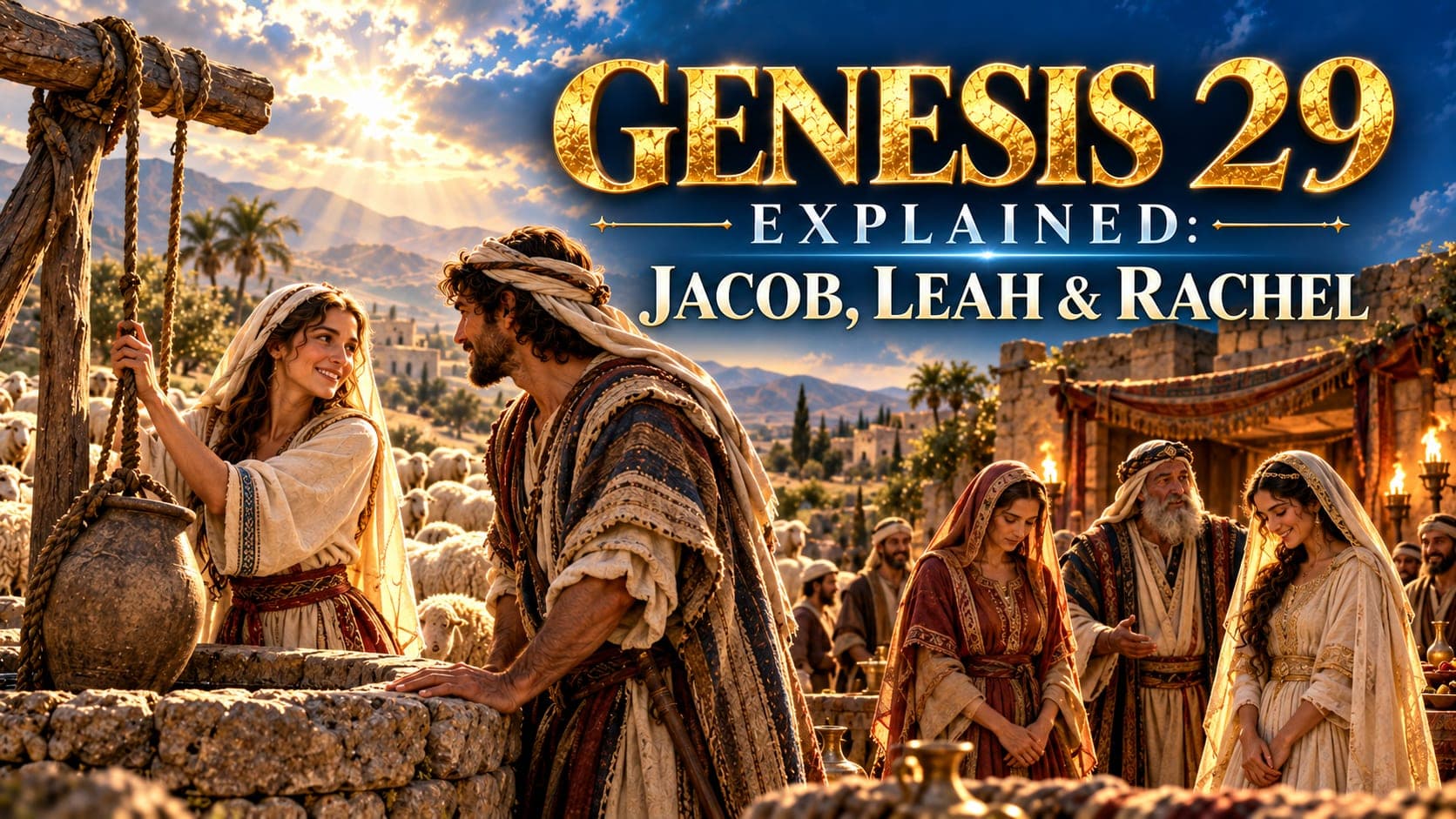
"Then Jacob went on his journey, and came into the land of the people of the east."
He finds a well with three flocks of sheep waiting beside it and a great stone over its mouth, heavy enough that it took the combined effort of every shepherd present to roll it away. This was the local custom: no single flock owner watered first or took more than a fair share, so the stone stayed in place until everyone had gathered.
"And he looked, and behold a well in the field, and, lo, there were three flocks of sheep lying by it; for out of that well they watered the flocks: and a great stone was upon the well's mouth."
Jacob asks the shepherds if they know Laban, and before he even finishes the conversation, Rachel arrives with her father's sheep.
"And while he yet spake with them, Rachel came with her father's sheep: for she kept them."
"And it came to pass, when Jacob saw Rachel the daughter of Laban his mother's brother, and the sheep of Laban his mother's brother, that Jacob went near, and rolled the stone from the well's mouth, and watered the flock of Laban his mother's brother."
💡 Verse 10 names Laban three times in a single sentence, and Genesis is not being careless. The repetition slows the reader down at the exact moment Jacob realizes who he is looking at. A stone that normally took a group of shepherds working together, Jacob moves by himself, in one motion, the instant he understands whose sheep these are.
This is not the first time a member of this family has arrived at a well in a foreign land and met their future spouse there. Abraham's servant found Rebekah at a well outside this same region a generation earlier. Genesis keeps returning to wells as the place where this family finds the person God has for them next.
"And Jacob kissed Rachel, and lifted up his voice, and wept."
A kiss between newly discovered relatives was a customary greeting in that culture, not a romantic gesture on its own, but the weeping is entirely personal. Jacob has been walking alone for days, running from a brother who wanted him dead, and the first face he sees from home is weeping too, from relief as much as anything else.
Rachel runs to tell her father, and Laban's reaction mirrors his sister Rebekah's family a generation before.
"And Laban said to him, Surely thou art my bone and my flesh. And he abode with him the space of a month."
📌 "Bone and my flesh" is the same phrase Adam used for Eve in Genesis 2:23. It is covenant language for the closest possible kinship, and Laban says it before Jacob has done anything to earn it, purely because of who his mother was.
2. Jacob's Wage and His Love for Rachel (verses 15 to 20)
After a month, Laban raises the question of payment, and Genesis pauses to introduce his two daughters properly.
"And Laban had two daughters: the name of the elder was Leah, and the name of the younger was Rachel."
"Leah was tender eyed; but Rachel was beautiful and well favoured."
"Tender eyed" is a hard phrase to pin down. Some read it as a real compliment, something soft or delicate about Leah's eyes. Others read it as the text gently noting a weakness, especially set right next to a flat statement that Rachel was beautiful in every way. Genesis does not explain further, and the honest answer is that translators and readers have never fully agreed on which was meant.
What is clear is where Jacob's heart lands.
"And Jacob loved Rachel; and said, I will serve thee seven years for Rachel thy younger daughter."
"And Jacob served seven years for Rachel; and they seemed unto him but a few days, for the love he had to her."
💡 Jacob arrived with nothing, so he offers the one thing he does have: years of his own labor. Seven years was a serious bride price by any measure, yet verse 20 says they felt like a few days to him. This is one of the few places in Genesis where the text steps outside the plain record of events to tell the reader exactly what was happening inside someone's heart.
3. The Wedding Night Switch (verses 21 to 25)
Seven years end, and Jacob asks for what he has earned in plain, direct words.
"And Jacob said unto Laban, Give me my wife, for my days are fulfilled, that I may go in unto her."
Laban gathers the men of the place for a feast, and under cover of night and a veiled bride, switches daughters.
"And it came to pass, that in the morning, behold, it was Leah: and he said to Laban, What is this thou hast done unto me? did not I serve with thee for Rachel? wherefore then hast thou beguiled me?"
⚠️ The word Jacob uses, "beguiled," is the exact charge his own family could have leveled at him in Genesis 27. A veiled face and a darkened tent hid Leah's identity the same way goat skins on Jacob's arms once hid his own identity from a blind Isaac. Genesis never states outright that this is payback for what Jacob did to Esau, but it places the two scenes close enough together, using close enough language, that the echo is hard to miss.
Laban's excuse, when it comes, exposes exactly what kind of custom Jacob had ignored back home.
"And Laban said, It must not be so done in our country, to give the younger before the firstborn."
📌 Jacob spent Genesis 27 taking a firstborn's place for himself. Here, in Haran, the local custom protects the firstborn's place whether anyone wants it protected or not. The very rule Jacob broke in his father's tent is the rule that just cost him his wedding night.
4. The Second Seven Years (verses 27 to 30)
Laban offers a way forward, and it costs Jacob another seven years of labor.
"Fulfil her week, and we will give thee this also for the service which thou shalt serve with me yet seven other years."
"And Jacob did so, and fulfilled her week: and he gave him Rachel his daughter to wife also."
💡 Jacob finishes Leah's seven day wedding celebration first, then receives Rachel right after, and only then works the second seven years. Laban gets both daughters married and fourteen years of labor out of the arrangement, while Jacob ends up with two wives he never planned on having and a rivalry he will be living inside for the rest of his life.
"And he went in also unto Rachel, and he loved also Rachel more than Leah, and served with him yet seven other years."
Genesis states Jacob's unequal love plainly and without commentary. It does not defend polygamy or present two wives from one household as God's design. Genesis 2:24 already described one man and one woman becoming one flesh. What follows in this chapter and the next shows exactly the kind of pain a household built outside that pattern actually produces.
5. Leah's Four Sons (verses 31 to 35)
The chapter closes by shifting attention away from Jacob's preference and toward whom the LORD actually notices.
"And when the LORD saw that Leah was hated, he opened her womb: but Rachel was barren."
📌 The husband overlooks Leah. The LORD does not. Four sons follow, and Genesis records the reason behind each name, straight from what Leah herself said when she named them.
"And Leah conceived, and bare a son, and she called his name Reuben: for she said, Surely the LORD hath looked upon my affliction; now therefore my husband will love me."
"And she conceived again, and bare a son; and said, Because the LORD hath heard that I was hated, he hath therefore given me this son also: and she called his name Simeon."
"And she conceived again, and bare a son; and said, Now this time will my husband be joined unto me, because I have born him three sons: therefore was his name called Levi."
"And she conceived again, and bare a son: and she said, Now will I praise the LORD: therefore she called his name Judah; and left bearing."
Reuben means something close to "see, a son," tied to Leah's own words about God seeing her affliction. Simeon means "heard." Levi means "joined," Leah's hope that three sons would finally attach her husband's heart to her. By the fourth son the hoping for Jacob stops, and the name changes shape completely. Judah means "praise."
✅ Watch what happens across four names: affliction, then being heard, then wanting to be joined, then simply praising God with no mention of Jacob at all. Leah moves from chasing her husband's love toward something steadier.
None of these four sons is the one Jacob favored. Levi becomes the priestly tribe with no land inheritance of its own. Judah becomes the tribe of Israel's kings, the line Matthew traces all the way to Jesus. The unloved wife's sons, not the favored wife's, carry the weight of what comes next in Israel's story.
Hard Questions Genesis 29 Raises
Is Jacob's wedding night deception meant to read as payback for Genesis 27? Genesis never states this outright as punishment. What the text does is place the two scenes close together and let Jacob use the very word, beguiled, that fits what he did to Isaac. Readers have noticed the echo for centuries because the parallel is too close to be accidental: a father figure deceived in low light, a birth order rule bent or broken, a switch discovered only after it is too late to undo.
Why does Laban get away with this? Genesis records Laban's explanation, a regional custom about not giving the younger daughter before the firstborn, without saying whether that custom was genuine or a convenient excuse invented on the spot. Either way, Laban comes out of the arrangement with two married daughters and fourteen years of Jacob's labor, and Genesis lets the reader draw their own conclusion about how much of this was really about custom.
Does this chapter endorse polygamy? No. Genesis records that Jacob had two wives and loved one more than the other, and it records the pain that produced, without a single verse presenting it as good or as God's design. Genesis 2:24 already set the pattern of one man and one woman. What Jacob ends up with here is the result of Laban's deception, not a model the rest of Scripture holds up for anyone to copy.
Why does God favor Leah with children instead of Rachel, the wife Jacob actually loves? Verse 31 gives the reason directly: the LORD saw that Leah was hated. Scripture does not tie God's attention to who a husband happens to prefer. Leah is overlooked by the person closest to her and seen by God anyway.
Practical Tips From Genesis 29
This chapter has real, practical weight for anyone who has been overlooked or has done the overlooking.
- What you do to others tends to find its way back around. Jacob deceived his father in the dark and was deceived himself in the dark, by the very family he ran to for safety. Take that seriously before you take a shortcut at someone else's expense.
- Love that costs you something is worth noticing. Jacob's seven years felt like a few days because of who he was working for. What you are willing to labor for says something true about where your heart already is.
- Being unloved by people does not mean being unseen by God. Leah names her first three sons around a hope that Jacob would finally love her. God had already seen her before any of that hoping started.
- You do not need to win someone else's affection to have something to praise God for. Leah's fourth son comes with no mention of Jacob at all, only praise. That shift did not come from getting what she originally wanted.
- Read the fine print before you commit years to something. Jacob never confirms the terms in writing and pays for it. Say plainly what you expect, and get it plainly agreed to, before you give someone years of your life.
Top 4 Bible Verses From Genesis 29
1. Genesis 29:20
"And Jacob served seven years for Rachel; and they seemed unto him but a few days, for the love he had to her."
One of the most quoted lines about love in Genesis, and it describes years of hard labor, not a feeling. Jacob's love is measured in what he was willing to give up time for.
2. Genesis 29:25
"And it came to pass, that in the morning, behold, it was Leah: and he said to Laban, What is this thou hast done unto me? did not I serve with thee for Rachel? wherefore then hast thou beguiled me?"
Jacob using the same accusation, deception, that could have been made against him three chapters earlier. The man who tricked his father wakes up tricked himself.
3. Genesis 29:31
"And when the LORD saw that Leah was hated, he opened her womb: but Rachel was barren."
God notices the wife her own husband does not favor. This one verse sets the direction for the rest of the chapter and the family conflict still to come.
4. Genesis 29:35
"And she conceived again, and bare a son: and she said, Now will I praise the LORD: therefore she called his name Judah; and left bearing."
The birth of Judah, the ancestor of Israel's kings and of Jesus, named not for winning her husband's heart but simply for praise. The royal line begins with a woman who stopped chasing love and started giving thanks.

Frequently Asked Questions About Genesis 29
What does Genesis 29 mean?
It records Jacob meeting Rachel at a well in Haran, working seven years to marry her, being deceived into marrying her older sister Leah instead, working seven more years to also marry Rachel, and the birth of Leah's first four sons: Reuben, Simeon, Levi, and Judah.
Why did Jacob work seven years for Rachel?
Jacob arrived in Haran with nothing after fleeing his brother Esau, so instead of paying a bride price in goods the way his grandfather Abraham once did, he offered seven years of labor to Laban, Rachel's father, in Genesis 29:18.
Why did Laban trick Jacob into marrying Leah?
Laban claimed local custom did not allow a younger daughter to marry before the firstborn, in Genesis 29:26. Genesis does not confirm whether this was Laban's honest reason or a convenient excuse, only that it cost Jacob another seven years of labor to also marry Rachel.
What does "tender eyed" mean in Genesis 29:17?
The phrase is genuinely debated. Some read it as a compliment describing something soft or gentle about Leah's eyes, while others read it as noting a weakness, especially placed right next to the description of Rachel as fully beautiful. Genesis does not settle which reading is correct.
Did Jacob love Leah?
Genesis 29:30 says plainly that Jacob loved Rachel more than Leah. The chapter does not say Jacob hated Leah, only that his love was unequal between his two wives, which is exactly what Leah's own words while naming her sons reflect.
What do the names Reuben, Simeon, Levi, and Judah mean?
Genesis 29:32 to 35 ties each name to what Leah said at the birth: Reuben to God seeing her affliction, Simeon to God hearing that she was unloved, Levi to her hope of being joined to her husband, and Judah simply to praising the LORD.
Why is the birth of Judah in this chapter important?
Judah becomes the ancestor of Israel's royal line, including King David, and Matthew's genealogy traces Jesus back through this same tribe. The line that leads to Christ begins here, with the son of the wife Jacob did not favor.
Was it sinful for Jacob to marry two sisters?
Genesis records the marriage without commenting on it directly, but it also records exactly the kind of rivalry and pain that follows in the next chapter. Leviticus 18:18 later forbids marrying a woman and her sister as rivals, a law given generations after Jacob's situation.
How does Jacob rolling the stone connect to Genesis 24?
Genesis 24 shows Abraham's servant meeting Rebekah at a well in this same region, and Genesis 29 shows her son Jacob meeting Rachel at a well nearby. Both scenes involve a traveler, a woman arriving with water or sheep, and a family running to welcome the visitor.
Does Genesis 29 connect to what Jacob did in Genesis 27?
The language lines up closely. Jacob used disguise to take a blessing meant for his older brother, and here he is the one deceived, with an older daughter substituted for a younger one under cover of darkness. Genesis lets that parallel speak for itself.
Final Thoughts
Genesis 29 is a chapter about love, deception, and who actually gets seen.
📌 Jacob deceived his father in low light and was deceived himself in low light. Genesis never spells this out as punishment, but it does not need to. The echo is loud enough on its own.
📌 A husband's favoritism was not the last word on Leah's life. The LORD saw what Jacob overlooked, and four sons later, Leah had moved from chasing love toward simply praising God.
📌 God's bigger plans often run through the person everyone else passes over. The line that leads to King David and to Jesus starts with Leah, not with the wife Jacob actually wanted.
You may feel like the overlooked one in your own story right now, the Leah instead of the Rachel.
So here is your one next step.
Ask God to show you where He has already been seeing you, even in the places you assumed no one noticed.