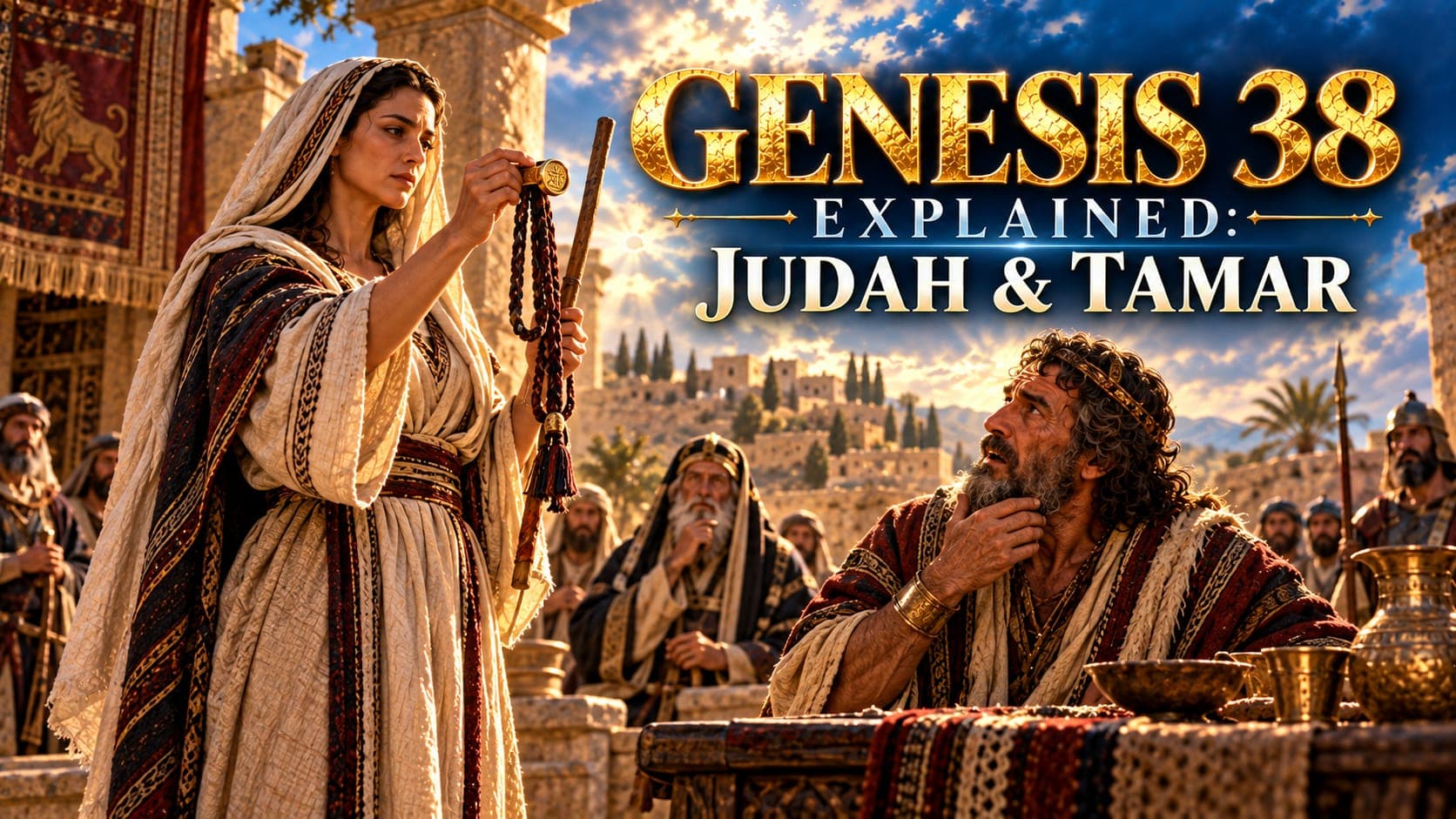
📖 Genesis 38 Explained: Judah, Tamar, and the Twins Pharez and Zarah
Joseph just got sold into Egypt. His father is grieving a son he thinks is dead.
And Genesis stops that story cold to tell you about a completely different man's family.
Genesis 38 explained is the story of Judah, the brother who first suggested selling Joseph for silver, and his daughter in law Tamar, a widow he wronged twice and then publicly condemned to death while hiding his own part in her pregnancy. It is one of the most uncomfortable chapters in Genesis, full of dead sons, a broken promise, a roadside disguise, and a confession Judah never wanted to make.
Maybe you have watched someone in power judge another person for the very thing they themselves did in secret.
- ❓ Why does this chapter interrupt Joseph's story instead of coming later?
- ❓ What actually happened to Onan, and why does the Bible call it wicked?
- ❓ Why did Judah order Tamar burned before he knew the child was his own?
- ❓ How does a story this messy end up in the family line of Jesus?
📌 Tamar takes a real risk to get what she was legally owed, and Judah, the man who wronged her, is the one who ends up saying she was right and he was wrong.
This walkthrough covers Genesis 38 start to finish: Judah's move away from his brothers, the deaths of Er and Onan, the promise Judah never kept, Tamar's disguise at the roadside, the trial almost nobody survives, and the twins born at the very end who carry this family's name forward.
This chapter has more to say about hidden sin and hard justice than its reputation lets on.
What Happened Just Before This Chapter
Genesis 37 ended with Joseph sold to Ishmeelite traders for twenty pieces of silver and carried into Egypt, while his father Jacob tore his clothes and mourned a son he believed was torn apart by a wild animal. Judah is the brother who proposed the sale in the first place, telling his brothers there was more profit in selling Joseph than killing him outright.
📌 Genesis 38 picks up right where that guilt would still be fresh, and it does not follow Joseph into Egypt at all. Instead it turns to Judah, the brother whose idea started the whole scheme, and spends a full chapter on what his own household looked like once he stepped away from the rest of the family. The Joseph story does not resume until the very next chapter.
Genesis 38 Explained Verse by Verse
1. Judah Leaves His Brothers, and Two Sons Die (verses 1 to 10)
The chapter opens with Judah putting distance between himself and his family.
"And it came to pass at that time, that Judah went down from his brethren, and turned in to a certain Adullamite, whose name was Hirah."
⚠️ "At that time" ties this move directly to the sale of Joseph. Genesis does not explain Judah's motive, but the timing is hard to miss. Judah was born to Leah as Jacob's fourth son. Here he marries a Canaanite woman, the daughter of a man named Shuah, and has three sons with her: Er, Onan, and Shelah.
Judah arranges a wife for his firstborn, and the chapter turns dark fast.
"And Judah took a wife for Er his firstborn, whose name was Tamar. And Er, Judah's firstborn, was wicked in the sight of the LORD; and the LORD slew him."
💡 Genesis never says what Er did. It only says the LORD found him wicked enough to end his life. Tamar becomes a widow before the chapter has finished introducing her.
Judah then does what the custom of the time expected of him: he gives Tamar to his next son, Onan, so that Er's line will not simply vanish.
"And Judah said unto Onan, Go in unto thy brother's wife, and marry her, and raise up seed to thy brother. And Onan knew that the seed should not be his; and it came to pass, when he went in unto his brother's wife, that he spilled it on the ground, lest that he should give seed to his brother."
"And the thing which he did displeased the LORD: wherefore he slew him also."
📌 The text is specific about what displeased the LORD. Onan was willing to take Tamar and the privileges that came with her, but he refused to let any child of that union carry his dead brother's name forward. He took the benefit and denied the responsibility, and the verse states plainly that this choice, not simply the act itself, is what the LORD judged.
2. A Promise Withheld, and a Bold Disguise (verses 11 to 19)
Two sons are gone, and Judah still has a third. He is not willing to risk him.
"Then said Judah to Tamar his daughter in law, Remain a widow at thy father's house, till Shelah my son be grown: for he said, Lest peradventure he die also, as his brethren did. And Tamar went and dwelt in her father's house."
⚠️ Judah blames Tamar for his sons' deaths without saying so directly. He sends her back to her father under the cover of waiting for Shelah to grow up, but Genesis will show later that Judah never intended to keep that word. Tamar goes home with a promise attached to her future that Judah has no plan to honor.
Years pass. Judah's own wife dies, his mourning ends, and he goes up to shear his sheep.
"And it was told Tamar, saying, Behold thy father in law goeth up to Timnath to shear his sheep."
💡 By now Tamar can see that Shelah is grown and no wedding is coming. Judah has quietly let his promise expire.
"And she put her widow's garments off from her, and covered her with a vail, and wrapped herself, and sat in an open place, which is by the way to Timnath; for she saw that Shelah was grown, and she was not given unto him to wife."
"When Judah saw her, he thought her to be an harlot; because she had covered her face."
📌 Tamar does not trick Judah with words. She simply puts on the right clothes in the right place and lets Judah draw his own conclusion. Genesis says he does not recognize her at all, which tells you plainly that Judah has not thought about Tamar in years.
"And he said, What pledge shall I give thee? And she said, Thy signet, and thy bracelets, and thy staff that is in thine hand. And he gave it her, and came in unto her, and she conceived by him."
⚠️ A signet, a cord, and a staff were not small items. A signet worked like a personal signature, pressed into wax or clay to prove who authorized something. Tamar does not ask for payment. She asks for proof, and Judah, eager to be on his way, hands over the one set of objects in all of Canaan that could only belong to him.
3. The Search for the Woman Nobody Can Find (verses 20 to 23)
Judah tries to settle the account and send the promised payment, a young goat, through his friend.
"Then he asked the men of that place, saying, Where is the harlot, that was openly by the way side? And they said, There was no harlot in this place."
💡 Hirah asks specifically for a temple attendant tied to local worship, not the ordinary word for a prostitute Judah used, and the locals answer that no such woman was ever there at all. Tamar has already vanished back into her widow's clothes, and with them, her disguise.
"And Judah said, Let her take it to her, lest we be shamed: behold, I sent this kid, and thou hast not found her."
📌 Judah's only concern here is being laughed at, not the encounter itself. He is willing to lose the signet, the cord, and the staff rather than keep asking questions that might draw more attention. He drops the matter and moves on with his life.
4. "She Hath Been More Righteous Than I" (verses 24 to 26)
About three months pass before the news reaches Judah, and his reaction is instant.
"And it came to pass about three months after, that it was told Judah, saying, Tamar thy daughter in law hath played the harlot; and also, behold, she is with child by whoredom. And Judah said, Bring her forth, and let her be burnt."
⚠️ Judah demands the harshest sentence Genesis records anywhere, and he does it without a single question about who the father is. He still believes Tamar is simply a widow living under his roof's authority who has disgraced his family name, and he is ready to have her killed for it before he learns the truth touches him directly.
Tamar does not argue. She sends the proof instead.
"When she was brought forth, she sent to her father in law, saying, By the man, whose these are, am I with child: and she said, Discern, I pray thee, whose are these, the signet, and bracelets, and staff."
"And Judah acknowledged them, and said, She hath been more righteous than I; because that I gave her not to Shelah my son. And he knew her again no more."
📌 Judah could have stayed silent and let Tamar burn rather than expose himself. He does the opposite. In front of witnesses, he admits the child is his and states plainly that Tamar acted more rightly than he did, because he never kept his word about Shelah. It costs him publicly, and he says it anyway.
5. Twins, and an Unexpected Firstborn (verses 27 to 30)
The chapter closes on a birth, and even that does not go the way anyone expects.
"And it came to pass, when she travailed, that the one put out his hand: and the midwife took and bound upon his hand a scarlet thread, saying, This came out first."
"And it came to pass, as he drew back his hand, that, behold, his brother came out: and she said, How hast thou broken forth? this breach be upon thee: therefore his name was called Pharez."
💡 The midwife ties a scarlet thread to the hand she sees first, expecting that child to be the firstborn. Instead the hand pulls back, and the other twin pushes past him into the world first. His name, Pharez, means breach or breaking through, and the boy who was marked to come first, Zarah, follows behind him.
📌 Genesis does not moralize the order of the birth. It just records it. But readers who know the rest of the Bible will recognize the pattern: a younger son overtaking an older one runs through this entire family, from Jacob and Esau to Ephraim and Manasseh later on, and it happens again here in the very next generation.

Hard Questions Genesis 38 Raises
Why does Genesis interrupt Joseph's story to tell Judah's? Genesis never states the reason directly, but the placement is deliberate. Coming right after Judah proposes selling his own brother, this chapter shows what that same man's character looked like at home: broken promises, quick judgment of someone else's sin, and a hidden failure of his own. The contrast lands harder because of where it sits, right before Joseph faces his own sexual temptation in Egypt and responds in exactly the opposite way Judah did here.
What exactly was Onan's sin? The text says plainly what displeased the LORD: Onan agreed to the arrangement in form, taking Tamar as his wife, but refused to let it produce an heir for his dead brother, spilling his seed rather than following through on the duty he had accepted. Genesis 38:9 and 10 name the withheld duty, the refusal to raise up his brother's name, as the specific act God judged, inside a custom that no longer applies outside that ancient family law.
What is the custom behind Onan being told to marry his brother's widow? Centuries later, the law of Moses puts a name and a formal process on exactly what Judah expected of Onan.
"If brethren dwell together, and one of them die, and have no child, the wife of the dead shall not marry without unto a stranger: her husband's brother shall go in unto her, and take her to him to wife, and perform the duty of an husband's brother unto her. And it shall be, that the firstborn which she beareth shall succeed in the name of his brother which is dead, that his name be not put out of Israel."
Genesis 38 shows this duty already practiced as family custom generations before Deuteronomy writes it into Israel's law.
Was Judah's death sentence for Tamar fair, given what he himself had just done? No, and the chapter does not pretend otherwise. Judah applies the harshest possible standard to Tamar while having no idea his own actions three months earlier are the reason she is pregnant. His own confession, "she hath been more righteous than I," is Genesis's own verdict on the double standard, spoken by the man guilty of it.
Was Tamar right to deceive her father in law? Genesis never condemns her for it, and Judah's own words treat her action as more righteous than his, not merely excusable. She was legally owed a husband from Judah's family and a place in that household's future, and Judah had quietly decided to deny her both without ever saying so. Her disguise forced an outcome her father in law had no intention of giving her honestly.
Practical Tips From Genesis 38
An uncomfortable chapter still has real weight for how you keep your word and judge others.
- Keep the promise, even when it costs you. Judah told Tamar to wait for Shelah and never intended to follow through. Broken promises rarely stay hidden forever.
- Check your own record before you judge someone else's. Judah called for Tamar's death without pausing to consider his own recent choices. The harshest verdicts often come from people who have not looked honestly at themselves first.
- Own it in public when you are wrong. Judah could have stayed silent and let Tamar suffer for his own failure. He chose to confess instead, in front of the very people who would judge him for it.
- Taking the benefit without the responsibility has a cost. Onan wanted what came with Tamar without honoring what he owed his brother. Genesis records that choice as the exact thing God judged.
- God's plans still move forward through messy, broken families. Nothing about this chapter is clean, and Judah's line still carries forward through it, all the way to Jesus.
Top 5 Bible Verses From Genesis 38
1. Genesis 38:11
"Then said Judah to Tamar his daughter in law, Remain a widow at thy father's house, till Shelah my son be grown: for he said, Lest peradventure he die also, as his brethren did. And Tamar went and dwelt in her father's house."
The broken promise the whole chapter turns on, spoken under the cover of a delay Judah never intended to end.
2. Genesis 38:18
"And he said, What pledge shall I give thee? And she said, Thy signet, and thy bracelets, and thy staff that is in thine hand. And he gave it her, and came in unto her, and she conceived by him."
Tamar asks for proof rather than payment, and Judah hands over the one set of items that can only belong to him.
3. Genesis 38:24
"And it came to pass about three months after, that it was told Judah, saying, Tamar thy daughter in law hath played the harlot; and also, behold, she is with child by whoredom. And Judah said, Bring her forth, and let her be burnt."
Judah demands the harshest sentence in the chapter before he knows the child is his own.
4. Genesis 38:26
"And Judah acknowledged them, and said, She hath been more righteous than I; because that I gave her not to Shelah my son. And he knew her again no more."
Judah's public confession, admitting his own failure cost more than his pride was worth to protect.
5. Matthew 1:3
"And Judas begat Phares and Zara of Thamar; and Phares begat Esrom; and Esrom begat Aram;"
Matthew's genealogy of Jesus, spelling Judah, Pharez, Zarah, and Tamar the way the Greek text carries them, names this exact family in the line that leads to Christ.

Frequently Asked Questions About Genesis 38
What does Genesis 38 mean?
It records Judah's move away from his brothers, the deaths of his sons Er and Onan, his broken promise to give Tamar his third son Shelah, Tamar's disguise that leads to Judah fathering her twins, and his public admission that she acted more rightly than he did.
Why did God kill Er and Onan?
Genesis 38:7 says Er was wicked in the LORD's sight without stating the specific sin. Genesis 38:9 and 10 are specific about Onan: he agreed to marry Tamar as custom required but refused to let that union produce an heir for his dead brother, and that refusal is what the text says displeased the LORD.
Why did Tamar disguise herself and trick Judah?
Genesis 38:14 says she acted because she saw Shelah was grown and Judah had not given him to her as promised. With no husband and no child to carry her place in the family forward, she took matters into her own hands rather than stay indefinitely in her father's house.
Was Judah wrong to sentence Tamar to death?
Yes, by the chapter's own account. Judah orders her burned before learning he is the father, then admits in Genesis 38:26 that Tamar had been more righteous than he was. The text does not soften his double standard.
What was the pledge Tamar asked Judah for?
Genesis 38:18 lists a signet, bracelets, and a staff. The signet worked like a personal seal, able to identify Judah specifically, which is exactly why she asked for it instead of ordinary payment.
Who were Pharez and Zarah?
They were the twin sons born to Judah and Tamar at the end of Genesis 38. A midwife marked Zarah's hand with a scarlet thread expecting him first, but Pharez broke through and was born ahead of him.
Why does Genesis 38 interrupt the Joseph story?
It sits right after Judah proposes selling Joseph in Genesis 37 and right before Joseph resists temptation in Egypt in Genesis 39, placing Judah's hidden failure directly beside his brother's integrity.
How is Tamar connected to Jesus?
Matthew 1:3 names her directly in the genealogy of Jesus, through her son Pharez. She is one of only a handful of women Matthew names in that entire list, most of them tied to unexpected or difficult circumstances rather than easy ones, alongside Ruth, who later marries into the very line Pharez started.
Is Tamar the same person as Tamar, David's daughter?
No. This Tamar lives generations earlier and marries into Judah's family directly. A different Tamar appears much later as King David's daughter in 2 Samuel 13, and the two share only a name.
Why did the midwife tie a scarlet thread to the baby's hand?
Genesis 38:28 says she did it to mark which twin came out first, expecting that hand to belong to the firstborn. The hand pulled back and the other twin, Pharez, was born ahead of him instead.
Final Thoughts
Genesis 38 is not a comfortable chapter, and it was never meant to be.
📌 A broken promise eventually comes due. Judah thought withholding Shelah from Tamar would simply go unnoticed. It shaped every choice she made after that.
📌 The harshest judge in the room is not always the most righteous person in it. Judah learned that about himself in front of witnesses, and said so out loud rather than let Tamar pay for his own silence.
📌 God writes a straight line through crooked stories. Nothing in this chapter looks like the start of a royal family line, and yet Pharez leads directly to David and eventually to Jesus.
You may be carrying a broken promise someone else made to you, or one you have quietly let slide on someone else.
So here is your one next step.
Name it honestly this week, the way Judah finally did, before someone else has to force the truth into the open.