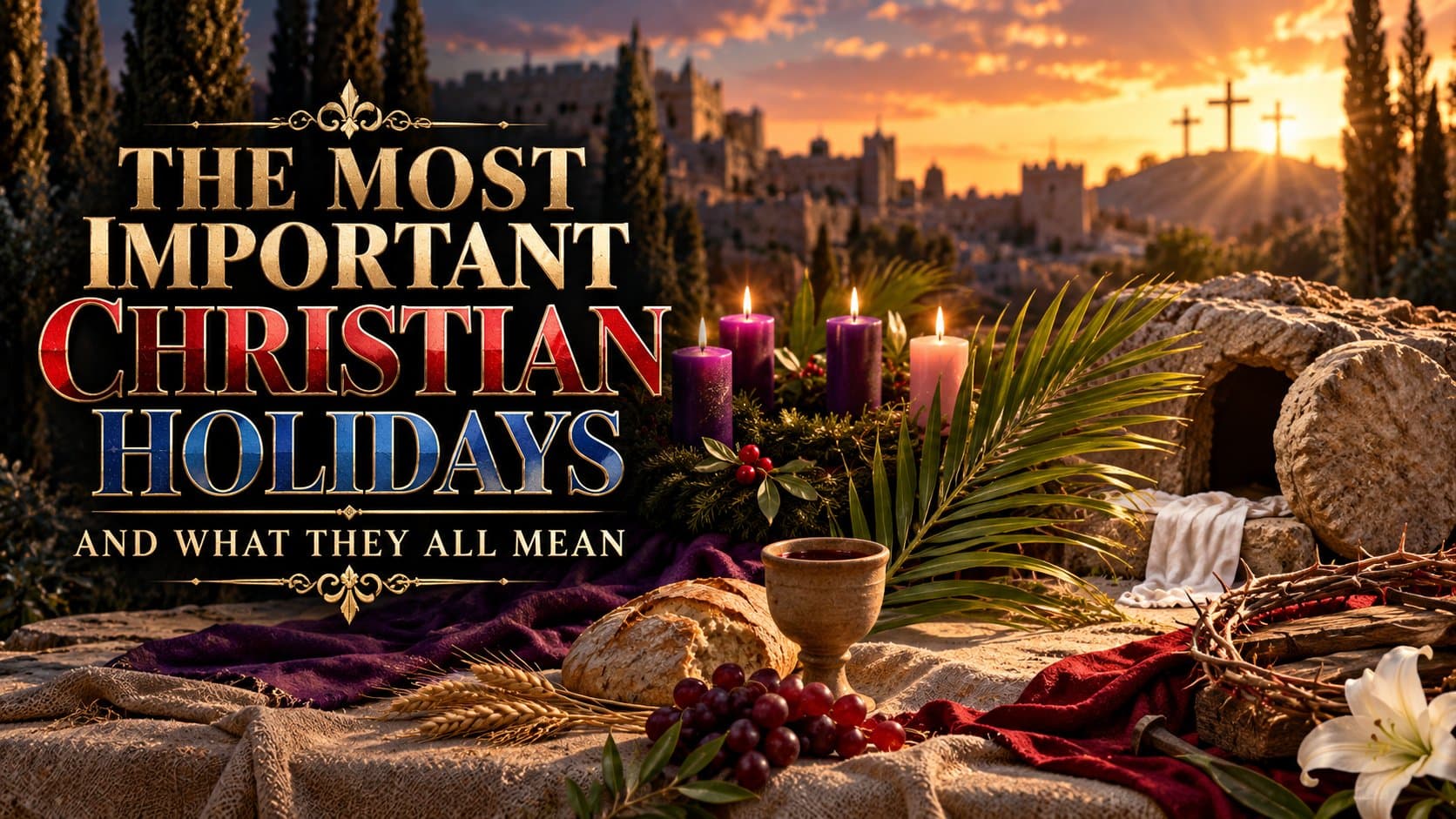
📖 What Are the Most Important Christian Holidays and What Do They Mean?
Your church calendar has a lot more on it than Christmas and Easter.
Advent. Lent. Pentecost. Epiphany. Maybe your bulletin even mentions a solemnity or a feast day you have never heard explained.
📌 Here is the plain answer. Christian holidays are not random dates on a calendar. Every one of them points back to something Jesus actually did, something the early church actually believed, or something Scripture actually commands.
Maybe you grew up keeping every one of these days without ever being told why. Maybe your own church keeps almost none of them, and the word Advent sounds foreign.
Either way, you are not alone, and this guide was written for exactly where you are standing right now.
This guide walks through the most important Christian holidays, in the order the church year actually moves through them. What each one celebrates. Where it comes from in Scripture or church history. How Catholics, Orthodox, and Protestants keep it differently, and sometimes not at all.
Every historical claim below is sourced, so you can go check it yourself.
Why This Matters for Your Faith
It is tempting to treat all of this as church trivia. Dates on a wall calendar, nice to know, not essential to your walk with God.
⚠️ That undersells what these holidays actually do. Each one takes a single event in the story of your salvation and gives it a whole day, or a whole season, so you cannot skip past it the way a quick Bible reading lets you.
Christmas will not let you forget that God became a human being. Easter will not let you forget that He rose. Pentecost will not let you forget that He sent His own Spirit to live inside ordinary people.
💡 The church calendar is a teaching tool, not a tradition for its own sake. It walks you through the whole gospel, every single year, whether or not you remembered to open your Bible that week.
You do not have to belong to a church that formally keeps every one of these days to benefit from knowing what they mean. Scripture is the foundation underneath all of them, and that foundation belongs to every Christian.
The Christian Holidays Every Believer Should Know
1. Easter: The Center of the Whole Christian Year
Start here, because the early church did. Every other Christian holiday sits on the calendar in relation to this one.
📌 Easter celebrates the resurrection of Jesus Christ, and Paul calls it the hinge the entire Christian faith turns on. He told the Corinthian church plainly what the earliest believers had already received as settled truth.
"For I delivered unto you first of all that which I also received, how that Christ died for our sins according to the scriptures; And that he was buried, and that he rose again the third day according to the scriptures:"
Without that third sentence, Christianity is just an admired teacher who died young. With it, death itself loses its final word.
An angel said it first, at an empty tomb, to women who came expecting a body and found none.
"And the angel answered and said unto the women, Fear not ye: for I know that ye seek Jesus, which was crucified. He is not here: for he is risen, as he said. Come, see the place where the Lord lay."
Easter does not land on a fixed calendar date the way Christmas does. It moves every year, tied to the spring full moon, because the earliest churches wanted it tied to the same season as the first Passover and resurrection.
Here is where it gets genuinely interesting, and where popular retellings get sloppy. A lot of articles claim the Council of Nicaea in 325 simply handed down one tidy formula for the whole church to follow forever. The Orthodox Church in America has pushed back on that exact claim in an official statement from one of its own bishops. No surviving record from the council itself spells out a single uniform formula, and the detailed nineteen year calculation most churches use today only became linked to Nicaea centuries later.
✅ What the council agreed on was simpler and still binding today. Every church should celebrate on the same Sunday, that Sunday should follow the first full moon after the spring equinox, and the date should no longer be calculated by Jewish Passover reckoning alone.
That one agreement held the whole church together on a single date for over twelve centuries. It only broke apart in 1582, when Rome adopted the Gregorian calendar and the Orthodox churches did not. Orthodox Easter is still calculated on the older Julian calendar, which is why it often falls weeks after the Western date, even though both traditions are technically following the same ancient rule.
2. Holy Week: The Days That Lead to Easter
You cannot really separate Easter from the week in front of it. Catholic, Orthodox, and many Protestant churches call this stretch Holy Week, and it carries its own weight.
Palm Sunday opens it, remembering the crowd that welcomed Jesus into Jerusalem the way a prophet centuries earlier had already pictured a coming king.
"Rejoice greatly, O daughter of Zion; shout, O daughter of Jerusalem: behold, thy King cometh unto thee: he is just, and having salvation; lowly, and riding upon an ass, and upon a colt the foal of an ass."
Maundy Thursday remembers the Last Supper, where Jesus gave His followers the meal that became Communion. Good Friday remembers the crucifixion itself, the one day of the year most Christian traditions agree should feel genuinely heavy.
Jesus had one word left when it was finished, and the Gospel of John records it directly.
"When Jesus therefore had received the vinegar, he said, It is finished: and he bowed his head, and gave up the ghost."
Catholic parishes keep the final three days, Thursday evening through Sunday, under their own name, the Sacred Paschal Triduum, counted by the United States Conference of Catholic Bishops as its own distinct season even though it sits inside the larger season of Easter.
Holy Saturday, in between, is the quiet day. Nothing in Scripture records what happened on it, and many liturgical churches hold no regular service at all until the Easter vigil that night, letting the silence make its own point.
3. Lent: Forty Days of Turning Back to God
Lent is the season that leads up to all of this, and it borrows its shape directly from something Jesus Himself did before His public ministry even began.
"Then was Jesus led up of the Spirit into the wilderness to be tempted of the devil. And when he had fasted forty days and forty nights, he was afterward an hungred."
Early Christian writers were already describing a forty day fast before Easter by the late fourth century. A travel journal from a pilgrim named Egeria, written around 380, describes an eight week fasting period in Jerusalem that excluded Saturdays and Sundays, which works out to exactly forty fasting days.
⚠️ Do not take the popular version of this history as settled further than that. Some sources say the Council of Nicaea itself already referred to a forty day period by name decades earlier, in 325. Others place the clearest evidence with Egeria's journal instead. Either way, the forty day shape was firmly in place by the end of the fourth century, well before Lent took its modern form.
Modern Lent begins on Ash Wednesday, when many churches mark worshippers' foreheads with ashes as a sign of mortality and repentance, and runs until Holy Saturday. Catholics keep specific rules around fasting and abstaining from meat on certain days during the season, while most Protestant churches that observe Lent leave the exact practice up to each believer's own conviction.
📌 Not every Christian tradition keeps Lent, and that is worth saying plainly. Many evangelical and Baptist congregations do not follow a fixed penitential season at all. Where it is kept, the goal across Catholic, Orthodox, and Protestant churches alike is the same one Jesus modeled in the wilderness: real prayer, real fasting, and a real turn back toward God, not a performance for anyone watching.
4. Pentecost: The Birthday of the Church
Fifty days after Easter, the season turns from remembering what Jesus did to remembering what He sent. Luke records exactly what happened in the upper room.
"And when the day of Pentecost was fully come, they were all with one accord in one place. And suddenly there came a sound from heaven as of a rushing mighty wind, and it filled all the house where they were sitting. And there appeared unto them cloven tongues like as of fire, and it sat upon each of them. And they were all filled with the Holy Ghost, and began to speak with other tongues, as the Spirit gave them utterance."
The name itself comes from the Greek word for fiftieth, and Luke chose that day on purpose. Pentecost was already a major Jewish festival, Shavuot, the Feast of Weeks, held exactly seven weeks after Passover to mark the end of the grain harvest and, in Jewish tradition, to remember God giving the law to Moses at Sinai.
💡 The timing is the whole point. On the same festival that once celebrated a law written on stone tablets, God poured out a Spirit written into human hearts instead. That is widely described as the birth of the church, the moment a scattered group of frightened disciples became a body with a mission.
Catholic and Orthodox churches keep Pentecost as a major solemnity closing the fifty day Easter season described earlier in how the whole church year is structured. Many Protestant and Pentecostal churches mark it too, often with special emphasis on the Holy Spirit's work in ordinary believers today.
5. Advent: Four Weeks of Waiting
The church year does not begin on January 1. It begins with the four Sundays of Advent, the season that opens the whole yearly cycle by looking two directions at once.
One eye looks back toward Bethlehem, preparing to remember Christ's first coming as a baby. The other looks forward to His promised return, which is why Advent readings often sound more urgent than cozy.
"Take ye heed, watch and pray: for ye know not when the time is."
Many churches mark the season with an Advent wreath, lighting one more candle each Sunday, a visual countdown toward Christmas built around hope, peace, joy, and love.
Advent is also the quietest season on this list in terms of how widely it is kept. Catholic and many Orthodox and mainline Protestant churches build their whole December around it. Plenty of other Christians skip straight to Christmas decorations the day after Thanksgiving instead, and nothing in Scripture commands either approach.
6. Christmas: The Word Became Flesh
If Easter is the center of the church year, Christmas is the holiday that reaches the most people, Christian or not. What it celebrates is bigger than the decorations around it suggest.
"And the angel said unto them, Fear not: for, behold, I bring you good tidings of great joy, which shall be to all people. For unto you is born this day in the city of David a Saviour, which is Christ the Lord."
Christmas marks the Incarnation, the belief that the eternal God actually became a human baby, with a heartbeat and a hungry cry, inside Mary's body in Bethlehem. That claim sits underneath everything explored at length in what Christmas actually celebrates.
⚠️ The exact date is where this holiday gets genuinely contested, and a good guide says so plainly. December 25 is not given anywhere in Scripture, and the full case for and against that specific date is complicated enough to deserve its own article. What is not contested is the claim the date was chosen to mark in the first place.
Orthodox churches on the older Julian calendar keep the Nativity on what falls as January 7 on the modern Gregorian calendar, the same event, a different calendar underneath it.
7. Epiphany: When the Light Reached the Nations
Twelve days after Christmas comes a holiday most American Christians barely notice, even though many of the world's Christians consider it a bigger celebration than Christmas itself.
"And when they were come into the house, they saw the young child with Mary his mother, and fell down, and worshipped him: and when they had opened their treasures, they presented unto him gifts; gold, and frankincense, and myrrh."
📌 Epiphany celebrates the moment Christ was revealed to people outside Israel. The wise men who brought those gifts were not Jewish worshippers. They were foreign scholars, and their visit is the first hint in Matthew's Gospel that this baby was not only the Jewish Messiah but the Savior of every nation. The full story behind this feast covers where the word Epiphany comes from and how different traditions keep it.
Western churches generally keep it on January 6. Many Eastern churches tie it instead to Christ's baptism in the Jordan, a different but related moment of God the Father publicly revealing who His Son was.

Practical Tips for Keeping These Holidays Well
Knowing what each holiday means is the first step. Here is how to actually let that knowledge shape a year, whether your own church keeps every one of these days or none of them.
- Read the actual Bible passage behind each holiday. Not a devotional about it, the real text. Read Matthew 28 before Easter, Luke 2 before Christmas, Acts 2 before Pentecost.
- Learn one real historical fact instead of a guess. Now you know Easter moves with the moon, Lent reached its forty day shape by the fourth century, and Advent opens the church year rather than closing the calendar year.
- Ask your own church why it keeps the holidays it keeps. If your congregation skips Lent or Advent entirely, that is a real choice someone made, not an accident. It is worth understanding why.
- Let Easter outrank Christmas in your own heart, even if the culture does not. Scripture treats the resurrection as the hinge of the whole faith. Give it the weight Paul gave it.
- Use the waiting seasons on purpose. Advent and Lent are both built around waiting rather than arriving. Resist rushing straight to the celebration and let the waiting do its work on you.
- Talk across church lines. If you have Catholic, Orthodox, or Protestant friends who keep these days differently, ask them what each holiday means in their own tradition. You will likely find more shared ground than you expected.
- Do not confuse a disputed date with a disputed truth. Nobody can prove December 25 or even the exact spring Sunday some early computations assumed. Every Christian tradition agrees Jesus was actually born and actually rose. Hold the date loosely and the claim firmly.
Top 5 Bible Verses Behind the Christian Holidays
Every holiday on this list is built on top of real Scripture. Here are five verses worth knowing by heart.
1. Isaiah 9:6
"For unto us a child is born, unto us a son is given: and the government shall be upon his shoulder: and his name shall be called Wonderful, Counsellor, The mighty God, The everlasting Father, The Prince of Peace."
Written centuries before Bethlehem, this is the promise that Advent spends four weeks waiting for and Christmas finally announces as fulfilled. A child. A government. A whole string of titles no ordinary baby could ever carry.
2. Zechariah 9:9
"Rejoice greatly, O daughter of Zion; shout, O daughter of Jerusalem: behold, thy King cometh unto thee: he is just, and having salvation; lowly, and riding upon an ass, and upon a colt the foal of an ass."
This is the verse behind Palm Sunday, the gate into Holy Week. A king who comes humble instead of mounted on a warhorse is exactly the kind of king the crowds in Jerusalem cheered for, right before the week turned dark.
3. 1 Corinthians 15:3 and 4
"For I delivered unto you first of all that which I also received, how that Christ died for our sins according to the scriptures; And that he was buried, and that he rose again the third day according to the scriptures:"
Scholars widely consider this one of the oldest pieces of Christian teaching in the whole New Testament, likely already a fixed creed Paul had received from others. It is Easter reduced to its irreducible core: died, buried, risen.
4. Joel 2:28 and 29
"And it shall come to pass afterward, that I will pour out my spirit upon all flesh; and your sons and your daughters shall prophesy, your old men shall dream dreams, your young men shall see visions: And also upon the servants and upon the handmaids in those days will I pour out my spirit."
Peter quoted this exact prophecy out loud on the first Pentecost, standing in front of a confused Jerusalem crowd, telling them plainly that what they had just watched happen was not chaos. It was Joel's ancient promise finally arriving.
5. Revelation 21:5
"And he that sat upon the throne said, Behold, I make all things new. And he said unto me, Write: for these words are true and faithful."
Every holiday in this guide points somewhere beyond itself, toward a promise not yet finished. Advent waits for it. Easter guarantees it. Revelation puts the final sentence on it. Nothing stays broken forever.
Frequently Asked Questions About Christian Holidays
What are the most important Christian holidays?
Easter and Christmas stand above every other date, with Easter widely considered the more theologically central of the two. Holy Week, Lent, Pentecost, Advent, and Epiphany round out the major seasons most liturgical churches build their year around.
What is the difference between a feast and a solemnity?
In the Catholic Church, celebrations are ranked by importance. A solemnity, like Easter or Christmas, is the highest rank. A feast ranks below that, and a memorial, honoring a particular saint on most days of the year, ranks below a feast.
Do Protestants celebrate the same holidays as Catholics?
Nearly all Protestants keep Christmas and Easter. Fewer keep Lent, Advent, or Pentecost on a fixed calendar, and many evangelical and Baptist churches do not follow a liturgical calendar at all. Where a season is kept, the Scripture behind it is shared across traditions even when the practices differ.
Why does Easter move to a different date every year?
Because the earliest churches tied it to the spring full moon rather than a fixed calendar day, the way the original Passover and resurrection fell in that season. The modern result is a Sunday that shifts within a several week window every year.
Why do Orthodox and Western churches celebrate Easter on different dates?
Both trace their method back to the same ancient agreement, but Orthodox churches still calculate the date using the older Julian calendar, while Western churches switched to the Gregorian calendar in 1582. The calendars have drifted apart, so the resulting dates often do too.
What is the point of Lent if it is not in the Bible by name?
Lent as a named season is a later church development, but its shape, forty days of fasting and turning back to God, is modeled directly on what Jesus did in the wilderness before His ministry began. The practice is church tradition built on a biblical pattern, not a biblical command itself.
Is Pentecost really the birthday of the church?
That is the common description, and it fits what happened in Acts 2 well. It is also worth knowing that some Orthodox theology pushes back on the phrase itself, holding that the church in some sense existed before that day. Either way, Pentecost marks the moment the Holy Spirit was given to ordinary believers in a new way.
What is the difference between Advent and Lent?
Both are seasons of waiting and preparation, but they prepare for different things. Advent leads into Christmas and looks toward Christ's first and final coming. Lent leads into Easter and focuses on repentance ahead of the crucifixion and resurrection.
Why do some Christians consider Epiphany a bigger holiday than Christmas?
In parts of the world, especially where Eastern Christianity is strong, Epiphany carries more historical weight than Christmas because it marks Christ being revealed to the whole world, not only celebrating His birth. Local custom and history shape which holiday gets the bigger celebration.
Do I have to attend church to properly keep a Christian holiday?
The Catholic Church designates certain days as holy days of obligation, where attendance is expected. Outside of that specific teaching, Scripture never ties the meaning of these days to a single required ritual. What matters most is whether the truth behind the day actually reaches your own heart.
Final Thoughts
None of these holidays exist to give you something to decorate for. Every single one of them is the church refusing to let you forget a piece of the gospel.
📌 Advent will not let you forget that you are waiting on God. Christmas will not let you forget that He came close. Lent will not let you forget that you need to turn back. Easter will not let you forget that death lost. Pentecost will not let you forget that His Spirit actually lives in you.
You do not need a church calendar on your wall to believe any of that. But walking through the year with these holidays in view is one of the oldest ways Christians have found to keep the whole story in front of them, instead of only the parts that are convenient.
Pick one holiday from this guide that your own church does not emphasize. Read the Scripture behind it this week, on your own, and let it do what it has done for believers for almost two thousand years.
📚 Sources
Every claim in this article traces back to one of these. All links checked 29 October 2026.
- Liturgical Year & Calendar
United States Conference of Catholic Bishops (USCCB)
The source for the six seasons of the Catholic liturgical year, the Sacred Paschal Triduum, the 1969 General Roman Calendar, and holy days of obligation.
- Concerning the Date of Pascha and the 1st Ecumenical Council
Orthodox Church in America, statement by Archbishop Peter
The source for what the Council of Nicaea likely did and did not decide about the date of Easter in 325, and for the 1582 split between the Julian and Gregorian calculations.
- Lent Lasts for 40 Days. Have You Ever Wondered Why?
uCatholic
The source for the fourth century Lenten references, including the Council of Nicaea's use of the word tessarakoste and the pilgrim Egeria's travel journal from around 380.
- Pentecost
Wikipedia
The source for the Shavuot and Feast of Weeks background, the 50 day count from Easter, and the description of Pentecost as the birthday of the church, including the Orthodox theological pushback on that phrase.