📖 Numbers 1 Explained: Counting Israel's Army in the Wilderness
A whole book opens with a headcount. Not a vision, not a battle, a census.
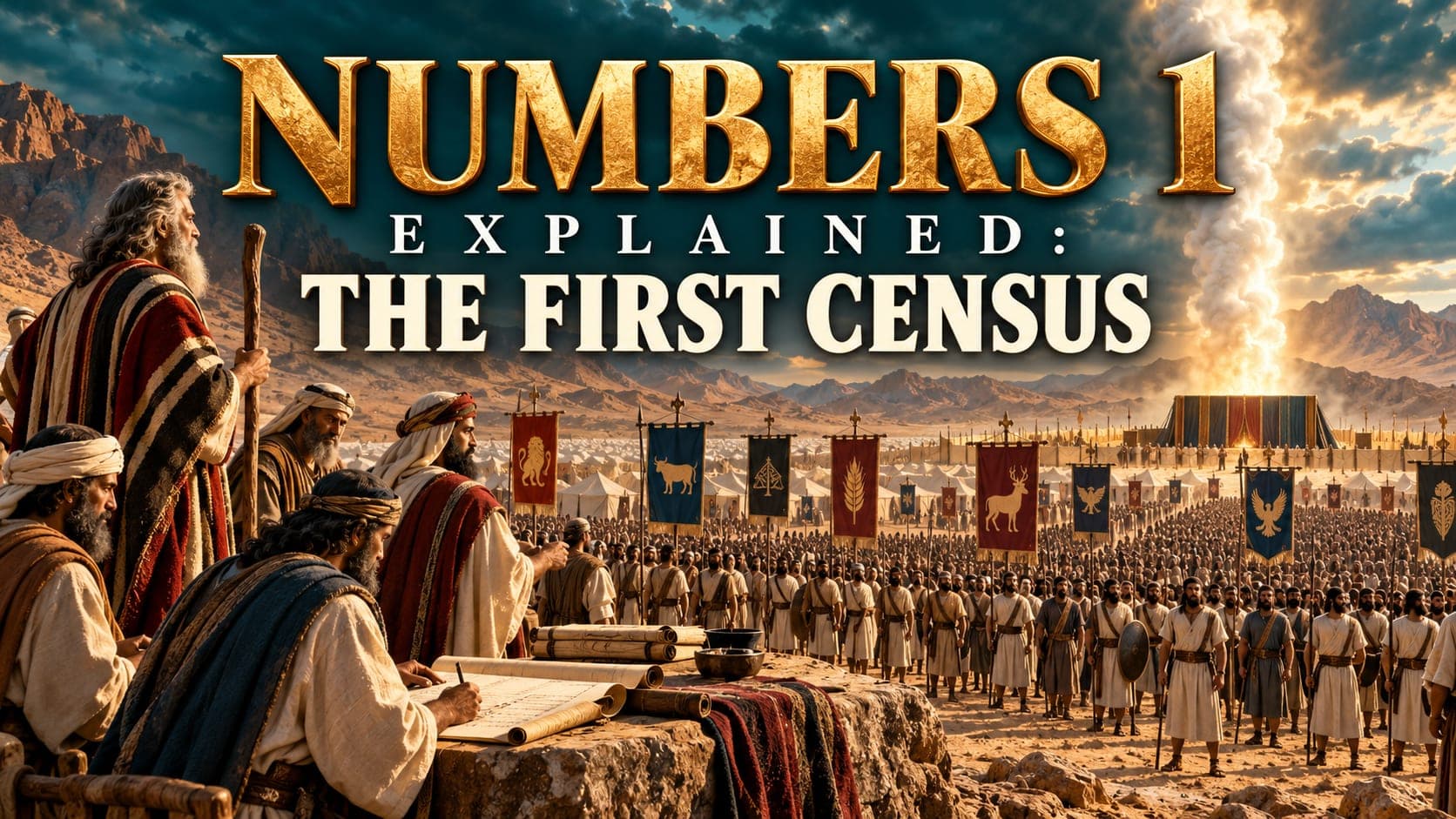
Numbers 1 explained is Moses standing at the door of the tabernacle with Aaron and twelve tribal leaders, going family by family through every man in Israel old enough to fight. The book of Numbers gets its name from this chapter, and from the second count that comes near the end of it.
Maybe you have skimmed past this chapter, assuming a list of names and numbers has nothing left to teach once you know the total.
- ❓ Why does God want a nation of former slaves counted like an army?
- ❓ Why is Reuben named first, when he had already lost his place as firstborn?
- ❓ Why are the Levites left out of the count entirely?
- ❓ And can six hundred and three thousand, five hundred and fifty men really be right?
📌 Numbers 1 is not a filler chapter before the real story starts. It is God turning a people who left Egypt in a panic into an organized nation, tribe by tribe, name by name.
This walkthrough goes through the chapter in order: the command to count, the twelve princes chosen to help, the tally for each tribe, the grand total, and the Levites set apart for a different kind of service entirely.
Read slowly. A census rarely sounds like worship, but this one is.
What Happened Just Before This Chapter
Leviticus 27 closed the book of Leviticus with the price of a vow and the one line repeated twice in its final two chapters: these are the commandments the LORD gave Moses at Sinai. That book answered how a holy God could live among an unclean people. It never once answered how that people would actually move, camp, or defend itself in open desert.
Numbers 1 picks up about a month after the tabernacle was finally raised. The date in the opening verse, the first day of the second month of the second year since Egypt, places this chapter almost exactly one year after the exodus itself. The tabernacle now stands finished in the middle of the camp. What Israel needs next is structure around it, and that structure starts with knowing exactly how many fighting men it has.

Numbers 1 Explained Verse by Verse
1. A Census for War, Not Just a Headcount (verses 1 to 3)
The chapter opens by naming exactly where and when this command was given.
"And the LORD spake unto Moses in the wilderness of Sinai, in the tabernacle of the congregation, on the first day of the second month, in the second year after they were come out of the land of Egypt, saying, Take ye the sum of all the congregation of the children of Israel, after their families, by the house of their fathers, with the number of their names, every male by their polls;"
"By their polls" means one head counted at a time, not an estimate. "After their families, by the house of their fathers" means this was never going to be one flat number for the whole nation. Every man had to be placed inside his own tribe and his own household first.
The next verse narrows exactly who gets counted and why.
"From twenty years old and upward, all that are able to go forth to war in Israel: thou and Aaron shall number them by their armies."
📌 This was never a general population count. It was a muster roll. Women, children, and men too old to fight are not part of this number, not because they did not matter, but because this specific list answers one question: how large is Israel's standing army on the day it needs one.
💡 Twenty years old and upward lines up with the age the rest of the book treats as full adulthood. It is the same threshold the next generation will be judged by after the spies bring back their report.
2. One Man From Every Tribe (verses 4 to 16)
Moses and Aaron do not do this alone. God names a helper for every tribe.
"And with you there shall be a man of every tribe; every one head of the house of his fathers."
Twelve names follow, one per tribe, each one already a recognized head of his own household:
- 👤 Reuben: Elizur son of Shedeur.
- 👤 Simeon: Shelumiel son of Zurishaddai.
- 👤 Judah: Nahshon son of Amminadab.
- 👤 Issachar: Nethaneel son of Zuar.
- 👤 Zebulun: Eliab son of Helon.
- 👤 Ephraim and Manasseh, the two sons of Joseph: Elishama son of Ammihud, and Gamaliel son of Pedahzur.
- 👤 Benjamin: Abidan son of Gideoni.
- 👤 Dan: Ahiezer son of Ammishaddai.
- 👤 Asher: Pagiel son of Ocran.
- 👤 Gad: Eliasaph son of Deuel.
- 👤 Naphtali: Ahira son of Enan.
💡 Notice that twelve names cover twelve tribes without Levi being one of them. Jacob had twelve sons, but Levi's descendants are set apart later in this same chapter, so Joseph's two sons, Ephraim and Manasseh, each stand as a full tribe in his place. The count of twelve never changes, only which names fill it.
One of these names matters far beyond this census. Nahshon, prince of Judah, is listed generations later as an ancestor of King David, and through David, of Jesus. The man chosen to help count Judah's soldiers is standing in the family line the whole Bible is building toward.
"These were the renowned of the congregation, princes of the tribes of their fathers, heads of thousands in Israel."
3. Counting the Tribes, One by One (verses 17 to 43)
With the twelve princes in place, the actual count begins, tribe by tribe, starting with Jacob's oldest son.
"Those that were numbered of them, even of the tribe of Reuben, were forty and six thousand and five hundred."
❓ Why does Reuben still go first? By the time of this census, Reuben had already lost the honor that normally comes with being the firstborn. Genesis 49 records Jacob stripping Reuben of his excellency because of what he did to his father's bed. Yet this chapter still lists him first, tribe by tribe, in plain birth order. Losing the firstborn's blessing never erased Reuben's place in the family line itself.
The count continues through all twelve tribes, each one given the exact same formula.
- ⚔️ Simeon: fifty nine thousand, three hundred.
- ⚔️ Gad: forty five thousand, six hundred and fifty.
- ⚔️ Issachar: fifty four thousand, four hundred.
- ⚔️ Zebulun: fifty seven thousand, four hundred.
- ⚔️ Ephraim: forty thousand, five hundred.
- ⚔️ Manasseh: thirty two thousand, two hundred.
- ⚔️ Benjamin: thirty five thousand, four hundred.
- ⚔️ Dan: sixty two thousand, seven hundred.
- ⚔️ Asher: forty one thousand, five hundred.
- ⚔️ Naphtali: fifty three thousand, four hundred.
"Those that were numbered of them, even of the tribe of Judah, were threescore and fourteen thousand and six hundred."
📌 Judah comes out the largest tribe by far, at seventy four thousand, six hundred men. Manasseh is the smallest, at thirty two thousand, two hundred. Judah leading the count here is not an accident the rest of the Bible ignores. This is the tribe that later produces David's throne and, through Nahshon's own line, Jesus.
4. The Grand Total: 603,550 (verses 44 to 46)
Once every tribe reports its number, the chapter adds them all together.
"Even all they that were numbered were six hundred thousand and three thousand and five hundred and fifty."
Add the twelve tribal totals from this chapter yourself and they land on the exact same figure: six hundred and three thousand, five hundred and fifty fighting men, twenty years old and up. That is before counting a single woman, child, or man past sixty.
This is not the first time this exact number shows up in the story. A near identical census, taken to collect the half shekel that funded the tabernacle, happened only a short time before this one.
"And the silver of them that were numbered of the congregation was an hundred talents, and a thousand seven hundred and threescore and fifteen shekels, after the shekel of the sanctuary: A bekah for every man, that is, half a shekel, after the shekel of the sanctuary, for every one that went to be numbered, from twenty years old and upward, for six hundred thousand and three thousand and five hundred and fifty men."
📌 The same count, six hundred and three thousand, five hundred and fifty, shows up in both Exodus and Numbers. The money raised while building the tabernacle in Exodus 30 and Exodus 38 and the army organized here in Numbers 1 come from the same body of men, counted only months apart. It also closely matches the men who originally walked out of Egypt.
"And the children of Israel journeyed from Rameses to Succoth, about six hundred thousand on foot that were men, beside children."
💡 The nation that left Egypt a year earlier as a fleeing crowd is, by Numbers 1, the same size nation now organized into armies, with named leaders, defined families, and a fixed order of march. The people did not shrink or grow much in a year. What changed was structure.
5. The Levites Set Apart (verses 47 to 54)
One tribe never enters the total at all, and the chapter explains exactly why.
"But the Levites after the tribe of their fathers were not numbered among them."
"Only thou shalt not number the tribe of Levi, neither take the sum of them among the children of Israel: But thou shalt appoint the Levites over the tabernacle of testimony, and over all the vessels thereof, and over all things that belong to it: they shall bear the tabernacle, and all the vessels thereof; and they shall minister unto it, and shall encamp round about the tabernacle."
⚠️ Leaving the Levites out of the military count was never a demotion. It was a different assignment entirely. While the other twelve tribes trained for war, the Levites carried, guarded, and served the tabernacle itself, a full time task of its own.
The next verse makes clear why that job carried real weight.
"And when the tabernacle setteth forward, the Levites shall take it down: and when the tabernacle is to be pitched, the Levites shall set it up: and the stranger that cometh nigh shall be put to death."
📌 Anyone outside the Levites who handled the tabernacle without that calling faced death, not as cruelty, but as the cost of treating something holy carelessly. The same seriousness runs through the camp's layout, described in the chapter's final verses.
"And the children of Israel shall pitch their tents, every man by his own camp, and every man by his own standard, throughout their hosts. But the Levites shall pitch round about the tabernacle of testimony, that there be no wrath upon the congregation of the children of Israel: and the Levites shall keep the charge of the tabernacle of testimony."
The Levites camped in a ring around the tabernacle, forming a buffer between a holy God and an ordinary camp. Their presence there was not decoration. It existed to keep wrath from falling on the rest of the nation.
The chapter closes with the simplest line in the whole census.
"And the children of Israel did according to all that the LORD commanded Moses, so did they."
💡 No complaint, no delay, no edited roll call. After a year that already included a golden calf and more than one outburst against Moses, this chapter ends with straight obedience to a command that cost nothing less than every man's name and tribe being put on permanent record.

Hard Questions Numbers 1 Raises
Why does Reuben still appear first if Jacob already stripped him of his birthright? Genesis 49 took away Reuben's special blessing and excellency, the honor and leadership that normally belonged to the firstborn. It never erased the plain fact of birth order. Numbers 1 lists tribes the way a family record would, oldest son first, which is a different thing entirely from ranking tribes by status. Reuben lost the blessing. He never stopped being Jacob's eldest son.
Is 603,550 fighting men a realistic number for this point in the story? Taken at face value, it implies a total population, including women, children, and those past sixty, of well over two million people living in the Sinai wilderness. Some readers find that scale hard to picture for a group traveling on foot through a desert. Scripture repeats this same total three separate times, in Exodus 38, here in Numbers 1, and again in the second census near the end of the book, which argues against a simple copying error. A smaller group of scholars has proposed that the Hebrew word usually translated "thousand" may sometimes describe a military unit or clan rather than a literal one thousand men, which would lower the total considerably. The text itself gives the number as stated and does not flag any uncertainty about it, so this walkthrough reads it the way Numbers 1 presents it.
Does leaving women and children out of the count mean they did not matter to God? The text gives no reason to read it that way. This specific list answers one narrow military question: how many men could Israel send to war. Women and children appear constantly elsewhere in Numbers, counted by family, protected by law, and central to the inheritance rules later in the book. Being left off a muster roll for soldiers is not the same as being left out of the covenant.
Why did anyone outside the Levites face death for handling the tabernacle in verse 51? The warning is not about an accidental brush against a tent peg. It targets someone taking on tabernacle duty without the calling God had just assigned to the Levites alone. The same chapter that shows mercy toward a poorer man's vow in Leviticus 27 also shows, here, how seriously God treats access to His own presence. Holiness in this book is never casual.
Top Verses From Numbers 1
1. Numbers 1:3
"From twenty years old and upward, all that are able to go forth to war in Israel: thou and Aaron shall number them by their armies."
The verse that defines the entire census: a muster for war, not a general count of every man, woman, and child in Israel.
2. Numbers 1:46
"Even all they that were numbered were six hundred thousand and three thousand and five hundred and fifty."
The grand total, repeated almost word for word in Exodus 38 and again later in Numbers 26, anchoring the size of this generation across three separate counts.
3. Numbers 1:49 and 50
"Only thou shalt not number the tribe of Levi, neither take the sum of them among the children of Israel: But thou shalt appoint the Levites over the tabernacle of testimony, and over all the vessels thereof, and over all things that belong to it: they shall bear the tabernacle, and all the vessels thereof; and they shall minister unto it, and shall encamp round about the tabernacle."
Being left out of a count can still mean being given a weightier job, not a lesser one. The Levites traded a place in the army for sole custody of God's own dwelling place.
4. Numbers 1:52 and 53
"And the children of Israel shall pitch their tents, every man by his own camp, and every man by his own standard, throughout their hosts. But the Levites shall pitch round about the tabernacle of testimony, that there be no wrath upon the congregation of the children of Israel: and the Levites shall keep the charge of the tabernacle of testimony."
A ring of Levites around a holy tent, standing between ordinary Israel and the risk of approaching God carelessly.
5. Numbers 1:54
"And the children of Israel did according to all that the LORD commanded Moses, so did they."
A quiet verse after a year of complaints and one golden calf, closing the chapter on complete obedience instead of resistance.

Frequently Asked Questions About Numbers 1
What is Numbers 1 about?
Numbers 1 records a census of every Israelite man twenty years old and older who was able to go to war, counted tribe by tribe with Moses, Aaron, and a prince chosen from each tribe, reaching a total of 603,550 men.
Why did God command a census in Numbers 1?
The census organized Israel's fighting men by tribe and family ahead of the march toward the promised land, giving the nation a known military size and a defined structure for camping and traveling together.
Why were the Levites not counted with the other tribes?
Verses 47 through 50 set the Levites apart for a different assignment, caring for and transporting the tabernacle, so they were counted separately rather than folded into the military total of the other twelve tribes.
Why is Reuben listed first in Numbers 1 if he lost his birthright?
Jacob took away Reuben's special blessing in Genesis 49, but that never changed his actual birth order. Numbers 1 lists the tribes the way a family record would, starting with the eldest son, regardless of the honor he had already lost.
How many men were counted in Numbers 1?
603,550 men, ages twenty and up, able to go to war. Judah was the largest tribe at 74,600 and Manasseh the smallest at 32,200.
Does 603,550 fighting men mean Israel's population was over two million?
Taken at face value, a count of that many men would put the total population, including women, children, and those past sixty, well above two million. Some scholars have suggested the Hebrew word for thousand could occasionally describe a smaller unit, which would lower that figure, but the text itself states the number plainly without flagging any uncertainty.
Who was Nahshon, and why does his name matter?
Nahshon, son of Amminadab, was chosen to help number the tribe of Judah in this chapter. He is later named as an ancestor in King David's family line, placing him directly in the genealogy Scripture traces forward to Jesus.
Why did each tribe need its own prince for the census?
Verse 4 required a recognized head of household from each tribe to stand with Moses and Aaron, keeping the count accurate and accountable within each family line rather than left to two men managing twelve tribes alone.
Is the census in Numbers 1 the same one described in Exodus 38?
Both passages report the identical total, 603,550 men twenty years old and up, taken only months apart. Exodus 38 ties that count to the half shekel collected for the tabernacle; Numbers 1 organizes the same men into tribal armies for the march ahead.
What does Numbers 1 teach Christians today?
That God cares about order and specifics, not just grand gestures. Every name, tribe, and number in this chapter mattered to Him, a pattern that still holds for the details of an ordinary life today.
Final Thoughts
Numbers 1 reads like paperwork, but it is really the start of a nation learning to stand in formation.
📌 Being left off one list can mean being assigned a bigger job, not a smaller one. The Levites were not counted among the soldiers because God had already given them sole care of His own dwelling place.
📌 Losing an honor does not erase your place in the story. Reuben still opens the roll call, firstborn by birth even after losing the firstborn's blessing.
📌 Obedience here looked like a headcount, nothing dramatic at all. After a year that included a golden calf, this chapter closes on Israel simply doing everything the LORD commanded, name by name.
You will probably never be counted by tribe or stand in a census like this one. But the same God who knew the name behind every number in Numbers 1 still keeps track of the ordinary details of your own life just as closely.
So here is your one next step.
Think of one task in front of you this week that feels more like paperwork than purpose. Do it anyway, the way Israel did here, and trust that God is building something with it you cannot yet see.