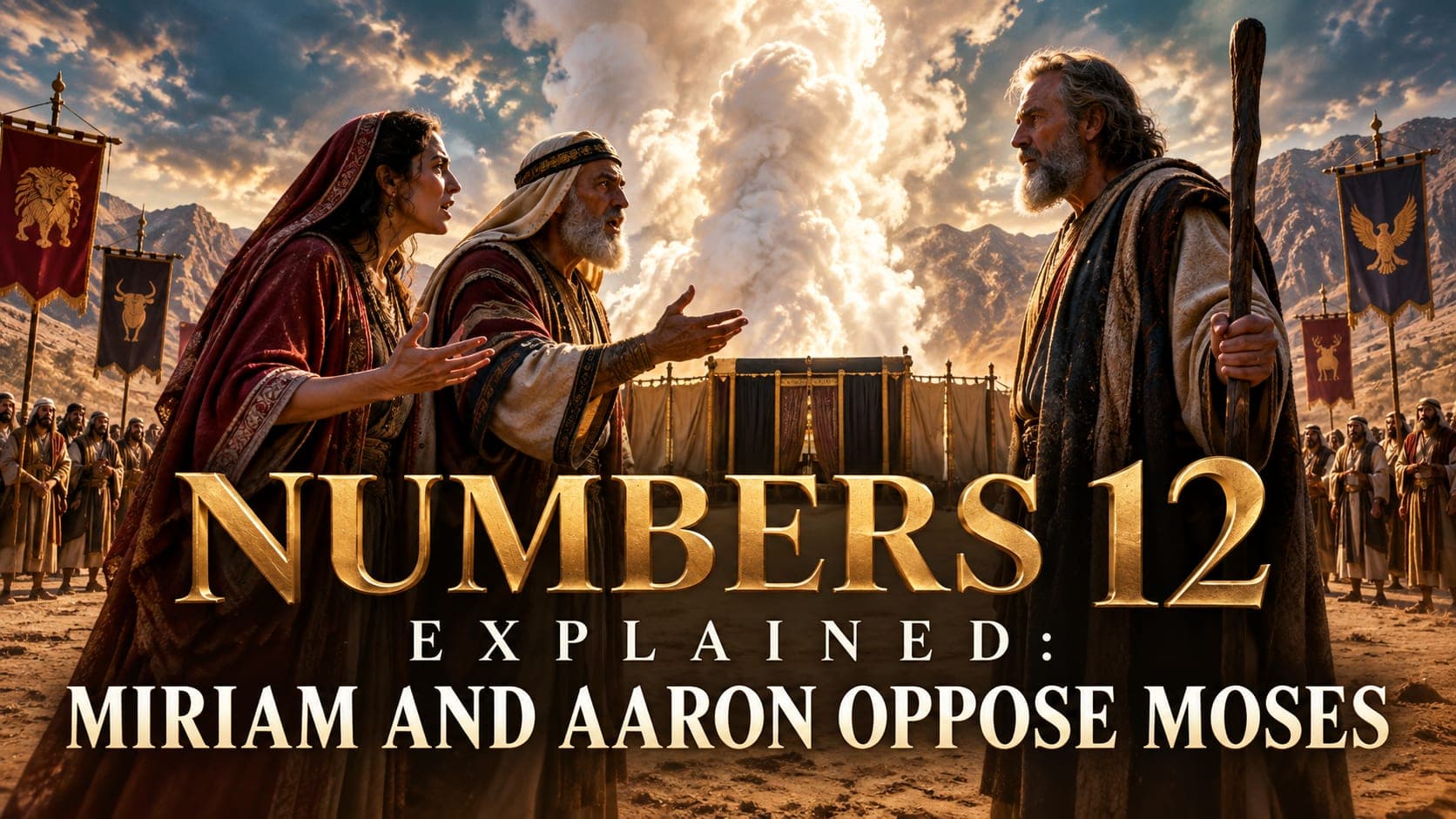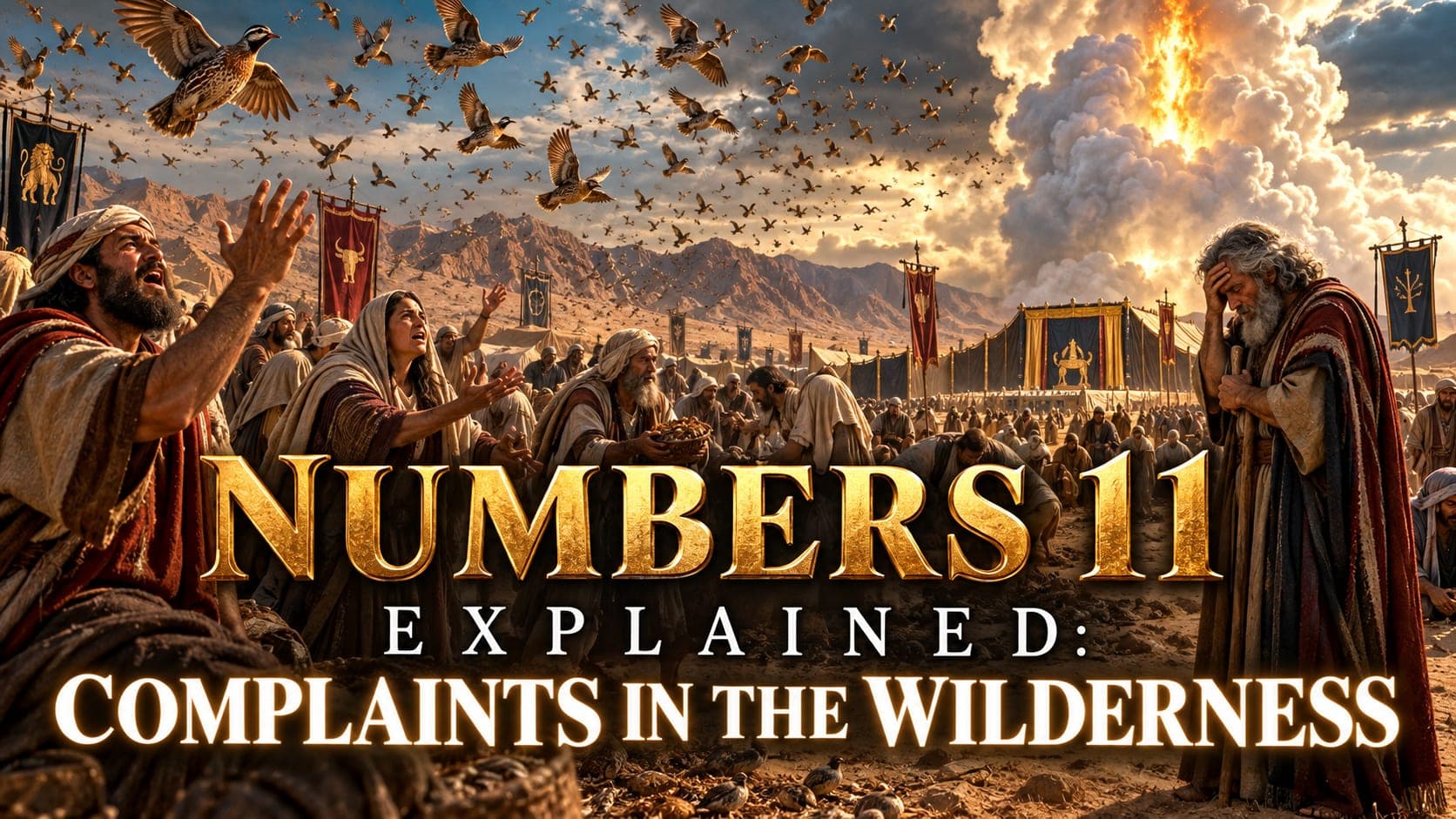
📖 Numbers 11 Explained: Complaining, Quail, and Seventy Elders
Three days into the march, and the complaining has already started.
Numbers 11 explained is the chapter where Israel's brand new momentum out of Sinai runs straight into an old appetite for Egypt. A fire breaks out over complaining. A craving for meat turns into open weeping at every tent door. And the one man carrying the whole camp finally says he cannot do this alone anymore.
Maybe you know what it is like to be exhausted by a job nobody else seems able to share.
- ❓ Why did God get angry at a request He had already granted once before?
- ❓ Who were the seventy elders, and why did God choose that specific number?
- ❓ Why did Joshua want to stop two men from prophesying?
- ❓ And why did a feast of meat end in a plague?
📌 Numbers 11 is about the difference between a real need and a demanding craving, and about what happens when one leader tries to carry a whole nation's weight by himself.
This walkthrough goes through the chapter in order: the fire at Taberah, the craving for Egypt's food, Moses breaking under the weight of the people, God's answer of seventy elders, the quail that came with a warning attached, and the plague that followed it.
A hard chapter, and one that says more about complaining than almost any other in the Bible.
What Happened Just Before This Chapter
Numbers 10 ended with the cloud lifting after nearly a year camped at Sinai, the trumpets sounding, and the whole nation finally marching in the exact order God had assigned. Moses had just asked his brother in law Hobab to stay on as a guide, and the ark had gone ahead of the camp for three days, searching out a resting place.
Numbers 11 picks up at the end of that very same three day stretch. The march that closed the last chapter on such a high note, trumpets, order, a prayer for God to rise up and scatter His enemies, runs almost immediately into the opposite mood. The people who had just watched the cloud lift after a year of waiting are, within days, wishing they had never left the place the cloud lifted them from.

Numbers 11 Explained Verse by Verse
1. The Fire at Taberah (verses 1 to 3)
The chapter opens with no warning and no specific complaint named.
"And when the people complained, it displeased the LORD: and the LORD heard it; and his anger was kindled; and the fire of the LORD burnt among them, and consumed them that were in the uttermost parts of the camp."
📌 The text never says what, exactly, the people were complaining about in verse 1. It simply calls it complaining, and the fire that answers it burns at the edges of the camp, the "uttermost parts," rather than everywhere at once. Whatever started it, the response from God was immediate and visible.
Moses steps in the moment the people cry out, and the fire stops.
"And the people cried unto Moses; and when Moses prayed unto the LORD, the fire was quenched. And he called the name of the place Taberah: because the fire of the LORD burnt among them."
💡 Taberah means burning. A brand new name, given to a brand new place, only days into the journey, and it names a judgment rather than a victory. The camp that had just marched out under trumpets and a prayer for enemies to scatter now has a map marker for its own first failure.
2. Lusting After Egypt's Food (verses 4 to 9)
Taberah barely has time to cool before a second, more specific complaint starts.
"And the mixt multitude that was among them fell a lusting: and the children of Israel also wept again, and said, Who shall give us flesh to eat?"
Exodus 12 already mentioned this detail: a "mixed multitude" left Egypt alongside the children of Israel, people who were not necessarily descendants of Jacob but had joined the departure anyway. Here they are named as the ones whose craving starts the complaint, and the rest of the camp follows them into it. Then the complaint gets specific.
"We remember the fish, which we did eat in Egypt freely; the cucumbers, and the melons, and the leeks, and the onions, and the garlick: But now our soul is dried away: there is nothing at all, beside this manna, before our eyes."
⚠️ Notice what gets called free. Egypt was slavery. The fish and vegetables being missed came from the same land where Pharaoh worked them under taskmasters and ordered their children killed. Memory, when it is hungry enough, edits out the chains and only keeps the menu.
Right in the middle of the complaint, the chapter pauses to describe the very thing they are tired of.
"And the manna was as coriander seed, and the colour thereof as the colour of bdellium. And the people went about, and gathered it, and ground it in mills, or beat it in a mortar, and baked it in pans, and made cakes of it: and the taste of it was as the taste of fresh oil."
💡 This description does not quite match the one in Exodus 16, and the difference is worth noticing rather than explaining away. Exodus 16:31 says raw manna tasted "like wafers made with honey." Numbers 11:8 describes manna that has been ground in mills and baked into cakes, and says that tasted like fresh oil. Two different preparations of the same food, described at two different points, not two contradictory reports about the same bite.
3. Moses Breaks Under the Weight (verses 10 to 15)
The weeping does not stay quiet, and it does not stay contained to one spot in the camp.
"Then Moses heard the people weep throughout their families, every man in the door of his tent: and the anger of the LORD was kindled greatly; Moses also was displeased."
📌 Every family, every tent door, all at once. This was not a handful of loud voices. It was the sound of an entire camp, and Moses hears all of it land on him at the same time God hears it.
What comes out of Moses next is some of the rawest honesty in the whole book.
"And Moses said unto the LORD, Wherefore hast thou afflicted thy servant? and wherefore have I not found favour in thy sight, that thou layest the burden of all this people upon me? Have I conceived all this people? have I begotten them, that thou shouldest say unto me, Carry them in thy bosom, as a nursing father beareth the sucking child, unto the land which thou swarest unto their fathers?"
💡 "As a nursing father beareth the sucking child" is Moses describing exactly what leading this people actually feels like to him. Not a title. Not an honor. A grown man carrying a crying infant that is not his own, for a distance he never agreed to and cannot put down.
Moses finishes by asking God to end his life rather than make him carry it any further.
"I am not able to bear all this people alone, because it is too heavy for me. And if thou deal thus with me, kill me, I pray thee, out of hand, if I have found favour in thy sight; and let me not see my wretchedness."
⚠️ This is the same man who argued Pharaoh into letting Israel go and who has interceded for this people more than once already. He is not weak for saying this. He is at the end of something real, and he says so out loud to God instead of quietly collapsing or quietly quitting.
4. Seventy Elders to Share the Burden (verses 16, 17, 24, and 25)
God does not answer Moses' complaint by removing the people. He answers it by multiplying the leadership.
"And the LORD said unto Moses, Gather unto me seventy men of the elders of Israel, whom thou knowest to be the elders of the people, and officers over them; and bring them unto the tabernacle of the congregation, that they may stand there with thee."
"And I will come down and talk with thee there: and I will take of the spirit which is upon thee, and will put it upon them; and they shall bear the burden of the people with thee, that thou bear it not thyself alone."
📌 "That thou bear it not thyself alone" answers Moses' complaint almost word for word. This is not the first time someone has told Moses to stop carrying everything by himself. Exodus 18 already recorded Jethro telling him to appoint judges over thousands, hundreds, fifties, and tens, so that they could "bear the burden" with him. That earlier plan handled everyday disputes. This one is different. God Himself takes the spirit already resting on Moses and shares it with seventy men, not to settle arguments, but to carry a weight no human arrangement alone could lighten.
The moment itself happens exactly as promised.
"And Moses went out, and told the people the words of the LORD, and gathered the seventy men of the elders of the people, and set them round about the tabernacle. And the LORD came down in a cloud, and spake unto him, and took of the spirit that was upon him, and gave it unto the seventy elders: and it came to pass, that, when the spirit rested upon them, they prophesied, and did not cease."
💡 Giving the spirit to seventy men never meant Moses had less of it. The text does not describe division, as if a fixed portion got split seventy one ways. It describes multiplication, the same spirit resting on more people at once, so one man's burden became seventy one men's shared work.
5. Meat Until It Comes Out Your Nostrils (verses 18 to 23)
Alongside the plan for Moses, God answers the people's actual complaint too, and the answer comes with a warning built in.
"And say thou unto the people, Sanctify yourselves against to morrow, and ye shall eat flesh: for ye have wept in the ears of the LORD, saying, Who shall give us flesh to eat? for it was well with us in Egypt: therefore the LORD will give you flesh, and ye shall eat."
"Ye shall not eat one day, nor two days, nor five days, neither ten days, nor twenty days; But even a whole month, until it come out at your nostrils, and it be loathsome unto you: because that ye have despised the LORD which is among you, and have wept before him, saying, Why came we forth out of Egypt?"
⚠️ God grants the request, and the granting is itself the discipline. A whole month of meat, until the very thing they wept for becomes sickening to them. The craving was never really about an empty stomach. It was about rejecting the God who was already feeding them, and the abundance He sends exposes exactly that.
Moses, hearing the scale of what is promised, cannot picture how it is even possible.
"And Moses said, The people, among whom I am, are six hundred thousand footmen; and thou hast said, I will give them flesh, that they may eat a whole month. Shall the flocks and the herds be slain for them, to suffice them? or shall all the fish of the sea be gathered together for them, to suffice them?"
God's answer to that doubt is as short as the question was long.
"And the LORD said unto Moses, Is the LORD’s hand waxed short? thou shalt see now whether my word shall come to pass unto thee or not."
📌 Moses had just told God the burden was too heavy for one man to carry. Here he is asking whether God's own hand is too short to provide. The same chapter catches both the leader and the people doubting whether God's resources match the need in front of them, and answers both doubts the same way: not with an argument, but with provision.
6. Eldad, Medad, and Joshua's Jealousy (verses 26 to 30)
Not every man chosen for the spirit was actually standing at the tabernacle when it fell.
"But there remained two of the men in the camp, the name of the one was Eldad, and the name of the other Medad: and the spirit rested upon them; and they were of them that were written, but went not out unto the tabernacle: and they prophesied in the camp."
💡 "They were of them that were written" matters here. Eldad and Medad were already on the list of seventy. They simply stayed in the camp instead of going out to the tabernacle, and the spirit found them there anyway. Whatever God was doing was not limited to one building.
Joshua's reaction is immediate, and it comes from loyalty, not malice.
"And there ran a young man, and told Moses, and said, Eldad and Medad do prophesy in the camp. And Joshua the son of Nun, the servant of Moses, one of his young men, answered and said, My lord Moses, forbid them."
Moses' answer is the opposite of threatened.
"And Moses said unto him, Enviest thou for my sake? would God that all the LORD’s people were prophets, and that the LORD would put his spirit upon them!"
📌 Joshua wanted to protect Moses' position. Moses did not want a position that needed protecting from more people hearing from God. A man who had just complained about carrying the burden alone is, a few verses later, hoping out loud that everyone in the camp would get to carry some of what he carries.
7. The Quail, the Plague, and Kibrothhattaavah (verses 31 to 35)
The promise from verses 18 to 20 arrives exactly as described, and in the exact scale Moses could not picture.
"And there went forth a wind from the LORD, and brought quails from the sea, and let them fall by the camp, as it were a day’s journey on this side, and as it were a day’s journey on the other side, round about the camp, and as it were two cubits high upon the face of the earth."
A day's journey in every direction, piled roughly knee high. This is not the small, ordinary quail migration Exodus 16 described once before at the start of the wilderness years. It is an answer sized to match the exact doubt Moses had just raised.
"And the people stood up all that day, and all that night, and all the next day, and they gathered the quails: he that gathered least gathered ten homers: and they spread them all abroad for themselves round about the camp."
⚠️ A full day and a full night and most of a second day spent gathering, and the chapter says the person who gathered the least still gathered ten homers. An abundance this far past reasonable need is its own kind of warning, not only a gift.
The judgment promised in verse 20 lands before anyone has even finished chewing.
"And while the flesh was yet between their teeth, ere it was chewed, the wrath of the LORD was kindled against the people, and the LORD smote the people with a very great plague. And he called the name of that place Kibrothhattaavah: because there they buried the people that lusted."
📌 Kibrothhattaavah means graves of lust. The camp now has two new names on its map from this single chapter, Taberah for burning and Kibrothhattaavah for the graves this craving dug, both earned in the space of a few days of marching. The chapter ends with the simplest possible sentence, moving the story forward.
"And the people journeyed from Kibrothhattaavah unto Hazeroth; and abode at Hazeroth."

Hard Questions Numbers 11 Raises
Why did God get angry about a request for meat when He had already sent quail once before, back in Exodus 16, without any anger attached? The two requests are not identical. In Exodus 16 the people had no food source at all yet, and God provided both manna and quail to meet a real, unmet need. By Numbers 11 the manna was already falling daily and had been for about a year. The complaint here is not that the people had nothing to eat. Verse 6 says plainly there was nothing "beside this manna," which concedes they were being fed. What had changed was not the provision but the gratitude for it, and Psalm 78:18 later names the difference directly: "they tempted God in their heart by asking meat for their lust."
Was it wrong for Moses to ask God to kill him? Scripture never condemns Moses for verse 15. What follows it is not rebuke but help: seventy elders, immediately, with no scolding attached. God's pattern across this chapter is to answer honest exhaustion with practical relief rather than a lecture about faith. That is worth noticing next to how differently God answers the people's complaint in the very same chapter.
Did Eldad and Medad keep prophesying after this chapter? The text does not say. It records one moment, the spirit resting on them in the camp, and Moses' response to Joshua, and then moves on without ever mentioning either man again by name anywhere else in Scripture.
Why does the manna taste like fresh oil here when Exodus 16:31 describes it as tasting like honey? The two verses describe different stages of the same food. Exodus 16:31 describes manna eaten in something closer to its raw state. Numbers 11:8 describes manna that has first been ground in mills or beaten in a mortar, then baked into cakes. A food that tastes like honey raw and like oil once ground and baked is a difference in preparation, not a disagreement between the two books about what manna actually was.
Top Verses From Numbers 11
1. Numbers 11:15
"And if thou deal thus with me, kill me, I pray thee, out of hand, if I have found favour in thy sight; and let me not see my wretchedness."
One of the most honest sentences any leader in the Bible ever says to God. Moses does not hide how heavy this job has become, and God does not punish him for saying so.
2. Numbers 11:17
"And I will come down and talk with thee there: and I will take of the spirit which is upon thee, and will put it upon them; and they shall bear the burden of the people with thee, that thou bear it not thyself alone."
God's direct answer to a leader who said the weight was too much. Shared leadership was His idea before it was anyone else's request.
3. Numbers 11:23
"And the LORD said unto Moses, Is the LORD’s hand waxed short? thou shalt see now whether my word shall come to pass unto thee or not."
A short answer to a long doubt. Moses could not picture how to feed six hundred thousand men for a month, and God simply asks whether His own hand is actually too short for it.
4. Numbers 11:29
"And Moses said unto him, Enviest thou for my sake? would God that all the LORD’s people were prophets, and that the LORD would put his spirit upon them!"
A leader who wanted the work shared, not guarded. Moses welcomes more people hearing from God instead of treating it as competition.
5. Psalm 78:30 and 31
"They were not estranged from their lust. But while their meat was yet in their mouths, The wrath of God came upon them, and slew the fattest of them, and smote down the chosen men of Israel."
A psalm written generations later, still describing the exact scene from Kibrothhattaavah: meat still in their mouths when the judgment fell. This chapter stayed in Israel's memory for a long time.

Frequently Asked Questions About Numbers 11
What is Numbers 11 about?
Numbers 11 covers a fire that breaks out over complaining at Taberah, the people craving Egypt's food instead of manna, Moses telling God the burden of leading them is too heavy to carry alone, seventy elders given the spirit to share that burden, a month of quail sent as both gift and judgment, and a plague that follows it at a place named Kibrothhattaavah.
What does Taberah mean?
Taberah means burning. Verse 3 names the place after the fire of the LORD that burned among the camp in response to the people's complaint in verse 1.
Who was the mixed multitude in Numbers 11?
Exodus 12:38 first describes a mixed multitude leaving Egypt alongside the children of Israel, people joined to the nation without necessarily descending from Jacob. Numbers 11:4 names this same group as the ones whose craving for meat starts the complaint the rest of the camp joins.
Why did Moses ask God to kill him?
Verses 11 to 15 record Moses overwhelmed by the weight of leading a whole nation through weeping, hunger, and complaint, with no one else sharing the load. He asks for death rather than continued exhaustion, and God answers with practical help rather than rebuke.
Why seventy elders specifically?
Verse 16 has God instruct Moses to gather seventy men already recognized as elders and officers over the people. The text does not explain the exact number beyond that it matched the recognized leadership already in place, now given the spirit to formally share Moses' burden.
Why did Joshua want to stop Eldad and Medad from prophesying?
Verses 27 and 28 show Joshua reacting out of loyalty to Moses, treating the two men prophesying away from the tabernacle as something irregular that needed correcting. Moses refuses, saying he wishes every person in the camp had the same spirit on them.
Why did the quail come with a warning attached?
Verses 19 and 20 have God promise meat for a full month, until it becomes loathsome, specifically because the people despised Him while demanding it. The abundance itself was shaped to expose the craving behind the complaint, not just satisfy it.
What does Kibrothhattaavah mean?
Kibrothhattaavah means graves of lust. Verse 34 names the place this way because of the people who died there in the plague that followed their craving for meat.
How much quail actually fell in Numbers 11?
Verse 31 describes quail covering an area roughly a day's journey in every direction around the camp, piled about two cubits, roughly knee high. Verse 32 adds that the person who gathered the least still gathered ten homers.
Why did God punish the people after giving them exactly what they asked for?
The request itself was the problem, not the food. Verse 20 states the people despised the LORD who was already among them and providing for them. Getting the meat did not undo the contempt behind asking for it that way, and the plague in verse 33 falls while that same attitude was still present, meat still between their teeth.
Final Thoughts
Numbers 11 is a hard chapter, but it does not end with only a warning.
📌 Complaining is not the same as asking. The people had a real God, already feeding them daily, and still chose to grieve over a slavery they were remembering wrong. Taberah and Kibrothhattaavah both trace back to that one habit.
📌 God answered an honest leader's exhaustion with help, not shame. Moses said the burden was too heavy, and seventy men received the spirit the very same day, with no lecture attached first.
📌 Sharing the work was never a threat to the one carrying it. Moses welcomed more people hearing from God, even two who never left the camp to get it.
You are probably not gathering quail by the homer. But the same question still sits underneath your own complaints: are you remembering what God has actually given you, or only what you have decided you are missing.
So here is your one next step.
Name one thing you have been complaining about this week, and ask honestly whether it is a real need or a craving dressed up as one.