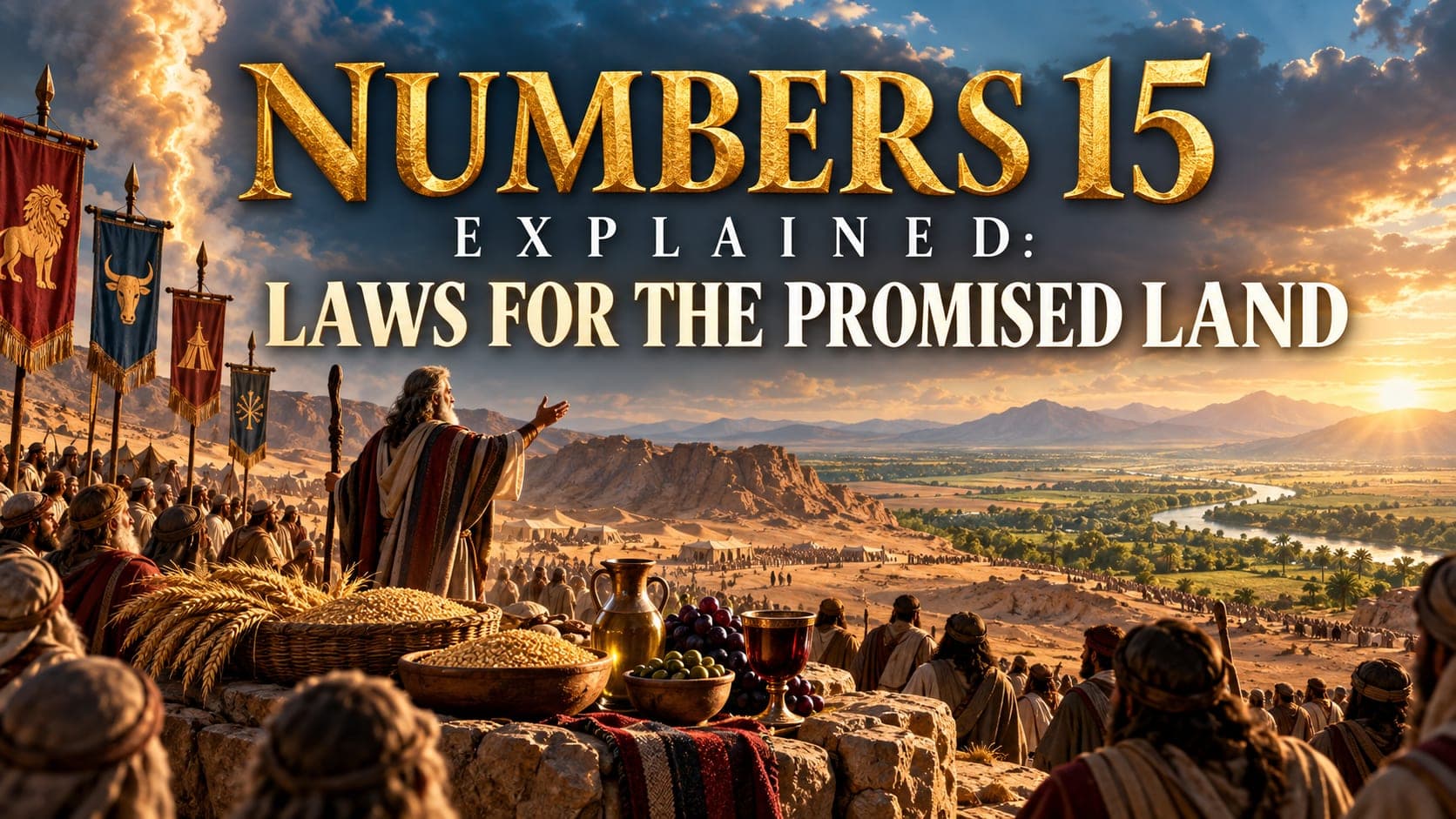
📖 Numbers 15 Explained: Offerings, the Sabbath, and the Fringe
One sentence of judgment. And right behind it, page after page of brand new law.
Numbers 15 explained is the strangest piece of timing in the book so far. Numbers 14 just finished sentencing an entire generation to die in the wilderness, every single one of them twenty years old and up, with only their children ever set to see the land. The very next thing God does is hand Moses detailed instructions for exactly how to worship once inside that land. Laws for people who, by the chapter before this one, are not going to be the ones who get there.
Maybe you have kept building toward something you were told you would not personally get to see finished.
- ❓ Why give land laws to people who just found out they are not going to the land?
- ❓ What is the real difference between an honest mistake and a sin done with a high hand?
- ❓ Why did a man who broke the Sabbath have to sit in custody before anyone decided what to do with him?
- ❓ What do tassels on a garment have to do with any of this?
📌 Numbers 15 answers the fear of the chapter before it with a promise the chapter before it never said out loud: the land is still coming. Just not for the people standing here right now.
This walkthrough goes through the whole chapter in order: the offerings meant for a land not yet reached, the dough lifted up to God before anyone eats a bite of it, the line between an honest mistake and open defiance, one man's sentence decided in real time, and the blue thread meant to catch a wandering eye before it wanders again.
A quieter chapter than the one before it. No less serious.
What Happened Just Before This Chapter
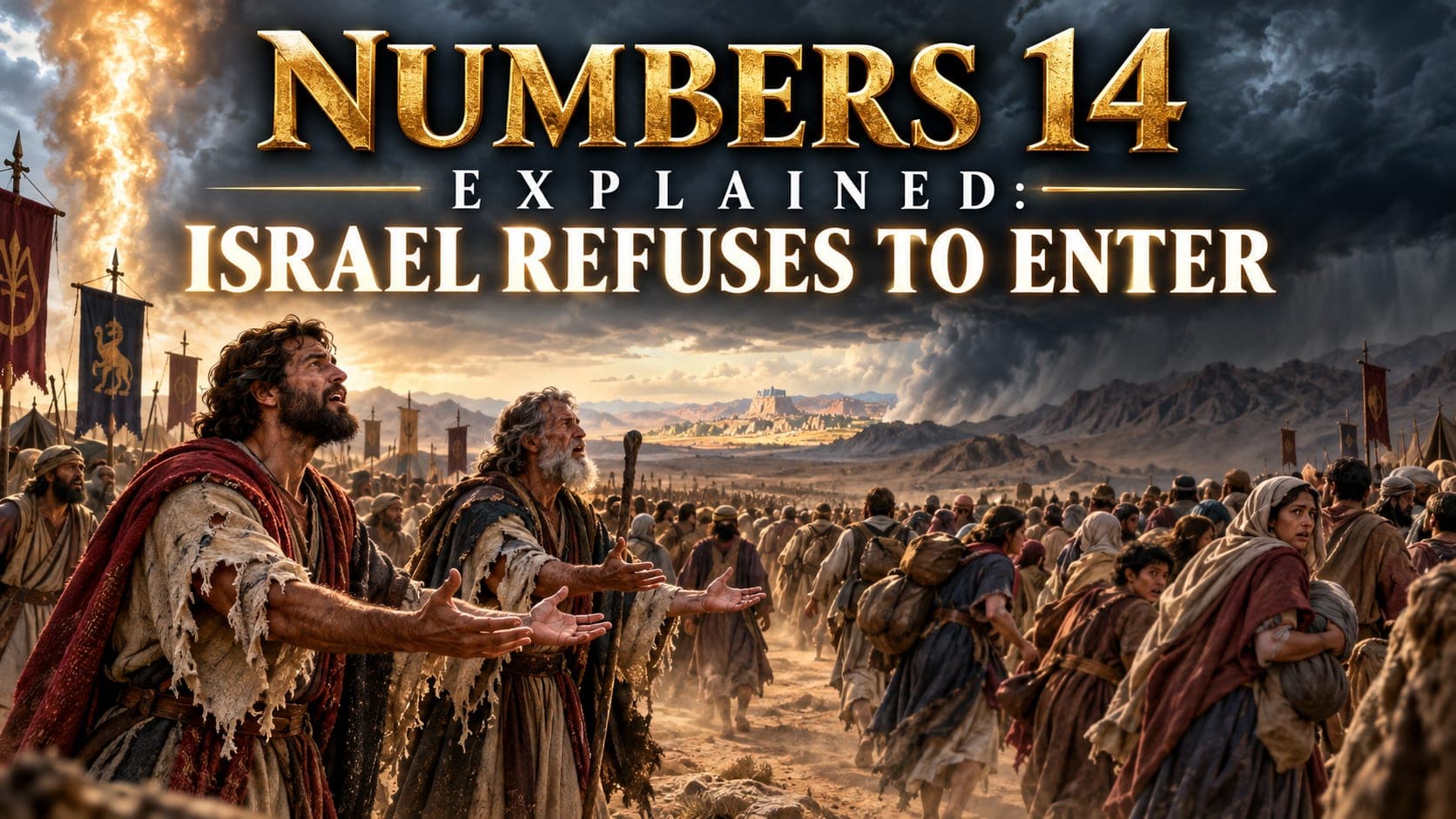
Numbers 14 ended about as low as this book gets. Ten spies came back afraid, the whole camp talked about stoning the two men who told them the truth, and God offered to start over with Moses alone. Moses talked Him out of destroying the nation, but the sentence on that specific generation still stood: forty years of wandering, one year for every day the spies spent in the land, until every adult who had refused to trust God for it was dead. A group tried to force their way up the hill anyway, without the ark and without Moses, and were beaten back to Hormah for it.
That is the mood this chapter opens into. Not a victory lap. A camp that has just been told it lost the one thing it had been walking toward for a year and a half, now listening to God talk about the land as if nothing had changed at all.
Numbers 15 Explained Verse by Verse
1. New Laws for a Land This Generation Will Never Enter (verses 1 to 16)
The chapter opens with a phrase that would have landed hard on anyone who had just heard Numbers 14.
"And the LORD spake unto Moses, saying, Speak unto the children of Israel, and say unto them, When ye be come into the land of your habitations, which I give unto you, And will make an offering by fire unto the LORD, a burnt offering, or a sacrifice in performing a vow, or in a freewill offering, or in your solemn feasts, to make a sweet savour unto the LORD, of the herd, or of the flock:"
📌 "When ye be come into the land" is not a maybe. God does not say "if you ever get there" or soften it with any doubt at all. He speaks about the land as a settled fact, in the same breath as the chapter that just took it away from the adults listening to Him say it. The promise was never actually in question. Only who would be alive to walk into it.
What follows is a set of specific recipes, scaled to the offering being brought.
"Then shall he that offereth his offering unto the LORD bring a meat offering of a tenth deal of flour mingled with the fourth part of an hin of oil. And the fourth part of an hin of wine for a drink offering shalt thou prepare with the burnt offering or sacrifice, for one lamb."
👀 A lamb calls for a smaller measure of flour, oil, and wine. A ram calls for more. A bullock, the largest animal named, calls for the most of all. The portions grow with the size of the gift, verse after verse, as if God is making sure no one brings a large animal and a small heart to go with it.
Then the chapter widens who this applies to.
"One ordinance shall be both for you of the congregation, and also for the stranger that sojourneth with you, an ordinance for ever in your generations: as ye are, so shall the stranger be before the LORD. One law and one manner shall be for you, and for the stranger that sojourneth with you."
💡 "As ye are, so shall the stranger be." The stranger here is a foreigner living among Israel, not a citizen by birth. The law does not create two tracks, one stricter and one looser. It states, twice in two verses, one law for both. Whatever these offerings meant for Israel, they meant the same thing for anyone living alongside them who brought one.
2. The First of Your Dough, Lifted Up to God (verses 17 to 21)
A second instruction follows the same opening, and moves from the altar to the kitchen.
"Then it shall be, that, when ye eat of the bread of the land, ye shall offer up an heave offering unto the LORD. Ye shall offer up a cake of the first of your dough for an heave offering: as ye do the heave offering of the threshingfloor, so shall ye heave it. Of the first of your dough ye shall give unto the LORD an heave offering in your generations."
A heave offering is lifted up and set apart before the rest gets eaten. Not the leftover end of the loaf, the first of the dough, before anyone at the table has taken a bite. This was not a tax collected at harvest time once a year. It was built into ordinary meals, every time bread got made, in a land Israel had not even reached yet.
3. An Honest Mistake, and a Sin Done With a High Hand (verses 22 to 31)
The chapter turns from offerings owed to sin committed, and it draws a sharp line through the middle of it.
"Then it shall be, if ought be committed by ignorance without the knowledge of the congregation, that all the congregation shall offer one young bullock for a burnt offering, for a sweet savour unto the LORD, with his meat offering, and his drink offering, according to the manner, and one kid of the goats for a sin offering. And the priest shall make an atonement for all the congregation of the children of Israel, and it shall be forgiven them; for it is ignorance."
"And if any soul sin through ignorance, then he shall bring a she goat of the first year for a sin offering. ... Ye shall have one law for him that sinneth through ignorance, both for him that is born among the children of Israel, and for the stranger that sojourneth among them."
👀 Two kinds of accidental sin, the whole congregation together and one person alone, and both paths lead to the same place: a sacrifice, an atonement, and forgiveness. Leviticus 4 already laid out this same category, sin through ignorance, and Numbers 15 restates it here and stretches it over the stranger as well as the native born. A mistake, even a serious one, had a way back built into it from the start.
Then the chapter names the one category that offering can never reach.
"But the soul that doeth ought presumptuously, whether he be born in the land, or a stranger, the same reproacheth the LORD; and that soul shall be cut off from among his people. Because he hath despised the word of the LORD, and hath broken his commandment, that soul shall utterly be cut off; his iniquity shall be upon him."
📌 "Presumptuously" here is the old translation of a Hebrew phrase that reads, more literally, "with a high hand." It describes a raised, defiant fist, not a lowered, careless one. The difference between the sins in this chapter was never about how much damage was done. It was about whether the person doing it knew exactly what God said and did it anyway, eyes open. That kind of sin, the text says plainly, has no offering waiting for it here.
Hebrews draws almost the same line centuries later, describing a sin that leaves nothing left to offer for it.
"For if we sin wilfully after that we have received the knowledge of the truth, there remaineth no more sacrifice for sins,"
💡 Not a claim that God refuses to forgive defiance. A warning that willful, open eyed sin is a different thing from a mistake, and that calling it a mistake when it was not one does not make the offering for mistakes apply to it.
4. One Man, One Sabbath, and a Sentence Decided in Real Time (verses 32 to 36)
Straight after defining what a high handed sin is, the chapter gives you an actual one, in progress.
"And while the children of Israel were in the wilderness, they found a man that gathered sticks upon the sabbath day. And they that found him gathering sticks brought him unto Moses and Aaron, and unto all the congregation. And they put him in ward, because it was not declared what should be done to him."
👀 Exodus 31 had already made working on the Sabbath a capital matter in principle, long before this day in the wilderness. What was missing was not the law. It was a precedent for exactly how to carry it out, in front of a whole watching camp, for a case this specific. So they held him, rather than acting on their own, and waited for God to answer that gap directly.
"And the LORD said unto Moses, The man shall be surely put to death: all the congregation shall stone him with stones without the camp. And all the congregation brought him without the camp, and stoned him with stones, and he died; as the LORD commanded Moses."
⚠️ Gathering sticks sounds small. That is exactly the point the chapter just made about a high hand. This was not a man caught stealing or striking someone in anger. It was an ordinary task, done openly, on the one day a known command had set apart. The size of the act was never the issue in verse 30. Knowing the command and doing it anyway was.
5. Tassels to Remember, Not to Decorate (verses 37 to 41)
The chapter closes with the smallest, most physical law in it.
"Speak unto the children of Israel, and bid them that they make them fringes in the borders of their garments throughout their generations, and that they put upon the fringe of the borders a ribband of blue: And it shall be unto you for a fringe, that ye may look upon it, and remember all the commandments of the LORD, and do them; and that ye seek not after your own heart and your own eyes, after which ye use to go a whoring:"
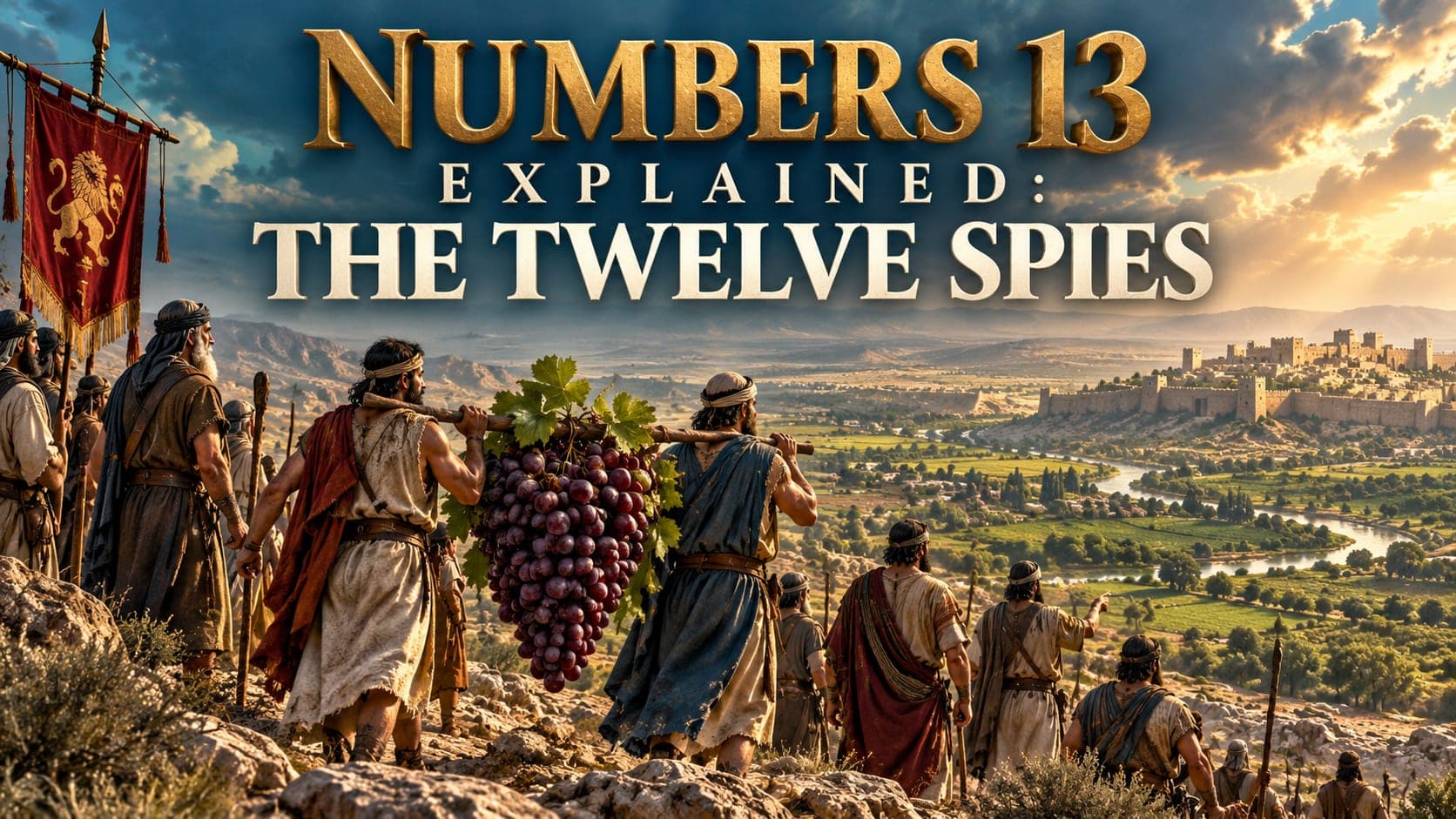
📌 "Your own eyes" is not a throwaway phrase in this book. Two chapters earlier, Numbers 13 recorded ten spies describing themselves as grasshoppers "in our own sight," a verdict about the enemy that was really a report about their own fear. That failure, trusting what their eyes told them over what God had already said, is the exact habit this fringe is built to interrupt. A small blue thread, stitched into the corner of everyday clothing, with one job: to catch the eye before the eye wanders somewhere it shouldn't.
Deuteronomy repeats the same command further into the wilderness years, almost in passing, as something Israel is simply still expected to be wearing.
"Thou shalt make thee fringes upon the four quarters of thy vesture, wherewith thou coverest thyself."
The chapter ends the same way it keeps circling back to God's own name as the reason for all of it.
"That ye may remember, and do all my commandments, and be holy unto your God. I am the LORD your God, which brought you out of the land of Egypt, to be your God: I am the LORD your God."
💡 "I am the LORD your God" closes the verse twice, back to back. After a whole chapter of offerings, dough, mistakes, defiance, and one death sentence, the chapter does not end on a rule. It ends on who gave it.

Hard Questions Numbers 15 Raises
Why give detailed land laws right after sentencing this generation to die outside the land? The two facts sit together without contradicting each other. Numbers 14 removed the adults standing there from ever entering Canaan. It never removed Canaan from the promise. These laws are addressed to whoever eventually does come into the land, which Numbers 14 had already said would still happen, just through the children rather than the parents listening to this chapter.
What is the actual difference between sin through ignorance and sin with a high hand? Not the size of the act or the damage it caused. Verses 22 through 29 cover mistakes, something done without realizing it broke a command. Verse 30 covers someone who knew the command and broke it anyway, on purpose. The text draws the line at knowledge and intent, not consequence.
Did a man really deserve to die for gathering a few sticks? The chapter does not soften this question, and it should not be softened for him. What it does make clear is that this was never framed as a punishment for firewood. It was the first real test case of the high handed sin verse 30 had just defined, a known command broken in plain sight, at the exact moment the nation most needed to relearn what trusting God's word actually looked like.
Why hold the man in custody instead of stoning him immediately, if Exodus 31 already made Sabbath breaking a capital matter? The principle was not new. The specific case was. Verse 34 says plainly that it was not yet declared what should be done to him, which reads as a question about procedure in this instance, not a question about whether the law applied at all.
Why does the stranger get full protection under this law? The text states it twice without qualifying it, in verse 16 for the offerings and verse 29 for sins of ignorance. A foreigner living among Israel was not left outside the system of atonement this chapter describes. The same law, and the same way back from an honest mistake, applied to both.
Top Verses From Numbers 15
1. Numbers 15:30 and 31
"But the soul that doeth ought presumptuously, whether he be born in the land, or a stranger, the same reproacheth the LORD; and that soul shall be cut off from among his people. Because he hath despised the word of the LORD, and hath broken his commandment, that soul shall utterly be cut off; his iniquity shall be upon him."
The clearest line in the chapter: knowing what God said and doing it anyway is a different category of sin than an honest mistake, no matter how the act itself looks from the outside.
2. Numbers 15:39
"And it shall be unto you for a fringe, that ye may look upon it, and remember all the commandments of the LORD, and do them; and that ye seek not after your own heart and your own eyes, after which ye use to go a whoring:"
A direct answer to the spies' failure in Numbers 13: a physical reminder stitched into daily life, meant to interrupt the moment a wandering eye starts deciding the truth instead of God's word.
3. Numbers 15:41
"I am the LORD your God, which brought you out of the land of Egypt, to be your God: I am the LORD your God."
Every offering, every law, every sentence in this chapter traces back to one fact stated twice in one breath: who God already is to this people, before any rule was ever given.
4. Hebrews 10:26
"For if we sin wilfully after that we have received the knowledge of the truth, there remaineth no more sacrifice for sins,"
The New Testament picking up the exact same distinction Numbers 15 draws: a mistake and a known, willful choice are not weighed the same way.

Frequently Asked Questions About Numbers 15
What is Numbers 15 about?
Numbers 15 covers offering laws for when Israel eventually enters the promised land, the heave offering of the first dough, the difference between sin committed through ignorance and sin committed presumptuously, the death of a man found gathering sticks on the Sabbath, and the command to wear fringes with a blue thread as a reminder of God's commandments.
Why does Numbers 15 give land laws right after Numbers 14's judgment?
Numbers 14 sentenced the adult generation to die in the wilderness without entering Canaan, but it never cancelled the promise of the land itself. Numbers 15 speaks to whoever eventually does come into it, which was always going to be true even though it would be the children, not the parents, who saw it.
What is the difference between sin through ignorance and sin with a high hand?
Verses 22 through 29 describe sin committed without realizing it broke a command, covered by a sacrifice and forgiven. Verse 30 describes sin committed by someone who knew exactly what God said and broke it anyway. The difference is knowledge and intent, not how serious the act looks.
What does "cut off from among his people" mean?
Verses 30 and 31 use it for a defiant, high handed sin that no sacrifice in this chapter covers. It describes being removed from the covenant community God is addressing, rather than being offered a sin offering the way an honest mistake was.
Why was the man who gathered sticks on the Sabbath put to death?
Exodus 31 had already made deliberate Sabbath breaking a capital matter. Numbers 15:32 to 36 records the first specific case of it reaching the camp, and the people held the man rather than acting on their own until God gave the exact sentence.
What is a heave offering?
Verses 19 to 21 describe it as a cake made from the first of the dough, lifted up and given to the LORD before the rest of the bread was eaten. It applied to ordinary meals, not only to harvest time offerings.
Did the stranger really get the same law as native born Israelites in Numbers 15?
Yes. Verses 15 and 16 state one ordinance and one law for both, and verse 29 repeats the same principle for sins committed through ignorance. The text draws no separate, lesser category for the stranger living among Israel.
What do the fringes in Numbers 15:38 mean?
A fringe with a blue thread, worn on the corners of everyday clothing, meant to be looked at as a reminder to keep God's commandments instead of following wherever the eyes and heart wander on their own.
How does Numbers 15 connect to the spies in Numbers 13 and 14?
Numbers 13:33 records the spies describing themselves as grasshoppers "in our own sight," trusting what their eyes told them over God's word. Numbers 15:39 answers that exact failure with a command not to seek "after your own heart and your own eyes," placing the lesson of the spy story into something Israel would wear every day.
Are the fringes from Numbers 15 still worn today?
Observant Jewish men still wear fringed garments called tzitzit, tracing the practice back to this command and its repetition in Deuteronomy 22:12. The purpose Numbers 15:39 gives, a visual reminder of God's commandments, is the same reason given for wearing them today.
Final Thoughts
Numbers 15 reads like a pause after a disaster. It is really the opposite.
📌 A promise does not end because the people in front of you failed it. God kept speaking about the land in the present tense to a generation that had just lost its own place in it, because the land was never only about them.
📌 An honest mistake and a known, willful choice are not the same sin, even when the act looks identical from the outside. This chapter built a whole legal category around that difference, and then handed you a real case to measure it against.
📌 What you keep looking at shapes what you end up trusting. The fringe was never decoration. It was aimed at the exact habit, following your own eyes, that had already cost this generation everything two chapters earlier.
You are not wearing a blue thread on your clothing. But you probably have something that plays the same role, or should.
So here is your one next step.
Name one ordinary thing in your day, a reminder on your wall, a verse on your phone, a habit before you eat, that could do for you what the fringe was built to do: catch your eye before it wanders somewhere your own heart would rather go.