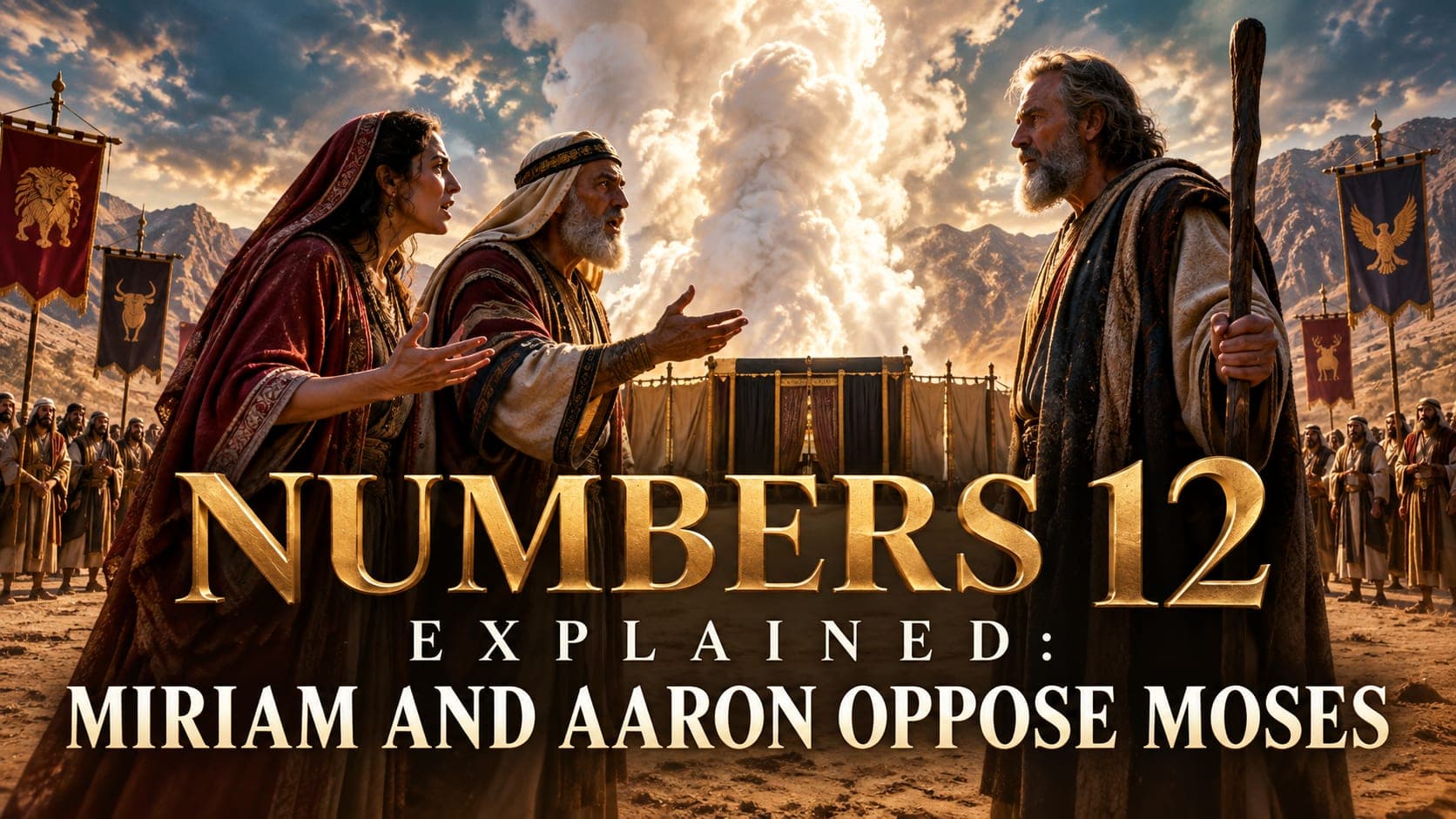
📖 Numbers 12 Explained: Miriam, Aaron, and the Woman Moses Married
One sentence about a marriage. One much bigger question hiding right behind it.
Numbers 12 explained is the shortest serious conflict in this book so far, and one of the strangest. Moses' own sister and brother open their mouths against him over the woman he married. Within two verses the real complaint turns out to be something else entirely, and before the chapter ends, one of them is standing outside the camp covered in leprosy.
Maybe you have watched a complaint about something small turn out to be about something much bigger, once people actually started talking.
- ❓ Was this really about who Moses married?
- ❓ Why did only Miriam get struck with leprosy, when the text says both of them spoke?
- ❓ Why does God compare ordinary prophets to Moses like this, out loud, in front of both accusers?
- ❓ And why did an entire nation have to stop marching for one woman's sake?
📌 Numbers 12 is not really about marriage. It is about who gets to speak for God, and what happens when two people who already carry real authority want more of it.
This walkthrough goes through the chapter in order: the accusation and the question underneath it, God's sudden summons, His own defense of Moses, the cloud that departed, Miriam's leprosy, Aaron's plea, Moses' one line prayer, and the seven days the whole camp spent waiting on one woman to be well.
A short chapter, and a sharp warning about jealousy hiding inside a smaller complaint.
What Happened Just Before This Chapter
Numbers 11 ended at Kibrothhattaavah, the graves of lust, after a month of quail and a plague that followed it. The camp had barely moved on to the next stop, Hazeroth, before the trouble in this chapter starts.
Numbers 11 was a conflict between Moses and an exhausted, hungry crowd. Numbers 12 is a conflict between Moses and the two people closest to him in the whole camp, his own sister and his own brother, the prophetess who once led the women in song at the Red Sea and the high priest who carried the names of all twelve tribes on his chest. This complaint comes from the top, not the bottom, and the chapter treats it far more seriously because of that.

Numbers 12 Explained Verse by Verse
1. The Complaint About the Cushite Wife, and the Real Issue Underneath It (verses 1 and 2)
The chapter opens with a single stated reason, repeated twice in one sentence for emphasis.
"And Miriam and Aaron spake against Moses because of the Ethiopian woman whom he had married: for he had married an Ethiopian woman."
"Ethiopian" here translates the Hebrew word for Cushite, a woman from Cush. Scripture never says when this marriage happened or names her, and the text moves on from the subject almost as fast as it raises it. What matters more than the wife herself is what Miriam and Aaron say in the very next breath.
"And they said, Hath the LORD indeed spoken only by Moses? hath he not spoken also by us? And the LORD heard it."
📌 Notice how fast the subject changes. Verse 1 is about a marriage. Verse 2 is about authority. The complaint about the wife never gets argued any further in the whole chapter. What God actually answers, at length, is the claim that Moses has no more right to speak for Him than Miriam or Aaron do.
That claim was not coming from nobody. Exodus 15 already called Miriam "the prophetess," and Aaron was the high priest God Himself had set apart. Both of them already carried real, God given authority. The sin here is not two nobodies pretending to a status they never had. It is two people with genuine standing deciding it was not enough.
2. A Rare Line From the Narrator: Moses Was Very Meek (verse 3)
Right in the middle of the accusation, the narration pauses to say something about the man being accused.
"(Now the man Moses was very meek, above all the men which were upon the face of the earth.)"
💡 This verse sits in parentheses in most English translations because it reads like an aside, not part of the flowing story. Moses does not say one word in his own defense anywhere in this chapter. He does not argue back, does not remind his siblings who led them out of Egypt, does not even seem to answer at all. The narrator tells you why before God ever steps in: the man had nothing to prove and was not going to start proving it now.
⚠️ Meekness is not the same as weakness. A weak man stays silent because he has no answer. Moses stays silent while God Himself prepares one.
3. God Calls All Three Out, Suddenly (verses 4 and 5)
Moses never takes this to God. God brings it to all three of them Himself, without any warning given first.
"And the LORD spake suddenly unto Moses, and unto Aaron, and unto Miriam, Come out ye three unto the tabernacle of the congregation. And they three came out."
"And the LORD came down in the pillar of the cloud, and stood in the door of the tabernacle, and called Aaron and Miriam: and they both came forth."
📌 "Suddenly" is the word that sets the tone for the rest of the chapter. This is not a slow, patient correction worked out over weeks. God interrupts whatever the three of them were doing, in front of each other, and makes this a face to face matter before it can turn into camp wide gossip. Notice, too, that verse 5 calls Aaron and Miriam forward specifically, while Moses stays where he is. He is not one of the people being summoned to answer. He is the one being defended.
4. God Defends Moses: Dreams, Riddles, and a Friend Who Sees Him Face to Face (verses 6 to 8)
What follows is one of the clearest descriptions anywhere in Scripture of what made Moses different.
"And he said, Hear now my words: If there be a prophet among you, I the LORD will make myself known unto him in a vision, and will speak unto him in a dream. My servant Moses is not so, who is faithful in all mine house. With him will I speak mouth to mouth, even apparently, and not in dark speeches; and the similitude of the LORD shall he behold: wherefore then were ye not afraid to speak against my servant Moses?"
👀 A true prophet of Israel still normally heard God through a vision or a dream, in "dark speeches," meaning riddles and symbols that needed interpreting.
👀 Moses received something else. "Mouth to mouth" and "apparently" both point to direct, plain speech, not something coded that had to be decoded afterward.
💡 "Faithful in all mine house" is the key phrase God uses to explain the difference. This was never about Moses being more gifted or more spiritual than Miriam and Aaron. It was about a specific role God had given him, built on a track record of faithfulness in it. Exodus 33 already described this exact relationship in almost the same words, "the LORD spake unto Moses face to face, as a man speaketh unto his friend." Numbers 12 is God saying the same thing again, this time as a direct rebuke to the two people questioning it.
The question that closes verse 8, "wherefore then were ye not afraid," is not really a question. It names exactly what was missing from Miriam and Aaron's complaint: a healthy fear of criticizing a man God Himself had already set apart this far.
5. The Cloud Departs, and Miriam Becomes Leprous (verses 9 and 10)
God does not finish with a lecture. The consequence lands before anyone has time to respond.
"And the anger of the LORD was kindled against them; and he departed. And the cloud departed from off the tabernacle; and, behold, Miriam became leprous, white as snow: and Aaron looked upon Miriam, and, behold, she was leprous."
⚠️ The cloud leaving and Miriam's skin turning white happen in the same breath. The visible sign of God's presence withdraws, and a visible sign of judgment appears in its place. Under the law this book keeps describing, a condition like this meant immediate separation from the rest of the camp, exactly the kind of case Leviticus 13 had already laid out rules for.
Only Miriam is struck, even though verse 1 names both of them as speaking. The text puts her name first both at the start of the complaint and at the end of the judgment, which is as much of an answer as the chapter gives for why the consequence lands on her specifically rather than on both of them equally.
6. Aaron's Plea, and Moses' One Line Prayer (verses 11 to 13)
Aaron does not go to God directly. He goes to the brother he was just accusing a few verses earlier.
"And Aaron said unto Moses, Alas, my lord, I beseech thee, lay not the sin upon us, wherein we have done foolishly, and wherein we have sinned. Let her not be as one dead, of whom the flesh is half consumed when he cometh out of his mother’s womb."
📌 "My lord" from Aaron to Moses is worth sitting with. This is the high priest, speaking to the brother he had just put on the same level as himself a few verses ago, now asking that same brother to go to God for him. Whatever Aaron believed about shared authority in verse 2, he clearly believes something different about who can actually fix this.
Moses does not make him wait, and does not make him ask twice.
"And Moses cried unto the LORD, saying, Heal her now, O God, I beseech thee."
💡 Eight words of actual request, from a man who had just been publicly accused by the people he is now praying for. This is the meekness from verse 3 showing up in action rather than only in description. Moses does not negotiate, does not ask for an apology first, does not even pause. He simply asks God to heal his sister.
7. Seven Days Outside the Camp, and the Whole Nation Waits (verses 14 to 16)
God answers the prayer, but not by removing the consequence instantly. He shortens it and shapes it instead.
"And the LORD said unto Moses, If her father had but spit in her face, should she not be ashamed seven days? let her be shut out from the camp seven days, and after that let her be received in again."
Spitting in someone's face was a recognized picture of public disgrace in that culture, the kind of shame a family simply had to sit with for a set number of days before life went back to normal. God reaches for an image Miriam and everyone listening would already understand, rather than inventing a new one. Seven days, not a lifetime, and not undefined. A real consequence with a real end date already attached to it.
"And Miriam was shut out from the camp seven days: and the people journeyed not till Miriam was brought in again. And afterward the people removed from Hazeroth, and pitched in the wilderness of Paran."
📌 "The people journeyed not till Miriam was brought in again" is the detail easiest to read past and the one worth stopping on longest. Numbers 9 already set the rule that governed this whole camp for forty years: move when the cloud moves, stay when it stays, for however long that takes. Here the same pattern repeats on a much smaller scale. An entire nation, counted by the hundreds of thousands, stayed camped at Hazeroth for one woman's sake, not because the cloud told them to, but because leaving her behind was never on the table.

Hard Questions Numbers 12 Raises
Who was the Ethiopian woman Moses married? Scripture never says, and this is a question Bible teachers answer two different ways. Some read her as Zipporah, the Midianite wife Exodus 2 already introduced, pointing out that Habakkuk 3:7 later pairs Cushan and Midian together as if the names overlapped in that region. On that view, nothing new happened here at all, Miriam and Aaron were simply objecting to a marriage everyone already knew about. Others read this as a different, later marriage to an actual woman from Cush, a view with roots in old Jewish tradition outside the Bible itself rather than in the text of Numbers. Scripture does not settle which reading is correct, and this is a place honest readers hold the question open.
Why did only Miriam get leprosy, when verse 1 says both Miriam and Aaron spoke against Moses? The text does not explain this directly. It does name Miriam first both at the start of the complaint and the end of the judgment, which many Bible teachers take as a sign she was the one who led it, with Aaron following along. The chapter states the fact without spelling out every reason behind it.
Did Moses really write a verse praising his own meekness? Traditional Jewish and Christian teaching holds Moses as the author of the first five books of the Bible, this one included. Read that way, verse 3 is not Moses boasting. It is a plain, almost clinical statement of fact, written under inspiration, serving the same purpose Moses' own silence serves in the rest of the chapter: explaining why he never once defends himself.
Was leprosy really the punishment that fit this particular sin? The text does not spell out why God chose this specific consequence over any other. It is worth noticing, without claiming more certainty than the chapter gives, that leprosy meant exactly what Miriam had just objected to in someone else: being set apart from the rest of the camp. Scripture states the judgment plainly and leaves readers to sit with that connection rather than explaining it outright.
Top Verses From Numbers 12
1. Numbers 12:3
"(Now the man Moses was very meek, above all the men which were upon the face of the earth.)"
A rare direct statement about Moses' character, placed right before he refuses to defend himself even once in the rest of the chapter.
2. Numbers 12:8
"With him will I speak mouth to mouth, even apparently, and not in dark speeches; and the similitude of the LORD shall he behold: wherefore then were ye not afraid to speak against my servant Moses?"
God's own description of what set Moses apart from every other prophet, and the closest thing in the chapter to an answer for why this complaint mattered so much.
3. Numbers 12:13
"And Moses cried unto the LORD, saying, Heal her now, O God, I beseech thee."
One of the shortest prayers in Scripture, prayed on behalf of the very sister who had just accused him, without a single condition attached.
4. Numbers 12:15
"And Miriam was shut out from the camp seven days: and the people journeyed not till Miriam was brought in again."
A whole nation waiting on one woman's restoration before taking another step. Discipline here never meant being forgotten.
5. Exodus 33:11
"And the LORD spake unto Moses face to face, as a man speaketh unto his friend."
The same relationship Numbers 12 defends, described earlier in almost identical words. What God says here was never a new claim invented on the spot to settle an argument.

Frequently Asked Questions About Numbers 12
What is Numbers 12 about?
Numbers 12 covers Miriam and Aaron speaking against Moses over his marriage to an Ethiopian woman, their deeper challenge to his unique authority, God defending Moses directly, Miriam being struck with leprosy, Aaron's plea and Moses' prayer for her, and the seven days the whole camp waited at Hazeroth before Miriam was allowed back in.
Who was the Ethiopian woman Moses married?
Scripture never names her or settles the question. Some Bible teachers identify her with Zipporah, Moses' Midianite wife from Exodus 2, reading "Ethiopian" as describing the same general region. Others hold she was a separate wife, a view that comes from Jewish tradition outside the Bible text itself rather than from Numbers 12.
Was Numbers 12 really about who Moses married?
The marriage is only mentioned in verse 1. Verse 2 moves immediately to the real complaint, whether Moses had any more right to speak for God than Miriam and Aaron did. Everything God answers in the rest of the chapter addresses that second question, not the first one.
Why did only Miriam get leprosy, if Aaron spoke against Moses too?
The text does not give a direct reason. It names Miriam first both when the complaint starts in verse 1 and when the leprosy appears in verse 10, which many readers take as a sign she led the complaint, with Aaron speaking up alongside her.
What does it mean that Moses was "very meek"?
It describes a man who did not need to defend his own position, even when his authority was directly questioned by his own family. Verse 3 states this as fact, and the rest of the chapter shows it in practice: Moses never argues back, and prays for Miriam's healing without hesitation.
What does "mouth to mouth" mean in Numbers 12:8?
It describes direct, plain communication, contrasted with the visions, dreams, and "dark speeches," meaning riddles, that ordinary prophets received. God used it to explain why speaking against Moses was more serious than ordinary disagreement.
Why did God compare Moses to other prophets instead of just rebuking Miriam and Aaron?
Their claim in verse 2 was a direct comparison, asking whether God spoke only through Moses or also through them. God's answer meets that comparison head on, explaining exactly what made His relationship with Moses different rather than simply forbidding the question.
Why did the whole camp have to wait seven days for Miriam?
Verse 15 states it plainly: the people did not journey until Miriam was brought back in. The text gives no indication anyone considered leaving her behind, even temporarily, while the camp moved on without her.
What does "as one dead, of whom the flesh is half consumed" mean in verse 12?
Aaron is describing how severe Miriam's condition looked, comparing it to a stillborn child whose body had already begun to decay. It is the language of real alarm, not exaggeration for effect, from a brother watching his sister's skin turn white in front of him.
How does Numbers 12 connect to the rest of the wilderness story?
It repeats a pattern the wilderness years keep returning to: real judgment paired with a built in mercy. The leprosy was real and serious, but it had a fixed end point from the moment God announced it, the same shape seen in the second Passover of Numbers 9 and the quail of Numbers 11.
Final Thoughts
Numbers 12 is short, but it does not waste a single verse.
📌 Jealousy rarely announces itself honestly. Miriam and Aaron's real complaint was about authority, and it still came out of their mouths dressed as a complaint about a marriage.
📌 Meekness let Moses stay silent while God defended him. A man with nothing to prove did not need to argue his own case, and prayed for the sister who accused him the moment she needed it.
📌 Judgment and mercy still arrived together. Seven days, with an end date attached from the start, and a whole camp that would not move on without Miriam.
You probably are not comparing yourself to a sibling's unique calling from God. But the same question still applies: when someone else is doing the exact job God actually gave them, is any part of you quietly wanting more of their place instead of your own.
So here is your one next step.
Name the last time you felt entitled to a role or a recognition that was never actually assigned to you, and bring it honestly to God instead of dressing it up as something smaller.