📖 Numbers 21 Explained: The Bronze Serpent and Sihon's Defeat
A battle won. A plague of snakes. A pole lifted up that Jesus Himself would later point to.
Numbers 21 explained is the chapter where this whole wandering story finally starts moving forward. After two straight chapters of death, burial, and a verdict that kept Moses and Aaron out of the promised land, Israel wins its first real battle, survives its own complaint turned deadly, and begins taking actual ground east of the Jordan.
Maybe you have been in a season where nothing but bad news seemed to land.
- ❓ Why does God send snakes as punishment for the same old complaint He has heard for forty years?
- ❓ Why does looking at a bronze snake on a pole heal a snakebite?
- ❓ Isn't a bronze image exactly the kind of thing God told Israel never to make?
- ❓ Who are Sihon and Og, and why does beating them matter so much?
📌 This chapter turns a symbol of the curse into the one place Israel could look and live, centuries before Jesus pointed back to it and said that is Me.
This walkthrough goes through the whole chapter in order: the victory at Hormah, the fiery serpents and the bronze serpent God provides, the long march with its strange little song to a well, and the two kings, Sihon and Og, whose defeat hands Israel its first real territory.
A short chapter that covers more ground, literally and spiritually, than almost any other in Numbers.
What Happened Just Before This Chapter
Numbers 20 closed out with two deaths and one verdict. Miriam died at Kadesh. Moses struck the rock instead of speaking to it, and both he and Aaron were told they would not enter the promised land because of it. Edom refused Israel safe passage along the king's highway, forcing a detour. Then Aaron himself died on Mount Hor, stripped of his priestly garments in full view of the camp, and the whole house of Israel mourned him thirty days.
Numbers 21 picks up right where that detour leaves off. Israel is moving again, skirting Edom's border, and for the first time in a long while, the news in this book is not only grief and judgment. A fight breaks out, and Israel actually wins it.

Numbers 21 Explained Verse by Verse
1. Victory at Hormah (verses 1 to 3)
The chapter opens with an attack, not a complaint, for once.
"And when king Arad the Canaanite, which dwelt in the south, heard tell that Israel came by the way of the spies; then he fought against Israel, and took some of them prisoners."
📌 "The way of the spies" is not a throwaway detail. It is the same route the twelve men took in Numbers 13, the mission that led to the whole generation's forty years of wandering when ten of them came back afraid. Israel is now walking, decades later, straight back through the territory that began this entire story. This time the response is different.
"And Israel vowed a vow unto the LORD, and said, If thou wilt indeed deliver this people into my hand, then I will utterly destroy their cities. And the LORD hearkened to the voice of Israel, and delivered up the Canaanites; and they utterly destroyed them and their cities: and he called the name of the place Hormah."
💡 Hormah means destruction. Instead of running from a threat the way the earlier generation ran from the giants' report, this Israel vows, fights, and wins. It is a small, local battle, but after so many chapters of defeat and death inside the camp itself, it is the first time in a long while that the enemy, rather than Israel, is the one who loses.
2. Discouragement, Complaint, and Fiery Serpents (verses 4 to 6)
The victory does not last long before the old pattern returns.
"And they journeyed from mount Hor by the way of the Red sea, to compass the land of Edom: and the soul of the people was much discouraged because of the way."
"And the people spake against God, and against Moses, Wherefore have ye brought us up out of Egypt to die in the wilderness? for there is no bread, neither is there any water; and our soul loatheth this light bread."
⚠️ Notice the complaint is not just against Moses this time. It is against God directly, by name. The detour around Edom was long, and the people had heard this same promise of bread and water met before, more than once. What changes here is not the complaint. It is the response to it.
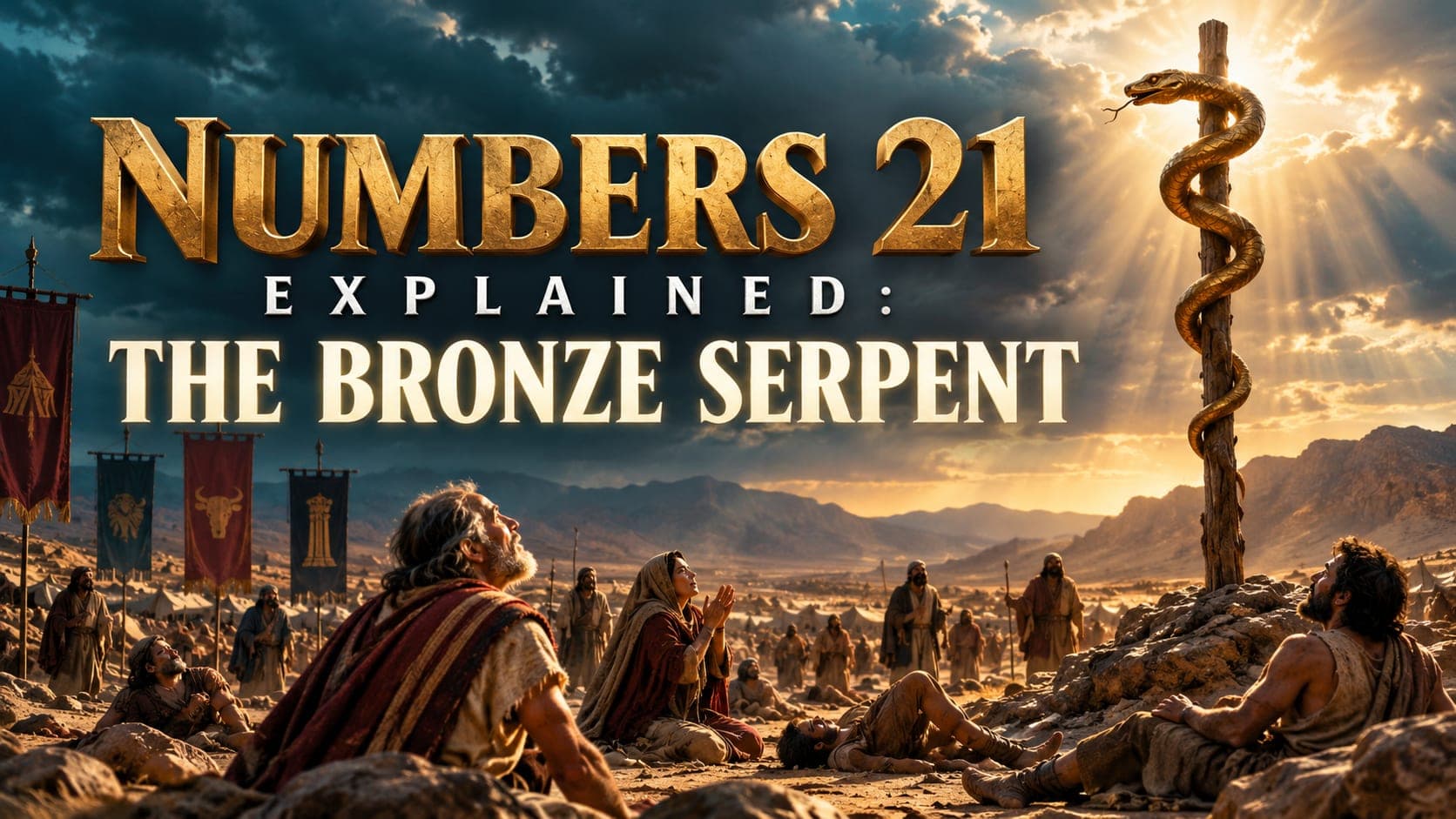
"And the LORD sent fiery serpents among the people, and they bit the people; and much people of Israel died."
The text does not give a death count here the way it does for some other judgments in this book. It only says "much people of Israel died," a real and painful loss left without a number attached to it.
3. The Bronze Serpent on a Pole (verses 7 to 9)
This time, unlike some earlier complaints in this book, the people respond immediately.
"Therefore the people came to Moses, and said, We have sinned, for we have spoken against the LORD, and against thee; pray unto the LORD, that he take away the serpents from us. And Moses prayed for the people."
📌 No argument, no blame shifted onto someone else. "We have sinned" comes first, and Moses prays for the very people who had just complained against him. God's answer, though, is not simply to remove the serpents.
"And the LORD said unto Moses, Make thee a fiery serpent, and set it upon a pole: and it shall come to pass, that every one that is bitten, when he looketh upon it, shall live."
"And Moses made a serpent of brass, and put it upon a pole, and it came to pass, that if a serpent had bitten any man, when he beheld the serpent of brass, he lived."
💡 The cure looks like the curse. A bronze snake, shaped like the very thing biting them, lifted up where a bitten person had to look at it on purpose to live. There was nothing in the metal itself that healed anyone. The healing was tied to simple, visible obedience: look, and live.
⚠️ This is the only place in the law where God commands an image to be made and looked at, after spending so much of this book guarding Israel from exactly that kind of worship. The difference is not subtle once you read it closely. The serpent was never worshiped here. It was looked at, once, as an act of trust in what God said He would do through it.
Centuries later, Jesus reached back to this exact image to explain His own purpose.
"And as Moses lifted up the serpent in the wilderness, even so must the Son of man be lifted up:"
"That whosoever believeth in him should not perish, but have eternal life."
📌 This is not a later interpretation layered onto the text. It is Jesus' own words, comparing His own death directly to this bronze serpent lifted up on a pole. A dying people, bitten by their own sin, told to look at the one thing lifted up for them and live. Jesus says that pattern is Him.
4. The Long March and the Song of the Well (verses 10 to 20)
After the crisis passes, the chapter slows down into a travel log, naming one stop after another as Israel presses toward Moab.
"And the children of Israel set forward, and pitched in Oboth. And they journeyed from Oboth, and pitched at Ijeabarim, in the wilderness which is before Moab, toward the sunrising."
💡 The text even cites an outside source for part of this itinerary, "the book of the wars of the LORD," a record that no longer survives anywhere today. Scripture quotes it by name here without explaining what else it contained or where it went. It is one of several ancient documents the Bible mentions in passing that simply have not come down to us.
At one stop, the mood shifts from a bare list of names into an actual song.
"And from thence they went to Beer: that is the well whereof the LORD spake unto Moses, Gather the people together, and I will give them water."
"Then Israel sang this song, Spring up, O well; sing ye unto it: The princes digged the well, the nobles of the people digged it, by the direction of the lawgiver, with their staves."
📌 Compare this to verse 5, where the same nation complained bitterly about no water and no bread. Here, when the water comes, the response is singing, with the princes and nobles themselves doing the digging rather than leaving it to someone else. One generation's worth of water crises produced one angry complaint and, right here, one genuine song. Both responses sit inside the very same chapter.
5. Sihon King of the Amorites Defeated (verses 21 to 32)
Israel tries the same approach that failed with Edom, this time with the Amorite king who controls the road ahead.
"And Israel sent messengers unto Sihon king of the Amorites, saying, Let me pass through thy land: we will not turn into the fields, or into the vineyards; we will not drink of the waters of the well: but we will go along by the king’s high way, until we be past thy borders."
"And Sihon would not suffer Israel to pass through his border: but Sihon gathered all his people together, and went out against Israel into the wilderness: and he came to Jahaz, and fought against Israel."
⚠️ Sihon is not provoked. He is the one who gathers his army and marches out to attack Israel first, after being offered the exact same courteous request Edom had already refused. Where Israel turned away from Edom rather than fight a relative, there is no such restraint required here. Sihon starts the battle, and Israel finishes it.
"And Israel smote him with the edge of the sword, and possessed his land from Arnon unto Jabbok, even unto the children of Ammon: for the border of the children of Ammon was strong."
This is new. Not a battle survived, not a plague ended, but actual land taken and held, the first real territory Israel possesses anywhere in this whole book. The text pauses to quote a taunting proverb about the fallen city of Heshbon.
"Wherefore they that speak in proverbs say, Come into Heshbon, let the city of Sihon be built and prepared: For there is a fire gone out of Heshbon, a flame from the city of Sihon: it hath consumed Ar of Moab, and the lords of the high places of Arnon."
💡 This proverb was not written about Israel. It describes Sihon's own earlier conquest of Moab, before Israel ever arrived, quoted here to show how thoroughly the city Israel just took had already changed hands by force once before. Heshbon falls to Israel the same way it had fallen to Sihon.
6. Og King of Bashan Defeated (verses 33 to 35)
One king down, Israel turns north, and a second king comes out to meet them the same way Sihon did.
"And they turned and went up by the way of Bashan: and Og the king of Bashan went out against them, he, and all his people, to the battle at Edrei."
"And the LORD said unto Moses, Fear him not: for I have delivered him into thy hand, and all his people, and his land; and thou shalt do to him as thou didst unto Sihon king of the Amorites, which dwelt at Heshbon."
📌 "Fear him not" is worth sitting with. Og was known later in Scripture as a king of unusual size, and his approach with his whole army could easily have revived the same fear that paralyzed the earlier generation back at Kadesh-barnea. This time God names the outcome before the battle even starts.
"So they smote him, and his sons, and all his people, until there was none left him alive: and they possessed his land."
Two kings, two kingdoms, taken in a single chapter. This land east of the Jordan, stretching from the Arnon to Bashan, becomes the first real inheritance Israel ever holds, and it sets up the territory the tribes of Reuben, Gad, and half of Manasseh will later settle in, long before the rest of the nation ever crosses into Canaan itself.

Hard Questions Numbers 21 Raises
Why did God send fiery serpents for a complaint He had heard many times before? The text does not explain why this particular complaint, in verse 5, drew this particular judgment when earlier complaints in this book drew other responses. What is clear from the chapter itself is that the people recognized it as sin immediately, in verse 7, without the text excusing the complaint either way.
Isn't making a bronze image exactly what the law forbids? God Himself commands this specific image in verse 8, the only time in the law He does so. The text draws a clear line between making the serpent, which God commanded, and worshiping it, which He never commanded and which later became a real problem. Centuries later, King Hezekiah had to deal with exactly that drift.
"He removed the high places, and brake the images, and cut down the groves, and brake in pieces the brasen serpent that Moses had made: for unto those days the children of Israel did burn incense to it: and he called it Nehushtan."
By Hezekiah's time, people were burning incense to the very object Moses had made at God's own instruction, centuries after it had done its job. Hezekiah destroyed it. The object God commanded in Numbers 21 and the idol some of Israel later made of it are not treated as the same thing by the text.
Does the bronze serpent actually point to Jesus, or is that read into the text? Numbers 21 itself makes no mention of a future savior. It is Jesus Himself, not a later Christian interpreter, who draws the comparison directly in John 3:14 and 15, naming His own being lifted up as the fulfillment of what Moses lifted up in the wilderness.
Was Israel the aggressor against Sihon and Og? The text says otherwise on both counts. Verses 21 through 23 show Israel asking only for peaceful passage, the same request already refused by Edom, before Sihon gathers his army and attacks first. Verse 33 shows Og marching out against Israel the same way. Neither battle in this chapter opens with an Israelite attack.
Why is the place called Hormah here, when Numbers 14:45 already used that same name for an earlier Israelite defeat in roughly the same region? Scripture records both without reconciling them. One possibility the text leaves open is that the name was given, or confirmed, more than once for the same general area across different events separated by decades. The text itself does not resolve the overlap, and neither should a reader claim more certainty about it than Scripture gives.
Top Verses From Numbers 21
1. Numbers 21:8 and 9
"And the LORD said unto Moses, Make thee a fiery serpent, and set it upon a pole: and it shall come to pass, that every one that is bitten, when he looketh upon it, shall live."
A cure shaped like the curse, lifted up where a dying person had to choose to look at it. The healing was always tied to trust, not to the metal itself.
2. John 3:14 and 15
"And as Moses lifted up the serpent in the wilderness, even so must the Son of man be lifted up: That whosoever believeth in him should not perish, but have eternal life."
Jesus Himself names this chapter as a picture of His own death, long before any Christian writer drew the comparison for Him.
3. Numbers 21:3
"And the LORD hearkened to the voice of Israel, and delivered up the Canaanites; and they utterly destroyed them and their cities: and he called the name of the place Hormah."
The first clean victory in a book that had mostly recorded defeat, death, and judgment up to this point. Hormah means destruction, and for once it describes the enemy's fate, not Israel's.
4. Numbers 21:17
"Then Israel sang this song, Spring up, O well; sing ye unto it:"
The same nation that complained bitterly about thirst a few verses earlier breaks into song when the water actually comes. Both reactions sit in the very same chapter.
5. Numbers 21:34
"And the LORD said unto Moses, Fear him not: for I have delivered him into thy hand, and all his people, and his land; and thou shalt do to him as thou didst unto Sihon king of the Amorites, which dwelt at Heshbon."
A promise given before the battle, not after. God names the outcome ahead of time, against a king whose size alone could have revived the same fear that cost the earlier generation its future.

Frequently Asked Questions About Numbers 21
What is Numbers 21 about?
Numbers 21 covers Israel's victory over king Arad at Hormah, the plague of fiery serpents and the bronze serpent God provides to heal those bitten, the journey toward Moab including a song at a well, and the defeat of two kings, Sihon of the Amorites and Og of Bashan, which gives Israel its first real territory.
Why did God send fiery serpents to punish Israel?
Numbers 21:5 and 6 record the people speaking against both God and Moses over the long detour, and serpents being sent among them as a result. The text states the judgment without fully explaining why this complaint specifically drew this response.
What was the bronze serpent, and why did looking at it heal people?
Numbers 21:8 and 9 describe a serpent of brass set on a pole at God's command. Anyone bitten who looked at it lived. The healing was tied to the act of trusting and obeying what God said He would do, not to any power in the metal.
Isn't the bronze serpent an idol, the kind of image God forbids?
God Himself commands this one image in verse 8, which sets it apart from the idols the law forbids elsewhere. It became a problem only centuries later, when people started burning incense to it, and 2 Kings 18:4 records King Hezekiah destroying it for that reason.
How does the bronze serpent connect to Jesus?
Jesus makes the connection Himself in John 3:14 and 15, comparing His own being lifted up to the serpent Moses lifted up in the wilderness, so that whoever looks to Him in faith would live.
What happened to the bronze serpent later?
It survived for centuries until people began worshiping it. 2 Kings 18:4 says King Hezekiah broke it in pieces and called it Nehushtan, removing it along with other objects Israel had turned into idols.
Who were Sihon and Og?
Sihon was king of the Amorites at Heshbon, and Og was king of Bashan further north. Numbers 21:21 through 35 records both kings attacking Israel first, and Israel defeating both and taking their land.
Why does defeating Sihon and Og matter so much?
This is the first real territory Israel possesses in the entire book of Numbers, land east of the Jordan that later becomes the inheritance of the tribes of Reuben, Gad, and half of Manasseh, well before the rest of the nation crosses into Canaan.
What is "the book of the wars of the LORD"?
Numbers 21:14 quotes it by name as a source for part of Israel's travel record. It does not survive anywhere today, and Scripture does not describe its full contents or what happened to it.
Why does Israel sing a song to a well?
Numbers 21:16 through 18 records the princes and nobles themselves digging the well at Beer, and the nation responding with song rather than complaint, a striking contrast to the bitter water complaint earlier in the very same chapter.
Final Thoughts
Numbers 21 covers more emotional ground than its length suggests.
📌 The same chapter holds a deadly complaint and a joyful song. Verse 5 records bitter words over thirst. A few verses later, the people sing over a well their own princes dug. Both responses to hardship are real, and they sit side by side here.
📌 The cure for the curse was never hidden. It was lifted up to be looked at. The bronze serpent healed no one who refused to look. Centuries later, Jesus said that was always a picture of Himself.
📌 God named the victory before the battle started. "Fear him not" came before Og's army ever reached Israel. The fear that cost the earlier generation its future never got the chance to take root here.
You are probably not facing fiery serpents or an army at Edrei this week. But you likely know what it is to be worn down by a long detour, and to need something simple to look at instead of something complicated to fix on your own.
So here is your one next step.
Whatever is biting at you right now, bring it honestly to God the way Israel finally did in verse 7, instead of carrying it quietly until it spreads.