📖 Numbers 27 Explained: A New Inheritance and a New Leader
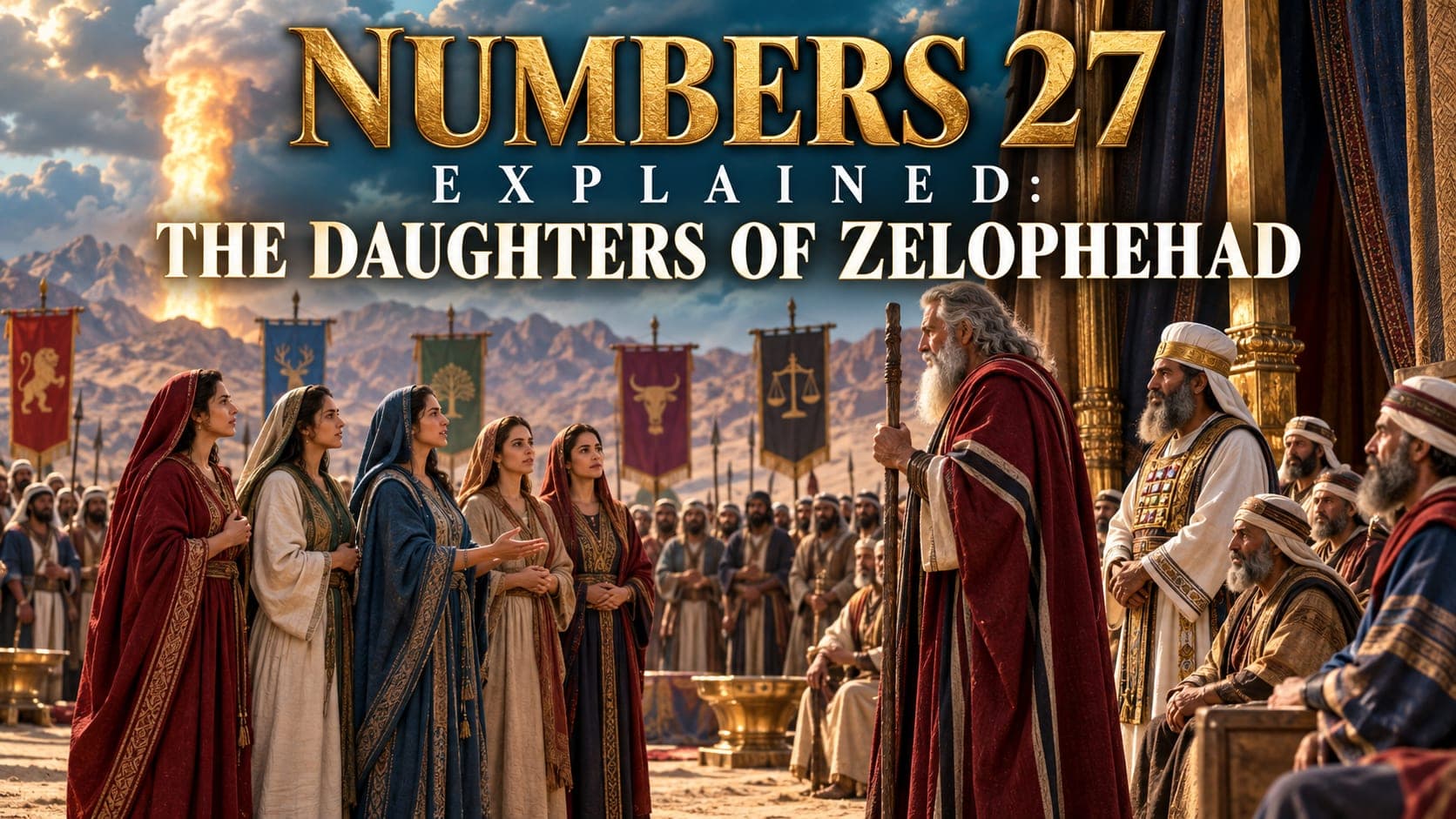
Five women walk up to the door of the tabernacle with no man standing in front of them to make their case.
Numbers 27 explained is the chapter where that one request reshapes the law for every family in Israel, and then, in the same breath, Moses learns exactly how and where his own story will end. A single chapter carries both a new inheritance rule and a new leader for the whole nation.
Maybe you have had to speak up for something fair, with nobody official standing beside you.
- ❓ Who were Zelophehad's daughters, and why does their request become law for the whole nation?
- ❓ Why does God bring up an old failure right before announcing that Moses will die?
- ❓ What does Moses ask for, once he knows his own time is almost over?
- ❓ Why is Joshua's authority handed to him through a priest instead of face to face with God?
📌 One family with no son forces a permanent answer out of God, and the man who led Israel out of Egypt spends his last recorded act asking for someone else to take care of them, not for himself.
This walkthrough goes through the whole chapter in order: the daughters' case at the tabernacle door, the ruling that becomes law for every future family like theirs, Moses being told to climb Mount Abarim and die, his request for a shepherd, and Joshua's public commissioning before Eleazar and the whole congregation.
Twenty three verses, and an entire changing of the guard happens inside them.
What Happened Just Before This Chapter
Numbers 26 closed out the second census, confirming that every man counted at Sinai decades earlier, except Caleb and Joshua, had died exactly as God swore back in Numbers 14. Tucked into that long list of names and numbers was one small, easy to miss detail: a man named Zelophehad, from the tribe of Manasseh, had no sons, only five daughters, named one by one in the middle of a military roll.
Numbers 27 picks that detail back up. The land is about to be divided by that same census, tribe by tribe, family by family. A family with no son has no obvious way to receive a share of it, and five daughters are not willing to let their father's name disappear from Israel without saying so.

Numbers 27 Explained Verse by Verse
1. Zelophehad's Daughters Step Forward (verses 1 to 4)
The chapter opens by tracing one family back four full generations before naming the women at the center of it.
"Then came the daughters of Zelophehad, the son of Hepher, the son of Gilead, the son of Machir, the son of Manasseh, of the families of Manasseh the son of Joseph: and these are the names of his daughters; Mahlah, Noah, and Hoglah, and Milcah, and Tirzah."
💡 Hepher, Gilead, Machir, Manasseh, Joseph. Scripture rarely spends a whole sentence on a genealogy this long for women about to speak, and it is not padding. It proves exactly who these five are and exactly where their claim to land sits inside the tribe, before a single word of their actual request is heard.
Notice where they choose to make their case.
"And they stood before Moses, and before Eleazar the priest, and before the princes and all the congregation, by the door of the tabernacle of the congregation, saying,"
📌 Five women, with no brother and no husband speaking for them in the text, stand at the most public and most sacred spot in the whole camp. Not a private appeal to one judge. The door of the tabernacle, in front of Moses, Eleazar, the tribal princes, and the entire congregation at once.
Then comes the case itself.
"Our father died in the wilderness, and he was not in the company of them that gathered themselves together against the LORD in the company of Korah; but died in his own sin, and had no sons."
"Why should the name of our father be done away from among his family, because he hath no son? Give unto us therefore a possession among the brethren of our father."
⚠️ The first thing they clear up is not their request. It is their father's record. They make sure everyone hears that Zelophehad was not part of Korah's rebellion, the same revolt the census one chapter earlier had just paused to remember. He died for his own ordinary sin, the common lot of everyone in that wilderness generation, not for joining an uprising against Moses and the LORD.
💡 "Done away from among his family" is the real weight behind their words. In a tribal system where land marked a family's permanent place in the nation, having no son meant having no legal way to hold on to that place at all. The daughters are not asking for a favor. They are asking whether their father ever existed, in any way that will still matter once the land is divided.
2. God Settles the Case, and Writes a Permanent Law (verses 5 to 11)
Moses does not rule on this himself.
"And Moses brought their cause before the LORD."
📌 The answer comes back immediate and completely on their side. No committee, no waiting period, no partial concession.
"The daughters of Zelophehad speak right: thou shalt surely give them a possession of an inheritance among their father's brethren; and thou shalt cause the inheritance of their father to pass unto them."
"Speak right" is as direct an endorsement as Scripture gives anyone making a legal appeal. But God does not stop at settling one family's case. He turns it into a standing rule for every family in Israel that will ever face the same situation.
"And thou shalt speak unto the children of Israel, saying, If a man die, and have no son, then ye shall cause his inheritance to pass unto his daughter."
"And if he have no daughter, then ye shall give his inheritance unto his brethren. And if he have no brethren, then ye shall give his inheritance unto his father's brethren. And if his father have no brethren, then ye shall give his inheritance unto his kinsman that is next to him of his family, and he shall possess it: and it shall be unto the children of Israel a statute of judgment, as the LORD commanded Moses."
💡 Five rungs, in order: son, daughter, brothers, father's brothers, nearest kinsman. The goal running through every rung is the same. A family's land, and the name attached to it, is never simply allowed to vanish for lack of a son. Daughters are not an afterthought in that list. They are the very first answer the law gives once a son is not there.
📌 One bold request at the tabernacle door becomes a statute of judgment for the entire nation. Five sisters with no legal standing of their own just changed what every future family in Israel could expect when a father died without a son.
3. Moses Is Told to Climb the Mountain and Die (verses 12 to 14)
Without any transition, the subject changes from a family's future to Moses' own ending.
"And the LORD said unto Moses, Get thee up into this mount Abarim, and see the land which I have given unto the children of Israel."
"And when thou hast seen it, thou also shalt be gathered unto thy people, as Aaron thy brother was gathered."
📌 God does not soften this. Moses is told to climb a mountain, look at a land he has spent forty years walking toward, and then die there, the same way Aaron already did on Mount Hor. Seeing it and entering it are two different gifts, and only one of them is still on the table.
The reason given is old news by now, but God names it again anyway.
"For ye rebelled against my commandment in the desert of Zin, in the strife of the congregation, to sanctify me at the water before their eyes: that is the water of Meribah in Kadesh in the wilderness of Zin."
💡 The failure is Numbers 20, where Moses struck the rock twice in frustration instead of simply speaking to it as commanded.
"And the LORD spake unto Moses and Aaron, Because ye believed me not, to sanctify me in the eyes of the children of Israel, therefore ye shall not bring this congregation into the land which I have given them."
⚠️ That sentence was spoken decades before this chapter, and it has not expired or softened with time. Moses led the nation faithfully through plagues, rebellions, a wilderness generation's death, and a second census, and the consequence from one bad afternoon at Meribah still stands waiting for him at the end of it. Scripture never treats this as unfair. It treats faithfulness and consequence as two things that can both be fully true about the same man at once.
Moses tells this same story himself, later, with the mountain named more specifically.
"Get thee up into this mountain Abarim, unto mount Nebo, which is in the land of Moab, that is over against Jericho; and behold the land of Canaan, which I give unto the children of Israel for a possession: And die in the mount whither thou goest up, and be gathered unto thy people; as Aaron thy brother died in mount Hor, and was gathered unto his people: Because ye trespassed against me among the children of Israel at the waters of MeribahKadesh, in the wilderness of Zin; because ye sanctified me not in the midst of the children of Israel. Yet thou shalt see the land before thee; but thou shalt not go thither unto the land which I give the children of Israel."
💡 Abarim is the mountain range, Nebo is the specific peak inside it. Numbers 27 gives the command in general terms. Deuteronomy, told near the very end of Moses' life, fills in exactly which summit it turned out to be.
4. Moses Asks for a Shepherd, Not for Himself (verses 15 to 17)
Given news of his own death, Moses responds with a request that is entirely about everyone else.
"And Moses spake unto the LORD, saying, Let the LORD, the God of the spirits of all flesh, set a man over the congregation,"
"Which may go out before them, and which may go in before them, and which may lead them out, and which may bring them in; that the congregation of the LORD be not as sheep which have no shepherd."
📌 No complaint, no bargaining for more time, no request about his own legacy. The last recorded words Moses speaks in this chapter are a plea for someone else to be ready to lead the moment he is gone. He names the exact danger he wants to prevent: a nation wandering like sheep with no one to go before them or bring them back.
💡 That image does not end with Moses. Centuries later, Jesus looks at a crowd and feels the very same thing Moses was trying to prevent here.
"But when he saw the multitudes, he was moved with compassion on them, because they fainted, and were scattered abroad, as sheep having no shepherd."
A dying leader's fear for his people in the wilderness and a coming Savior's compassion for a crowd in Galilee are describing the exact same danger, separated by well over a thousand years.
5. Joshua Is Commissioned Before the Whole Congregation (verses 18 to 23)
God answers the request by name, with no deliberation shown in the text.
"And the LORD said unto Moses, Take thee Joshua the son of Nun, a man in whom is the spirit, and lay thine hand upon him;"
"And set him before Eleazar the priest, and before all the congregation; and give him a charge in their sight."
"And thou shalt put some of thine honour upon him, that all the congregation of the children of Israel may be obedient."
📌 "Some of thine honour," not all of it. Joshua receives a real, public transfer of authority, but the text is careful about the word it chooses. He is not about to become a second Moses in every sense. The next verse shows exactly where the difference lies.
"And he shall stand before Eleazar the priest, who shall ask counsel for him after the judgment of Urim before the LORD: at his word shall they go out, and at his word they shall come in, both he, and all the children of Israel with him, even all the congregation."
💡 The Urim sat inside the high priest's breastplate, a method of inquiry God gave Israel generations earlier, back when the priesthood itself was first set up.
"And thou shalt put in the breastplate of judgment the Urim and the Thummim; and they shall be upon Aaron's heart, when he goeth in before the LORD: and Aaron shall bear the judgment of the children of Israel upon his heart before the LORD continually."
⚠️ Scripture never explains exactly how the Urim worked. No mechanism, no description of what Eleazar actually saw or did with it, is given anywhere in the text. What is clear is the arrangement it creates. Moses spoke with God directly. Joshua will need Eleazar standing between him and that same access, every single time a decision has to be made.
The chapter closes with the commissioning actually carried out, exactly as commanded.
"And Moses did as the LORD commanded him: and he took Joshua, and set him before Eleazar the priest, and before all the congregation: And he laid his hands upon him, and gave him a charge, as the LORD commanded by the hand of Moses."
📌 Moses obeys the very command that guarantees his own replacement, in front of the entire nation, without any recorded hesitation. Scripture later confirms the laying on of hands actually took.
"And Joshua the son of Nun was full of the spirit of wisdom; for Moses had laid his hands upon him: and the children of Israel hearkened unto him, and did as the LORD commanded Moses."
That verse, read generations later, is simply the proof that what happens quietly in Numbers 27 held up once Moses was actually gone.

Hard Questions Numbers 27 Raises
Why does God bring up Meribah again, decades after it happened, right when announcing Moses will die? Numbers 27:14 restates the same reason already given in Numbers 20:12. The text does not treat this as a new charge or a harsher judgment added late. It is the original consequence, still standing, named plainly one more time at the moment it finally comes due. Nothing in the chapter suggests God forgot, softened, or reconsidered it across the years in between.
Is the inheritance law in verses 8 through 11 really about equal rights for women, the way a modern reader might take it? The text itself frames the ruling around keeping a family's land and name from disappearing, not as a general statement about women's standing in Israelite society. What is still genuinely remarkable, on the text's own terms, is that daughters sit at the very top of that list, ahead of brothers, father's brothers, and distant kinsmen, the moment a son is not there.
Did Joshua receive the same authority Moses had? Numbers 27:20 specifically says Joshua receives "some" of Moses' honor, not the whole of it, and verse 21 puts Eleazar and the Urim between Joshua and any word from the LORD. A later summary of Moses' life draws the line even more sharply.
"And there arose not a prophet since in Israel like unto Moses, whom the LORD knew face to face,"
Joshua leads with real, God given authority. He does not lead with the exact relationship Moses had, and Scripture is honest enough to say so in plain words rather than letting readers assume otherwise.
What exactly was the Urim, and how did it answer a question? Honest teaching has to stop where the text stops. Exodus 28:30 confirms the Urim and Thummim sat in the high priest's breastplate and were used for judgment before the LORD. Neither that verse nor Numbers 27:21 describes the actual method, whether it involved stones, lots, or something else entirely. Guessing at the mechanics beyond what is written would be adding to the text, not explaining it.
Does this chapter settle Zelophehad's daughters' case for good, with nothing left unresolved? Numbers 27 settles the inheritance itself. A later chapter in this same book raises a separate concern, about which tribe their children would belong to once the daughters married, and answers it with an additional condition on top of the ruling given here. The inheritance right granted in this chapter is not undone by that later question, only narrowed by one practical detail.
Top Verses From Numbers 27
1. Numbers 27:7
"The daughters of Zelophehad speak right: thou shalt surely give them a possession of an inheritance among their father's brethren; and thou shalt cause the inheritance of their father to pass unto them."
God's immediate, unqualified endorsement of five women's public appeal, turned into a lasting statute in the very next verses.
2. Numbers 27:17
"Which may go out before them, and which may go in before them, and which may lead them out, and which may bring them in; that the congregation of the LORD be not as sheep which have no shepherd."
A dying leader's only recorded request for himself is that someone else be ready to take his place. The same fear for a shepherdless flock reappears in Jesus' own ministry centuries later.
3. Numbers 27:12 and 13
"Get thee up into this mount Abarim, and see the land which I have given unto the children of Israel. And when thou hast seen it, thou also shalt be gathered unto thy people, as Aaron thy brother was gathered."
The moment a forty year journey is told, plainly and without softening, exactly how it will end for the man who led it.
4. Numbers 27:18
"Take thee Joshua the son of Nun, a man in whom is the spirit, and lay thine hand upon him;"
A successor is named the same day Moses learns he will not finish the journey himself, with no gap left open for the nation to drift leaderless.
5. Numbers 27:20
"And thou shalt put some of thine honour upon him, that all the congregation of the children of Israel may be obedient."
A careful word choice. Joshua is given real, public authority, and the text still marks it as a share of Moses' honor rather than the whole of it.

Frequently Asked Questions About Numbers 27
What is Numbers 27 about?
Numbers 27 records Zelophehad's five daughters winning the right to inherit their father's land, the new inheritance law that ruling becomes for all Israel, God telling Moses he will die on Mount Abarim for his sin at Meribah, Moses asking God for a new leader, and Joshua being publicly commissioned to replace him.
Who were the daughters of Zelophehad?
Numbers 27:1 names them Mahlah, Noah, Hoglah, Milcah, and Tirzah, daughters of a man from the tribe of Manasseh who died in the wilderness with no sons. They approached Moses, Eleazar, and the whole congregation to ask for a share of the Promised Land in their father's name.
Why did God give this new inheritance law in Numbers 27?
A family with no son had no clear way to keep its place in the land about to be divided among the tribes. Numbers 27:7 to 11 answers Zelophehad's daughters' specific case and then sets a permanent order for every future family in Israel facing the same situation.
Why did God tell Moses he would die on Mount Abarim?
Numbers 27:14 names the reason directly: Moses rebelled against God's instruction at the waters of Meribah, striking a rock in anger instead of simply speaking to it as commanded in Numbers 20. The consequence announced then was still in force decades later.
What was Moses' sin at Meribah?
Numbers 20:12 says Moses did not believe God enough to sanctify Him before Israel's eyes, striking the rock twice with his rod rather than trusting the word God gave him to speak to it. That single act of unbelief, not the whole of his leadership, is what the text names as the cause.
Why did Moses ask for a new leader instead of asking for more time?
Numbers 27:15 to 17 records Moses asking God to set a man over the congregation so Israel would not be left like sheep with no shepherd. His concern, in his own last recorded request in this chapter, is entirely for the people he is about to leave behind.
Why was Joshua chosen to succeed Moses?
Numbers 27:18 describes Joshua as "a man in whom is the spirit," chosen by God in direct response to Moses' request. The chapter does not list qualifications beyond that description and God's own selection of him.
Did Joshua get all of Moses' authority?
Numbers 27:20 says Moses was to put "some" of his honor on Joshua, not all of it, and Deuteronomy 34:10 later states plainly that no prophet since has arisen in Israel like Moses, whom the LORD knew face to face. Joshua leads with real authority, on different terms than Moses had.
What was the Urim mentioned in Numbers 27:21?
The Urim was part of the high priest's breastplate, described in Exodus 28:30 as a means of judgment before the LORD. Numbers 27:21 says Joshua would need Eleazar to ask counsel through it, rather than hearing directly from God the way Moses did. Scripture does not explain exactly how it worked.
Does the law from Numbers 27 still apply later in the Bible?
Yes, it stands as a permanent statute in Numbers 27:11. A later chapter in Numbers adds one further condition about which tribe a daughter's inheritance belongs to if she marries outside her own tribe, without taking away the inheritance right granted here.
Final Thoughts
Numbers 27 holds two very different stories together, and neither one cancels the other out.
📌 One bold, public request can become permanent protection for people who never asked the question themselves. Five sisters at the tabernacle door changed what every landless family in Israel could expect for generations after them.
📌 A faithful life and a real consequence can both be true about the same person. Moses led Israel through everything this book has recorded, and one afternoon of striking a rock in anger still closes his story exactly as God said it would.
📌 The clearest sign of real leadership is what someone asks for once they know they are leaving. Moses, told he will die, spends his words on the people, not on himself.
You are probably not dividing tribal land or naming your own successor this week. But you may be the one holding a fair request nobody has answered yet, or the one being asked to plan for who continues your work once you are gone.
So here is your one next step.
Read Numbers 27:16 and 17 and ask who in your own life you are quietly leaving as sheep with no shepherd, simply because you have not said anything yet.