📖 Numbers 2 Explained: Arranging Israel's Camp Around the Tabernacle
Two million people, give or take, and not one tent pitched wherever it felt convenient.
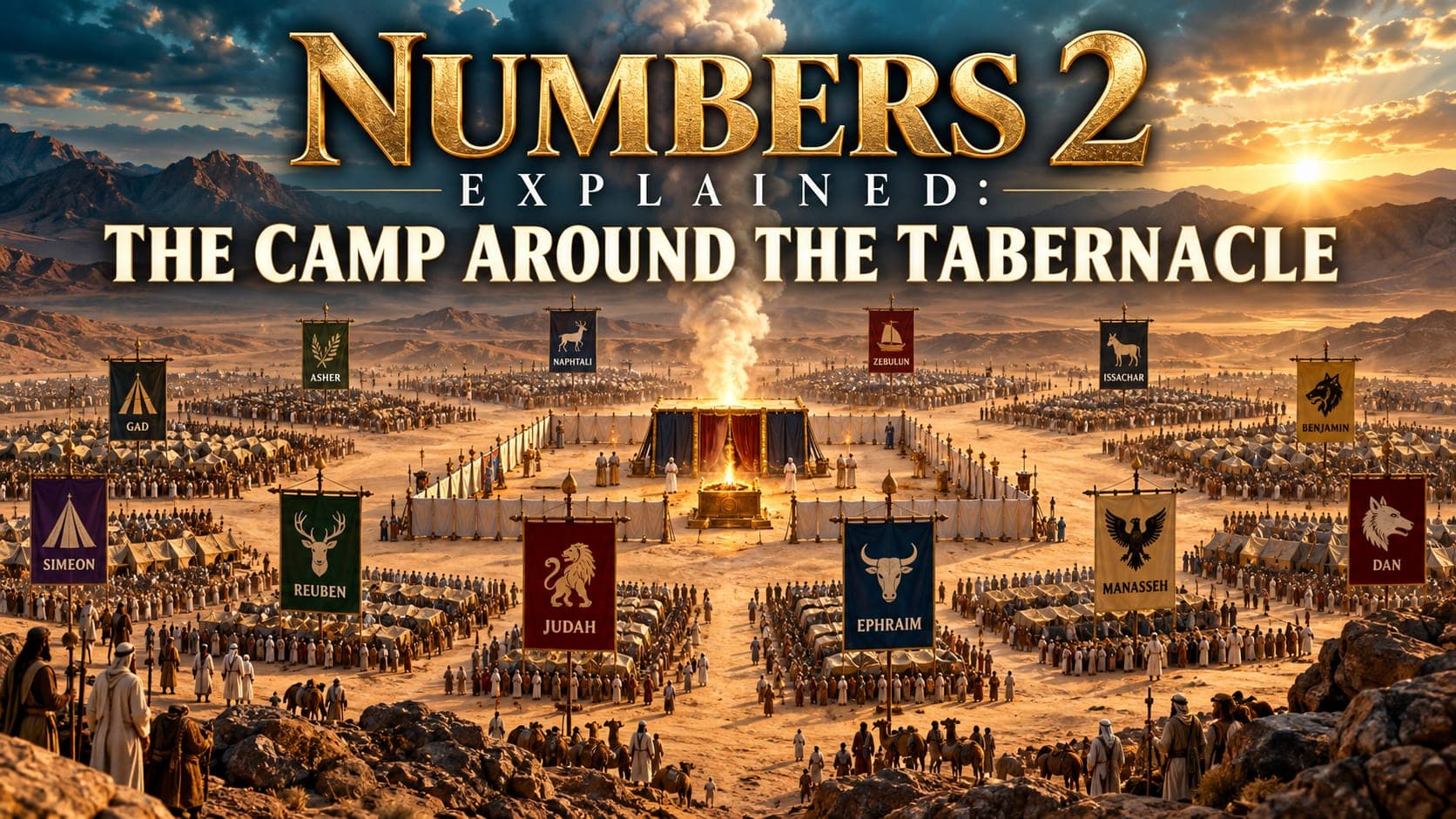
Numbers 2 explained is God handing Moses a map before anyone moves an inch. Every tribe gets a direction, a neighbor, and a place in the marching order, built around one fixed point that never changes position: the tabernacle itself, sitting dead center of the whole camp.
You already met the twelve tribes and their totals in the last chapter.
- ❓ Why does Judah get the east side, facing the one gate into the tabernacle courtyard?
- ❓ Why does Reuben, the actual firstborn, end up in the second rank instead of the first?
- ❓ Why does the chapter put the Levites and the tabernacle in the exact middle of everything?
- ❓ And why does Dan get stuck going last?
📌 Numbers 2 turns a crowd of twelve tribes into a formation, with God's own dwelling place fixed at the center of it, not off to one side.
Here is the chapter worked through in order: the standards each tribe camped under, the four camps on the four sides of the tabernacle, the Levites holding the center, and the final tally that locks this chapter to the one right before it.
There is more order hiding in this layout than a quick glance usually catches.
What Happened Just Before This Chapter
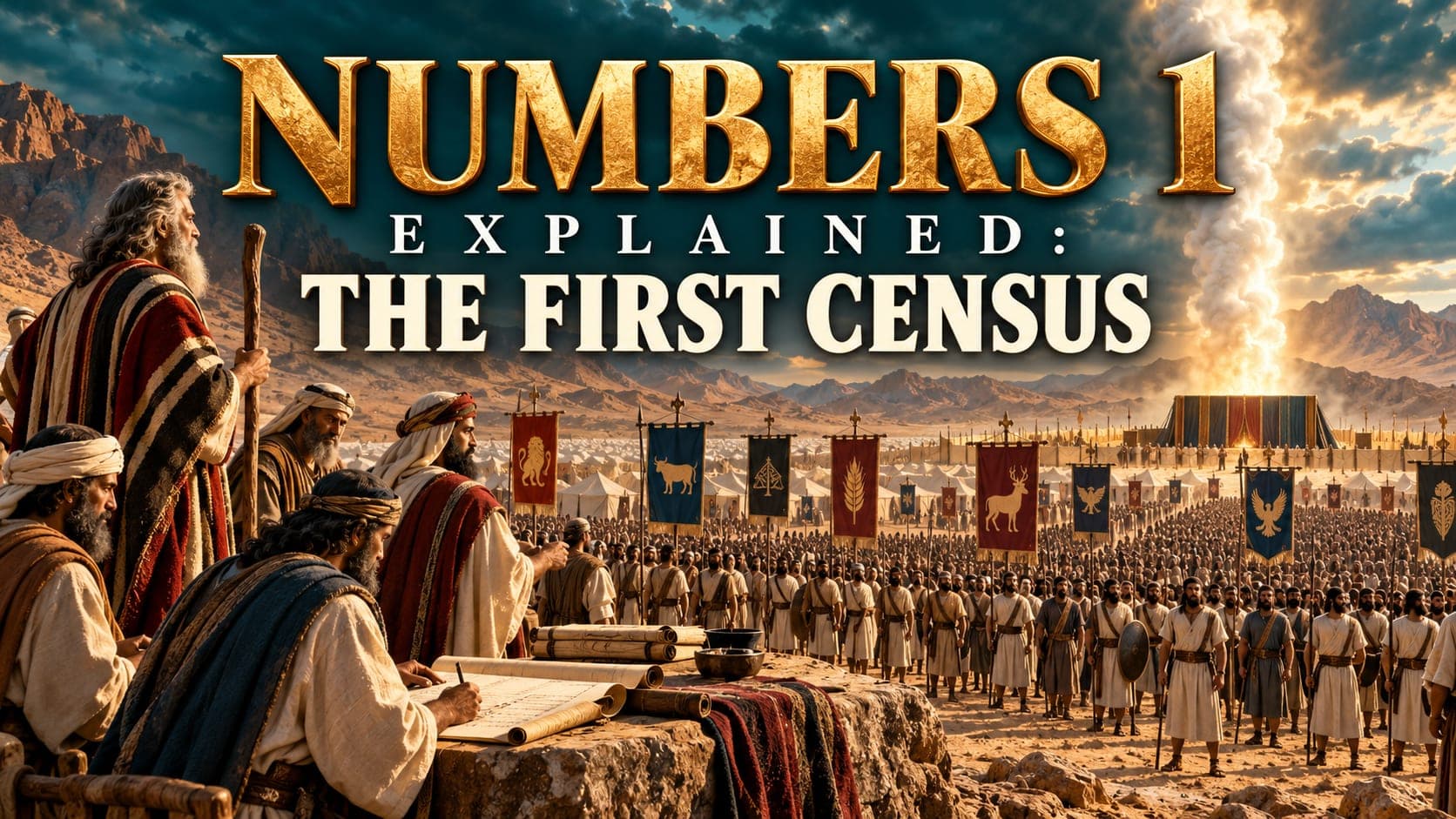
Numbers 1 answered one question: how many fighting men does Israel actually have. Moses, Aaron, and a prince from each tribe counted every man twenty years old and up, tribe by tribe, until the number landed on 603,550.
Numbers 2 answers the question that count never touched. Knowing the size of an army is not the same as knowing where that army stands. A nation of two million people, traveling together and camping together in open desert, needed an assigned spot for every single family, or the whole camp would be chaos within a day. This chapter is Moses receiving that assignment directly from the LORD, tribe by tribe, side by side.

Numbers 2 Explained Verse by Verse
1. One Standard Per Tribe, One Spot Per Family (verses 1 and 2)
The chapter opens with the rule that governs everything after it.
"Every man of the children of Israel shall pitch by his own standard, with the ensign of their father’s house: far off about the tabernacle of the congregation shall they pitch."
A standard was a tribal banner, something a man could spot from a distance and walk toward without needing to ask anyone where his family belonged. No man had to wonder which tent was his. He only had to find his tribe's flag.
📌 "Far off about the tabernacle" is doing real work in this verse. Every tribe camped at a distance from the tabernacle, not pressed against it. That gap was not an accident of space running out. It was a buffer, the same instinct behind the Levites' own placement, keeping ordinary Israel near enough to belong and far enough to stay safe.
2. East: Judah Leads the Camp (verses 3 to 9)
The LORD starts with the side facing the sunrise, and one tribe in particular.
"And on the east side toward the rising of the sun shall they of the standard of the camp of Judah pitch throughout their armies: and Nahshon the son of Amminadab shall be captain of the children of Judah."
The east side mattered because the tabernacle itself only had one way in. The gate of its courtyard, described back in Exodus 27, faced east. Camp there, and you camp facing the one entrance into God's presence on earth.
Judah, Issachar, and Zebulun form this eastern group, and Judah leads it. That placement is not random either. Jacob's deathbed words over his sons in Genesis 49 promised Judah a scepter and the obedience of his brothers, long before this tribe had a king, a capital, or a single battle won. Numbers 2 is that promise already shaping where Judah gets to stand.
"All that were numbered in the camp of Judah were an hundred thousand and fourscore thousand and six thousand and four hundred, throughout their armies. These shall first set forth."
💡 Judah, Issachar, and Zebulun together total 186,400 men, the largest of the four camps by a wide margin. "These shall first set forth" settles the marching order too. Whenever the whole nation moves, this is the camp that walks out first.
3. South: Reuben's Camp Goes Second (verses 10 to 16)
The south side belongs to the man who was actually born first.
"On the south side shall be the standard of the camp of Reuben according to their armies: and the captain of the children of Reuben shall be Elizur the son of Shedeur."
Reuben, Simeon, and Gad make up this camp, and together they march second, not first. Reuben was Jacob's literal firstborn, yet he still answers to a place behind Judah, the same demotion Numbers 1 already traced back to what Reuben did to his father's bed. A lost blessing kept costing him position, chapter after chapter.
This camp is also worth remembering for what happens much later in the wilderness. Dathan, Abiram, and On, the men who joined Korah's rebellion against Moses, all came from this same tribe of Reuben. Pitched side by side for years under one standard, men from this camp had every chance to grow close enough to conspire together when the moment came.
"All that were numbered in the camp of Reuben were an hundred thousand and fifty and one thousand and four hundred and fifty, throughout their armies. And they shall set forth in the second rank."
Reuben, Simeon, and Gad add up to 151,450 men. "Second rank" is plain and final. No ambiguity, no tribe arguing for a better spot. The order was fixed before anyone took a single step.
4. The Tabernacle Holds the Center (verse 17)
Right in the middle of the march order sits one verse that explains the whole design.
"Then the tabernacle of the congregation shall set forward with the camp of the Levites in the midst of the camp: as they encamp, so shall they set forward, every man in his place by their standards."
Read the order so far and the picture becomes clear. Judah's three tribes go first. Reuben's three tribes go second. Then comes the tabernacle itself, carried by the Levites, traveling in the dead center of the whole nation rather than tucked safely at the back or sent ahead alone.
📌 God did not travel at the edge of His people's lives. He traveled in the exact middle of them. Whatever direction Israel looked, forward or back, the tabernacle was never far from view.
5. West: Ephraim Camps Ahead of His Older Brother (verses 18 to 24)
The west side carries an old family story quietly forward.
"On the west side shall be the standard of the camp of Ephraim according to their armies: and the captain of the sons of Ephraim shall be Elishama the son of Ammihud."
Ephraim, Manasseh, and Benjamin stand together here, and Ephraim leads even though Manasseh was born first. That order traces straight back to Genesis 48, where a dying Jacob deliberately crossed his hands to bless the younger son above the older one. Decades later, the camp itself still reflects that one deliberate choice.
"All that were numbered of the camp of Ephraim were an hundred thousand and eight thousand and an hundred, throughout their armies. And they shall go forward in the third rank."
Ephraim, Manasseh, and Benjamin total 108,100 men, the smallest of the four camps, and they march third. Smaller did not mean skipped. Every camp, large or small, still had an exact place in the line.
6. North: Dan's Camp Brings Up the Rear (verses 25 to 31)
The north side, and the last camp in the whole order, belongs to Dan.
"The standard of the camp of Dan shall be on the north side by their armies: and the captain of the children of Dan shall be Ahiezer the son of Ammishaddai."
Dan, Asher, and Naphtali make up this final camp.
"All they that were numbered in the camp of Dan were an hundred thousand and fifty and seven thousand and six hundred. They shall go hindmost with their standards."
⚠️ "Hindmost" sounds like last place, but going last in a camp this size was its own responsibility. This camp of 157,600 men marched behind every other tribe, every family, and every slow wagon in the whole nation. Nothing straggling at the back of two million people moved without passing this camp first.
7. The Same Total, and the Same Obedience (verses 32 to 34)
The chapter closes by adding its own numbers together.
"These are those which were numbered of the children of Israel by the house of their fathers: all those that were numbered of the camps throughout their hosts were six hundred thousand and three thousand and five hundred and fifty."
Add the four camp totals, 186,400, 151,450, 108,100, and 157,600, and the sum lands on the exact same 603,550 that closed Numbers 1. The two chapters are companion counts of the same men, one sorted by tribe, the other sorted by camp and marching position.
"But the Levites were not numbered among the children of Israel; as the LORD commanded Moses."
"And the children of Israel did according to all that the LORD commanded Moses: so they pitched by their standards, and so they set forward, every one after their families, according to the house of their fathers."
📌 Numbers 1 ended on obedience. Numbers 2 ends on the exact same note. Two chapters built almost entirely out of names, directions, and numbers, and both of them close the same way: Israel simply did what the LORD said, down to the smallest family.

Hard Questions Numbers 2 Raises
Why repeat tribal numbers Numbers 1 already gave? Numbers 1 reported each tribe on its own. Numbers 2 groups three tribes at a time into one camp total, information the earlier chapter never calculated. The repetition sets up new math, not the same math twice.
Does the text explain why each side carried spiritual meaning? Not directly. Numbers 2 never says the east side is holier than the north, and this walkthrough will not claim more than the text does. What it does say plainly is that the east side faced the tabernacle's one gate, which gives Judah's position a clear practical reason without needing to invent a symbolic one.
Was this layout only for camping, or for marching too? Both. Verse 2 covers pitching tents, and verses 9, 16, 24, and 31 each name a rank in the order of march. The same arrangement governed Israel standing still and Israel on the move.
Why did the order need to be fixed instead of left flexible? The text does not explain the reasoning, but the scale makes the answer obvious enough. A camp of this size, moving as one body through open desert, could not function if families had to relocate or renegotiate position every time it broke camp. A fixed order meant every man already knew exactly where to stand before Moses said a word.
Top Verses From Numbers 2
1. Numbers 2:2
"Every man of the children of Israel shall pitch by his own standard, with the ensign of their father’s house: far off about the tabernacle of the congregation shall they pitch."
The rule behind the whole chapter: every family had an assigned place, and every family kept a respectful distance from the tabernacle itself.
2. Numbers 2:3
"And on the east side toward the rising of the sun shall they of the standard of the camp of Judah pitch throughout their armies: and Nahshon the son of Amminadab shall be captain of the children of Judah."
Judah takes the east side facing the tabernacle's only gate, a position that lines up with Jacob's promise over Judah generations earlier in Genesis 49.
3. Numbers 2:17
"Then the tabernacle of the congregation shall set forward with the camp of the Levites in the midst of the camp: as they encamp, so shall they set forward, every man in his place by their standards."
The center of this chapter, literally. God's dwelling place traveled in the middle of the nation, not off to one side of it.
4. Numbers 2:31
"All they that were numbered in the camp of Dan were an hundred thousand and fifty and seven thousand and six hundred. They shall go hindmost with their standards."
Last in line was still a real assignment. Someone had to walk at the back of two million people, and Dan's camp carried that job.
5. Numbers 2:34
"And the children of Israel did according to all that the LORD commanded Moses: so they pitched by their standards, and so they set forward, every one after their families, according to the house of their fathers."
The same closing line as Numbers 1, almost word for word. A chapter of logistics ends, again, on plain obedience.

Frequently Asked Questions About Numbers 2
What is Numbers 2 about?
Numbers 2 arranges Israel's twelve tribes into four camps of three tribes each, one camp on every side of the tabernacle, and sets the order in which those camps broke camp and marched.
Why did Judah camp on the east side?
The east side faced the tabernacle's single gate, so Judah's camp stood directly in line with the one entrance into the courtyard. Judah also leads the march in verse 9, matching the leadership Jacob promised this tribe in Genesis 49.
Why were the Levites placed in the middle of the camp?
Verse 17 puts the tabernacle, carried by the Levites, in the exact center of the march order, between the eastern and southern camps on one side and the western and northern camps on the other. God's dwelling place stayed at the heart of the nation rather than at its edge.
Why does Reuben camp second instead of first?
Reuben was Jacob's literal firstborn, but Numbers 1 already recorded that he lost his father's special blessing. Numbers 2 reflects that same lost standing by placing his camp second in the march order rather than first.
Why does Ephraim appear ahead of Manasseh in this chapter?
Manasseh was the older brother, but Genesis 48 records Jacob deliberately blessing Ephraim above him. Numbers 2 keeps that reversal in place by naming Ephraim first and giving his name to the whole western camp.
Why was Dan's camp placed last?
Verse 31 calls Dan's position "hindmost," the final camp in the marching order. The text does not call this a demotion. Someone had to cover the rear of a nation this size, and that assignment fell to Dan, Asher, and Naphtali.
Does the camp order in Numbers 2 match the march order later in Numbers?
Numbers 2 sets this exact order: Judah's camp first, Reuben's camp second, the Levites and tabernacle in the middle, Ephraim's camp third, and Dan's camp last. Verses 9, 16, 24, and 31 state each rank directly inside this chapter.
How many people does the 603,550 total in Numbers 2 represent?
That figure, repeated from Numbers 1, counts only men twenty years old and up who were able to fight. It does not include women, children, the elderly, or the Levites, so the total population traveling in this camp was considerably larger than the number itself suggests.
Why does Numbers 2 list captains who already appeared in Numbers 1?
Repeating the same twelve names ties this chapter directly to the census that just happened. The men who helped count each tribe in Numbers 1 are the same men leading those tribes into their assigned camp positions here.
What does Numbers 2 teach Christians today?
That God cares about order, not just outcomes. Every family in this chapter had a known place, and God's own presence stayed at the center of that order rather than at a safe distance from it.
Final Thoughts
Numbers 2 looks like a seating chart, but it is really a picture of where God chooses to live.
📌 God placed Himself at the center, not the edge. The tabernacle traveled in the exact middle of the march order, surrounded on every side rather than tucked away alone.
📌 Old family history kept shaping new positions. Judah's leadership, Reuben's lost rank, and Ephraim's place ahead of Manasseh all trace back to blessings and losses recorded chapters earlier in Genesis.
📌 Even the last place in line was a real assignment. Dan's camp went hindmost, covering the rear of the whole nation, not forgotten by it.
You will likely never be assigned a direction to camp in or a rank to march in. But the same God who gave every family in this chapter an exact place still has one for you, wherever you land in the order.
So here is your one next step.
Think of the place in your life that feels least significant right now, the equivalent of marching last. Ask whether you have been treating it as forgotten instead of assigned.