📖 Numbers 4 Explained: Carrying the Ark Without Touching It
One wrong touch in this chapter could cost a man his life, and the text says so without flinching.
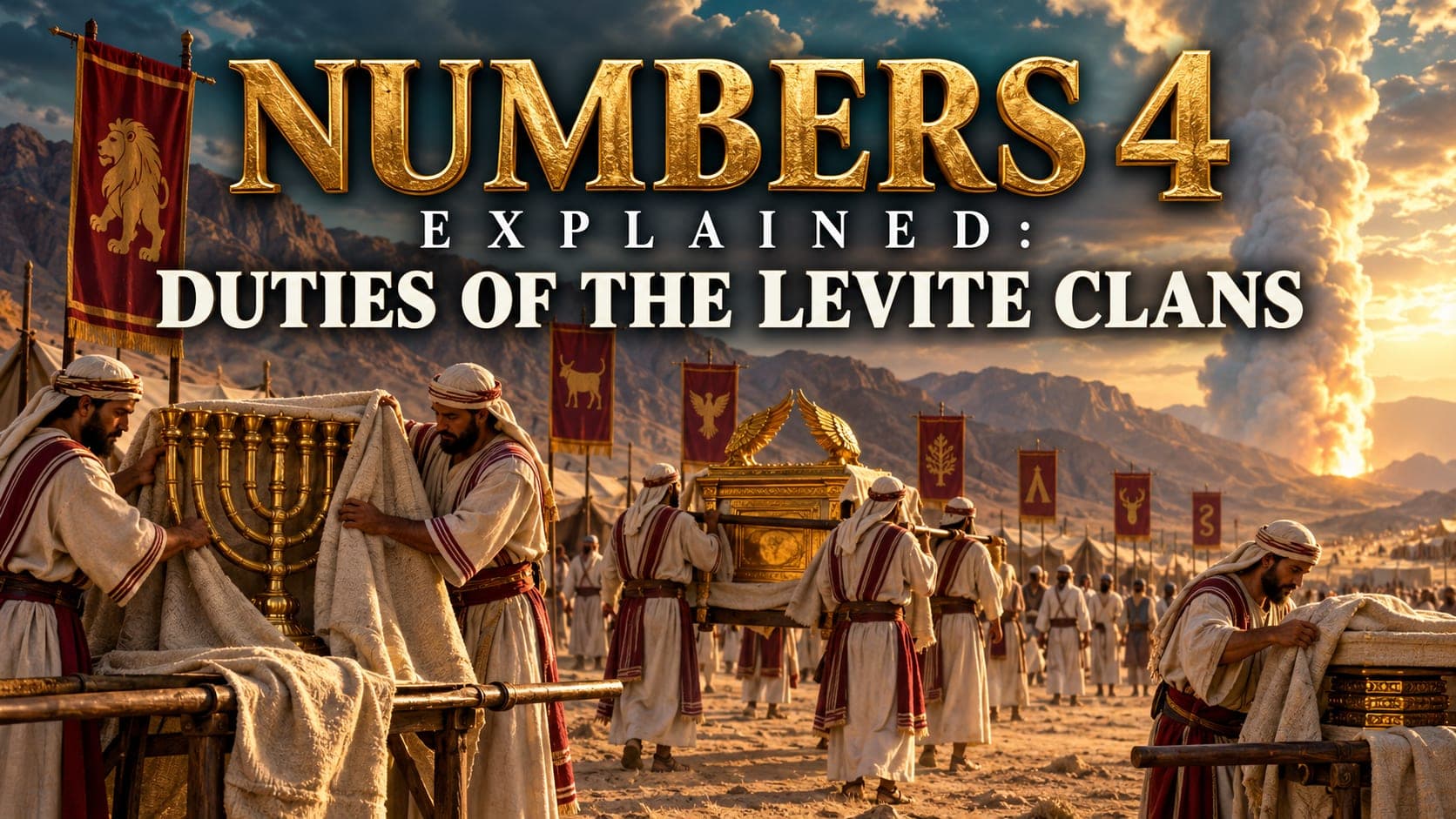
Numbers 4 explained is the full job description for the family trusted with the heaviest, holiest cargo in the whole camp. The ark, the table, the lampstand, and the altars all had to be covered, carried, and guarded by men who were never allowed to look at what they were carrying.
Maybe you have wondered why getting close to God ever had to come with warnings attached at all.
- ❓ Why does carrying holy furniture come with a death warning built right into the instructions?
- ❓ Why are the men assigned to carry the ark not allowed to look at it?
- ❓ Why does this chapter use a completely different age range than the last one did?
- ❓ And why, this time, does the final count actually add up?
📌 Numbers 4 is not only a packing list for the tabernacle. It is a picture of how closely God let His people approach Him, and on exactly whose terms.
This walkthrough goes through the chapter in order: the Kohathites and their age range, the covering of the holy things before anyone could touch them, the warning Eleazar had to enforce, and the two other families who carried everything else.
Few chapters make the difference between reverence and carelessness this plain.
What Happened Just Before This Chapter
Numbers 3 counted the whole tribe of Levi from a month old and up, split it into three family lines, Gershon, Kohath, and Merari, and gave each one a different part of the tabernacle to camp beside and care for. That chapter named the jobs in general terms: Gershon took the fabric, Kohath took the holiest contents, Merari took the frame.
Numbers 4 is where those general assignments turn into step by step procedure. It answers the question Numbers 3 never quite finished: exactly how do you move the presence of God across a desert without anyone dying in the process.

Numbers 4 Explained Verse by Verse
1. Numbering the Kohathites, Thirty to Fifty (verses 1 to 4)
The chapter opens with a new census, but this one is not counting the whole tribe. It is counting one family, inside one age window.
"Take the sum of the sons of Kohath from among the sons of Levi, after their families, by the house of their fathers, From thirty years old and upward even until fifty years old, all that enter into the host, to do the work in the tabernacle of the congregation."
📌 Three different censuses, three different age ranges, and none of them match by accident. Numbers 1 counted fighting men twenty years old and up. Numbers 3 counted every male Levite a month old and older, because that count tracked who belonged to God, not who could carry anything. This count only wants men at the peak of their physical strength, thirty to fifty, because the job ahead of them is not paperwork. It is lifting and hauling the heaviest, most dangerous objects in the whole camp.
Verse four narrows the target even further. This service is specifically about the most holy things, not the tabernacle in general. Everything that follows in this chapter builds off that one phrase.
2. Wrapping the Ark Before Anyone Can Carry It (verses 5 to 14)
Before a single Kohathite touches anything, Aaron and his sons go in first and cover every piece themselves.
"And when the camp setteth forward, Aaron shall come, and his sons, and they shall take down the covering vail, and cover the ark of testimony with it: And shall put thereon the covering of badgers’ skins, and shall spread over it a cloth wholly of blue, and shall put in the staves thereof."
The ark described here is the same object built in Exodus 25, the box holding the stone tablets and topped by the mercy seat. The same chapter in Exodus describes the table, the lampstand, and the altars this chapter now prepares for travel. One at a time, Aaron and his sons wrap each one the same careful way.
"And upon the golden altar they shall spread a cloth of blue, and cover it with a covering of badgers’ skins, and shall put to the staves thereof:"
The golden altar held the incense described in Exodus 30. Every object gets its own layer, its own cloth, and its own set of carrying poles slid into place before the camp moves an inch. Nothing here is improvised. Verses seven through fourteen repeat the same three steps for the table, the lampstand, and the altar of burnt offering: cover it, wrap it again, attach the staves.
3. "They Shall Not Touch Any Holy Thing, Lest They Die" (verse 15)
Only once everything is fully covered does the chapter let the Kohathites anywhere near it.
"And when Aaron and his sons have made an end of covering the sanctuary, and all the vessels of the sanctuary, as the camp is to set forward; after that, the sons of Kohath shall come to bear it: but they shall not touch any holy thing, lest they die. These things are the burden of the sons of Kohath in the tabernacle of the congregation."
📌 The Kohathites carried the holiest objects in Israel without ever laying a hand directly on them. They lifted the poles, not the ark. They shouldered the covered bundle, not the uncovered mercy seat underneath it. The covering was not decoration. It was the one thing standing between a man doing his job and a man who had just touched what he had no right to touch.
4. Eleazar's Separate Watch Over the Tabernacle (verse 16)
Right in the middle of the carrying instructions, the chapter pauses for one man's job that looks nothing like the others.
"And to the office of Eleazar the son of Aaron the priest pertaineth the oil for the light, and the sweet incense, and the daily meat offering, and the anointing oil, and the oversight of all the tabernacle, and of all that therein is, in the sanctuary, and in the vessels thereof."
Eleazar did not carry a single board or curtain. His job was the oil, the incense, the daily offering, and "the oversight of all the tabernacle," the same oil and incense Exodus 30 describes being made under exact instructions. The most dangerous physical work in the camp, carrying the ark, sat under the direct watch of Aaron's own son. Nobody handed the riskiest job to someone and then walked away from it.
5. Protecting Kohath From What They Must Never See (verses 17 to 20)
God speaks to Moses and Aaron again, and this time the instruction reads less like a threat and more like a rescue plan.
"Cut ye not off the tribe of the families of the Kohathites from among the Levites: But thus do unto them, that they may live, and not die, when they approach unto the most holy things: Aaron and his sons shall go in, and appoint them every one to his service and to his burden:"
"But they shall not go in to see when the holy things are covered, lest they die."
⚠️ "Cut ye not off" is a command to keep a family alive, not a warning aimed against them. God tells Aaron and his sons to go in ahead of the Kohathites and assign each man his exact task, specifically so the family does not lose men to carelessness around what they were never meant to view uncovered. The danger was real. So was the protection built around it.
6. Gershon's Fabric and Merari's Frame (verses 21 to 33)
With Kohath's instructions settled, the chapter moves to the two families carrying everything that was not the most holy furniture.
"And they shall bear the curtains of the tabernacle, and the tabernacle of the congregation, his covering, and the covering of the badgers’ skins that is above upon it, and the hanging for the door of the tabernacle of the congregation,"
Gershon's men, also counted from thirty to fifty, carried the tent and its coverings, the same curtains built in Exodus 26. Verse twenty eight places their whole service under Ithamar, Aaron's other surviving son, not Eleazar.
Merari's family carried what was left: the skeleton that held the whole structure upright.
"And this is the charge of their burden, according to all their service in the tabernacle of the congregation; the boards of the tabernacle, and the bars thereof, and the pillars thereof, and sockets thereof,"
Boards, bars, pillars, and sockets, the frame the curtains hung on, also fell under Ithamar's charge. Notice the pattern across all three families: the family carrying the holiest objects answered to Eleazar, and the two families carrying fabric and framework both answered to Ithamar. The risk level of the cargo decided which of Aaron's sons supervised it.
7. The Census That Finally Adds Up (verses 34 to 49)
The chapter closes by counting every man in the thirty to fifty window across all three families.
"And those that were numbered of them by their families were two thousand seven hundred and fifty."
"Even those that were numbered of them, throughout their families, by the house of their fathers, were two thousand and six hundred and thirty."
"Even those that were numbered of them after their families, were three thousand and two hundred."
"Even those that were numbered of them, were eight thousand and five hundred and fourscore."
💡 Add the three family totals yourself: 2,750 Kohathites, plus 2,630 Gershonites, plus 3,200 Merarites, comes to exactly 8,580, the same number verse 48 gives for the whole group. Numbers 3 left a 300 man gap between its family totals and its final count that the text never explained. This chapter's numbers land exactly where they should, every single one of them accounted for.

Hard Questions Numbers 4 Raises
Why thirty to fifty here, instead of the twenty year old cutoff in Numbers 1 or the month old count in Numbers 3? Each census served a different purpose. Numbers 1 counted men ready for war. Numbers 3 counted every Levite male as a matter of legal standing before God, regardless of age or strength. Numbers 4 counted men for the physically demanding work of carrying heavy, awkwardly shaped loads across rough ground, which calls for men already past youth but not yet worn down by age.
Why was touching, or even seeing, the covered holy things treated as a capital risk? The text does not spend time explaining the mechanism, only the rule. Scripture later shows this was never an empty threat. In 2 Samuel 6, a man named Uzzah reaches out to steady the ark during transport and dies on the spot, generations after this chapter was written. Numbers 4 reads very differently once you know that warning was not decoration.
Why does Eleazar's job in verse 16 read nothing like the Kohathites' job he supervised? His list, oil, incense, the daily offering, anointing oil, oversight of the whole tabernacle, looks like the work of a caretaker, not a mover. But it put him in direct, ongoing contact with the same sanctuary his relatives carried. The man overseeing the most dangerous physical task was not someone removed from the danger himself.
Why call an instruction to keep men away from danger a command not to "cut off" a family? The phrasing in verse 18 treats the Kohathites' survival as something Moses and Aaron were responsible for protecting, not something the Kohathites had to manage entirely on their own. God put the safeguard on the leaders assigning the work, not only on the men doing it.
Top Verses From Numbers 4
1. Numbers 4:15
"And when Aaron and his sons have made an end of covering the sanctuary, and all the vessels of the sanctuary, as the camp is to set forward; after that, the sons of Kohath shall come to bear it: but they shall not touch any holy thing, lest they die. These things are the burden of the sons of Kohath in the tabernacle of the congregation."
The rule the whole chapter is built around: carry it, but never touch it uncovered. The men closest to the ark were also the men most restricted around it.
2. Numbers 4:20
"But they shall not go in to see when the holy things are covered, lest they die."
Even watching the covering happen was off limits. The warning protected the Kohathites from a danger they could not fully see coming on their own.
3. Numbers 4:3
"From thirty years old and upward even until fifty years old, all that enter into the host, to do the work in the tabernacle of the congregation."
A specific age window for a specific kind of labor, different from every other census in these chapters, because this work demanded strength the other counts did not need.
4. Numbers 4:16
"And to the office of Eleazar the son of Aaron the priest pertaineth the oil for the light, and the sweet incense, and the daily meat offering, and the anointing oil, and the oversight of all the tabernacle, and of all that therein is, in the sanctuary, and in the vessels thereof."
A son of Aaron holding direct oversight of the tabernacle itself, standing between the Kohathites' dangerous job and anything going wrong with it.

Frequently Asked Questions About Numbers 4
What is Numbers 4 about?
Numbers 4 gives the exact procedure for moving the tabernacle, covering the ark and its furniture before anyone touches them, and assigns the Kohathites, Gershonites, and Merarites their specific carrying duties with a precise age range for the work.
Who were the Kohathites?
The Kohathites were one of the three family lines of Levi, the same family Moses and Aaron themselves descended from, assigned to carry the ark, the table, the lampstand, and the altars once Aaron and his sons had fully covered them.
Why could the Kohathites carry the ark but not touch it?
Verse 15 states plainly that touching any holy thing meant death. The Kohathites lifted the covered bundle by its carrying poles after Aaron and his sons wrapped everything, which let them transport the ark without ever making direct contact with it.
Why did Numbers 4 use a different age range than Numbers 1 and Numbers 3?
Numbers 1 counted men twenty years old and up for military service. Numbers 3 counted every male Levite from a month old for legal standing before God. Numbers 4 counted men thirty to fifty specifically for the physically demanding work of carrying the tabernacle.
What was Eleazar's job in Numbers 4?
Verse 16 gives Eleazar charge of the oil for the lampstand, the incense, the daily offering, the anointing oil, and oversight of the whole tabernacle, placing him in direct supervision over the Kohathites' dangerous carrying work.
What did Gershon and Merari carry?
Gershon's family carried the tabernacle's curtains, coverings, and hangings. Merari's family carried the boards, bars, pillars, and sockets that formed its frame. Both families served under Ithamar, Aaron's other son.
Why were the holy things covered before being carried?
The covering protected the Kohathites from touching or seeing the uncovered holy objects, which verses 15 and 20 both say could cost a man his life. Aaron and his sons did the covering themselves before any Kohathite came near.
How many Levites served under Numbers 4, and does the math add up?
2,750 Kohathites, 2,630 Gershonites, and 3,200 Merarites add up to exactly 8,580, the same total verse 48 gives for the whole group. Unlike the family totals in Numbers 3, this chapter's numbers match perfectly.
Final Thoughts
Numbers 4 spends forty nine verses on a packing procedure, and it still has something to say about how you approach anything holy.
📌 Closeness to God came with real limits, not negotiable ones. The Kohathites carried the ark itself and still were never allowed to touch it uncovered or watch it being wrapped.
📌 The most dangerous job carried the heaviest supervision. Eleazar's direct oversight sat on top of the Kohathites' work, and the warnings around them were enforced by leadership, not left to chance.
📌 Protection and danger showed up in the same sentence. "Cut ye not off" was a command to keep a family alive, built around a risk that was never pretended away.
You will never carry a covered ark on your shoulder. But the same God who protected the Kohathites by setting clear limits still protects you the same way, with boundaries that are not there to punish you but to keep you standing.
So here is your one next step.
Name one boundary God has set in your life that has felt restrictive. Ask whether it has actually been keeping you alive, the way the covering over the ark kept the Kohathites alive.