📖 Numbers 36 Explained: The Daughters of Zelophehad and the Last Word of Numbers
Thirty six chapters, and the book of Numbers ends on a question about marriage.
Not a battle. Not a plague. Not a border.
Numbers 36 explained is the last chapter of Numbers, and it closes the book by finishing a story that started chapters earlier: five sisters who asked for their father's land, got it, and then ran into a problem nobody had thought through yet. If they marry outside their own tribe, does their inheritance leave with them?
Maybe you have watched a good decision create a problem nobody saw coming.
- ❓ Why does five women's marriage choice need a ruling from Moses himself?
- ❓ What does the Year of Jubile have to do with any of this?
- ❓ Is this law protecting women, or restricting them?
- ❓ Why does the whole book of Numbers end here, of all places?
📌 Numbers 36 is not a footnote after the real story ended. It is God protecting a promise He already made, down to the last detail that could have quietly undone it.
This walkthrough goes through the whole chapter in order: the problem the leaders of Gilead bring to Moses, the LORD's answer, the reasoning behind the rule, the daughters' own obedience, and the single closing verse that ends the entire book of Numbers.
Thirteen verses, and every one of them is still protecting a decision made in Numbers 27.
What Happened Just Before This Chapter
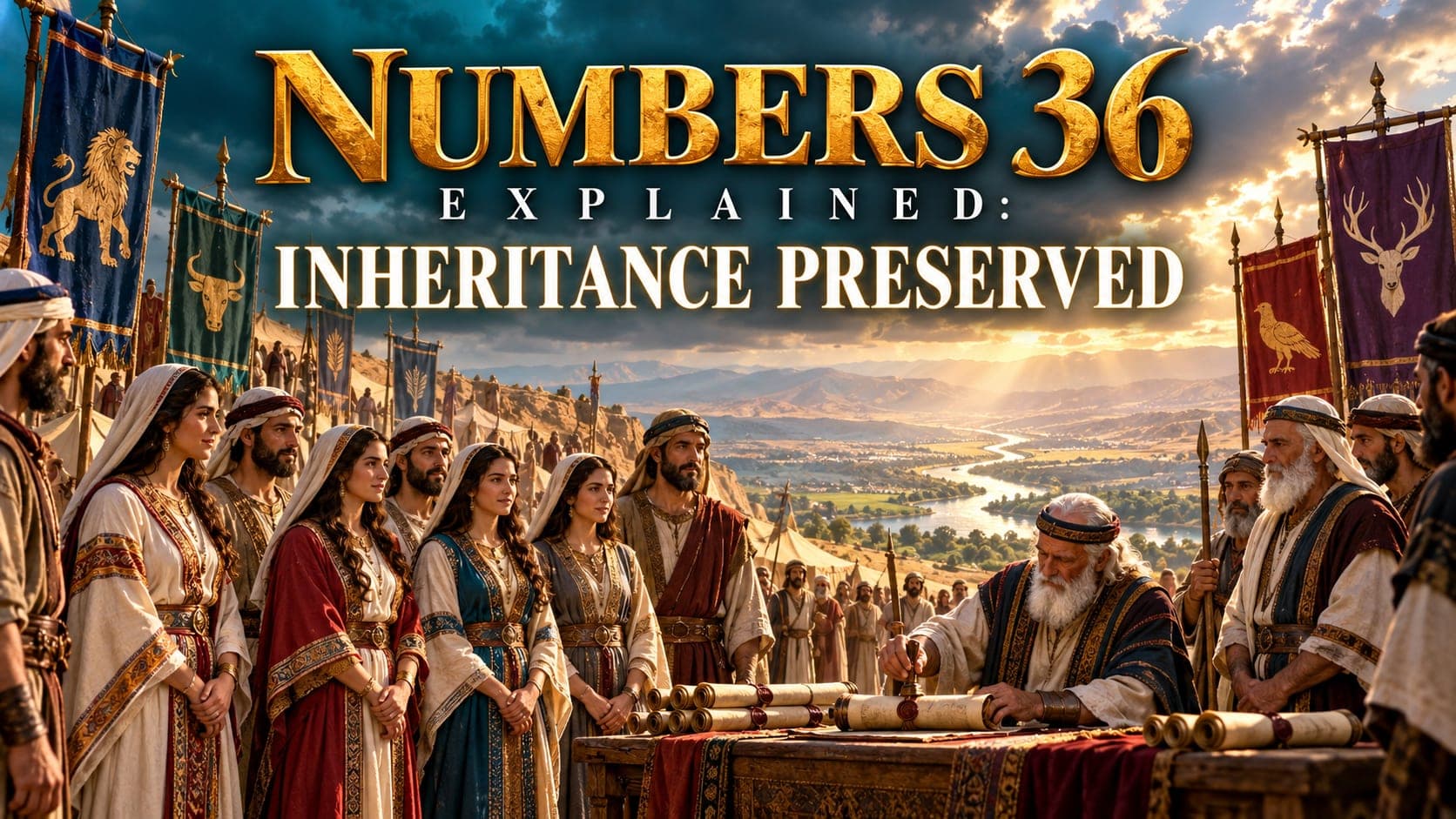
To understand Numbers 36, you have to go back nine chapters. In Numbers 27, five sisters, Mahlah, Noah, Hoglah, Milcah, and Tirzah, came to Moses with a problem. Their father Zelophehad had died in the wilderness with no sons, which meant his name and his land were about to disappear from Israel entirely. God sided with them completely, and through Moses established a new rule: when a man dies without a son, his inheritance passes to his daughters.
Numbers 34 then drew the actual borders of Canaan, and Numbers 35 set aside cities for the Levites and for anyone who killed someone by accident. The map is finished. The law is in place. Everything is ready for Israel to cross the Jordan.
But one detail from Numbers 27 never got addressed, and the leaders of Zelophehad's own tribe are the ones who finally bring it up.
Numbers 36 Explained Verse by Verse
1. The Chief Fathers of Gilead Raise a Real Problem (verses 1 to 4)
The chapter opens with a group of men who have a direct stake in how this plays out.
"And the chief fathers of the families of the children of Gilead, the son of Machir, the son of Manasseh, of the families of the sons of Joseph, came near, and spake before Moses, and before the princes, the chief fathers of the children of Israel:"
💡 These men are from Manasseh, the same tribe Zelophehad belonged to. This is not an outside complaint. It is Zelophehad's own extended family, worried about what happens to land that still carries their tribe's name.
Their concern is specific, not vague.
"And they said, The LORD commanded my lord to give the land for an inheritance by lot to the children of Israel: and my lord was commanded by the LORD to give the inheritance of Zelophehad our brother unto his daughters. And if they be married to any of the sons of the other tribes of the children of Israel, then shall their inheritance be taken from the inheritance of our fathers, and shall be put to the inheritance of the tribe whereunto they are received: so shall it be taken from the lot of our inheritance."
📌 Notice what they are not arguing. They are not asking God to take the land back from the daughters, and they are not questioning the ruling from Numbers 27. They accept it fully. Their worry is narrower and sharper: once land belongs to a woman, and she marries into a different tribe, whose land is it the moment she becomes that tribe's wife?
Then they name the part that makes the problem permanent, not just awkward.
"And when the jubile of the children of Israel shall be, then shall their inheritance be put unto the inheritance of the tribe whereunto they are received: so shall their inheritance be taken away from the inheritance of the tribe of our fathers."
⚠️ This is the detail that turns a family worry into a national problem. Normally the Year of Jubile reset everything. Land that had been sold or leased returned to its original family, exactly as Leviticus 25 describes. But a daughter's inheritance was never sold or leased. If she married into another tribe, the land simply became that tribe's land through her marriage, and no jubile would ever undo that. Every fifty years would make the shift more permanent, not less.
2. The LORD's Answer: Marry Within the Tribe (verses 5 and 6)
Moses does not work out an answer on his own. He takes it straight to God, the same way he did with the original request in Numbers 27.
"And Moses commanded the children of Israel according to the word of the LORD, saying, The tribe of the sons of Joseph hath said well."
📌 "Hath said well" is the same kind of response God gave the daughters themselves back in Numbers 27:7. Both the daughters' original request and the tribe's follow up concern get the same verdict: a fair question, honestly raised, deserves a real answer, not a brush off.
Here is the answer itself.
"This is the thing which the LORD doth command concerning the daughters of Zelophehad, saying, Let them marry to whom they think best; only to the family of the tribe of their father shall they marry."
💡 Read the freedom in that sentence as carefully as the restriction. "Let them marry to whom they think best" comes first. The daughters are not assigned husbands. They are not told who to marry. The only boundary is which tribe the husband belongs to, not which man inside it.
3. Why the Rule Applies to Every Tribe, Not Just Manasseh (verses 7 to 9)
The LORD does not stop at settling one family's case. He turns the ruling into a permanent principle for the whole nation.
"So shall not the inheritance of the children of Israel remove from tribe to tribe: for every one of the children of Israel shall keep himself to the inheritance of the tribe of his fathers. And every daughter, that possesseth an inheritance in any tribe of the children of Israel, shall be wife unto one of the family of the tribe of her father, that the children of Israel may enjoy every man the inheritance of his fathers."
📌 This was never only about Zelophehad's five daughters. Verse 8 widens the rule to any daughter, in any tribe, who inherits land because her father had no sons. The exact situation that happened once to Zelophehad's family could happen again anywhere in Israel, and the law gets ahead of it before it does.
The chapter restates the core principle one more time, almost word for word.
"Neither shall the inheritance remove from one tribe to another tribe; but every one of the tribes of the children of Israel shall keep himself to his own inheritance."
💡 Verses 7 and 9 say almost the same thing on purpose. Numbers 34 drew Canaan's outer borders with that same kind of careful, repeated precision. This chapter is drawing the inner borders, the lines between one tribe's ground and another's, with the same seriousness.
4. The Daughters Do Exactly What Was Asked (verses 10 to 12)
After nine verses of debate and ruling, the chapter tells you plainly how the five women actually responded.
"Even as the LORD commanded Moses, so did the daughters of Zelophehad: For Mahlah, Tirzah, and Hoglah, and Milcah, and Noah, the daughters of Zelophehad, were married unto their father's brothers' sons:"
📌 Here are the same five names from Numbers 27, in the same order, now actually married. This is not a vague summary. The text names each sister individually a second time, confirming that the ruling was not just agreed to in theory. It was carried out, by name.
And the land stayed exactly where the law said it had to.
"And they were married into the families of the sons of Manasseh the son of Joseph, and their inheritance remained in the tribe of the family of their father."
💡 They married their father's brothers' sons, their own cousins, inside the same tribe of Manasseh. The land their father fought to keep in Numbers 27 never left Manasseh's hands for a single generation.
5. The Last Verse of the Whole Book (verse 13)
Numbers does not end with a story. It ends with a label on everything that came before it.
"These are the commandments and the judgments, which the LORD commanded by the hand of Moses unto the children of Israel in the plains of Moab by Jordan near Jericho."
📌 Thirty six chapters, almost forty years, two entire generations, and the book closes by calling all of it commandments and judgments given through one man, in one place. Israel is still camped in the plains of Moab, still on the wrong side of the Jordan, exactly where Numbers 33 first placed them. The crossing itself has not happened yet. Numbers ends at the border, not past it.

Hard Questions Numbers 36 Raises
Is this law protecting the daughters, or restricting them? Both things are true, and the text does not hide either one. Verse 6 opens with real freedom, "let them marry to whom they think best," which was not nothing in the ancient world. But that freedom has a real boundary attached, the tribe of their father. The restriction exists to protect something the text treats as more important than individual preference: the permanence of the tribal inheritance God had just finished assigning in Numbers 34. The daughters themselves, in verses 10 and 11, show no resistance to the boundary at all.
Why does this rule only apply to daughters who inherit land, not to daughters in general? Because the problem only exists where land is involved. A daughter with brothers never received the inheritance in the first place, so her marriage never moved tribal land anywhere. This law is narrow on purpose. It solves the exact gap Numbers 27 left open and nothing more.
Does this restrict women more than men? Not in the way it might first appear. Men also kept their inheritance inside their own tribe automatically, simply by staying in their father's family line, which is why the problem never showed up for sons. The daughters needed a rule spelled out only because they were, for the first time in Numbers 27, allowed to hold land directly instead of through a male relative. The restriction in Numbers 36 is the cost of extending that same right.
Does marrying a cousin in verse 11 raise a problem for a modern reader? Marriage between close relatives was common and lawful in the ancient world, and Scripture only forbids specific close relationships, listed later in Leviticus 18, which did not include the first cousin marriages described here. Reading a modern cultural discomfort back into the text would be reading something into it that the chapter itself never raises as a concern.
How does this law compare to what happens later with Ruth and Boaz? They are related in spirit but not the same law. Numbers 36 restricts which tribe an heiress may marry into, so land never crosses tribal lines. Ruth's story runs on a different mechanism entirely, a kinsman buying back a dead relative's land so the family name does not disappear.
"Moreover Ruth the Moabitess, the wife of Mahlon, have I purchased to be my wife, to raise up the name of the dead upon his inheritance, that the name of the dead be not cut off from among his brethren, and from the gate of his place: ye are witnesses this day."
💡 Different law, same underlying value running through both stories: God consistently treats a family's land and a family's name as things worth protecting by name, not just in principle.
Top Verses From Numbers 36
1. Numbers 36:6
"This is the thing which the LORD doth command concerning the daughters of Zelophehad, saying, Let them marry to whom they think best; only to the family of the tribe of their father shall they marry."
Real freedom and a real boundary in the same sentence. The daughters choose their own husbands, inside the one limit that protects their father's inheritance.
2. Numbers 36:7
"So shall not the inheritance of the children of Israel remove from tribe to tribe: for every one of the children of Israel shall keep himself to the inheritance of the tribe of his fathers."
The principle behind the entire chapter, stated as a permanent national rule rather than a one time exception for a single family.
3. Numbers 36:12
"And they were married into the families of the sons of Manasseh the son of Joseph, and their inheritance remained in the tribe of the family of their father."
The payoff of the whole chapter. A right won in Numbers 27 is still intact here, because five women did exactly what the ruling asked of them.
4. Numbers 36:13
"These are the commandments and the judgments, which the LORD commanded by the hand of Moses unto the children of Israel in the plains of Moab by Jordan near Jericho."
The last sentence of the whole book of Numbers, closing almost forty years of history with a plain statement of what all of it actually was: law given through one man, at one place, before the river was ever crossed.
Frequently Asked Questions About Numbers 36
What is Numbers 36 about?
Numbers 36 settles a problem left open by the daughters of Zelophehad's inheritance in Numbers 27: if an heiress marries outside her tribe, her land would permanently transfer to her husband's tribe. God rules that any daughter who inherits land must marry within her father's own tribe, and the five sisters do exactly that.
Who were the daughters of Zelophehad?
Mahlah, Noah, Hoglah, Milcah, and Tirzah, five sisters from the tribe of Manasseh whose father died in the wilderness without any sons. Numbers 27 records them successfully asking Moses for the right to inherit his land, and Numbers 36 shows how that right was protected once they married.
Why did the daughters of Zelophehad have to marry within their own tribe?
Numbers 36:3 and 4 explain the danger plainly: if they married into another tribe, their inheritance would transfer to that tribe permanently, even surviving the Year of Jubile, since the land was never sold, only passed by marriage. Marrying within their father's tribe kept the land exactly where it started.
What does the Year of Jubile have to do with Numbers 36?
The jubile, described fully in Leviticus 25, normally returned sold or leased land to its original family every fifty years. But a daughter's inherited land was never sold, so jubile would not undo a transfer caused by her marriage. Numbers 36:4 names that gap directly as the reason the rule was needed.
Did the daughters of Zelophehad actually obey the ruling?
Yes. Numbers 36:10 to 12 name all five sisters again and state plainly that they married within their father's own family, specifically their father's brothers' sons, so their inheritance stayed inside the tribe of Manasseh.
Why is Numbers 36 the last chapter of the book?
Because by this point every major piece is finished: the people are counted, the land is divided by borders and by lot, the cities are set aside, and even this last loose thread about tribal inheritance is closed. Verse 13 sums up the whole book as commandments and judgments given in the plains of Moab, with Israel still camped at the border, ready to cross.
Does Numbers 36 restrict women's rights?
It limits which tribe an heiress could marry into, not who specifically she could marry or whether she had a say. Verse 6 states the daughters could marry whomever they thought best within that boundary. The restriction exists because the daughters had just been given a right, land ownership, that sons already held automatically, and the boundary was the condition attached to that right.
Were Zelophehad's daughters marrying their cousins?
Yes. Numbers 36:11 says they married their father's brothers' sons, which makes their husbands first cousins. This was lawful and common in the ancient world, and Scripture's later lists of forbidden relationships in Leviticus 18 never include this kind of marriage.
Does Numbers end before Israel crosses the Jordan?
Yes. Numbers 36:13 places Israel in the plains of Moab, by the Jordan, near Jericho, exactly where the later chapters of the book have had them camped. The actual crossing into Canaan happens in the book of Joshua, after Moses has died and Deuteronomy has recorded his final words.
Final Thoughts
Numbers ends quietly, and that is exactly the point.
📌 God does not let a good decision come apart at the seams. Numbers 27 gave the daughters their father's land. Numbers 36 makes sure that gift could not quietly dissolve through an ordinary marriage nobody meant any harm by.
📌 Freedom and boundary are not opposites in this chapter. "Let them marry to whom they think best" and "only to the family of the tribe of their father" sit in the very same verse, and neither one cancels the other.
📌 A book this long ends on five women keeping a promise. Not a king, not a battle, not a miracle. Mahlah, Noah, Hoglah, Milcah, and Tirzah doing exactly what was asked of them, and the inheritance held.
You probably are not dividing tribal land this week. But you likely have a promise or a provision in your own life that could quietly slip away through no dramatic failure at all, just an ordinary choice nobody thought all the way through.
So here is your one next step.
Name one thing God has given you that you need to guard on purpose, the way these five sisters guarded their father's land, and decide today what boundary actually protects it.