📖 Numbers 7 Explained: Twelve Princes, One Identical Gift
Twelve men bring the exact same gift, in the exact same words, and Scripture writes every single one of them down in full.
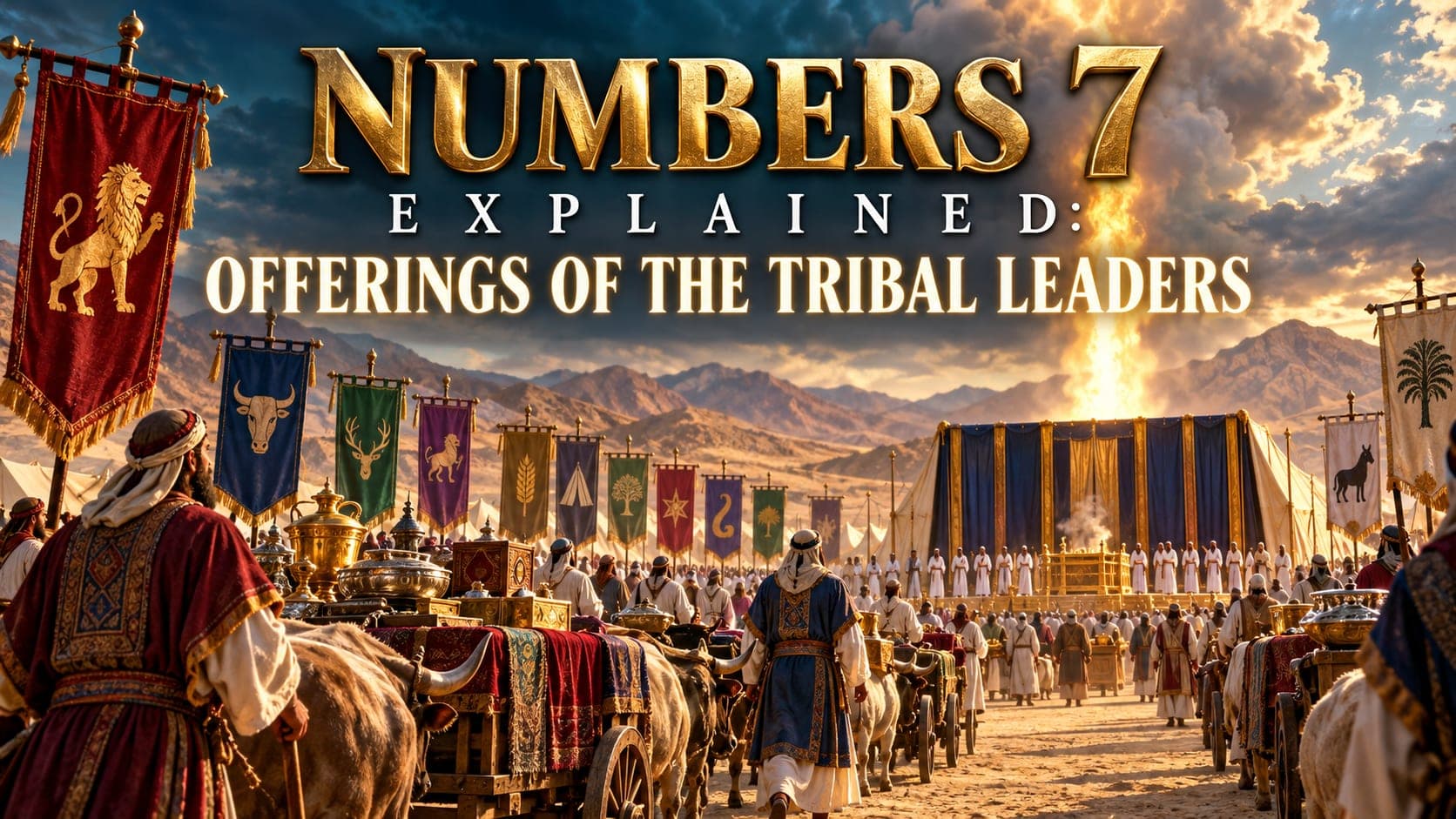
Numbers 7 explained is the longest chapter in the book of Numbers, and almost all of its length comes from one thing repeating twelve times over: a silver charger, a silver bowl, a gold spoon of incense, and a matching set of animals, brought by a different tribal leader on each of twelve straight days.
Maybe that sounds like a chapter you could skim and still get the point.
- ❓ Why does the Bible spell out an identical gift twelve separate times instead of saying it once?
- ❓ Why do the Kohathites, who carried the holiest objects in camp, get none of the wagons handed out here?
- ❓ Why does this chapter actually happen before the census that opens the book?
- ❓ And what is Moses doing at the very end of the chapter that nothing before it explained?
📌 Numbers 7 is not filler. It is twelve leaders, named one at a time, each one trusted enough to bring exactly what mattered, on exactly the day assigned to him.
This walkthrough goes through the chapter in order: the wagons given to two Levite families and withheld from a third, the single gift every prince brought, the totals that prove the record keeping down to the shekel, and the voice Moses finally hears once the altar is dedicated.
Few chapters reward a close, patient read more than this one does.
What Happened Just Before This Chapter
Numbers 6 closed with the priestly blessing, Aaron and his sons putting God's name on the whole nation. Numbers 7 opens on what looks like the next event in the story, but it is actually reaching backward.
Verse 1 dates this chapter to "the day that Moses had fully set up the tabernacle," and Exodus 40 already dated that day exactly: the first day of the first month of the second year. Numbers 1 dated its own census to the first day of the second month of that same year, a full month later. The chapter you are about to read happened before the book's own opening census, not after it. Numbers tells its early story out of strict calendar order on purpose, because the dedication belonged with the tabernacle furniture Exodus had just finished, not with the marching instructions Numbers had just started giving.
Numbers 7 Explained Verse by Verse
1. The Day the Tabernacle Was Finally Finished (verses 1 to 3)
The chapter opens by naming the moment that triggers everything that follows: the tabernacle is up, anointed, and sanctified, furniture and all.
"And it came to pass on the day that Moses had fully set up the tabernacle, and had anointed it, and sanctified it, and all the instruments thereof, both the altar and all the vessels thereof, and had anointed them, and sanctified them; That the princes of Israel, heads of the house of their fathers, who were the princes of the tribes, and were over them that were numbered, offered: And they brought their offering before the LORD, six covered wagons, and twelve oxen; a wagon for two of the princes, and for each one an ox: and they brought them before the tabernacle."
📌 These are the same twelve men named as tribal captains in Numbers 1 and Numbers 2. Nahshon, Nethaneel, Eliab, and the rest were counted as leaders of their tribes before this chapter ever gives them a single line of their own. Numbers 7 is where those names stop being entries on a census and start being men who step forward, one at a time, with something in their hands.
Six wagons, twelve oxen, one wagon shared between two princes and one ox apiece. The gift is modest at first glance, until the next few verses explain exactly where it was going and why.
2. Wagons for the Family That Carries, None for the Family That Shoulders (verses 4 to 9)
God tells Moses exactly who receives the wagons and oxen, and the answer splits the Levites right down a line this book already drew.
"Two wagons and four oxen he gave unto the sons of Gershon, according to their service: And four wagons and eight oxen he gave unto the sons of Merari, according unto their service, under the hand of Ithamar the son of Aaron the priest. But unto the sons of Kohath he gave none: because the service of the sanctuary belonging unto them was that they should bear upon their shoulders."
💡 This single verse is the reason the Kohathites never got wheels. Numbers 4 already explained that Kohath carried the ark, the table, the lampstand, and the altars on their own shoulders, wrapped and covered, never touching them directly and never loading them onto a cart. Numbers 7 is not introducing a new rule here. It is showing that rule already in effect, with real wagons handed to Gershon and Merari for the tent and the frame, and nothing handed to Kohath for the one job wheels could never be trusted with.
Two wagons and four oxen for Gershon, four wagons and eight oxen for Merari. Add them and the six wagons and twelve oxen from verse 3 are accounted for exactly, with nothing left over and nothing missing.
3. Twelve Days, Twelve Princes, One Order Already Set (verses 10 and 11)
With the wagons settled, the chapter turns to a second, much larger gift: the dedication of the altar itself.
"And the princes offered for dedicating of the altar in the day that it was anointed, even the princes offered their offering before the altar. And the LORD said unto Moses, They shall offer their offering, each prince on his day, for the dedicating of the altar."
"Each prince on his day" sets up the rest of the chapter: one leader, one day, twelve days running. And the order was not drawn by lot or chosen on the spot. Judah goes first, then Issachar, then Zebulun. Reuben, Simeon, and Gad follow. Then Ephraim, Manasseh, and Benjamin. Then Dan, Asher, and Naphtali last.
📌 That is not a new lineup. It is the exact camp order Numbers 2 laid out, group by group, from the tribes pitched on the east side closest to the tabernacle entrance to the tribes stationed on the north. Twelve days of dedication followed the same structure twelve tribes already lived inside every time the camp pitched its tents.
4. Nahshon Goes First, and Sets the Pattern for Everyone After Him (verses 12 to 17)
Day one belongs to Judah, the tribe that marched at the very front of the camp.
"And he that offered his offering the first day was Nahshon the son of Amminadab, of the tribe of Judah: And his offering was one silver charger, the weight thereof was an hundred and thirty shekels, one silver bowl of seventy shekels, after the shekel of the sanctuary; both of them were full of fine flour mingled with oil for a meat offering: One spoon of ten shekels of gold, full of incense: One young bullock, one ram, one lamb of the first year, for a burnt offering: One kid of the goats for a sin offering: And for a sacrifice of peace offerings, two oxen, five rams, five he goats, five lambs of the first year: this was the offering of Nahshon the son of Amminadab."
One silver charger at a hundred and thirty shekels. One silver bowl at seventy. One gold spoon of incense at ten. A bullock, a ram, and a lamb for the burnt offering. A goat for the sin offering. Two oxen, five rams, five goats, and five lambs for the peace offering. Six separate items, four categories of offering, named in full for one man.
💡 Every detail in this list will reappear eleven more times before the chapter is finished, word for word, number for number, changing only the prince's name and his tribe. Nahshon's gift is not a summary. It is the template.
5. Eleven More Names, Nothing Changed but the Name (verses 18 to 83)
Nethaneel of Issachar brings it on day two. Eliab of Zebulun brings it on day three. Elizur of Reuben, Shelumiel of Simeon, Eliasaph of Gad, Elishama of Ephraim, Gamaliel of Manasseh, Abidan of Benjamin, Ahiezer of Dan, Pagiel of Asher, and Ahira of Naphtali each take their own day, through the twelfth.
📌 Scripture could have written this chapter in one sentence. "All twelve princes brought the same offering Nahshon brought" would have said everything true about what happened. It chose instead to spell out the same silver charger, the same silver bowl, the same gold spoon, and the same string of animals, a full eleven more times, pausing only to swap in a new name and a new tribe each time.
That choice is the real content of this section. A shortcut would have treated the twelve gifts as one event with twelve copies. The text treats them as twelve separate men, each one named, each one recorded in full, on the day that belonged to him and no one else. Nothing about the length here is accidental. The repetition is the point being made.
6. The Totals That Match Down to the Shekel (verses 84 to 88)
Once all twelve days are finished, the chapter adds everything up.
"This was the dedication of the altar, in the day when it was anointed, by the princes of Israel: twelve chargers of silver, twelve silver bowls, twelve spoons of gold: Each charger of silver weighing an hundred and thirty shekels, each bowl seventy: all the silver vessels weighed two thousand and four hundred shekels, after the shekel of the sanctuary: The golden spoons were twelve, full of incense, weighing ten shekels apiece, after the shekel of the sanctuary: all the gold of the spoons was an hundred and twenty shekels."
"All the oxen for the burnt offering were twelve bullocks, the rams twelve, the lambs of the first year twelve, with their meat offering: and the kids of the goats for sin offering twelve. And all the oxen for the sacrifice of the peace offerings were twenty and four bullocks, the rams sixty, the he goats sixty, the lambs of the first year sixty. This was the dedication of the altar, after that it was anointed."
💡 Check the arithmetic yourself and it holds up every time. Twelve silver chargers at a hundred and thirty shekels each come to one thousand five hundred and sixty. Twelve silver bowls at seventy each come to eight hundred and forty. Added together, that is exactly two thousand four hundred, the number verse 85 gives for the silver. Twelve gold spoons at ten shekels each come to exactly one hundred and twenty, matching verse 86. Twelve days of one bullock, one ram, and one lamb for the burnt offering land on twelve of each in verse 87. Twelve days of two oxen, five rams, five goats, and five lambs for the peace offering land on twenty four, sixty, sixty, and sixty in verse 88.
📌 Every single total in this chapter is exactly twelve times one day's gift, with nothing rounded and nothing lost. A record this long invites copying mistakes. This one has none. The same God who told Aaron and his sons to cover the ark with exact care back in Numbers 4 kept exact count here too.
7. The Voice That Finally Answers From the Mercy Seat (verse 89)
After twelve days of gifts, the chapter ends on one verse that has nothing to do with princes, wagons, or shekels.
"And when Moses was gone into the tabernacle of the congregation to speak with him, then he heard the voice of one speaking unto him from off the mercy seat that was upon the ark of testimony, from between the two cherubims: and he spake unto him."
Years earlier, God had told Moses exactly where this would happen:
"And there I will meet with thee, and I will commune with thee from above the mercy seat, from between the two cherubims which are upon the ark of the testimony, of all things which I will give thee in commandment unto the children of Israel."
⚠️ Verse 89 is that promise finally keeping itself. Exodus 25 described the ark and the mercy seat being built, with God saying He would speak from between the cherubim once they were finished. Numbers 7 closes with Moses walking in and hearing exactly that voice, from exactly that place, now that the tabernacle, the altar, and every gift brought to dedicate it are finally in order. The chapter spent eighty eight verses on gold, silver, oxen, and names. It ends on the one thing none of that gold or silver could buy: God actually speaking.

Hard Questions Numbers 7 Raises
Why record the identical gift twelve full times instead of summarizing it once? Scripture never explains the choice directly, only makes it. What is visible in the text is that each repetition keeps a different man's name attached to his own gift on his own day, rather than folding twelve individuals into one combined total. A summary would have been shorter and said everything materially true. It would also have erased the fact that this was twelve separate acts of obedience, not one.
Why does Numbers 7 happen before the census in Numbers 1, if it comes later in the book? Verse 1 dates this chapter to the day the tabernacle was finished, which Exodus 40 already placed on the first day of the first month of the second year. Numbers 1 opens a month later, on the first day of the second month. The book does not always move forward in strict calendar order. Numbers 7 belongs with the tabernacle's completion in Exodus, placed here instead because it also explains where the Levites' wagons came from before the marching chapters that follow need them.
Why did Gershon and Merari receive wagons while Kohath received none? Verse 9 states the reason directly. Kohath's service was to carry the most holy objects on their own shoulders, the same requirement Numbers 4 laid out in detail. Gershon carried curtains and coverings, Merari carried boards and frames, and both of those loads could ride safely on a cart in a way the covered ark and its furniture never could.
Was the order of the twelve days random? No. Judah, Issachar, and Zebulun go first, followed by Reuben, Simeon, and Gad, then Ephraim, Manasseh, and Benjamin, then Dan, Asher, and Naphtali. That is the exact camp order Numbers 2 had already fixed for how the tribes pitched their tents and marched. The dedication followed a structure the nation was already living inside.
Top Verses From Numbers 7
1. Numbers 7:9
"But unto the sons of Kohath he gave none: because the service of the sanctuary belonging unto them was that they should bear upon their shoulders."
One sentence that quietly confirms a rule Numbers 4 already set: the heaviest, holiest load in the camp never rode on a cart, no matter how many wagons the other Levites received.
2. Numbers 7:11
"And the LORD said unto Moses, They shall offer their offering, each prince on his day, for the dedicating of the altar."
The verse that turns twelve identical gifts into twelve distinct days. Shared timing never meant shared identity in this chapter.
3. Numbers 7:84 and 85
"This was the dedication of the altar, in the day when it was anointed, by the princes of Israel: twelve chargers of silver, twelve silver bowls, twelve spoons of gold: Each charger of silver weighing an hundred and thirty shekels, each bowl seventy: all the silver vessels weighed two thousand and four hundred shekels, after the shekel of the sanctuary:"
A total that checks out exactly against twelve repeated gifts, down to the last shekel, after eighty eight verses where a mistake would have been easy to make.
4. Numbers 7:89
"And when Moses was gone into the tabernacle of the congregation to speak with him, then he heard the voice of one speaking unto him from off the mercy seat that was upon the ark of testimony, from between the two cherubims: and he spake unto him."
A promise made back in Exodus 25, kept the moment the tabernacle and its dedication were finally complete.

Frequently Asked Questions About Numbers 7
What is Numbers 7 about?
Numbers 7 records the twelve tribal princes giving wagons and oxen to the Levites, then bringing an identical dedication offering to the altar on twelve separate days, one tribe per day, closing with Moses hearing God's voice from the mercy seat.
Why is Numbers 7 the longest chapter in Numbers?
Because it writes out the same gift in full twelve separate times, once for each prince, rather than stating the gift once and noting that eleven others matched it. The length comes directly from that choice to record every man by name.
Why did the princes bring wagons and oxen to the Levites?
The tabernacle now had to travel with the camp, and someone had to haul its curtains, boards, bars, and pillars. The wagons and oxen went specifically to Gershon and Merari, the two Levite families responsible for that equipment.
Why did the Kohathites not receive any wagons?
Verse 9 states it directly: their service was to carry the most holy things on their own shoulders, the same rule Numbers 4 laid out, so no wagon was ever part of their assignment.
Did all twelve tribes bring the exact same gift?
Yes. Every prince brought one silver charger, one silver bowl, one gold spoon of incense, one bullock, one ram, one lamb, one goat, and a matching peace offering of two oxen, five rams, five goats, and five lambs, down to the same weights in shekels.
Does the order the princes gave their gifts mean anything?
Yes. The twelve days follow the exact camp order Numbers 2 had already fixed, starting with Judah, Issachar, and Zebulun on the east side and ending with Dan, Asher, and Naphtali on the north.
Why does Numbers 7 come after Numbers 1 through 6, if it happened earlier?
Verse 1 dates this chapter to the day the tabernacle was finished, a month before the census that opens Numbers 1. The book places the dedication here anyway because it belongs with the tabernacle furniture Exodus just completed and explains the Levites' wagons before the marching chapters need them.
What does the voice from the mercy seat in verse 89 mean?
Exodus 25:22 had God promise He would speak to Moses from above the mercy seat, between the two cherubim, once the ark was built. Numbers 7:89 is that promise being kept, now that the tabernacle and its dedication are complete.
Who was Nahshon, the first prince to offer?
Nahshon the son of Amminadab was the prince of the tribe of Judah, the tribe stationed and marching at the front of the whole camp. Ruth 4:20 and Matthew 1:4 place him directly in the ancestry that leads to David and to Christ.
What does Numbers 7 teach Christians today?
That God kept an exact, individual record of twelve identical gifts rather than treating them as one interchangeable total, and that He kept a promise about speaking to His people the moment everything was finally ready to receive it.
Final Thoughts
Numbers 7 looks, at first, like the chapter most worth skipping. Read closely, it is one of the most carefully kept.
📌 Twelve identical gifts still got twelve individual records. Nahshon, Nethaneel, Eliab, and the rest were never flattened into one combined total. Each man's day, and each man's name, stayed attached to what he personally brought.
📌 Nothing here was improvised. The wagons matched the Levites' actual jobs. The order matched the camp. The totals matched the math. A record this long had every reason to drift, and it never did.
📌 The chapter's real ending is not a number at all. After eighty eight verses of gold and silver, verse 89 lands on Moses hearing the voice God had promised years earlier, from the exact mercy seat Exodus 25 described.
You will never bring a silver charger to a tabernacle altar. But the same God who kept count of twelve identical gifts down to the shekel is still keeping count of what you bring Him now, even when it looks no different from what everyone around you is giving.
So here is your one next step.
Bring whatever you were already planning to give God this week, and bring it as your own, on your own day, the way each prince in this chapter did, instead of letting it blur into everyone else's.