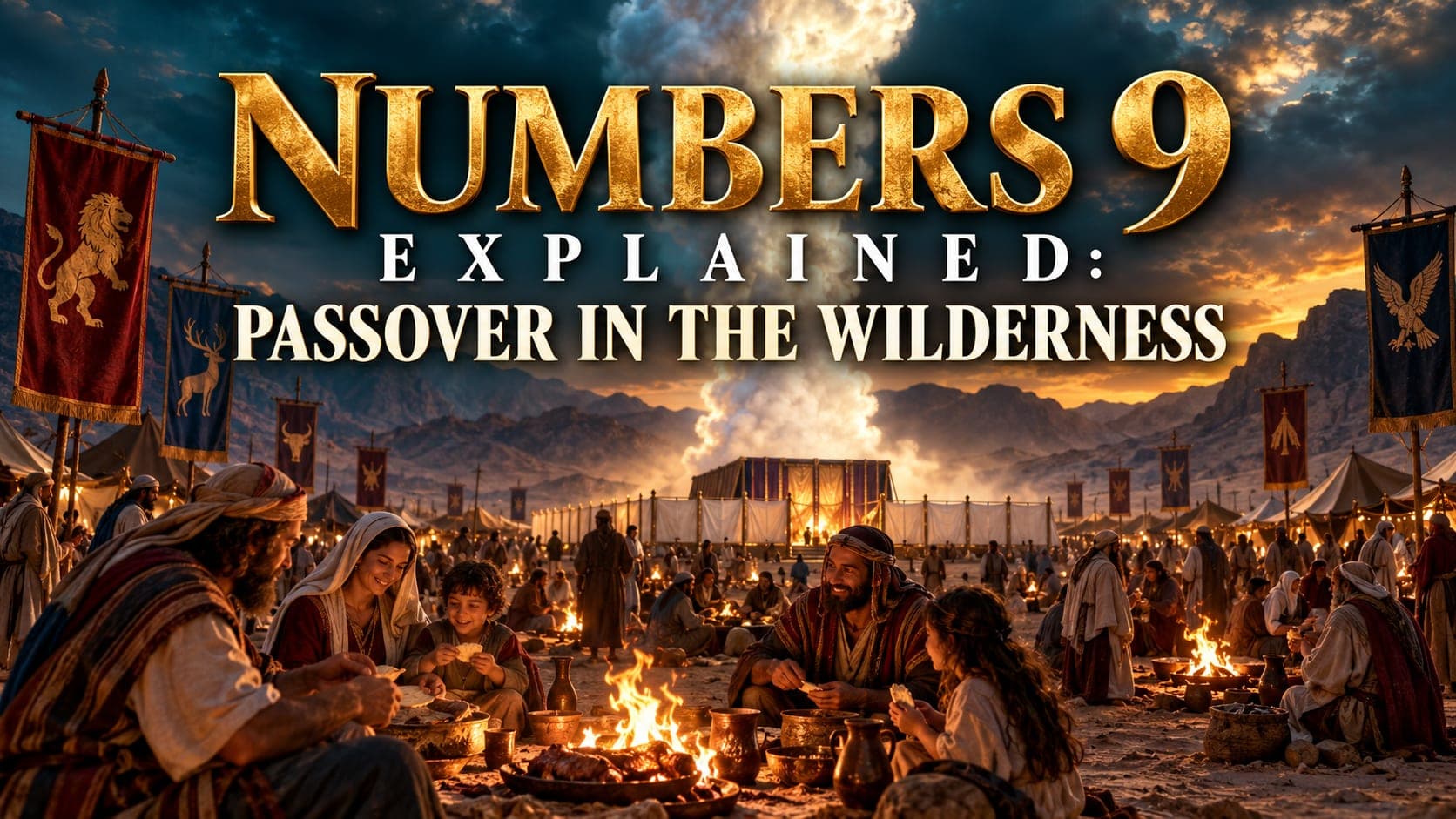
📖 Numbers 9 Explained: The Second Passover and the Pillar of Cloud
A man touches a dead body. A law he did not break anyway shuts him out of the one feast every Israelite was supposed to keep that year.
Numbers 9 explained splits in two. The first half settles what happens when a man wants to obey God but a situation outside his control makes it impossible. The second half hands the whole camp a single rule for the next forty years: move when the cloud moves, stay when it stays, and do not try to guess ahead of it.
Both halves ask the same underlying question in different clothes.
- ❓ What happened to the men who could not keep the Passover on time?
- ❓ Why does Numbers 9 take place before Numbers 1, even though it comes after it in the book?
- ❓ What does it actually mean to be "cut off from among his people"?
- ❓ Why would God ask Israel to stay camped in one spot for a whole year?
📌 Numbers 9 is about obedience that depends on paying close attention, not obedience on autopilot. A missed feast gets a second chance. A moving cloud gets watched day and night, for years, without anyone ever being told when it would move next.
This walkthrough goes through the chapter in order: the Passover kept exactly on schedule, the men it could not reach, the second Passover God built for them, the warning attached to it, and the cloud and fire that decided every single mile Israel walked in the wilderness.
A short chapter doing two very different jobs, both about the same thing underneath.
What Happened Just Before This Chapter
Numbers 8 ended with the Levites cleansed, dedicated, and finally serving in the tabernacle between the ages of twenty five and fifty. Numbers 9 reads like the natural next step: the tabernacle is built, staffed, and ready, so now it actually gets used.
But the date in verse 1 gives something away. Numbers 9 happens in the first month of the second year. Numbers 1, the census that opens this whole book, happens in the second month of that same year. Exodus 40 already recorded the tabernacle being raised on the first day of that first month. That means the Passover in this chapter happened only two weeks after the tabernacle went up, and roughly two weeks before Numbers 1 ever started counting anyone. Numbers 9 is placed where it is for what it teaches, not for when it happened.

Numbers 9 Explained Verse by Verse
1. A Passover Kept Exactly on Schedule (verses 1 to 5)
The chapter opens with a command Israel had already received once before, at Sinai itself.
"And the LORD spake unto Moses in the wilderness of Sinai, in the first month of the second year after they were come out of the land of Egypt, saying, Let the children of Israel also keep the passover at his appointed season."
This is not a new feast being introduced. Exodus 12 already gave the Passover its rules the night Israel left Egypt. Numbers 9 is the first time Israel keeps it again, exactly one year later, now that they are a free nation camped at the mountain instead of a people fleeing a king.
Verse 5 confirms it happened without a single detail skipped.
"And they kept the passover on the fourteenth day of the first month at even in the wilderness of Sinai: according to all that the LORD commanded Moses, so did the children of Israel."
📌 "According to all that the LORD commanded" closes this section the same way it closes dozens of instructions across these books. Nothing here was improvised. The whole nation lined up behind the exact date, the exact hour, and the exact rites Exodus 12 had already spelled out.
2. The Men Who Could Not Keep It (verses 6 to 8)
Right after that clean, obedient picture, the chapter introduces a problem obedience alone could not solve.
"And there were certain men, who were defiled by the dead body of a man, that they could not keep the passover on that day: and they came before Moses and before Aaron on that day: And those men said unto him, We are defiled by the dead body of a man: wherefore are we kept back, that we may not offer an offering of the LORD in his appointed season among the children of Israel?"
The text never says how these men became defiled. Touching a corpse, handling a burial, even being present at a death could all make a person ceremonially unclean under the law, and an unclean person could not come near the Passover meal. These were not men trying to get out of keeping the feast. They wanted in, and the law itself was keeping them out.
💡 Notice what they do with the problem. They do not quietly skip the feast and say nothing. They bring the conflict straight to Moses and Aaron and ask the question out loud.
Moses does not have an answer ready, and he says so plainly.
"And Moses said unto them, Stand still, and I will hear what the LORD will command concerning you."
⚠️ Moses does not invent a ruling on the spot, and he does not brush the men off either. He takes the actual problem to God and waits for an actual answer, rather than guessing at what mercy should look like.
3. A Second Passover, Built Into the Law Itself (verses 9 to 12)
God's answer does not just cover these particular men. It becomes a permanent provision for anyone in their position, ever.
"Speak unto the children of Israel, saying, If any man of you or of your posterity shall be unclean by reason of a dead body, or be in a journey afar off, yet he shall keep the passover unto the LORD."
Two situations get covered here, not just one: being defiled by a dead body, and being on a journey far from camp. Both could keep a man from the tabernacle through no disobedience of his own. The law makes room for both.
"The fourteenth day of the second month at even they shall keep it, and eat it with unleavened bread and bitter herbs. They shall leave none of it unto the morning, nor break any bone of it: according to all the ordinances of the passover they shall keep it."
📌 Exactly one month later, to the same day, with every rule from Exodus 12 still attached. No bone broken, nothing left until morning, unleavened bread and bitter herbs the same as always. This was never a watered down version of Passover for people who missed the real one. It was the same feast, on a second date, kept with the same seriousness.
4. A Warning, and One Law for Everyone (verses 13 and 14)
The mercy in verses 9 to 12 has a hard edge right next to it, aimed at a very different kind of person.
"But the man that is clean, and is not in a journey, and forbeareth to keep the passover, even the same soul shall be cut off from among his people: because he brought not the offering of the LORD in his appointed season, that man shall bear his sin."
⚠️ The second Passover was for people who genuinely could not come, not for people who simply did not want to. A man with no excuse, clean and present and able, who still refused to keep the feast, faced being "cut off from among his people." The provision in verses 9 to 12 only makes sense next to a warning this serious. Grace for the genuinely unable and a hard line for the unwilling are not contradictions. They sit in the same two verses on purpose.
Then the chapter widens the circle one more time.
"And if a stranger shall sojourn among you, and will keep the passover unto the LORD; according to the ordinance of the passover, and according to the manner thereof, so shall he do: ye shall have one ordinance, both for the stranger, and for him that was born in the land."
Exodus 12:48 and 49 already said a circumcised foreigner living among Israel kept the same Passover law as anyone born into the nation. Numbers 9:14 simply repeats that one law applies to both, right in the same breath as the second Passover rule. Being born an Israelite gave no special exemption, and being born outside Israel gave no special excuse either.
5. The Cloud That Had Already Spoken Once (verses 15 and 16)
Without any transition, the chapter leaves the Passover behind completely and turns to something that started before this chapter ever began.
"And on the day that the tabernacle was reared up the cloud covered the tabernacle, namely, the tent of the testimony: and at even there was upon the tabernacle as it were the appearance of fire, until the morning."
Exodus 40 already described this exact moment: a cloud covering the newly finished tabernacle the day it went up, with the glory of the LORD filling it so completely that Moses could not even enter. Numbers 9 is not reporting new news here. It is reaching back to that same day to explain what came of it.
And the pattern itself was not new either. Back in Exodus 13, as Israel first left Egypt, God already led them by a pillar of cloud in the day and a pillar of fire by night. Numbers 9 is the third time this same cloud and fire shows up in Israel's story, now settling permanently over the tabernacle instead of only going ahead of the people.
6. Moving Only When God Moved (verses 17 to 23)
The rest of the chapter turns that cloud into the rule that would govern every single mile of Israel's journey for the next four decades.
"And when the cloud was taken up from the tabernacle, then after that the children of Israel journeyed: and in the place where the cloud abode, there the children of Israel pitched their tents."
"At the commandment of the LORD the children of Israel journeyed, and at the commandment of the LORD they pitched: as long as the cloud abode upon the tabernacle they rested in their tents."
📌 The phrase "at the commandment of the LORD" appears seven times in the last six verses of this chapter. No other section in Numbers repeats one phrase that often in that short a space. The chapter is not just telling you the cloud decided when Israel moved. It is making sure you cannot read these verses without that phrase landing on you again and again.
The length of each stop was completely outside Israel's control, and the text makes a point of saying so.
"Or whether it were two days, or a month, or a year, that the cloud tarried upon the tabernacle, remaining thereon, the children of Israel abode in their tents, and journeyed not: but when it was taken up, they journeyed."
Two days. A month. A year. No warning was given ahead of time for any of it. A camp of this size could not simply decide to get moving on a convenient morning. Everyone, from Moses down to the newest child born in the wilderness, watched the same cloud and waited on the same signal.
The chapter ends by naming exactly whose authority was behind the whole system.
"At the commandment of the LORD they rested in the tents, and at the commandment of the LORD they journeyed: they kept the charge of the LORD, at the commandment of the LORD by the hand of Moses."
💡 "By the hand of Moses" matters here. The cloud itself moved at God's will, but Moses was still the one through whom that will reached the camp day to day. Even a sign this visible still worked through the leader God had already appointed, not around him.

Hard Questions Numbers 9 Raises
What does it mean to be "cut off from among his people"? Verse 13 states the consequence without spelling out exactly how it was carried out. Bible teachers hold different views here. Some read it as a formal removal from the covenant community, a kind of excommunication. Others read it as God Himself cutting that person's life short, since several other Old Testament laws use similar language for cases where no human court was meant to carry out the sentence. Scripture does not settle which is meant in every case, and this is one of the places honest readers hold the question open rather than claim certainty the text does not give.
Why does Numbers 9 appear after Numbers 1 through 8, if it happened before all of them? The date in verse 1 places this Passover in the first month of the second year, while Numbers 1's census happened in the second month of that same year. Numbers does not always run in strict time order. It groups material by subject at points like this one, finishing the story of the newly built tabernacle, its furniture, and its staff before circling back to describe this earlier event that explains how Israel was actually using that tabernacle from the moment it stood.
Did Israel ever actually use the second Passover rule from this chapter again? Centuries later, 2 Chronicles 30 records King Hezekiah keeping Passover in the second month instead of the first, because the priests had not sanctified themselves in time and the people had not gathered quickly enough. Hezekiah's reason was different from the defilement and distant journey covered in Numbers 9, but the second month date he used was not invented on the spot. Numbers 9 had already established that a delayed Passover, kept honestly, was still a real Passover.
Why would God ask people to stay camped in one place for as long as a year, with no explanation given? Verse 22 names the possibility directly without explaining the reasoning behind any specific stop. The text simply presents it as something Israel had to trust rather than understand in the moment. Waiting without being told why, for however long the cloud stayed, was as much a part of the test as the walking itself.
Top Verses From Numbers 9
1. Numbers 9:6 and 7
"And there were certain men, who were defiled by the dead body of a man, that they could not keep the passover on that day: and they came before Moses and before Aaron on that day: And those men said unto him, We are defiled by the dead body of a man: wherefore are we kept back, that we may not offer an offering of the LORD in his appointed season among the children of Israel?"
A problem brought into the open instead of quietly avoided. The whole chapter's mercy begins with men who refused to just stay silent about being shut out.
2. Numbers 9:13
"But the man that is clean, and is not in a journey, and forbeareth to keep the passover, even the same soul shall be cut off from among his people: because he brought not the offering of the LORD in his appointed season, that man shall bear his sin."
The line that keeps the second Passover from becoming an excuse. Mercy for the genuinely unable sits right beside a warning for anyone simply unwilling.
3. Numbers 9:14
"And if a stranger shall sojourn among you, and will keep the passover unto the LORD; according to the ordinance of the passover, and according to the manner thereof, so shall he do: ye shall have one ordinance, both for the stranger, and for him that was born in the land."
One law, stated plainly, for anyone willing to keep it. Birth into Israel bought no special privilege here, and birth outside it bought no special exclusion.
4. Numbers 9:17
"And when the cloud was taken up from the tabernacle, then after that the children of Israel journeyed: and in the place where the cloud abode, there the children of Israel pitched their tents."
The single rule behind every mile Israel walked for forty years. Not a schedule they set, a signal they watched for.
5. Numbers 9:23
"At the commandment of the LORD they rested in the tents, and at the commandment of the LORD they journeyed: they kept the charge of the LORD, at the commandment of the LORD by the hand of Moses."
The chapter's closing summary, and the one phrase it will not let you forget. Every stop and every step traced back to the same source.

Frequently Asked Questions About Numbers 9
What is Numbers 9 about?
Numbers 9 covers Israel keeping the Passover at Sinai exactly on schedule, God providing a second Passover one month later for anyone defiled by a dead body or away on a journey, and the cloud and fire over the tabernacle that told the whole camp when to move and when to stay.
Why couldn't some Israelites keep the first Passover?
Verses 6 and 7 describe men made ceremonially unclean by contact with a dead body. The law required a person to be clean before taking part in the Passover, so these men were kept back through no willful disobedience of their own.
What was the second Passover, and who could use it?
Verses 9 to 12 set a Passover one month later, on the fourteenth day of the second month, for anyone unclean by a dead body or on a distant journey during the first one. It followed every rule of the original Passover rather than a simpler version.
What does it mean to be "cut off from among his people"?
Verse 13 attaches this consequence to anyone able to keep the Passover who simply refused to. Bible teachers read it either as removal from the covenant community or as God shortening that person's life, and Scripture does not state which is meant in every instance.
Why does Numbers 9 happen before Numbers 1, even though it comes later in the book?
Numbers 9:1 dates this Passover to the first month of the second year, while Numbers 1:1 dates the census to the second month of that same year. Numbers groups some material by topic rather than strict time order, finishing the tabernacle story before returning to this earlier event.
Did anyone later in the Bible use the second Passover rule from Numbers 9?
2 Chronicles 30 records King Hezekiah keeping Passover in the second month for a different reason, an unready priesthood and a people not yet gathered, but the second month date itself traces back to the provision Numbers 9 first established.
Why did a stranger get the same Passover rule as a native Israelite?
Verse 14 repeats a rule Exodus 12:48 and 49 already gave: a foreigner willing to keep the Passover under its full requirements kept it under the exact same law as someone born into Israel, with no separate or lesser version offered.
What was the cloud over the tabernacle?
Verses 15 and 16 describe a cloud resting over the tabernacle by day and an appearance of fire by night, the same visible sign of God's presence Exodus 40 recorded the day the tabernacle was first raised, and the same pattern God had already used to lead Israel out of Egypt in Exodus 13.
How did Israel know when to move camp?
Verses 17 to 23 explain that the camp moved only when the cloud lifted from the tabernacle and stopped only when it settled again, whether that meant staying in one place for two days or for a full year.
Final Thoughts
Numbers 9 covers a feast and a cloud, but one lesson runs underneath both halves.
📌 Being unable is never the same as being unwilling, and God's law tells the difference apart. The men defiled by a dead body got a second Passover built just for them. The man who simply refused got a warning instead.
📌 God does not owe anyone an explanation for how long the waiting lasts. Two days, a month, or a year, the camp stayed put until the cloud itself gave the signal, with no schedule handed out ahead of time.
📌 The same cloud and fire shows up three times in Israel's story because the same God was leading the whole way through. Exodus 13 out of Egypt, Exodus 40 over the new tabernacle, Numbers 9 governing every mile after that. It was never a new sign. It was the same one, kept.
You are not watching a literal cloud over your life. But the same question sits underneath yours that sat underneath theirs: will you move when God actually says move, and stay when He says stay, even without knowing how long either one will last.
So here is your one next step.
Think of the last thing you were waiting on God for, and ask honestly whether you were watching for His signal, or trying to set your own schedule and call it faith.