📖 Numbers 8 Explained: Cleansing the Levites and the Age of Service
Shaved heads. Washed clothes. The whole nation stepping forward to lay hands on one tribe at once.
Numbers 8 explained moves from the gold and silver of the last chapter to something far more physical: Aaron lighting the lampstand exactly as he was shown, then the entire camp watching the Levites go through a cleansing that looks a lot like a sacrifice, because in one sense it is one.
A short chapter closes it out, and that short ending has puzzled readers for a long time.
- ❓ Why did the Levites need shaving and washing when they were already set apart by birth?
- ❓ Why does the whole congregation, not just Aaron, lay hands on them?
- ❓ Why does this chapter say Levites started serving at twenty five, when Numbers 4 said thirty?
- ❓ And what actually happened to a Levite once he turned fifty?
📌 Numbers 8 is the moment one tribe stops being set apart on paper and gets set apart in front of everyone, with a start date and a retirement date both written down.
This walkthrough goes through the chapter in order: the lamps lit exactly to pattern, the washing and shaving that cleansed the Levites, the hands the whole nation laid on them, the old debt from Egypt this chapter quietly settles, and the working life the Levites were given, start to finish.
A short chapter, with more going on in it than its length suggests.
What Happened Just Before This Chapter
Numbers 7 ended with twelve princes finishing twelve days of identical gifts, and Moses finally hearing God's voice from the mercy seat once the tabernacle, the altar, and its dedication were all complete. Numbers 8 picks up in that same newly finished tabernacle and turns from the furniture and the offerings to the men who would actually run it day to day.
The chapter opens on the lampstand Aaron had just been shown how to build and light, then spends most of its length on a ceremony the Levites had not yet gone through even though Numbers 3 had already counted them and assigned their families their jobs. Being numbered was not the same as being cleansed and sent in. Numbers 8 is where that actually happens.

Numbers 8 Explained Verse by Verse
1. The Lamps Lit Exactly as Shown (verses 1 to 4)
The chapter opens with four short verses that could easily be skipped past, and almost nothing in them is new information.
"And the LORD spake unto Moses, saying, Speak unto Aaron, and say unto him, When thou lightest the lamps, the seven lamps shall give light over against the candlestick. And Aaron did so; he lighted the lamps thereof over against the candlestick, as the LORD commanded Moses."
📌 The whole point of these verses is the last clause, not the lamps. "As the LORD commanded Moses" closes this short section the same way it closes dozens of instructions across Exodus and Numbers. Aaron was not improvising a nice way to arrange seven lamps. He was repeating, to the letter, something he had already been shown.
Verse 4 confirms exactly where that showing happened.
"And this work of the candlestick was of beaten gold, unto the shaft thereof, unto the flowers thereof, was beaten work: according unto the pattern which the LORD had shewed Moses, so he made the candlestick."
Exodus 25 is where God first showed Moses the pattern for this lampstand, down to the almond blossoms worked into the beaten gold. Numbers 8 is not adding anything to that design years later. It is simply confirming that once the tabernacle was finally standing, the lamp got lit exactly the way the pattern required, with no shortcuts taken once the real work began.
2. Cleansed Before They Could Serve (verses 5 to 8)
From the lamp, the chapter turns to the Levites, and the instructions get far more physical than anything about the candlestick.
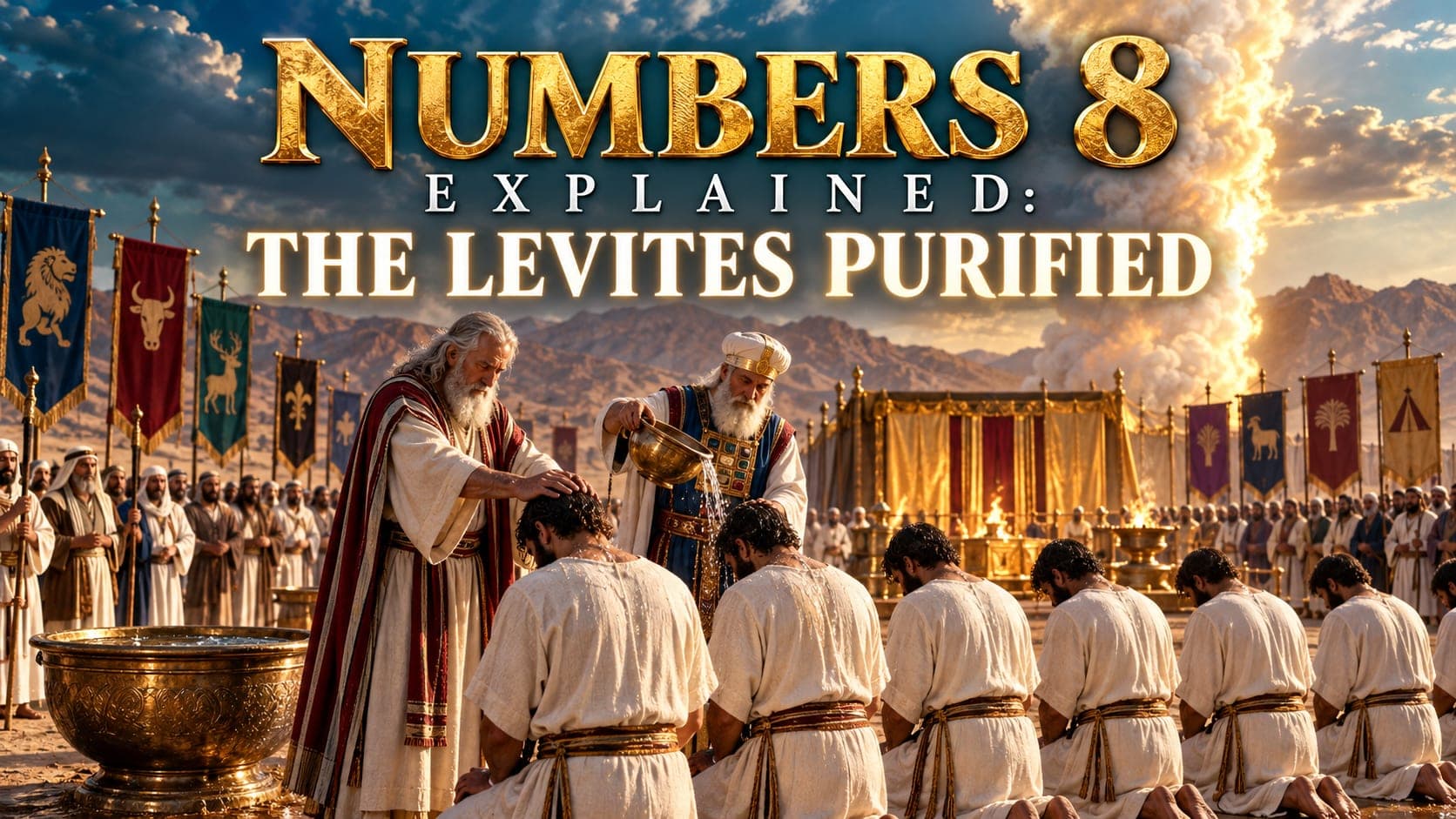
"Take the Levites from among the children of Israel, and cleanse them. And thus shalt thou do unto them, to cleanse them: Sprinkle water of purifying upon them, and let them shave all their flesh, and let them wash their clothes, and so make themselves clean."
Water sprinkled on them, every part of their body shaved, their clothes washed. Nothing here is symbolic only in theory. A Levite about to begin this ceremony would have looked, by the end of it, like a different man than the one who walked in.
💡 Shaving "all their flesh" was not a haircut. It meant the whole body, a total removal of anything that belonged to their old, ordinary life before this service began. Then came the offerings.
"Then let them take a young bullock with his meat offering, even fine flour mingled with oil, and another young bullock shalt thou take for a sin offering."
Two bullocks, one for a sin offering and one for a burnt offering, the same pairing an ordinary Israelite would bring for their own guilt. The Levites were being set apart for the holiest work in the camp, and the chapter does not let that status skip past the fact that they still needed atonement first, the same as anyone else.
3. The Whole Nation Lays Hands on One Tribe (verses 9 to 14)
What happens next is one of the more unusual pictures in the whole book.
"And thou shalt bring the Levites before the LORD: and the children of Israel shall put their hands upon the Levites: And Aaron shall offer the Levites before the LORD for an offering of the children of Israel, that they may execute the service of the LORD."
📌 Not just Aaron. Not just the priests. "The children of Israel" themselves lay hands on the Levites. Laying on hands elsewhere in Scripture usually transfers something, a blessing, a responsibility, or guilt onto a sacrifice. Here the whole nation is the one doing the laying on, and the Levites are the ones receiving it, standing in for the entire congregation's own service to God.
Verse 14 states plainly what all of this was building toward.
"Thus shalt thou separate the Levites from among the children of Israel: and the Levites shall be mine."
"The Levites shall be mine" is the shortest sentence in the chapter and the one everything else serves. The washing, the shaving, the two bullocks, and the nation's hands were not random rituals stacked together. Every one of them was moving toward this one claim God makes on this one tribe.
4. An Old Debt From Egypt, Finally Settled (verses 15 to 19)
The chapter then explains why God specifically wanted this tribe, and the reason reaches back decades.
"For they are wholly given unto me from among the children of Israel; instead of such as open every womb, even instead of the firstborn of all the children of Israel, have I taken them unto me. For all the firstborn of the children of Israel are mine, both man and beast: on the day that I smote every firstborn in the land of Egypt I sanctified them for myself."
That night is the night Exodus 12 describes, the Passover night when every firstborn in Egypt died except the ones covered by the blood on the doorposts. From that night on, God held a claim on every firstborn son in Israel, man and beast both, simply because they had been spared when Egypt's were not.
Numbers 3 already introduced the substitution this chapter is finishing: the Levites standing in for every firstborn son in the other eleven tribes, so that one whole tribe serves instead of one son out of every family serving. Numbers 8:19 adds the reason in plain words.
"And I have given the Levites as a gift to Aaron and to his sons from among the children of Israel, to do the service of the children of Israel in the tabernacle of the congregation, and to make an atonement for the children of Israel: that there be no plague among the children of Israel, when the children of Israel come nigh unto the sanctuary."
⚠️ "That there be no plague" is not a throwaway phrase. Getting close to a holy God without the right mediator in place was dangerous, not simply disrespectful. The Levites, cleansed and set between the ordinary Israelite and the sanctuary, were part of how the nation could approach God at all without it costing them their lives.
5. Moses and Aaron Obey to the Letter (verses 20 to 22)
After the explanation, the chapter confirms the ceremony actually happened exactly as commanded.
"And Moses, and Aaron, and all the congregation of the children of Israel, did to the Levites according unto all that the LORD commanded Moses concerning the Levites, so did the children of Israel unto them."
Verse 22 closes this section with a short line that is easy to read past.
"And after that went the Levites in to do their service in the tabernacle of the congregation before Aaron, and before his sons: as the LORD had commanded Moses concerning the Levites, so did they unto them."
📌 Three times in three verses, the chapter repeats that it happened "as the LORD commanded Moses." A tribe carrying this much responsibility was never left to figure out the details for itself. Every step of becoming a Levite in active service traced back to an exact instruction, not a local custom that grew up around the tabernacle.
6. A Working Life With a Start and a Finish (verses 23 to 26)
The chapter closes on something new: an age range for Levite service, something no earlier chapter had given.
"This is it that belongeth unto the Levites: from twenty and five years old and upward they shall go in to wait upon the service of the tabernacle of the congregation: And from the age of fifty years they shall cease waiting upon the service thereof, and shall serve no more."
Twenty five to begin, fifty to stop carrying the full workload. But stopping did not mean leaving entirely.
"But shall minister with their brethren in the tabernacle of the congregation, to keep the charge, and shall do no service. Thus shalt thou do unto the Levites touching their charge."
💡 A Levite past fifty kept the charge without doing the service. He stayed attached to the work, likely guiding and assisting the younger men still doing the heavy carrying Numbers 4 had already described, without the physical demands of that labor falling on him anymore. Retirement from the tabernacle was not the same thing as being sent away from it.

Hard Questions Numbers 8 Raises
Why does Numbers 8 say Levites began at twenty five, when Numbers 4 said thirty? Numbers 4 repeats "from thirty years old and upward" seven separate times for the Kohathites, Gershonites, and Merarites carrying the tabernacle. Numbers 8:24 gives twenty five instead. The text never explains the gap directly, but the most widely accepted reading treats the five years between twenty five and thirty as a training period, a Levite beginning lighter duties at twenty five and taking up the full carrying service described in Numbers 4 once he reached thirty. Centuries later, 1 Chronicles 23:24 and 27 record King David lowering the starting age again, to twenty, once the tabernacle had settled permanently in Jerusalem and the heaviest carrying work was no longer needed. Scripture records multiple ages across different seasons of Israel's history rather than a single number that never moved.
Why did the Levites need cleansing and a sin offering if they were already set apart by birth? Being born into the tribe of Levi determined their assignment, not their personal standing before God. The sprinkled water, the shaving, the washed clothes, and the two bullocks all dealt with something birth could not: the ordinary guilt and uncleanness every Israelite carried, Levite or not, before approaching a holy God in close service.
Why does the whole congregation lay hands on the Levites, instead of only Aaron? Verse 19 calls the Levites a gift Israel was giving to Aaron and his sons. A gift from the whole nation fits a ceremony where the whole nation, not one priest alone, physically marks the transfer. The Levites were standing in for the service and the firstborn of every family in the camp, so every family's hands took part in setting them apart for it.
Did a Levite past fifty really stop working completely? Verse 26 says he stopped doing "service" but still kept "the charge." The text draws a real line between the two without spelling out every task on each side of it. The plain reading is that the heaviest physical labor ended at fifty while some ongoing responsibility, likely guidance and oversight, did not.
Top Verses From Numbers 8
1. Numbers 8:14
"Thus shalt thou separate the Levites from among the children of Israel: and the Levites shall be mine."
The shortest sentence in the chapter and the reason for every verse around it. One tribe, claimed by name, out of the whole nation.
2. Numbers 8:17
"For all the firstborn of the children of Israel are mine, both man and beast: on the day that I smote every firstborn in the land of Egypt I sanctified them for myself."
A claim that reaches back to the one night everything changed in Egypt, and never let go of what it was owed.
3. Numbers 8:19
"And I have given the Levites as a gift to Aaron and to his sons from among the children of Israel, to do the service of the children of Israel in the tabernacle of the congregation, and to make an atonement for the children of Israel: that there be no plague among the children of Israel, when the children of Israel come nigh unto the sanctuary."
A gift with a stated purpose: keeping ordinary Israelites safe from the danger of approaching a holy God without the right mediator in place.
4. Numbers 8:24 and 25
"This is it that belongeth unto the Levites: from twenty and five years old and upward they shall go in to wait upon the service of the tabernacle of the congregation: And from the age of fifty years they shall cease waiting upon the service thereof, and shall serve no more."
The clearest start and finish line given to any job in the whole book of Numbers, down to the exact year.

Frequently Asked Questions About Numbers 8
What is Numbers 8 about?
Numbers 8 covers Aaron lighting the tabernacle lampstand exactly as God showed Moses, then the full cleansing and dedication ceremony that set the Levites apart for service, and closes with the age range, twenty five to fifty, for active Levite duty.
Why did the Levites have to shave their whole body?
Verse 7 commands shaving "all their flesh" as part of a full cleansing before entering service, alongside sprinkled water and washed clothes. It marked a complete break from their ordinary life before they began tabernacle duty.
Why does the Bible say the Levites were taken instead of the firstborn?
Exodus 12 records God sparing Israel's firstborn sons the night He struck down Egypt's firstborn. From that point, every Israelite firstborn son belonged to God in a special sense, and Numbers 8:16 and 17 explain that the Levites were taken as a substitute for all of them.
Why does Numbers 8 say Levites started at twenty five when Numbers 4 said thirty?
The text gives both numbers without reconciling them directly. The common explanation is that twenty five began a period of lighter duty or training, with the full carrying service of Numbers 4 beginning at thirty. 1 Chronicles 23 later records the age lowered again, to twenty, once the tabernacle no longer had to be carried through the wilderness.
What happened to a Levite after he turned fifty?
Verse 25 says he stopped carrying the full workload of service, and verse 26 adds that he still kept "the charge" alongside the younger Levites, just without doing the heavy labor himself.
Why did the whole congregation lay hands on the Levites?
Verse 19 calls the Levites a gift from the children of Israel to Aaron and his sons. The entire nation laying hands on them matched a gift being given by the entire nation, not by Aaron alone.
What does this chapter mean by a sin offering for the Levites?
Verse 8 required one bullock as a sin offering and another as a burnt offering before the Levites began their service. Being chosen for this role did not exempt them from needing atonement the same as any other Israelite.
Why does this chapter mention the lampstand before the Levites?
Verses 1 to 4 confirm Aaron lit the lampstand exactly to the pattern God showed Moses in Exodus 25. It sets the tone for the rest of the chapter: every detail that follows, including the Levites' cleansing, was carried out exactly as commanded, with nothing left to guesswork.
Does Numbers 8 still apply to Christians today?
The specific ceremony belonged to Israel's priestly system, now fulfilled in Christ. The underlying principle, that approaching a holy God requires a cleansing and a mediator the person cannot provide for themselves, is exactly what the New Testament says Jesus accomplishes once for all.
Final Thoughts
Numbers 8 is a short chapter carrying a long history inside it.
📌 Being chosen was never the same as being exempt. The Levites were set apart by birth and still needed water, shaving, and a sin offering before they could serve. No amount of status replaces the need to be made clean.
📌 A debt from one terrible night in Egypt was still being paid off here. The Levites standing in for Israel's firstborn traces straight back to the Passover, decades earlier, and this chapter is where that substitution was finally carried out in full.
📌 God gave this tribe a start date and a stop date, and kept both. Twenty five to begin, fifty to step back from the heaviest work, with service continuing in a different shape after that. Nothing about this job was left open ended.
You will never shave your head before a tabernacle door. But the same God who required real cleansing before real service still asks for your life to actually be cleansed before you serve Him, not just assigned to the task.
So here is your one next step.
Ask whether you have been treating your own calling the way Israel almost treated the Levites: counted and assigned, but never actually brought near enough to be cleansed for it.