📖 Numbers 10 Explained: The Silver Trumpets and the First March
Two trumpets of silver, and an entire nation learns to listen for them.
Numbers 10 explained is the chapter where the waiting finally ends. After a whole book of counting, cleansing, and camping at Sinai, the cloud lifts for good and roughly two million people start walking, in a fixed order, toward a land none of them have ever seen.
Maybe you have wondered what actually got that many people moving at once, in the right order, without chaos.
- ❓ What were the two silver trumpets actually for?
- ❓ Why does the tabernacle travel in the middle of the line instead of the front?
- ❓ Who was Hobab, and did he actually go with Israel?
- ❓ Why does the ark suddenly go "before them" after the chapter just placed it in the middle of the camp?
📌 Numbers 10 is the sound of a year of preparation finally turning into motion. Every tribe, every trumpet blast, and every Levite family had a place already assigned, long before the first person took a single step.
This walkthrough goes through the chapter in order: the two trumpets and what each signal meant, the exact day the cloud lifted, the marching order itself, Moses asking his brother in law to stay, and the three days that followed.
A short chapter, and the hinge the whole book of Numbers swings on.
What Happened Just Before This Chapter
Numbers 9 ended with a single rule governing the whole camp: move when the cloud moves, stay when it stays, for however long that takes. It never told Israel how the actual order to move would reach a camp that size, tent by tent, tribe by tribe. Numbers 10 answers that question before it answers anything else.
It also finally delivers on something this book has been building toward since Numbers 1 first counted the tribes and Numbers 2 arranged them around the tabernacle. All of that counting and arranging was never only for life at a standstill. It was for this moment, when the whole camp had to fold up and move as one body.

Numbers 10 Explained Verse by Verse
1. One Pair of Trumpets, Five Uses (verses 1 to 10)
The chapter opens with a simple instruction and a very specific material.
"Make thee two trumpets of silver; of a whole piece shalt thou make them: that thou mayest use them for the calling of the assembly, and for the journeying of the camps."
Two trumpets, not one, and both beaten out of a single piece of silver rather than joined from parts. No earlier chapter ever mentioned them. They show up here because this is the first moment the camp actually needs a way to hear an order before anyone could see it carried out.
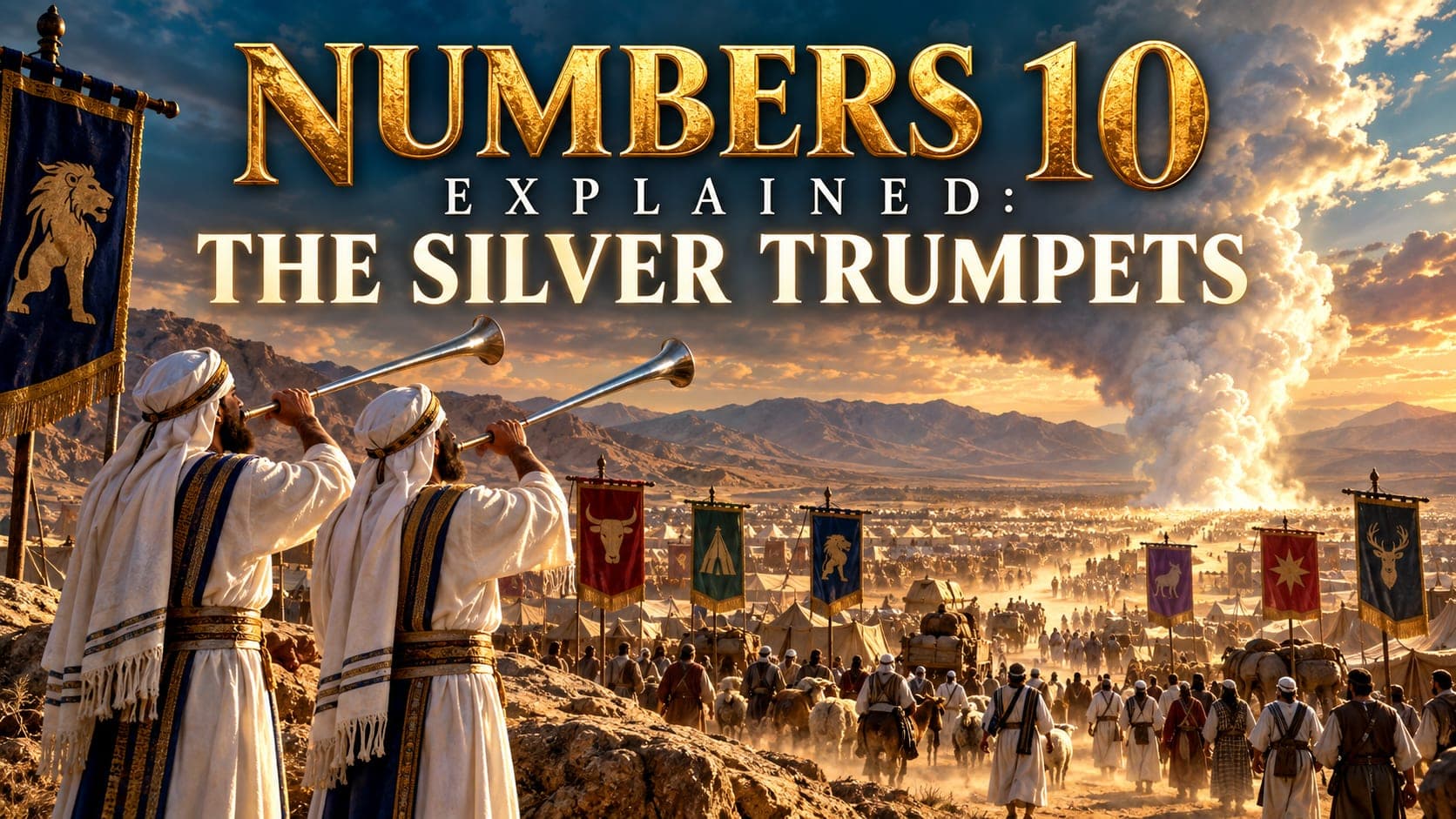
💡 The two trumpets covered five separate uses, and the number of trumpets or the kind of blast told the camp which one was happening. Both trumpets together, blown plainly rather than as an alarm, called the whole assembly to Moses at the tabernacle door. One trumpet alone called only the princes, the tribal leaders, rather than everybody.
"When ye blow an alarm, then the camps that lie on the east parts shall go forward. When ye blow an alarm the second time, then the camps that lie on the south side shall take their journey: they shall blow an alarm for their journeys."
An alarm sounded was a different signal again, used specifically to set the camp walking. The text names the first alarm for the east camp and the second for the south camp by name, and then moves straight on to who blew the trumpets at all.
"And the sons of Aaron, the priests, shall blow with the trumpets; and they shall be to you for an ordinance for ever throughout your generations."
Only the priests blew them. Not Moses, not the tribal princes, not whichever Levite happened to be nearby. The last two verses of this section take the trumpets somewhere the marching orders never needed to go.
"And if ye go to war in your land against the enemy that oppresseth you, then ye shall blow an alarm with the trumpets; and ye shall be remembered before the LORD your God, and ye shall be saved from your enemies."
⚠️ The same instrument that told the camp when to walk also told God, in a sense, when His people needed Him. Verse 10 adds a fifth use again, over burnt offerings and peace offerings at festivals and new moons, "for a memorial before your God." One pair of trumpets, covering the whole range from everyday travel to war to worship.
2. The Cloud Lifts, on an Exact Day (verses 11 to 13)
After ten verses about instruments nobody had used yet, the chapter turns to the day the rule from Numbers 9 was finally put into practice.
"And it came to pass on the twentieth day of the second month, in the second year, that the cloud was taken up from off the tabernacle of the testimony."
Israel had been camped at Sinai since roughly the third month of the first year, when Exodus 19 first describes them arriving at the mountain. By this verse, nearly a full year has passed at one mountain. The twentieth day of the second month of the second year is the date the waiting ends.
"And the children of Israel took their journeys out of the wilderness of Sinai; and the cloud rested in the wilderness of Paran."
📌 Verse 13 closes this short section the same way Numbers has closed almost every major event so far. "According to the commandment of the LORD by the hand of Moses." The first march of a nation this size did not begin with excitement or confusion. It began with an order given through the one leader God had already appointed to give it.
3. The Order of March: Judah First, the Tabernacle in the Middle (verses 14 to 28)
What follows reads almost exactly like Numbers 2, which fixed the order the tribes camped in around the tabernacle. But a closer look shows this is not a simple repeat.
"In the first place went the standard of the camp of the children of Judah according to their armies: and over his host was Nahshon the son of Amminadab."
Judah leads, exactly as Numbers 2 already set, with Issachar and Zebulun marching alongside under the same standard. Nahshon, named here, is the same prince who brought the very first dedication gift in Numbers 7. But right after Judah's division, the text inserts something Numbers 2 never mentioned at all.
"And the tabernacle was taken down; and the sons of Gershon and the sons of Merari set forward, bearing the tabernacle."
💡 Gershon and Merari, the two Levite families carrying the curtains, coverings, boards, and bars, march second, directly behind Judah. That placement is practical, not ceremonial. If they go early, they can have the tabernacle structure standing again by the time the rest of the camp arrives at the new site.
Reuben's division follows next, and then the chapter places the last Levite family in a very deliberate spot.
"And the Kohathites set forward, bearing the sanctuary: and the other did set up the tabernacle against they came."
"The other did set up the tabernacle against they came" is the whole reason for the order. Numbers 4 already described the Kohathites carrying the ark, the table, and the lampstand on their own shoulders, every piece wrapped and covered before they ever touched it. Those objects needed a finished tabernacle waiting for them, not an empty field. Gershon and Merari went ahead specifically so that by the time Kohath arrived with the holiest furniture in the camp, there was already a structure built to receive it.
Ephraim's division comes after Kohath, and Dan's division closes the line.
"And the standard of the camp of the children of Dan set forward, which was the rereward of all the camps throughout their hosts: and over his host was Ahiezer the son of Ammishaddai."
📌 "Rereward" means rear guard. Dan, Asher, and Naphtali did not march last because they mattered least. They marched last because every camp needs someone watching the back of the line, and that job fell to the same division every single time Israel moved.
4. Moses Asks Hobab to Stay (verses 29 to 32)
Right in the middle of a chapter about trumpets and marching order, the text pauses for one personal conversation.
"And Moses said unto Hobab, the son of Raguel the Midianite, Moses’ father in law, We are journeying unto the place of which the LORD said, I will give it you: come thou with us, and we will do thee good: for the LORD hath spoken good concerning Israel."
Hobab answers that he would rather go home to his own land and his own family. Exodus 18 already showed Moses' father in law, there called Jethro, visiting the camp and giving Moses advice about judging the people, before returning to his own country. Moses presses Hobab specifically because of what he already knows about this part of the wilderness.
"And he said, Leave us not, I pray thee; forasmuch as thou knowest how we are to encamp in the wilderness, and thou mayest be to us instead of eyes."
💡 "Instead of eyes" is a striking request. Israel already had the cloud telling them when to move and where to stop. What they did not have was anyone who actually knew this desert firsthand, the wells, the passes, the dangers a cloud overhead could not describe on the ground. Moses wanted both: God's guidance from above and Hobab's knowledge from the ground he had walked his whole life.
5. Three Days Out, the Ark Searching for a Resting Place (verses 33 to 36)
The chapter closes with the first three days of actual walking, and one detail that reads differently from the order just given.
"And they departed from the mount of the LORD three days’ journey: and the ark of the covenant of the LORD went before them in the three days’ journey, to search out a resting place for them."
📌 "Before them" here describes the ark leading the search for where to camp next, not necessarily the ark marching at the physical front of every single division every day. Moses closes the section with a short prayer spoken each time the ark moved and each time it rested.
"And it came to pass, when the ark set forward, that Moses said, Rise up, LORD, and let thine enemies be scattered; and let them that hate thee flee before thee. And when it rested, he said, Return, O LORD, unto the many thousands of Israel."
Centuries later, Psalm 68 opens with almost the same words Moses spoke here, "Let God arise, let his enemies be scattered." A prayer first spoken over a box carried through the desert became a prayer the whole nation still sang long after the wilderness was over.

Hard Questions Numbers 10 Raises
Was Hobab Moses' father in law, or his brother in law? The text calls Hobab "the son of Raguel the Midianite, Moses' father in law," which reads ambiguously in English. Exodus 2:18, 3:1, and 18:1 all identify Reuel, also spelled Jethro, as the priest of Midian and Moses' actual father in law. That makes Hobab, Reuel's son, Moses' brother in law rather than his father in law. Yet Judges 4:11 calls Hobab himself "the father in law of Moses" using the same title. Bible teachers read this two ways. Some think Hobab and Jethro were two names for the same man. Others think the Hebrew word behind "father in law" covered a wider range of a wife's male relatives than the single English phrase does, which would make both verses correct without either man being confused for the other. Scripture does not settle which reading is right, and this is a place honest readers hold the question open.
Did Hobab actually go with Israel in the end? Verses 29 to 32 record Moses' request and Hobab's first answer, which was no, but the chapter never states his final decision. Judges 1:16 and 4:11 both mention Kenites, descendants connected to Hobab, living and moving among the tribes of Israel generations later. That later detail fits with Hobab eventually agreeing to stay, though Numbers 10 itself leaves the moment unresolved.
Why does the ark go "before them" in verse 33 when verse 21 already placed the Kohathites, who carried the ark, in the middle of the marching order? The two verses are describing different things. Verses 14 to 28 lay out the standing order the whole camp marched in on an ordinary day. Verse 33 describes one specific task on this particular three day stretch: the ark went ahead, however that was arranged logistically, to search out where the camp should stop next. A scouting role for one short journey does not cancel the regular marching order the rest of the chapter already gave.
Why does the chapter only name an alarm for the east camp and the south camp, and not the west or north? Verses 5 and 6 spell out the first alarm for the east and the second for the south by name, then the text moves on without repeating the pattern for the other two camps. Numbers 2 already fixed four camps marching in a set order, so the most natural reading is that a third and fourth alarm followed the same pattern for the remaining camps, even though this particular chapter only bothers to spell out the first two by name.
Top Verses From Numbers 10
1. Numbers 10:9
"And if ye go to war in your land against the enemy that oppresseth you, then ye shall blow an alarm with the trumpets; and ye shall be remembered before the LORD your God, and ye shall be saved from your enemies."
The same instrument that moved the camp also carried its cry for help. A trumpet blown in battle was never just a battlefield signal. It was a plea God promised to answer.
2. Numbers 10:21
"And the Kohathites set forward, bearing the sanctuary: and the other did set up the tabernacle against they came."
The one line that explains the whole marching order. Every Levite family had a place in line for a reason, and this reason was logistics, not rank.
3. Numbers 10:31
"And he said, Leave us not, I pray thee; forasmuch as thou knowest how we are to encamp in the wilderness, and thou mayest be to us instead of eyes."
Moses wanted the cloud above him and a man who knew the ground beside him. Trusting God's guidance never meant refusing the help God put in front of him.
4. Numbers 10:35
"And it came to pass, when the ark set forward, that Moses said, Rise up, LORD, and let thine enemies be scattered; and let them that hate thee flee before thee."
A prayer spoken over a box in the desert, and the same words Psalm 68 opens with centuries later. A leader's private words at the start of a journey became Israel's words for generations.

Frequently Asked Questions About Numbers 10
What is Numbers 10 about?
Numbers 10 covers the two silver trumpets and their signals, the exact day the cloud lifted from the tabernacle after nearly a year at Sinai, the marching order of the twelve tribes and the Levites, Moses asking Hobab to stay as a guide, and the first three days of Israel's journey.
What were the silver trumpets used for?
Verses 2 to 10 give them five uses: calling the whole assembly, calling only the princes, giving the alarm that told each camp when to start journeying, sounding an alarm in battle, and sounding over sacrifices at festivals and new moons as a memorial before God.
Who was allowed to blow the trumpets?
Verse 8 restricts this to the sons of Aaron, the priests, and calls it "an ordinance for ever throughout your generations." No one else in the camp, however senior, was given this role.
How long did Israel camp at Sinai before this chapter?
Roughly a year. Exodus 19 places their arrival at Sinai in the third month of the first year, and Numbers 10:11 dates the cloud lifting to the twentieth day of the second month of the second year.
Why did the tabernacle travel in the middle of the camp instead of the front?
Verses 17 and 21 explain it directly. Gershon and Merari carried the tabernacle structure early in the line so it could be rebuilt before the Kohathites arrived carrying the ark and the holy furniture, which needed a finished tabernacle ready to receive them rather than an empty campsite.
Who was Hobab?
Verse 29 names him as the son of Raguel the Midianite, connected to Moses by marriage. Scripture uses language that could mean he was Moses' brother in law or his father in law, and Bible teachers hold both readings without full agreement on which is meant.
Did Hobab agree to go with Israel?
Numbers 10 records Moses' request and Hobab's initial refusal, but never states his final choice. Later references to Kenites living among Israel in Judges 1:16 and 4:11 suggest he, or at least his family, eventually stayed.
Why did Moses want Hobab to stay if God was already guiding Israel with the cloud?
Verse 31 gives Moses' own reason: Hobab knew how to encamp in this particular wilderness. The cloud told Israel when to move and stop. Hobab could offer the kind of practical, ground level knowledge the cloud never spoke to.
What does "the ark went before them" mean in verse 33?
It describes the ark's role on this specific three day journey, searching out a resting place for the camp, which is a different detail from the standing marching order given earlier in the chapter where the Kohathites carrying the ark marched in the middle of the line.
What prayer did Moses say when the ark moved?
Verses 35 and 36 record two short prayers, one spoken when the ark set forward asking God to rise up and scatter His enemies, and one spoken when it rested asking God to return to the thousands of Israel. Psalm 68 opens with nearly the same words centuries later.
Final Thoughts
Numbers 10 is a short chapter, but it is the one where a year of preparation finally becomes motion.
📌 Every piece of this march had already been assigned before anyone took a step. The trumpets, the order, even which Levite family went first, none of it was improvised once the cloud actually lifted.
📌 Trusting God and asking for help from someone who knew the ground were never in competition. Moses had the cloud. He still asked Hobab to stay.
📌 A private prayer, spoken over a box in the wilderness, outlived the journey it was said on. Generations later, Israel was still praying something close to Moses' own words whenever they needed God to move.
You are probably not watching a literal cloud decide your next move. But the same question still applies: when it is finally time to go, is your own life as ready to move as Israel's camp was on the twentieth day of the second month.
So here is your one next step.
Think of one thing you have been preparing for without actually starting, and ask honestly what you are still waiting on before you finally take the first step.