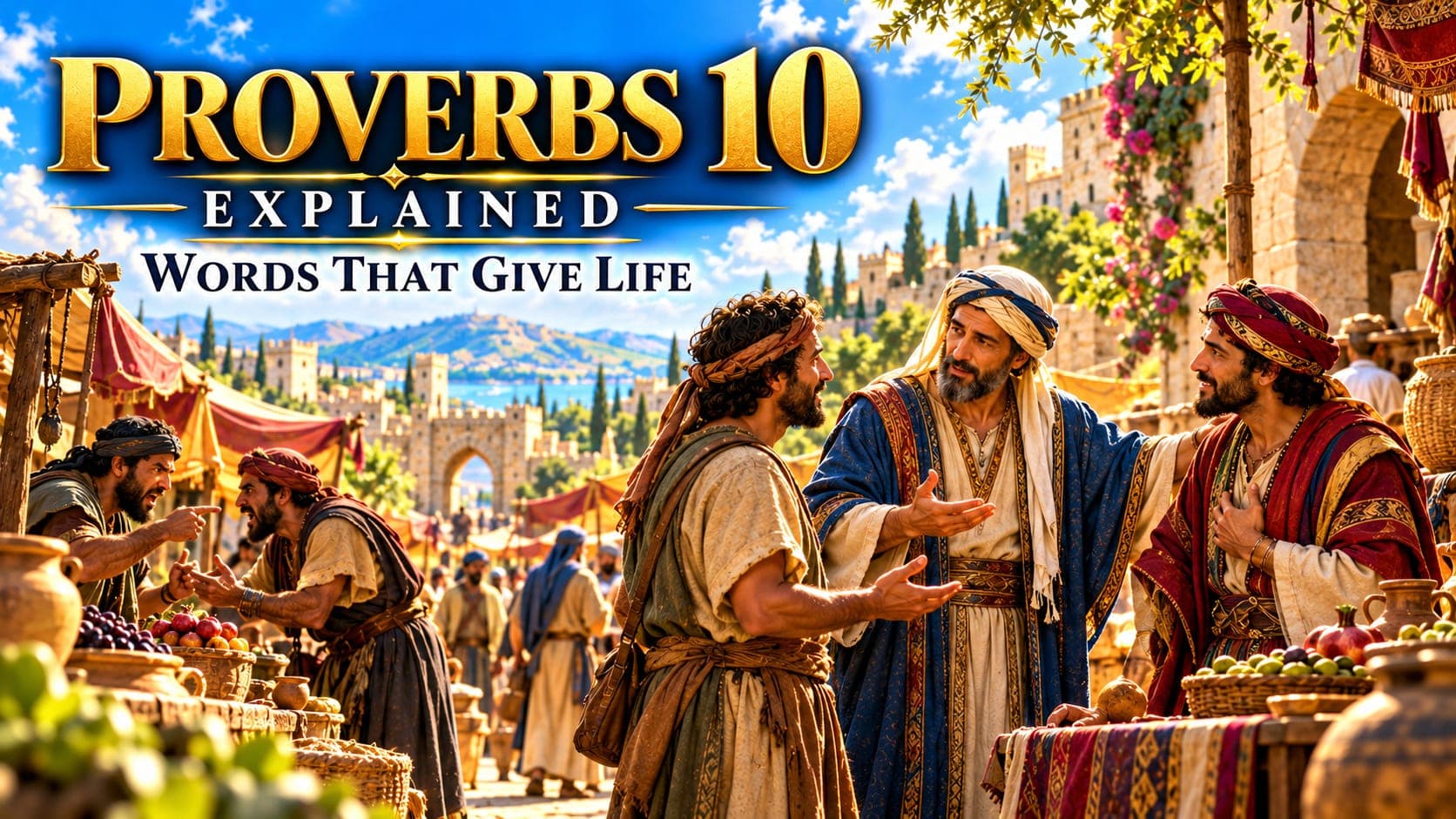
📖 Proverbs 10 Explained: Wisdom, Work, and the Tongue
Nine chapters of long fatherly speeches just ended. This one opens with something completely different: thirty two short, stand alone sayings, one right after another.
Proverbs 10 explained is where the book of Proverbs actually becomes the book most people picture when they hear its name. No more extended warnings about one dangerous woman or one patient teacher. Just verse after verse, each one a complete thought on its own, almost all of them built the same way: this is what the righteous do, but here is what the wicked do instead.
Maybe you have tried to read Proverbs straight through like a story and gotten stuck right here, wondering why the chapters suddenly stopped connecting to each other.
- ❓ Why does the chapter suddenly feel so different from Proverbs 1 through 9?
- ❓ Does "the rich man's wealth is his strong city" mean money proves righteousness?
- ❓ Why does the chapter repeat the exact same line twice?
- ❓ What does "love covereth all sins" actually mean?
📌 More of this one chapter is about your mouth than about anything else. Twelve of its thirty two verses mention the mouth, lips, tongue, or words.
This walkthrough goes through all thirty two verses in order, grouped by the theme each cluster actually shares: family and work, speech, love and correction, excess talk, what each side can expect, and how the chapter closes.
Read it slowly. These are short verses, but almost none of them are simple.
What Happened Just Before This Chapter
Proverbs 9 closed the book's long opening section with one final scene: Wisdom and Folly, two women, two houses, two invitations that sounded almost identical. That chapter ended nine straight chapters of a father pleading with his son in extended speeches, each one building toward a single decision between two paths.
Proverbs 10 does not continue that speech. It restarts the book instead.
"The proverbs of Solomon. A wise son maketh a glad father: but a foolish son is the heaviness of his mother."
📌 "The proverbs of Solomon" is almost the exact phrase that opened the whole book back in Proverbs 1:1. That is not an accident of repetition. Most scholars read it as a deliberate heading, a second title page marking where the long introductory speeches end and the book's actual collection of proverbs begins. Chapters 1 through 9 were the argument for why wisdom matters. Chapter 10 is the wisdom itself, handed over one verse at a time.
That shift explains why this chapter can feel disconnected on a first read. It is not telling one continuing story. It is a string of complete, independent thoughts, most of them built on the same pattern: a line about the righteous or the wise, followed by "but," followed by a line about the wicked or the foolish. Twenty six of this chapter's thirty two verses use that exact word, but, to set up the contrast. The rest still contrast two outcomes even without the word. Once you see that pattern, the chapter stops feeling scattered and starts feeling like what it is: the same scale held up to one situation after another.
Proverbs 10 Explained Verse by Verse
1. A Wise Son and an Honest Hand (verses 1 to 5)
The chapter opens at home, with the same family language that has framed the whole book since its first verses: a son who can bring his parents either joy or grief, depending on the choices he makes. Verse 1 already quoted above sets the tone for everything that follows. Wisdom is not an abstract idea here. It shows up first as something a parent can actually see in a child's daily life.
From there the chapter moves straight into money and work, without pausing.
"Treasures of wickedness profit nothing: but righteousness delivereth from death. The LORD will not suffer the soul of the righteous to famish: but he casteth away the substance of the wicked."
"He becometh poor that dealeth with a slack hand: but the hand of the diligent maketh rich. He that gathereth in summer is a wise son: but he that sleepeth in harvest is a son that causeth shame."
💡 Verse 5's picture of gathering in summer and sleeping through harvest is the same lesson Proverbs 6 taught at length through the ant, who gathers her food in harvest with no one standing over her. Chapter 6 spent six verses painting that picture. Chapter 10 compresses the same idea into half a sentence, which is exactly the shift this chapter represents: the same wisdom, now delivered in a single line instead of a full scene.
📌 Verse 2's wording, "righteousness delivereth from death," will come back almost word for word by the start of the next chapter. That kind of exact repetition is common across this whole opening run of short proverbs. The same truth gets stated more than once, in more than one setting, because it is true in more than one setting.
2. Blessing the Righteous Mouth, Covering the Wicked One (verses 6 to 11)
Here the chapter turns to a subject it will keep returning to for the rest of its length: what comes out of a person's mouth.
"Blessings are upon the head of the just: but violence covereth the mouth of the wicked. The memory of the just is blessed: but the name of the wicked shall rot."
"The wise in heart will receive commandments: but a prating fool shall fall. He that walketh uprightly walketh surely: but he that perverteth his ways shall be known."
"He that winketh with the eye causeth sorrow: but a prating fool shall fall. The mouth of a righteous man is a well of life: but violence covereth the mouth of the wicked."
⚠️ Look closely at verses 8 and 10, and again at verses 6 and 11. Verse 8 ends "but a prating fool shall fall," and verse 10 ends with the identical words. Verse 6 ends "but violence covereth the mouth of the wicked," and verse 11 ends with that exact same line too. This is not a copying error. Hebrew proverb collections used repeated refrain lines on purpose, the way a song returns to its chorus, to bracket a short unit of verses around one idea before moving to the next. Verses 6 through 11 form that kind of bracketed unit, opening and closing on the same two warnings.
Verse 10 is also worth a second look on its own. "He that winketh with the eye" describes a sly, private signal, the kind of look that stirs up trouble behind someone's back without a word being spoken. The text pairs it with the same fate as the loud, talkative fool in verse 8. Silent scheming and nonstop chatter are treated as two versions of the same problem: speech, or the manipulation that stands in for it, used carelessly.
3. Love That Covers, Wisdom That Listens (verses 12 to 17)
One of the most quoted lines in the whole book shows up next, almost without warning.
"Hatred stirreth up strifes: but love covereth all sins."
📌 Both Peter and James pick up this exact line centuries later. Peter writes, "above all things have fervent charity among yourselves: for charity shall cover the multitude of sins" (1 Peter 4:8), and James writes that turning someone back from error "shall save a soul from death, and shall hide a multitude of sins" (James 5:20). Neither verse is teaching that love pretends sin never happened. The point Solomon makes, and the one both apostles build on, is that love chooses not to broadcast and dwell on another person's failure the way hatred does. Hatred looks for reasons to keep a conflict alive. Love looks for a way to let it rest.
The chapter keeps moving, now toward teaching and correction.
"In the lips of him that hath understanding wisdom is found: but a rod is for the back of him that is void of understanding. Wise men lay up knowledge: but the mouth of the foolish is near destruction."
"The rich man’s wealth is his strong city: the destruction of the poor is their poverty. The labour of the righteous tendeth to life: the fruit of the wicked to sin."
"He is in the way of life that keepeth instruction: but he that refuseth reproof erreth."
💡 Verse 15 is easy to misread fast. It is not a promise that wealth proves someone righteous or that poverty proves someone did wrong. Read beside verse 2, which already said "treasures of wickedness profit nothing," the point is narrower and more practical: money functions as real protection in a hard world, and the lack of it leaves a person genuinely exposed. The chapter is describing how wealth and poverty actually function day to day, not handing out a verdict on anyone's character based on their bank balance.
4. Too Many Words, and a Blessing That Costs Nothing (verses 18 to 23)
The chapter circles back to speech again, this time focused on how much is said rather than what is said.
"He that hideth hatred with lying lips, and he that uttereth a slander, is a fool. In the multitude of words there wanteth not sin: but he that refraineth his lips is wise."
"The tongue of the just is as choice silver: the heart of the wicked is little worth. The lips of the righteous feed many: but fools die for want of wisdom."
📌 Verse 19 is not a command to stay silent. Verse 21, right next to it, says the lips of the righteous "feed many," which only happens through speaking. The warning is about volume without restraint, not about speech itself. The more words a person pours out without thinking, the more likely sin slips in somewhere among them. Restraint is what the verse praises, not silence.
"The blessing of the LORD, it maketh rich, and he addeth no sorrow with it."
"It is as sport to a fool to do mischief: but a man of understanding hath wisdom."
⚠️ Verse 22 gets quoted often as a stand alone promise of prosperity. Held next to verse 15's plainer observation about wealth and poverty, and next to the rest of Scripture's honest record of righteous people who stayed poor, it reads more carefully as a statement about God's blessing specifically: when it comes, it is not weighed down by the hidden cost or emptiness that wealth gained wickedly carries. It is not a guarantee that obedience always produces riches.
5. What the Wicked Fear, What the Righteous Hope For (verses 24 to 28)
The chapter now contrasts what each side can actually expect.
"The fear of the wicked, it shall come upon him: but the desire of the righteous shall be granted. As the whirlwind passeth, so is the wicked no more: but the righteous is an everlasting foundation."
"As vinegar to the teeth, and as smoke to the eyes, so is the sluggard to them that send him."
💡 Verse 26 pictures the sluggard through someone else's experience of him, not his own. Vinegar stings the teeth and smoke stings the eyes the moment they make contact. Sending a lazy person to do a job produces the exact same instant, irritating result for whoever was counting on him.
"The fear of the LORD prolongeth days: but the years of the wicked shall be shortened. The hope of the righteous shall be gladness: but the expectation of the wicked shall perish."
📌 "The fear of the LORD" returns here for the first time since it opened and closed the book's whole introduction. Proverbs 1:7 called it the beginning of knowledge. Proverbs 9:10 called it the beginning of wisdom. Verse 27 now names a concrete result of it: length of days. The phrase keeps anchoring the book every time it risks drifting into generic moral advice.
6. Established Forever (verses 29 to 32)
The chapter closes the way it has run the whole way through, one last contrast at a time.
"The way of the LORD is strength to the upright: but destruction shall be to the workers of iniquity. The righteous shall never be removed: but the wicked shall not inhabit the earth."
"The mouth of the just bringeth forth wisdom: but the froward tongue shall be cut out. The lips of the righteous know what is acceptable: but the mouth of the wicked speaketh frowardness."
📌 The chapter opened with a son's mouth bringing a parent either gladness or heaviness, and it closes on the same organ. Verses 31 and 32 return one final time to the mouth, lips, and tongue, the single theme that has threaded through more of this chapter than any other. Twelve of its thirty two verses mention speech in some form. A chapter that opened in a family's home closes by insisting that what comes out of your mouth is never a small matter.

Hard Questions Proverbs 10 Raises
Does verse 15 teach that wealth proves righteousness and poverty proves sin? The text says a rich man's wealth functions like a strong city, real protection, and that poverty leaves a person exposed. It is describing how money works in a fallen world, not ranking anyone's character. Verse 2, only a few lines earlier, already ruled out wealth as proof of righteousness by saying "treasures of wickedness profit nothing." Reading verse 15 as a verdict on a person's standing with God goes further than the verse itself claims.
Does verse 22 promise that obeying God always leads to riches? Taken alone, it can sound that way. Held against the rest of Scripture, including plenty of faithful, suffering people elsewhere in the Bible, it reads more carefully as a statement about the nature of God's blessing specifically, that it carries no hidden cost, rather than a universal formula guaranteeing wealth to everyone who obeys.
Why does the chapter repeat the same line twice in verses 6, 8, 10, and 11? This is a known feature of Hebrew proverb collections, not a copying mistake. A repeated line brackets a short group of verses around one shared idea, similar to a refrain. Verses 6 through 11 use this to frame one unit about speech and violence before the chapter moves on to its next theme.
Is verse 19's warning against "the multitude of words" a command to stay quiet? No. Verse 21, two lines later, praises the lips of the righteous for feeding many people, which requires speaking. The warning targets careless, unrestrained talking, not speech itself.
Does "love covereth all sins" in verse 12 mean love ignores wrongdoing? Both 1 Peter 4:8 and James 5:20 pick up this idea without ever suggesting sin should be excused or hidden from God. The contrast in the verse is with hatred, which stirs up strife and keeps conflict alive. Love, by contrast, does not go looking for reasons to expose and prolong a wrong once it has genuinely been dealt with.
Practical Tips From Proverbs 10
Thirty two short verses, almost all of them aimed at something you can act on today.
- Gather while it is still summer. Verse 5 praises the one who works while the work is available, the same lesson Proverbs 6 taught through the ant. Do not wait for the harvest to start preparing.
- Watch for a pattern in your own speech, not just a single bad moment. Verses 8, 14, 19, and 21 all describe speech as a steady habit that either feeds people or empties them. Ask which one your words have been doing lately.
- Let love stop reopening settled wounds. Verse 12 contrasts hatred, which keeps strife alive, with love, which does not keep dragging a dealt with offense back into the light.
- Accept instruction instead of just enduring it. Verse 17 says keeping instruction is the way of life, and refusing reproof is the way of error. The difference is not whether correction arrives, but how you respond when it does.
- Do not measure anyone's standing with God by their bank account. Verses 2, 15, and 22 together resist any easy formula connecting money directly to righteousness. Judge character by what verses 6 through 32 actually describe: the mouth, the hands, and the heart.
- Let the fear of the LORD stay foundational, not occasional. Verse 27 names a real, concrete benefit to it. It has anchored this book since Proverbs 1 and keeps resurfacing for a reason.
Top 5 Bible Verses From Proverbs 10
1. Proverbs 10:12
"Hatred stirreth up strifes: but love covereth all sins."
The most quoted line in the chapter, echoed directly by both Peter and James in the New Testament. Love does not excuse wrong. It simply refuses to keep strife alive the way hatred does.
2. Proverbs 10:1
"The proverbs of Solomon. A wise son maketh a glad father: but a foolish son is the heaviness of his mother."
The second title page of the book, marking where the long fatherly speeches end and the short, stand alone proverbs begin.
3. Proverbs 10:19
"In the multitude of words there wanteth not sin: but he that refraineth his lips is wise."
Not a command to stay silent, but a warning that careless, unrestrained talking makes room for sin to slip in almost unnoticed.
4. Proverbs 10:9
"He that walketh uprightly walketh surely: but he that perverteth his ways shall be known."
Integrity is described here as stability itself. The crooked path feels hidden right up until it is not.
5. Proverbs 10:27
"The fear of the LORD prolongeth days: but the years of the wicked shall be shortened."
The same fear of the LORD that opened and closed the book's introduction returns here with a concrete, lived out result attached to it.
Frequently Asked Questions About Proverbs 10
What is Proverbs 10 about?
It is the first chapter of the book's main collection of short, stand alone proverbs, mostly contrasting the righteous and the wicked on family, work, speech, and what each side can expect in the end.
Why does Proverbs 10 feel so different from Proverbs 1 through 9?
Chapters 1 through 9 are extended speeches from a father to his son. Verse 1's heading, "the proverbs of Solomon," echoes the book's opening line and marks a deliberate shift into a collection of short, independent sayings.
Why do verses 6, 8, 10, and 11 repeat the same lines?
Repeated refrain lines are a known feature of Hebrew proverb collections. They bracket a short group of verses around one shared idea, the way a chorus frames a song, rather than being a copying error.
What does "love covereth all sins" mean in Proverbs 10:12?
It means love does not go looking for reasons to keep a conflict alive once it has genuinely been addressed, unlike hatred, which the verse says stirs up strife. Both 1 Peter 4:8 and James 5:20 build on this same idea.
Does Proverbs 10 say rich people are always righteous?
No. Verse 2 already states that "treasures of wickedness profit nothing," and verse 15 describes how wealth functions as protection rather than claiming it proves character.
Does verse 22 promise every obedient person will get rich?
Read on its own it can sound that way, but Scripture elsewhere records many faithful people who stayed poor. The verse is best read as describing the nature of God's blessing, that it carries no hidden cost, not as a guaranteed formula.
What theme shows up most often in Proverbs 10?
Speech. Twelve of the chapter's thirty two verses mention the mouth, lips, tongue, or words, more than any other single subject in the chapter.
What does verse 19 mean by "in the multitude of words there wanteth not sin"?
It is a warning against careless, unrestrained talking, not a command to stay silent. Verse 21, right next to it, praises the righteous for speech that feeds many people.
How does Proverbs 10:5 connect to Proverbs 6?
Both verses praise gathering food during harvest instead of sleeping through it. Proverbs 6 spends several verses painting the picture through the ant. Proverbs 10:5 compresses the same lesson into a single line, matching this chapter's shorter, concentrated style.
What is the lesson of Proverbs 10 for today?
That wisdom is not only found in big decisions. It shows up in daily, almost unremarkable choices: how hard you work, how much you say, whether you accept correction, and whether your words build people up or tear them down.
Final Thoughts
Proverbs 10 trades one long argument for thirty two short ones, and somehow says just as much.
📌 Wisdom shows up in ordinary places first. A son's character, a summer's worth of work, a sentence spoken carelessly or carefully. None of this chapter's wisdom requires a dramatic moment to apply.
📌 Your mouth gets more attention here than anything else. Twelve verses return to it in one form or another, from the son in verse 1 to the final contrast in verse 32. What you say is never treated as a small matter.
📌 Love covers. Hatred exposes. Verse 12 alone explains why two of Christ's own apostles chose to repeat it.
So here is your one next step.
Pick one verse from this chapter, the one that named something you recognized in yourself, and let it shape one choice you make before today ends.
That is exactly how thirty two short sayings were meant to be read: one at a time, actually lived.