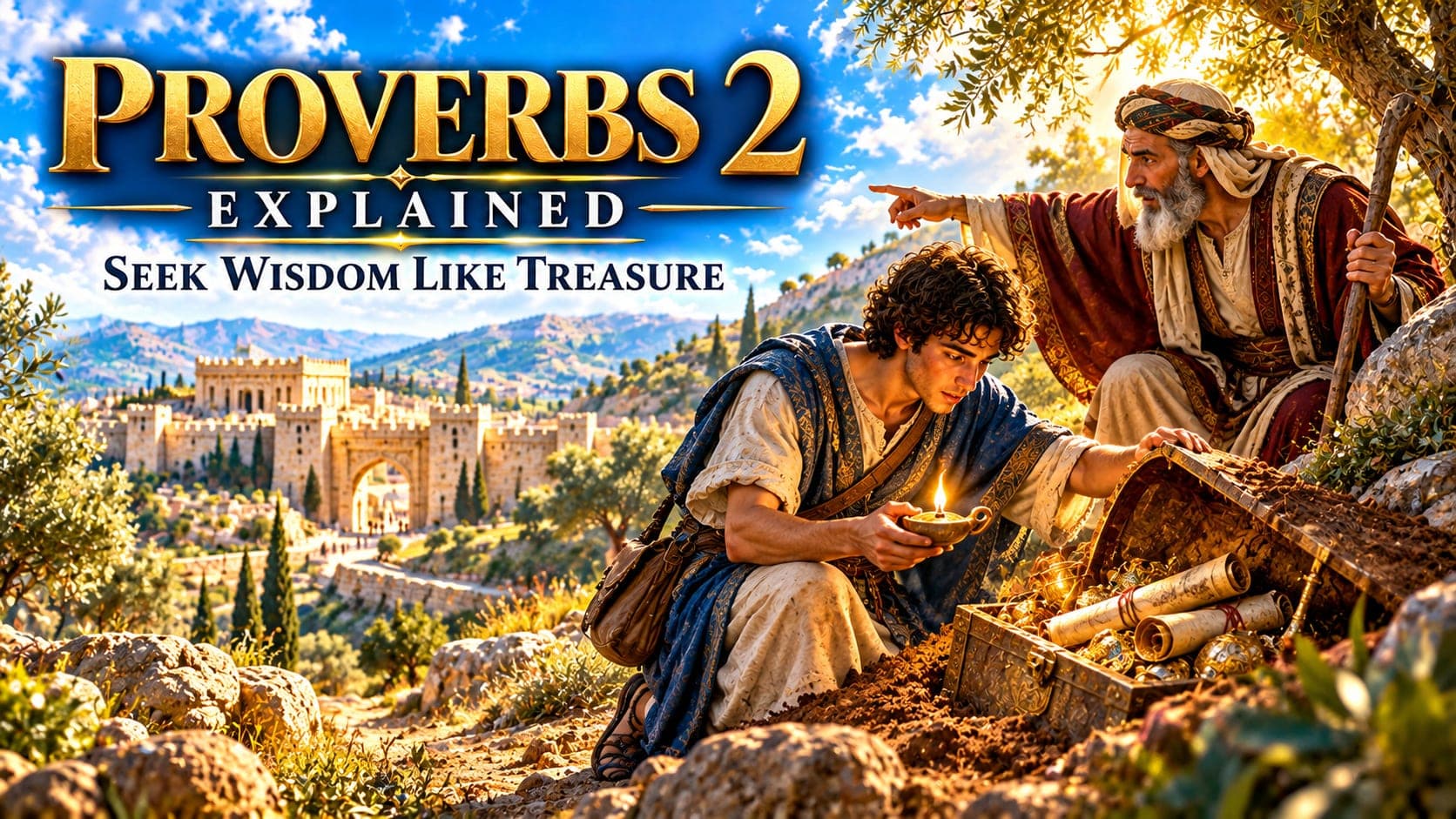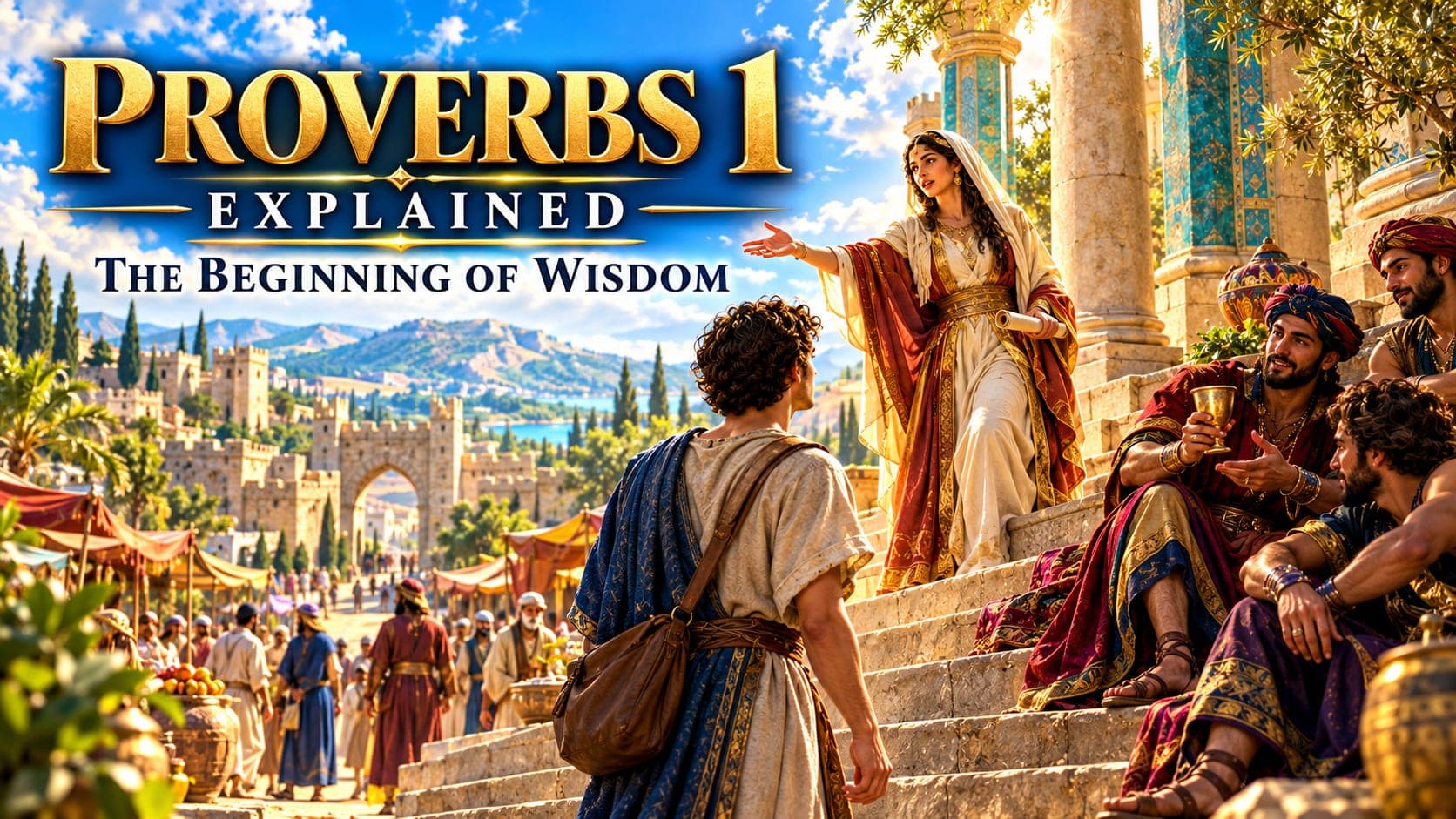
📖 Proverbs 1 Explained: Why Wisdom Begins With Fearing God
A father sits his son down before trouble ever finds him.
Not after. Before.
Proverbs 1 explained is the opening chapter of the most practical book in the Bible, and it does not waste a single verse getting to the point. It tells you exactly what this book is for, names the one thing every wise decision starts with, and then spends the rest of the chapter warning you about the two voices that will compete for your ear for the rest of your life.
Maybe you already know the feeling of standing between two invitations.
- ❓ What does it actually mean to fear the LORD?
- ❓ Why does a book about wisdom open with a warning about violent men?
- ❓ Who is the woman crying out in the streets in the second half of the chapter?
- ❓ Why would God let someone suffer instead of rescuing them the moment they call?
📌 Proverbs 1 is not a random collection of sayings. It is a father laying out the whole choice in front of his son before the son has to make it.
This walkthrough goes through Proverbs 1 in order: what the book is for, the one verse that unlocks the entire rest of Proverbs, a father's warning about the crowd that wants to pull you in, and wisdom herself shouting in the street, refusing to be ignored forever.
Read slowly. This chapter is asking you to pick a voice to listen to, right now.
What Happened Just Before This Chapter
Proverbs does not continue a story the way Genesis does. It opens a brand new book, and the very first verse tells you who is speaking.
"The proverbs of Solomon the son of David, king of Israel;"
Solomon inherited the throne from his father David, and early in his reign God offered him anything he wanted.
"In Gibeon the LORD appeared to Solomon in a dream by night: and God said, Ask what I shall give thee."
"Give therefore thy servant an understanding heart to judge thy people, that I may discern between good and bad: for who is able to judge this thy so great a people?"
📌 Solomon did not ask for riches, long life, or victory over his enemies. He asked for wisdom. God granted it, and gave him more besides. Proverbs is the record of a king writing down, for his own children, what that granted wisdom actually looks like in everyday decisions.
That context matters for reading chapter 1. This is not a stranger lecturing you. It is a father who was personally handed wisdom by God, now trying to pass it on before his son needs it.
Proverbs 1 Explained Verse by Verse
1. What This Book Is Actually For (verses 1 to 6)
Before Solomon writes a single proverb, he tells you why he is writing at all.
"To know wisdom and instruction; to perceive the words of understanding; To receive the instruction of wisdom, justice, and judgment, and equity; To give subtilty to the simple, to the young man knowledge and discretion."
Solomon stacks up wisdom, instruction, understanding, justice, judgment, equity, and discretion in three sentences. He is not being repetitive for style. He is showing you that wisdom touches more than one part of you. It is not only what you know. It is how you judge a situation, how careful you are with people, and how well you can tell where a choice is actually headed before you make it.
Verse 6 adds one more detail about how this book works.
"To understand a proverb, and the interpretation; the words of the wise, and their dark sayings."
💡 A proverb is a short, memorable saying built to be carried around in your head, not studied once and filed away. The book ahead of you is built for repetition. You are meant to read these chapters again and again over a lifetime, not finish Proverbs once and consider it handled.
2. The Verse That Unlocks Everything After It (verse 7)
Solomon spends six verses setting up the goal. Then he gives you the one sentence that explains how to actually get there.
"The fear of the LORD is the beginning of knowledge: but fools despise wisdom and instruction."
📌 This single verse is the hinge the entire book of Proverbs turns on. Every chapter after this one assumes you have already read it. Miss this verse, and the rest of Proverbs will feel like a pile of good advice with no center. Understand it, and the whole book becomes one long explanation of what this fear looks like in real situations.
The fear of the LORD here is not the fear you feel toward something that might hurt you at random. It is the weight a creature feels standing honestly before its Creator: a settled respect that takes God seriously enough to actually obey Him, not a dread that makes you want to run and hide from Him.
⚠️ Notice the second half of the verse just as closely as the first. A fool, in Proverbs, is not someone with a low IQ. It is someone who has heard wisdom and instruction and chosen to despise them anyway. Foolishness in this book is a decision, repeated often enough that it becomes a direction.
3. A Father's Warning Before Anything Goes Wrong (verses 8 and 9)
Solomon turns from general instruction to something more personal.
"My son, hear the instruction of thy father, and forsake not the law of thy mother: For they shall be an ornament of grace unto thy head, and chains about thy neck."
Both parents are named here, not just the father. In ancient Israel, a mother's teaching carried real weight in a child's upbringing, and Proverbs treats it as worth keeping right alongside a father's, the same instinct behind God's own pattern as a Father who disciplines and teaches the children He loves.
📌 An ornament and a chain were signs of honor and status in the ancient world, not decoration for its own sake. Solomon is saying that a child who actually holds onto parental instruction will carry something more valuable than jewelry: a reputation and a life that other people can see is well built.
4. The Crowd That Wants You to Join Them (verses 10 to 19)
Right after the warm image of a chain and an ornament, Solomon names the first real threat his son will face.
"My son, if sinners entice thee, consent thou not."
Entice is the same basic danger the serpent used on Eve in Genesis 3: a voice offering something appealing while leaving out exactly what it will cost. Solomon then quotes the invitation itself, word for word, so his son will recognize it the moment he hears it.
"If they say, Come with us, let us lay wait for blood, let us lurk privily for the innocent without cause: Let us swallow them up alive as the grave; and whole, as those that go down into the pit: We shall find all precious substance, we shall fill our houses with spoil: Cast in thy lot among us; let us all have one purse:"
⚠️ This is not a vague temptation toward bad influence. It is a description of an actual violent gang, robbing and killing strangers for profit and pooling what they steal in one shared purse. Solomon does not soften it or leave it abstract. He wants his son to see exactly what he is being invited into.
The instruction that follows is just as direct.
"My son, walk not thou in the way with them; refrain thy foot from their path: For their feet run to evil, and make haste to shed blood."
Then Solomon does something Proverbs does often. He explains why the warning is worth heeding.
"Surely in vain the net is spread in the sight of any bird. And they lay wait for their own blood; they lurk privily for their own lives."
💡 A bird that sees the net will not walk into it. But these men are so fixed on their profit that they cannot see the trap closing on themselves. The very violence they plan for others is the violence that ends up destroying them. Verse 19 makes the point plain:
"So are the ways of every one that is greedy of gain; which taketh away the life of the owners thereof."
📌 Greed for gain does not just risk hurting someone else. Proverbs says it circles back and takes the life of the person chasing it. It is the same warning behind why loving money, not simply wanting it, is what Scripture calls dangerous. That is the pattern Solomon wants his son to see clearly enough to walk away from the very first invitation, the same way God warned Cain about sin crouching at the door before he ever acted on it.
5. Wisdom Shouting in the Street (verses 20 to 23)
The chapter suddenly shifts voices. Wisdom itself is described as a person, calling out in public where no one can claim they never heard her.
"Wisdom crieth without; she uttereth her voice in the streets: She crieth in the chief place of concourse, in the openings of the gates: in the city she uttereth her words, saying,"
📌 Wisdom is not hiding in a library or locked behind a scholar's door. Solomon pictures her shouting in the busiest, loudest, most public places in the city: the marketplace and the city gate, where legal and business decisions were actually made. Wisdom is available to anyone willing to stop and listen, not reserved for a select few.
Then wisdom herself speaks, and the tone turns sharp.
"How long, ye simple ones, will ye love simplicity? and the scorners delight in their scorning, and fools hate knowledge?"
"Turn you at my reproof: behold, I will pour out my spirit unto you, I will make known my words unto you."
💡 Even in the middle of a rebuke, wisdom is still offering something, not just scolding. "I will pour out my spirit unto you" is an offer to those willing to turn, not a door already closed.
6. The Cost of Refusing to Listen (verses 24 to 33)
The offer in verse 23 has a limit. Wisdom describes what happens to those who keep refusing it.
"Because I have called, and ye refused; I have stretched out my hand, and no man regarded; But ye have set at nought all my counsel, and would none of my reproof:"
"I also will laugh at your calamity; I will mock when your fear cometh;"
⚠️ This is the hardest line in the chapter, and it deserves a straight explanation rather than a softened one. This is not God abandoning someone who is genuinely seeking Him. It is personified wisdom describing what naturally happens to people who spent years mocking every warning and are now facing the exact disaster those warnings were about. Their crisis is not a surprise. It is the outcome they were told about, repeatedly, and chose not to prepare for.
"Then shall they call upon me, but I will not answer; they shall seek me early, but they shall not find me: For that they hated knowledge, and did not choose the fear of the LORD:"
The chapter does not end on that warning. It closes with the other option, stated just as plainly.
"For the turning away of the simple shall slay them, and the prosperity of fools shall destroy them. But whoso hearkeneth unto me shall dwell safely, and shall be quiet from fear of evil."
📌 The chapter's final sentence promises safety, not doom. Solomon spends thirty three verses building toward a warning, and then hands his son the exit from it in that last line. Listening is still open the whole time this chapter is being read.
Hard Questions Proverbs 1 Raises
Does "fear of the LORD" mean God wants you to be afraid of Him? The text itself gives the answer in the same breath: this fear produces knowledge and instruction, not paralysis. It is reverence that leads somewhere, a respect serious enough to actually change how you live, rather than a dread that makes you want to hide. Fools in this chapter are not the ones who feel small before God. They are the ones who never take Him seriously enough to listen at all.
Is Solomon saying an atheist cannot know anything true? Proverbs 1:7 is about the beginning point of the kind of wisdom this book is describing, the ability to actually order your life well, not a claim that unbelievers cannot learn facts or skills. Solomon's target is deeper than information. It is the wisdom to use what you know rightly, and he says that starts with taking God seriously.
Is Wisdom in verses 20 to 33 a real person, or a literary device? This chapter presents wisdom as a personified voice, a common technique in Hebrew poetry to make an idea vivid and public rather than abstract. Later chapters of Proverbs, especially chapter 8, develop this picture much further, and some Christians see echoes of Christ in that later, fuller description. Chapter 1 itself does not make that identification explicit, so it is worth reading Proverbs 8 on its own before drawing that connection too tightly.
Does verse 26, where wisdom laughs at calamity, describe God mocking people in pain? Read alongside verses 24 and 25, this is not mockery of suffering itself. It answers years of ignored warnings with the plain statement that consequences, once refused help for so long, are not going to be rescued at the last minute just because the crisis finally arrived. The chapter still ends by promising safety to anyone who turns and listens, which is the opposite of a God who enjoys watching people suffer.
Why open a book about wisdom with a warning about literal violent crime? Because Solomon is not writing an abstract philosophy book. He is preparing his son for real invitations he will actually receive. Starting with the most extreme, most obvious danger, joining people who rob and kill for profit, sets the pattern for every smaller, subtler compromise the rest of Proverbs will address. If the son can spot and refuse this invitation, he has already practiced the discernment every quieter temptation after it will require.
Practical Tips From Proverbs 1
This chapter is not just an introduction. It is a set of decisions Solomon wants made ahead of time.
- Settle the fear of the LORD before you need it. Proverbs 1:7 says this is the beginning point, not something you figure out halfway through a crisis. Decide now whether you actually take God seriously enough to obey Him.
- Name the invitation before you are standing in front of it. Solomon quotes the gang's exact words so his son will recognize them instantly. Know in advance what a bad invitation sounds like in your own life.
- Watch for greed dressed up as opportunity. Verse 19 says greed for gain destroys the very person chasing it. Ask what a tempting offer is actually costing before you say yes.
- Practice saying no before the pressure is real. Self control is a skill built ahead of time, not something you can manufacture in the exact moment a gang, or any other bad invitation, is standing in front of you.
- Keep listening to instruction you already agreed with once. A father and mother's teaching in verses 8 and 9 was not new information by the time trouble showed up. Do not let familiar wisdom lose its weight just because you have heard it before.
- Do not wait for the loudest possible warning. Wisdom cries out in ordinary public places, not only in dramatic moments. Pay attention to the quiet warnings before you need the dramatic ones.
- Turn while the offer in verse 23 is still open. The chapter is clear that refusing wisdom repeatedly has a real cost, but it is just as clear that turning back is still available. Do not treat past refusals as a reason to keep refusing.
Top 5 Bible Verses From Proverbs 1
1. Proverbs 1:7
"The fear of the LORD is the beginning of knowledge: but fools despise wisdom and instruction."
The hinge verse of the entire book. Every chapter of Proverbs after this one assumes you have already accepted its premise: real wisdom starts with taking God seriously.
2. Proverbs 1:10
"My son, if sinners entice thee, consent thou not."
One short sentence that cuts through every excuse for going along with a bad crowd. The invitation is coming. The refusal has to be decided before it arrives.
3. Proverbs 1:19
"So are the ways of every one that is greedy of gain; which taketh away the life of the owners thereof."
The trap set for someone else closes on the one who set it. Greed does not just risk hurting others; Proverbs says it circles back on the person chasing it.
4. Proverbs 1:23
"Turn you at my reproof: behold, I will pour out my spirit unto you, I will make known my words unto you."
Even in the middle of a sharp rebuke, wisdom is still holding a door open. This is an invitation, not a verdict already handed down.
5. Proverbs 1:33
"But whoso hearkeneth unto me shall dwell safely, and shall be quiet from fear of evil."
The chapter's closing verse. After every warning, Solomon ends on the promise of safety for anyone still willing to listen.

Frequently Asked Questions About Proverbs 1
What is Proverbs 1 about?
It introduces the purpose of the whole book of Proverbs, states that the fear of the LORD is the beginning of knowledge, has a father warn his son against joining violent men for profit, and ends with wisdom personified as a woman calling out in public, warning what happens to those who keep refusing to listen.
Who wrote Proverbs 1?
Proverbs 1:1 names Solomon, the son of David and king of Israel, as the author of the proverbs that follow. Solomon had personally asked God for wisdom rather than riches or long life, recorded in 1 Kings 3, which is the wisdom this book puts into writing.
What does "the fear of the LORD is the beginning of knowledge" mean?
It means real wisdom starts with taking God seriously enough to obey Him, not with fear that makes you want to run from Him. Proverbs 1:7 pairs this fear directly with knowledge and instruction, showing it produces a changed life rather than paralysis.
What does Proverbs 1:10 mean by "if sinners entice thee"?
It is a father warning his son, in advance, that people will try to pull him into their plans, specifically the violent gang described in verses 11 to 14. The verse tells him exactly how to respond before the invitation ever comes: do not consent.
Who is the woman calling out in Proverbs 1:20 to 33?
Wisdom itself, described as a person crying out in public places so that no one can claim they never heard her. It is a poetic device common in Hebrew writing, and Proverbs 8 develops the same picture of wisdom much further later in the book.
Why does Proverbs 1 describe a violent gang instead of a simpler temptation?
Solomon starts with the most obvious, most extreme danger his son could face so the pattern of an appealing but destructive invitation is unmistakable. Once that pattern is recognized here, the quieter temptations covered later in Proverbs become easier to spot.
Does God really refuse to answer people in Proverbs 1:28?
The verse describes people who spent years mocking every warning and are now facing the crisis those warnings predicted. It is describing the natural end of persistent refusal, not a general rule that God ignores anyone who genuinely calls on Him for the first time.
What does "dark sayings" mean in Proverbs 1:6?
It refers to riddles or sayings that take some thought to fully unpack, not evil or secret content. Proverbs 1:6 groups it with proverbs and the words of the wise as things this book will help the reader understand.
Is Proverbs 1 only for young men?
It is written as a father addressing his son, matching the family setting of ancient Israel, but the warnings about bad company, greed, and refusing wisdom, and the promise of safety for those who listen, apply to any reader in any generation.
How does Proverbs 1 connect to the rest of the Bible?
Proverbs 1:7 sets the theme the rest of the book, and much of Old Testament wisdom literature, builds on. James 1:5 later echoes the same offer wisdom makes here, telling believers to simply ask God for the wisdom they lack rather than assuming it is out of reach.
Final Thoughts
Proverbs 1 hands you the whole choice before you ever have to make it under pressure.
📌 Wisdom begins with taking God seriously, not with being smart. Proverbs 1:7 puts the fear of the LORD before knowledge itself, not after it.
📌 The invitation to walk away from wisdom often looks like profit, not evil. The gang in verses 10 to 19 sold their offer as opportunity. It cost them their own lives instead.
📌 Refusing wisdom has a real cost, and turning back is still real too. The same chapter that warns about calamity ends with safety promised to anyone who still chooses to listen.
You are going to hear both voices this week. The crowd offering a shortcut, and wisdom calling out plainly in the open.
So here is your one next step.
Name one decision in front of you right now, and ask honestly which voice you have actually been listening to.