📖 Proverbs 11 Explained: Honest Scales and a Righteousness That Delivers
A crooked scale. A cosigned loan gone bad. A gossip who cannot keep a secret. A gold ring on a pig.
Proverbs 11 explained keeps the shape Proverbs 10 set up, thirty one short, stand alone sayings instead of one long speech, but this chapter leans harder on a single idea than almost any other in the book: righteousness is not a feeling. It is something that holds weight, protects you, and outlasts whatever money cannot buy back.
Maybe you have read this chapter fast and only remembered the strange image in verse 22.
- ❓ What actually counts as a false balance today?
- ❓ Why does verse 4 repeat a line from the chapter before it, almost word for word?
- ❓ What does it mean to be surety for a stranger?
- ❓ Does verse 16 really compare a woman's worth to a man's wealth?
📌 Some form of the word righteous appears twelve times in this chapter's thirty one verses. Wicked appears nine times. No chapter so far has kept the scale this tilted this long.
This walkthrough goes through all thirty one verses in order, grouped by what each cluster is actually weighing: honesty, riches, speech, loyalty, generosity, and what a life finally adds up to.
Read it slowly. Several of these lines are doing more work than their short length suggests.
What Happened Just Before This Chapter
Proverbs 10 opened the book's main collection of short proverbs with a new heading, "the proverbs of Solomon," and spent thirty two verses contrasting the righteous and the wicked on family, work, and speech. Proverbs 11 gets no new heading of its own. It simply keeps going, picking up the same contrast pattern without a pause.
One line makes the connection impossible to miss. Proverbs 10:2 ended, "but righteousness delivereth from death." Proverbs 11:4 ends the exact same way.
"Riches profit not in the day of wrath: but righteousness delivereth from death."
📌 That is not an accident, and it is not laziness on the writer's part. Short proverb collections repeat their most important lines on purpose, stating the same truth in more than one setting because it holds true in more than one setting. Chapter 10 said it about a man's stored up treasure. Chapter 11 says it about a man facing a coming day of judgment. Same seven words. Different pressure testing them.
Proverbs 11 Explained Verse by Verse
1. Honest Scales and a Humble Heart (verses 1 to 3)
The chapter opens in the marketplace, not the temple.
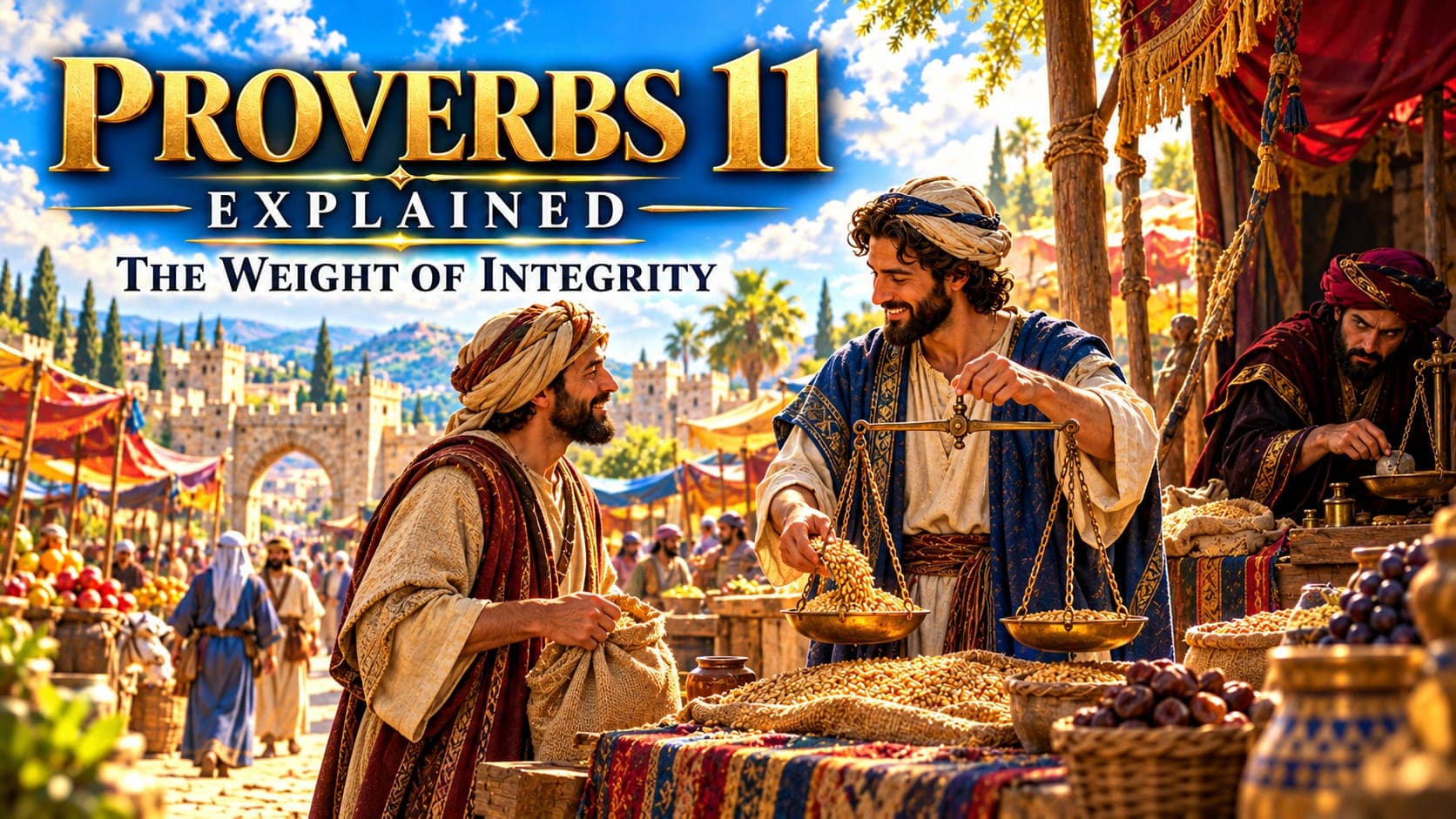
"A false balance is abomination to the LORD: but a just weight is his delight."
A balance was a hand held scale with weights on one side and goods on the other. A merchant who kept two sets of weights, a heavier set for buying and a lighter set for selling, could cheat every customer without ever telling a single lie out loud. The law Moses gave already named this exact practice as sin long before Solomon wrote this verse, and the prophets kept condemning it long after. Proverbs 11 opens with it because honesty in small, countable things is where character actually gets tested, not in the big moments you rehearse for.
From weights, the chapter moves straight to the heart behind them.
"When pride cometh, then cometh shame: but with the lowly is wisdom. The integrity of the upright shall guide them: but the perverseness of transgressors shall destroy them."
💡 Verse 1 and verse 3 are really the same warning from two directions. A false balance is dishonesty aimed outward, at someone else. Pride is dishonesty aimed inward, at yourself, inflating your own weight the same way a crooked merchant inflates his price. Both end the same way. What cheats someone else eventually destroys the one holding the scale.
2. Riches That Fail, Righteousness That Delivers (verses 4 to 8)
Verse 4, already quoted above, sets the theme for this whole stretch. The chapter keeps pressing the same point from different angles for four more verses.
"The righteousness of the perfect shall direct his way: but the wicked shall fall by his own wickedness. The righteousness of the upright shall deliver them: but transgressors shall be taken in their own naughtiness."
"When a wicked man dieth, his expectation shall perish: and the hope of unjust men perisheth. The righteous is delivered out of trouble, and the wicked cometh in his stead."
📌 Some form of the word deliver shows up five times in this chapter, and four of those five land in verses 4 through 9. That is deliberate concentration, not coincidence. The chapter is building a case before it moves on to anything else: righteousness is not only right, it is rescue.
Verse 8 is the sharpest line in the group. It does not just say the righteous escape trouble. It says the trouble that was coming does not simply vanish, it lands on the wicked instead. Scripture tells this exact story more than once, someone scheming disaster for a righteous person and walking straight into it themselves. Verse 8 states the pattern as a plain observation before you ever meet one of those stories by name.
3. A City Lives or Dies by Its Mouth (verses 9 to 14)
The chapter widens its lens from one person to a whole community, and speech is what connects the two.
"An hypocrite with his mouth destroyeth his neighbour: but through knowledge shall the just be delivered."
"When it goeth well with the righteous, the city rejoiceth: and when the wicked perish, there is shouting. By the blessing of the upright the city is exalted: but it is overthrown by the mouth of the wicked."
📌 Verse 11 names the same two forces, blessing and mouth, that verse 9 already put in motion. What one hypocrite does to a neighbor in verse 9, a whole city can do to itself in verse 11. A community is not just a collection of individuals who happen to live near each other. Its wellbeing rises or falls on what its people actually say about and to one another.
"He that is void of wisdom despiseth his neighbour: but a man of understanding holdeth his peace. A talebearer revealeth secrets: but he that is of a faithful spirit concealeth the matter."
"Where no counsel is, the people fall: but in the multitude of counsellors there is safety."
Verse 12 pairs two kinds of contempt that do not look alike on the surface. Open scorn for a neighbor is obvious. Staying quiet when you actually understand something is the opposite instinct, and the chapter calls it wisdom, not weakness, the same self control Proverbs praises elsewhere whenever a mouth could speak but chooses not to. Verse 13 then names the specific way contempt usually travels, through a mouth that cannot hold what it has been told. Verse 14 zooms all the way out to leadership. A nation, a family, or a church with no one speaking honest counsel into it is already in danger, long before any single crisis arrives to prove it.
4. Surety, a Gracious Woman, and a Merciful Man (verses 15 to 17)
The chapter turns from the city back to three specific choices one person can make.
"He that is surety for a stranger shall smart for it: and he that hateth suretiship is sure."
To be surety for someone was to guarantee their debt with your own money or property. If they could not pay, you did. Verse 15 is not warning against generosity. It is warning against guaranteeing a stranger's risk without knowing their character well enough to judge whether that risk is wise. ⚠️ Kindness and carelessness can look identical right up until the bill comes due.
"A gracious woman retaineth honour: and strong men retain riches. The merciful man doeth good to his own soul: but he that is cruel troubleth his own flesh."
Verse 16 is easy to misread as a ranking of worth between men and women. It is not that. It names two different things and what each one secures. Grace retains honour. Strength retains riches. Neither line says the other quality is missing or less valuable. The point of putting them side by side is simpler: character, not luck, is what actually holds onto what a person has gained.
Verse 17 makes a point this chapter keeps returning to in different forms. Mercy and cruelty are not first about what they do to someone else. They are first about what they do to the person practicing them.
5. Sowing Righteousness, Reaping Life (verses 18 to 21)
The chapter shifts into farming language to describe a principle that has nothing to do with farming.
"The wicked worketh a deceitful work: but to him that soweth righteousness shall be a sure reward. As righteousness tendeth to life: so he that pursueth evil pursueth it to his own death."
💡 A deceitful work pays out fast and fails later. A sown field pays out slowly and holds. Verse 18 is choosing its picture on purpose. Wickedness looks like the quicker wage. Righteousness is the one that is actually sure.
"They that are of a froward heart are abomination to the LORD: but such as are upright in their way are his delight. Though hand join in hand, the wicked shall not be unpunished: but the seed of the righteous shall be delivered."
📌 Abomination and delight are the same two words that opened the chapter back in verse 1. A false balance was an abomination. A just weight was his delight. Now a froward heart is an abomination, and the upright are his delight. The chapter frames its whole first section between those two matching pairs, from a crooked scale to a crooked heart.
"Hand join in hand" in verse 21 is an old idiom for a pledge, the way joining hands sealed an agreement or an oath. The verse is using it to make a flat guarantee. However many people join together to back the wicked, however sure the arrangement looks, it will not hold. No alliance changes the outcome this verse promises.
6. A Jewel Without Discretion, and a Generous Hand (verses 22 to 26)
One of the most vivid pictures in the whole book of Proverbs shows up next.
"As a jewel of gold in a swine’s snout, so is a fair woman which is without discretion."
Pigs were unclean animals under the law, the last place anyone would expect to find something valuable. ⚠️ The verse is not criticizing beauty. It is criticizing beauty without discretion, the kind of wisdom that knows how to use what you have been given. Real value wasted on the wrong setting still looks wasted, however much that value is actually worth.
"The desire of the righteous is only good: but the expectation of the wicked is wrath. There is that scattereth, and yet increaseth; and there is that withholdeth more than is meet, but it tendeth to poverty. The liberal soul shall be made fat: and he that watereth shall be watered also himself."
📌 Verse 24 is one of the harder lines in this chapter to believe until you have watched it happen. Giving generously looks like loss in the moment. The verse insists the opposite is just as true, that the person who scatters still increases, and the one who clings too tightly ends up with less, not more. Verse 25 adds the picture of watering a field. Water a field and your own clothes get wet too. You cannot pour out onto someone else without some of it landing back on you.
"He that withholdeth corn, the people shall curse him: but blessing shall be upon the head of him that selleth it."
Verse 26 is not against selling grain. It is against hoarding it while people are hungry, waiting for a shortage to drive the price higher before releasing it. The same grain, sold in season, earns a blessing. Withheld on purpose for profit, it earns a curse. The difference is not the product. It is the motive behind holding onto it, the same motive Proverbs 3 addressed when it told you to honor the LORD with your wealth instead of guarding it for yourself.
7. Seeking Good, Trusting Riches, and Winning Souls (verses 27 to 31)
The chapter closes by asking what a life is actually chasing after.
"He that diligently seeketh good procureth favour: but he that seeketh mischief, it shall come unto him."
"He that trusteth in his riches shall fall; but the righteous shall flourish as a branch."
Verse 28 is not telling you money is evil, the same question wanting money itself raises. It is telling you where you plant your trust matters. Trust placed in a bank balance has nothing underneath it when the balance changes. Trust placed in righteousness is compared to a branch still attached to something living, still able to flourish no matter what the account says.
"He that troubleth his own house shall inherit the wind: and the fool shall be servant to the wise of heart."
💡 You cannot inherit wind. That is the entire point of verse 29. A man who mismanages his own household, through cruelty or neglect or chaos, ends up with nothing solid to pass on, and the verse adds a hard twist: he may end up working for the very kind of person he refused to become.
"The fruit of the righteous is a tree of life; and he that winneth souls is wise. Behold, the righteous shall be recompensed in the earth: much more the wicked and the sinner."
📌 "A tree of life" already named wisdom herself back in Proverbs 3:18, and here it names the fruit of a righteous life instead. The phrase reaches all the way back to Eden and all the way forward to Revelation 22, where the tree of life reappears at the very end of the Bible. Winning souls, in this verse, is not narrowed to one specific activity. It describes a life whose fruit draws other people toward life instead of away from it.
Verse 31's closing line, that even the righteous face consequences here on earth, so how much more the wicked and the sinner, is quoted almost directly by Peter centuries later: "if the righteous scarcely be saved, where shall the ungodly and the sinner appear?" (1 Peter 4:18). The chapter ends on the same note it opened with. Nothing here escapes being weighed.
Hard Questions Proverbs 11 Raises
Does verse 16 rank a woman's worth below a man's wealth? No. The verse names two different things, grace and strength, and what each one secures, honour and riches. It is not comparing the value of a person to the value of money. It is observing that character, whichever form it takes, is what actually holds onto what someone has gained.
What does "hand join in hand" mean in verse 21? It is an old idiom for sealing a pledge or an alliance, the way joining hands confirmed an agreement. The verse uses it to say that however many people band together behind the wicked, the outcome will not change. No partnership guarantees escape from the consequence the verse names.
Is verse 22 saying beauty itself is bad? No. The comparison is between a jewel and a pig, an unclean animal under the law, not between beauty and ugliness. The verse is targeting beauty paired with a lack of discretion specifically, not physical appearance on its own.
Does verse 26 condemn selling grain for a profit? No. It condemns withholding grain from people who need it while waiting for scarcity to drive the price higher. The same grain sold in season earns a blessing in this verse. It is the motive of hoarding, not the act of selling, that earns the curse.
Does "winneth souls" in verse 30 only mean evangelism? The phrase is broader than one specific activity. It describes a life whose fruit, the actual outcome of how a person lives, draws others toward life rather than away from it. Later Christian tradition applied the phrase specifically to sharing the gospel, but the verse itself is describing a wider kind of life giving influence.
Practical Tips From Proverbs 11
Thirty one verses, most of them pointing straight at something you can check today.
- Check your own scales first. Verse 1 starts with honesty in small, countable things, not grand moral dilemmas. Look for the places you quietly round numbers in your own favor.
- Let humility arrive before pride forces shame to. Verse 2 gives you a choice of order. One of those two always shows up. You get to decide which one goes first.
- Guarantee a risk only when you actually know the person. Verse 15 is not against generosity. It is against backing a stranger's risk you have not taken the time to understand.
- Notice what your words do to the people around you. Verses 9 through 13 treat a careless mouth as something that can damage a whole community, not just one conversation.
- Scatter instead of clutching. Verse 24 promises that generosity increases rather than drains. Verse 25 adds that what you pour out onto others tends to land back on you.
- Plant your trust in something that stays alive. Verse 28 contrasts a bank balance that can vanish with a branch still attached to something living. Ask where your own sense of security actually comes from.
- Aim your life at drawing people toward life. Verse 30 describes fruit that pulls others closer to life instead of pushing them away from it. Ask what your own fruit is doing to the people closest to you.
Top 5 Bible Verses From Proverbs 11
1. Proverbs 11:1
"A false balance is abomination to the LORD: but a just weight is his delight."
The chapter opens in the marketplace because honesty in small, countable things is where character actually gets tested, long before any bigger decision ever arrives.
2. Proverbs 11:4
"Riches profit not in the day of wrath: but righteousness delivereth from death."
The same seven closing words that ended Proverbs 10:2, now applied to a coming day of judgment instead of a stored up treasure. Money cannot buy back what righteousness rescues.
3. Proverbs 11:24
"There is that scattereth, and yet increaseth; and there is that withholdeth more than is meet, but it tendeth to poverty."
Generosity looks like loss the moment it happens. This verse insists the opposite is just as real, and that clutching too tightly produces less, not more.
4. Proverbs 11:28
"He that trusteth in his riches shall fall; but the righteous shall flourish as a branch."
A bank balance has nothing underneath it once the balance changes. A branch stays attached to something living. The verse asks which one is actually holding you up.
5. Proverbs 11:30
"The fruit of the righteous is a tree of life; and he that winneth souls is wise."
Proverbs 3:18 already called wisdom a tree of life. Here the same phrase describes the fruit of a righteous life, reaching back to Eden and forward to Revelation 22.
Frequently Asked Questions About Proverbs 11
What is Proverbs 11 about?
It continues the book's main collection of short proverbs, weighing honesty, riches, speech, generosity, and loyalty against the same recurring contrast between the righteous and the wicked.
What does "false balance" mean in Proverbs 11:1?
A balance was a merchant's hand held scale. A false balance used mismatched weights to cheat customers without ever telling an outright lie, a practice the law of Moses also condemned by name.
What does "surety for a stranger" mean in Proverbs 11:15?
Surety meant guaranteeing someone else's debt with your own money. The verse warns against backing a stranger's risk before you actually know whether that risk is wise.
Why does Proverbs 11:4 repeat Proverbs 10:2 almost word for word?
Short proverb collections repeat their most important lines on purpose, applying the same truth to more than one setting. Chapter 10 applied it to stored up treasure. Chapter 11 applies it to a coming day of judgment.
What does "hand join in hand" mean in Proverbs 11:21?
It is an idiom for sealing a pledge or an alliance. The verse uses it to say that no partnership or agreement will let the wicked escape the outcome it names.
Does Proverbs 11:16 say women are only valued for grace?
No. The verse pairs two different qualities, grace and strength, with what each one secures, honour and riches. It is not ranking worth between men and women.
What does "winneth souls" mean in Proverbs 11:30?
It describes a life whose fruit draws other people toward life instead of away from it. Christian tradition later applied it to sharing the gospel specifically, but the verse itself describes a broader kind of influence.
Is Proverbs 11:26 against selling grain for profit?
No. It is against withholding grain from people who need it while waiting for a shortage to raise the price. Selling the same grain in season earns a blessing in the same verse.
Why is a gold ring in a swine's snout used as an image in verse 22?
Pigs were unclean animals under the law, the last place anyone would expect to find something valuable. The image targets beauty without discretion, not beauty itself.
What is the main lesson of Proverbs 11?
That righteousness functions as real protection, not just a moral preference. From honest scales to generous hands, the chapter keeps showing what actually holds up and what eventually falls.
Final Thoughts
Proverbs 11 keeps circling back to one question: what actually holds weight when everything else is tested.
📌 A crooked scale and a proud heart are the same sin wearing two different faces. Verse 1 names it in the marketplace. Verse 20 names it in the chest.
📌 Generosity is not loss dressed up as virtue. The chapter calls it what it actually is: increase. Verse 24 says so directly, and most of us only believe it after we have tested it ourselves.
📌 What you trust decides what survives you. Riches fall. A branch still attached to something living flourishes. Verse 28 leaves the choice plainly in front of you.
Take one honest look at your own scales this week.
Not the ones in a store. The ones you use to judge yourself more kindly than you judge everyone else.