📖 Proverbs 12 Explained: Roots That Hold and Lips That Snare
A root nothing can shake. A tongue that can wound like a sword or heal like medicine. A man who would rather be despised than go hungry pretending.
Proverbs 12 explained keeps the short, stand alone saying format this part of the book runs on, twenty eight verses in a row with almost no transition words connecting them. But read slowly and a pattern surfaces fast. This chapter keeps asking what actually holds up under pressure: a man's standing, a household, a marriage, a reputation built on words instead of truth.
Maybe you have skimmed this chapter before and only remembered the line about hating reproof.
- ❓ What does it mean that a righteous man cares for his animals?
- ❓ Is verse 21 promising that bad things never happen to good people?
- ❓ Why does the chapter compare some words to sword stabs and others to medicine?
- ❓ What made a "virtuous woman" in verse 4, and does that word still apply today?
📌 Eight of this chapter's twenty eight verses are about what comes out of someone's mouth. No earlier chapter in Proverbs has packed that many speech verses into one place.
This walkthrough works through the chapter in the order it was written, grouped by what each cluster of verses is actually testing: correction, roots, mercy, lips, and what finally proves durable.
Several of these lines sound simple on a first read. Slow down, and most of them are not.
What Happened Just Before This Chapter
Proverbs 11 spent thirty one verses weighing honest scales against crooked ones and righteousness against riches that fail. It closed on the image of fruit, "the fruit of the righteous is a tree of life," and a warning that even the righteous face consequences here on earth, so how much more the wicked. Proverbs 12 opens with no new heading, no pause, just the next saying in the same collection.
The connection runs deeper than position. Proverbs 11 opened on a false balance being an abomination to the LORD, and a just weight being His delight. Proverbs 12 closes its own tongue section the exact same way.
"Lying lips are abomination to the LORD: but they that deal truly are his delight."
📌 Abomination and delight are the same pair of words both chapters keep returning to. Chapter 11 used them for a merchant's weights. Chapter 12 uses them for a person's words. The target keeps moving. The test God applies to it does not.
Proverbs 12 Explained Verse by Verse
1. Loving Reproof, Finding Favor (verses 1 and 2)
The chapter opens with a test almost nobody enjoys taking.
"Whoso loveth instruction loveth knowledge: but he that hateth reproof is brutish."
Brutish means animal like, without reason. That is a hard word, and the verse means it to be. Correction is uncomfortable by design. It points out something you did not want pointed out. But the verse links loving correction to loving knowledge itself, as if you cannot really want one without wanting the other.
Verse 2 explains why this matters more than pride.
"A good man obtaineth favour of the LORD: but a man of wicked devices will he condemn."
💡 Verse 1 and verse 2 work as a pair. How you respond to correction in verse 1 is the private test. How God responds to the life that follows is the verdict in verse 2. One feeds the other.
2. A Root That Cannot Be Moved, a Wife Who Crowns or Shames (verses 3 and 4)
From a person's response to correction, the chapter turns to what actually gives a life stability.
"A man shall not be established by wickedness: but the root of the righteous shall not be moved."
Wickedness can look like it builds something fast. Roots take years, not seasons, and they do their work underground where nobody can see them. The verse is making a comparison between a structure with no foundation and a tree that has grown one slowly.
"A virtuous woman is a crown to her husband: but she that maketh ashamed is as rottenness in his bones."
Virtuous here carries the sense of strength and capable character, not only moral purity. The same word describes Ruth, who is called a virtuous woman by name in her own book, and it describes the woman praised at the very end of Proverbs. A crown sits visibly on top, honoring the one who wears it in public. Rottenness works the opposite way, hidden inside the bones, weakening a man from the inside where no one else can see the damage being done.
3. Right Thoughts, a House That Stands (verses 5 to 8)
The chapter moves from the root underground to what grows out of a person's thinking.
"The thoughts of the righteous are right: but the counsels of the wicked are deceit. The words of the wicked are to lie in wait for blood: but the mouth of the upright shall deliver them."
📌 Notice the order: thoughts first, then words. Verse 5 names what happens privately, inside a person's head, before verse 6 shows what that thinking produces out loud. Deceitful counsel does not start at the mouth. It starts earlier, where nobody is watching yet.
"The wicked are overthrown, and are not: but the house of the righteous shall stand. A man shall be commended according to his wisdom: but he that is of a perverse heart shall be despised."
Verse 7 pairs with verse 3. A root that will not be moved belongs to a house that will not fall. The wicked are described as being overthrown and then simply ceasing to be, while the righteous house keeps standing. Verse 8 shifts the test from permanence to reputation, what a community ends up thinking of a person once their wisdom, or the lack of it, becomes obvious over time.
4. Mercy for an Animal, Honest Work Over Pretense (verses 9 to 11)
Verse 9 is one of the more counterintuitive lines in the whole book.
"He that is despised, and hath a servant, is better than he that honoureth himself, and lacketh bread."
⚠️ The verse ranks quiet, provided for stability above impressive, empty pretending. Status without substance is worth less than a modest life that can actually feed itself. That is a hard trade for most people to accept, because the first option looks better from the outside.
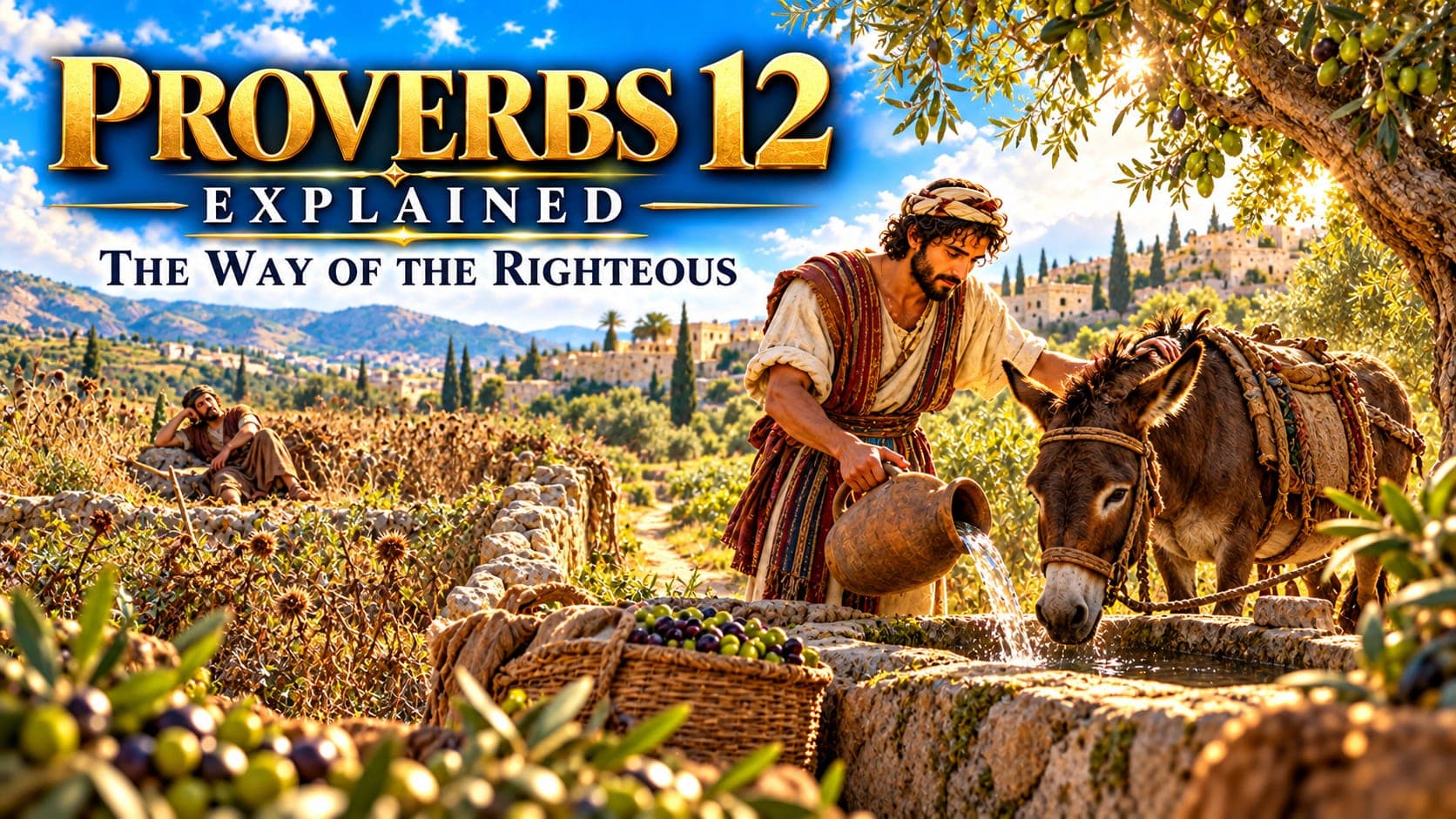
"A righteous man regardeth the life of his beast: but the tender mercies of the wicked are cruel."
📌 How a person treats an animal that cannot repay kindness reveals character a polite conversation never will. The law Moses gave already required rest for working animals and forbade muzzling an ox while it threshed grain. Verse 10 states the principle behind those laws plainly: righteousness reaches all the way down to how you treat something with no power over you at all.
"He that tilleth his land shall be satisfied with bread: but he that followeth vain persons is void of understanding."
Vain persons means empty ones, people chasing shortcuts with nothing real behind them. The contrast is between steady, unglamorous work on your own land and attaching yourself to whatever scheme looks exciting this season. Bread comes from the field you actually tend.
5. Roots, Nets, and Lips That Trap or Free (verses 12 to 14)
The chapter circles back to roots, this time contrasting them with something built to catch and destroy.
"The wicked desireth the net of evil men: but the root of the righteous yieldeth fruit."
A net is built to take something by force or trickery. A root is built to grow something slowly and feed whoever depends on it. The verse puts those two pictures side by side on purpose, one aimed outward to capture, the other aimed downward to nourish.
"The wicked is snared by the transgression of his lips: but the just shall come out of trouble. A man shall be satisfied with good by the fruit of his mouth: and the recompence of a man’s hands shall be rendered unto him."
💡 Verse 13 turns the net from verse 12 back on the one who desired it. The wicked man wanted a net for someone else. His own lips become the snare that catches him instead. Verse 14 then widens the picture past speech to include a person's hands, the work they actually do with them. Words and labor both come back around to the one who produced them.
6. The Tongue on Trial (verses 15 to 22)
This stretch is the longest single run in the chapter, and almost every verse in it is about speech.
"The way of a fool is right in his own eyes: but he that hearkeneth unto counsel is wise. A fool’s wrath is presently known: but a prudent man covereth shame."
Presently means immediately, not eventually. A fool's anger shows up on his face the second he feels it. A prudent man practices the opposite instinct, the same self control that holds a reaction back long enough to think before it becomes words someone cannot unhear.
"He that speaketh truth sheweth forth righteousness: but a false witness deceit. There is that speaketh like the piercings of a sword: but the tongue of the wise is health."
📌 Verse 18 names the two effects a single tongue can have, with nothing in between. Careless or cruel words do not just sting, the verse compares them to a sword actually piercing the body. Wise words do not merely soothe, they bring health, the way medicine does. Nobody's words sit neutral for long.
"The lip of truth shall be established for ever: but a lying tongue is but for a moment."
A lie can win the moment it is told. It rarely survives contact with time. Truth is the slower investment that still stands long after the convenient lie has already collapsed under its own weight.
"Deceit is in the heart of them that imagine evil: but to the counsellors of peace is joy. There shall no evil happen to the just: but the wicked shall be filled with mischief."
Verse 21 reads, on its surface, like a promise that nothing bad ever touches a righteous life. The rest of the Bible will not let that reading stand on its own, and this chapter addresses it honestly below.
"Lying lips are abomination to the LORD: but they that deal truly are his delight."
Verse 22 closes the tongue section exactly where the chapter opened, on what God finds abominable and what He delights in, just applied now to speech instead of to attitude toward correction.
7. Diligence, a Good Word, and a Road With No Death In It (verses 23 to 28)
The chapter closes by weighing what a person does with what they know, and what they do with their hands.
"A prudent man concealeth knowledge: but the heart of fools proclaimeth foolishness. The hand of the diligent shall bear rule: but the slothful shall be under tribute."
Verse 23 is not telling you to hide true knowledge out of pride. It is warning against blurting out everything you know the moment you know it, the same restraint verse 16 already praised. Verse 24 names a direct outcome, the same hand this book already praised for making a man rich now goes a step further and puts that hand in a position to rule, while the slothful hand ends up paying tribute to someone else instead.
"Heaviness in the heart of man maketh it stoop: but a good word maketh it glad."
💡 Stoop pictures a weight pressing a person physically downward. The cure the verse names is not complicated advice. It is one good word, said at the right moment, to a person carrying a heaviness you may not even be able to see from the outside.
"The righteous is more excellent than his neighbour: but the way of the wicked seduceth them. The slothful man roasteth not that which he took in hunting: but the substance of a diligent man is precious."
Verse 27 paints a strange little picture on purpose. A lazy hunter actually catches something, then cannot be bothered to finish the work of cooking it. Effort without follow through produces nothing you can actually eat. The diligent man's gain, by contrast, is called precious because he finished what he started.
"In the way of righteousness is life: and in the pathway thereof there is no death."
📌 The chapter ends on the same word it kept circling back to from the beginning: a path. Proverbs 3 already called wisdom's ways pleasant and her paths peace. Proverbs 12 closes by naming what walking that path actually leads to, life on one end, and nothing resembling death anywhere along the way.
Hard Questions Proverbs 12 Raises
Does verse 21 promise that nothing bad ever happens to a righteous person? Read on its own, the text says exactly that: no evil shall happen to the just. Christians have handled this two main ways. Some read it as the general pattern Proverbs describes throughout the book, a normal trajectory of life rather than an unconditional guarantee for every individual day. Others point out that righteous people clearly do suffer elsewhere in Scripture, Job and the prophets being the clearest examples, so the verse must mean no evil gets the final word over a righteous life, not that trouble never touches it along the way. Proverbs itself already said something close to this in chapter 11: even the righteous face consequences here on earth. The two statements sit together in the same book on purpose.
Is verse 10, about caring for an animal, really a moral command? Yes. The verse states plainly that a righteous man regards the life of his beast, and ties cruelty to animals directly to wickedness, not to a separate, lesser category of concern. The law given through Moses backs this up with specific commands protecting working animals, so this is not a modern idea read back into an old text.
Does "virtuous woman" in verse 4 only describe wives? The specific comparison in this verse is about marriage, a wife either crowning or shaming her husband. But the underlying word describes strength of character more broadly, the same word used of Ruth before she ever married Boaz. The verse is about marriage specifically, while the quality it names is not limited to married women alone.
Does verse 9 mean ambition itself is wrong? No. The contrast is between pretending to have status you cannot back up and living within a quieter, honest provision. A person can work hard and rise without the self honoring pretense the verse is actually warning against.
Practical Tips From Proverbs 12
Twenty eight verses, most of them pointing at something you can check in your own week.
- Notice how you actually react to correction. Verse 1 ties loving reproof directly to loving knowledge. Your reaction the next time someone corrects you is worth paying attention to.
- Let your roots grow where nobody else can see them. Verse 3 compares wickedness to a structure with no foundation. Build the private disciplines first.
- Check your words before you check your reputation. Verse 5 puts thoughts before speech. Whatever is honest in your head eventually becomes what comes out of your mouth.
- Treat something that cannot repay you well. Verse 10 measures character by how you treat an animal with no power over you. Look for the equivalent test in your own life this week.
- Hold your reaction back long enough to think. Verse 16 praises a prudent man who covers shame instead of broadcasting his anger the moment he feels it.
- Say the one good word someone near you needs today. Verse 25 names heaviness as something a single good word can actually lift.
- Finish what diligence starts. Verse 27's lazy hunter catches something and never cooks it. Effort that stops short still produces nothing to eat.
Top 5 Bible Verses From Proverbs 12
1. Proverbs 12:1
"Whoso loveth instruction loveth knowledge: but he that hateth reproof is brutish."
The chapter opens on a test almost nobody enjoys. How you respond to correction says more about your hunger for truth than almost anything else you could point to.
2. Proverbs 12:4
"A virtuous woman is a crown to her husband: but she that maketh ashamed is as rottenness in his bones."
A crown is visible and honors the one wearing it. Rottenness works invisibly, inside the bones, weakening from a place nobody else can see.
3. Proverbs 12:15
"The way of a fool is right in his own eyes: but he that hearkeneth unto counsel is wise."
A fool never gets the chance to see his own blind spot, because by definition he trusts his own eyes completely. Wisdom starts with admitting someone else might see what you cannot.
4. Proverbs 12:18
"There is that speaketh like the piercings of a sword: but the tongue of the wise is health."
Nobody's words sit neutral for long. The same mouth that could wound like a blade can bring healing instead, and the choice is made one sentence at a time.
5. Proverbs 12:25
"Heaviness in the heart of man maketh it stoop: but a good word maketh it glad."
A weight presses a person down that others may never notice. The cure this verse names is not complicated. It is one good word, said at the right moment.
Frequently Asked Questions About Proverbs 12
What is Proverbs 12 about?
It continues the book's collection of short, stand alone proverbs, testing what actually holds up under pressure: a person's response to correction, a stable root, a household, a reputation, and especially the words someone speaks.
What does "brutish" mean in Proverbs 12:1?
It means animal like, acting without reason. The verse uses the word deliberately, tying a hatred of correction to a lack of the understanding that is supposed to set a person apart.
Does Proverbs 12:21 mean righteous people never suffer?
Read alone, the verse says no evil shall happen to the just. Scripture elsewhere shows righteous people clearly suffering, so most readers take the verse as describing the overall pattern of a righteous life, or as a promise that evil never gets the final word, rather than a guarantee that trouble never touches it at all.
What does "virtuous woman" mean in Proverbs 12:4?
It describes strength of character and capability, not only moral purity. The same word describes Ruth before her marriage to Boaz, and it describes the woman praised at the end of the book of Proverbs.
Why does Proverbs 12 mention caring for animals?
Verse 10 ties how a person treats an animal directly to righteousness or cruelty. The law given through Moses backed this with specific protections for working animals, so the chapter is stating a principle Scripture already took seriously elsewhere.
What does "the tongue of the wise is health" mean in Proverbs 12:18?
It compares careless words to a sword piercing the body, and wise words to medicine that actually heals. The verse is making the point that speech is never neutral. It either damages or restores.
What does "vain persons" mean in Proverbs 12:11?
It means empty people, those chasing shortcuts or schemes with nothing substantial behind them. The verse contrasts following them with the steady, unglamorous work of tilling your own land.
Why does Proverbs 12:9 say it is better to be despised than to honor yourself?
The verse ranks a quiet, honestly provided for life above impressive sounding status with nothing real behind it. Pretended honor that leaves a person hungry is worth less than humble stability.
What is the main lesson of Proverbs 12?
That character shows up in what actually lasts, roots instead of quick structures, honest words instead of convenient lies, and diligence that finishes what it starts instead of stopping halfway.
Final Thoughts
Proverbs 12 keeps testing the same question from every angle: what actually holds up.
📌 A root grows where nobody can see it, and that is exactly why it holds. Verse 3 says wickedness builds nothing established. Verse 12 says the righteous root still yields fruit.
📌 Your words are never neutral. Verse 18 says so directly, a piercing sword on one side, health on the other, decided one sentence at a time.
📌 Finishing matters as much as starting. Verse 27's lazy hunter catches something and never cooks it. Diligence that stops halfway still leaves you hungry.
Take one honest look at your own roots this week.
Not what shows on the surface. What is actually growing underneath it, where only God sees it yet.