📖 Proverbs 13 Explained: The Mouth, the Rod, and True Riches
A man who acts rich and owns nothing. A man who looks poor and holds great wealth. A father who loves his son enough to correct him.
Proverbs 13 explained keeps the same short, stand alone saying format this stretch of the book has used since chapter 10, twenty five verses in a row with almost no transition between them. But this chapter has a particular obsession: the gap between how things look and how they actually are. A rich appearance can hide an empty hand. A poor appearance can hide a full one.
Maybe the only verse you remember from this chapter is the one about the rod, and maybe it has always bothered you a little.
- ❓ Does verse 24 command parents to physically beat their children?
- ❓ How can the same man be called both rich and poor at the same time?
- ❓ Why does the chapter say the poor man never hears a rebuke?
- ❓ What does it actually mean to keep your mouth and keep your life?
📌 This chapter names "life" or "death" outright four times in just twenty five verses. That is a tight concentration for a short chapter, and each one lands right at a turning point in the argument.
This walkthrough goes through all twenty five verses in the order they were written, grouped by what each small cluster is actually testing: the mouth, diligence and honesty, the paradox of riches, pride and patience, favor and folly, desire and company, and what finally gets passed down to the next generation.
Read slowly. Several of these lines say the opposite of what they seem to at first glance.
What Happened Just Before This Chapter
Proverbs 12 closed its long run on the tongue by naming a path with no death anywhere along it, and just before that it said a man would be satisfied with good by the fruit of his own mouth. Proverbs 13 opens by picking up that exact image and pushing it further.
"A wise son heareth his father’s instruction: but a scorner heareth not rebuke."
"A man shall eat good by the fruit of his mouth: but the soul of the transgressors shall eat violence."
📌 Verse 2 restates Proverbs 12:14 almost word for word, then changes what the wicked eat instead of good. Chapter 12 ended on the fruit of a righteous mouth. Chapter 13 opens the same way, then immediately shows the other side of that same coin: a transgressor's own mouth feeds him violence instead of good. The chapter has not moved on from speech. It has only changed its angle on it, now framed as something you actually consume.
Verse 1 also sets up a theme this chapter will not let go of: a father, a son, and whether the son is willing to listen. It is the same family language that opened Proverbs 10, and this chapter will return to that exact relationship in its very last cluster of verses.
Proverbs 13 Explained Verse by Verse
1. The Mouth That Keeps or Destroys (verses 1 to 3)
Verses 1 and 2 are already quoted above. The chapter finishes this opening cluster with a third line on the same organ.
"He that keepeth his mouth keepeth his life: but he that openeth wide his lips shall have destruction."
💡 Keepeth here carries the sense of guarding something valuable, the same word used elsewhere for guarding a city or a flock. Your own mouth, the verse says, needs that same kind of watch. "Openeth wide his lips" pictures someone who talks without a gate on what comes out, and the verse ties that habit directly to his own ruin, not just someone else's hurt feelings.
2. Diligence, Honesty, and the Light That Keeps Burning (verses 4 to 6)
The chapter shifts from speech to the two habits that decide most of a life: work and honesty.
"The soul of the sluggard desireth, and hath nothing: but the soul of the diligent shall be made fat."
A sluggard here is not someone without wants. He wants plenty. What he lacks is the willingness to work for what he wants, so the wanting itself never turns into anything.
"A righteous man hateth lying: but a wicked man is loathsome, and cometh to shame. Righteousness keepeth him that is upright in the way: but wickedness overthroweth the sinner."
📌 Verse 5 does not say the righteous man merely avoids lying. It says he hates it. That is a stronger claim than simple obedience to a rule. The verse is describing a settled disposition, not a habit of gritting your teeth and resisting temptation one lie at a time.
3. The Paradox of Riches (verses 7 to 9)
Here the chapter turns to one of its strangest and most memorable observations.
"There is that maketh himself rich, yet hath nothing: there is that maketh himself poor, yet hath great riches."
⚠️ Read fast, this sounds like nonsense. Read slowly, it is describing two kinds of pretending that run in opposite directions. One man performs wealth he does not actually have, spending and displaying beyond what is really his, while the appearance covers an empty account underneath. The other man lives simply, perhaps even looks poor to the people around him, while quietly holding real resources he never bothers to show off. The verse does not say which man is wiser. It is content to point out that looks and reality are two different things, a lesson how you relate to money depends on far more than what shows on the surface.
"The ransom of a man’s life are his riches: but the poor heareth not rebuke."
Verse 8 looks at the same paradox from a different angle. A rich man can be threatened, held for ransom, or extorted, because he has something worth taking. A poor man is never approached that way. He "heareth not rebuke" in that sense because no one bothers to threaten a man with nothing to lose. Riches protect in one direction and expose in another, a tension this book keeps returning to without ever resolving it into a simple rule.
"The light of the righteous rejoiceth: but the lamp of the wicked shall be put out."
💡 A lamp needs constant tending, oil, a trimmed wick, attention, or it goes out on its own. The verse pictures the wicked life the same way, something that burns for a while and then simply fails from the inside, while the righteous life keeps its own light rejoicing rather than merely surviving.
4. Pride, Patience, Hope Deferred, and the Word (verses 10 to 14)
The chapter widens out to how a person handles conflict, money, waiting, and instruction.
"Only by pride cometh contention: but with the well advised is wisdom."
📌 The verse does not say pride is one cause of conflict among several. It says contention comes "only" by pride. Strip away enough layers from almost any fight and a refusal to be told something tends to be sitting underneath it, the same refusal a patient, self controlled spirit is built to resist before it ever reaches a shouting match.
"Wealth gotten by vanity shall be diminished: but he that gathereth by labour shall increase."
"Vanity" here means emptiness, something built on nothing substantial, close to get rich quick thinking. Money gained that way tends to leak out as fast as it came in. Money built up slowly through actual labor tends to hold.
"Hope deferred maketh the heart sick: but when the desire cometh, it is a tree of life."
💡 This may be the most emotionally honest verse in the chapter. It does not scold anyone for feeling sick over a hope that keeps getting pushed back. It simply names what waiting does to a heart, plainly, without pretending patience is painless. The relief on the other side of that wait is called a tree of life, the same phrase Proverbs 3 used for wisdom herself, now used for a desire that finally, actually arrives.
"Whoso despiseth the word shall be destroyed: but he that feareth the commandment shall be rewarded. The law of the wise is a fountain of life, to depart from the snares of death."
Verse 14 names death directly, a snare set and waiting, and calls the law of the wise a fountain, something that keeps producing life rather than giving it once and running dry. Verses 13 and 14 together close this cluster the way it opened in verse 1: a word given, and a choice about whether to receive it.
5. Favor, Folly, Messengers, and Instruction (verses 15 to 18)
The chapter turns to how understanding, or the lack of it, shows up in daily dealings with other people.
"Good understanding giveth favour: but the way of transgressors is hard. Every prudent man dealeth with knowledge: but a fool layeth open his folly."
"A wicked messenger falleth into mischief: but a faithful ambassador is health."
📌 A messenger in this world carried someone else's words, often across real distance, with no way for the sender to correct him once he left. A messenger who twisted or dropped the message brought real trouble on himself and on whoever sent him. One who carried it faithfully is compared to health itself, the same weight Proverbs 12 gave to a tongue that heals rather than wounds.
"Poverty and shame shall be to him that refuseth instruction: but he that regardeth reproof shall be honoured."
Verse 18 pairs two outcomes that do not obviously belong together at first glance, poverty and shame on one side. The connection is not that refusing correction always causes literal poverty. It is that a person who will not be told anything keeps making the same avoidable mistakes, and those mistakes cost something real over time.
6. Desire, Company, and What Finally Pursues You (verses 19 to 21)
Three short verses weigh what a person wants against who a person spends time with.
"The desire accomplished is sweet to the soul: but it is abomination to fools to depart from evil."
Verse 19 pairs a desire that gets fulfilled with a fool who will not let go of evil even when it is pointed out to him. Both halves of the verse are about reaching something wanted, one a sweet desire finally met, the other a grip on wrongdoing a fool refuses to loosen even when leaving it would be the better outcome.
"He that walketh with wise men shall be wise: but a companion of fools shall be destroyed."
📌 The verse does not say a companion of fools might struggle or might be influenced. It says he shall be destroyed. That is a hard, flat statement about who you let shape your daily life. "Walketh with" describes an ongoing habit, not a single conversation, which means the warning is about sustained company, not one bad friend you happen to know.
"Evil pursueth sinners: but to the righteous good shall be repayed."
Verse 21 flips the usual picture. Sinners are not shown chasing evil. Evil is shown chasing them, as if the consequence of a wrong path eventually catches up to the one walking it, whether he is still looking for it or not.
7. Inheritance, Honest Work, and the Rod of Love (verses 22 to 25)
The chapter closes by asking what a life actually leaves behind, and how a parent prepares a child to receive it.
"A good man leaveth an inheritance to his children’s children: and the wealth of the sinner is laid up for the just."
"Much food is in the tillage of the poor: but there is that is destroyed for want of judgment."
💡 Verse 23 is easy to read past quickly. It says a poor man's own field can still produce plenty, which means poverty alone is not what destroys a household. Something else can, a lack of judgment, which ruins what honest tillage would otherwise have grown.
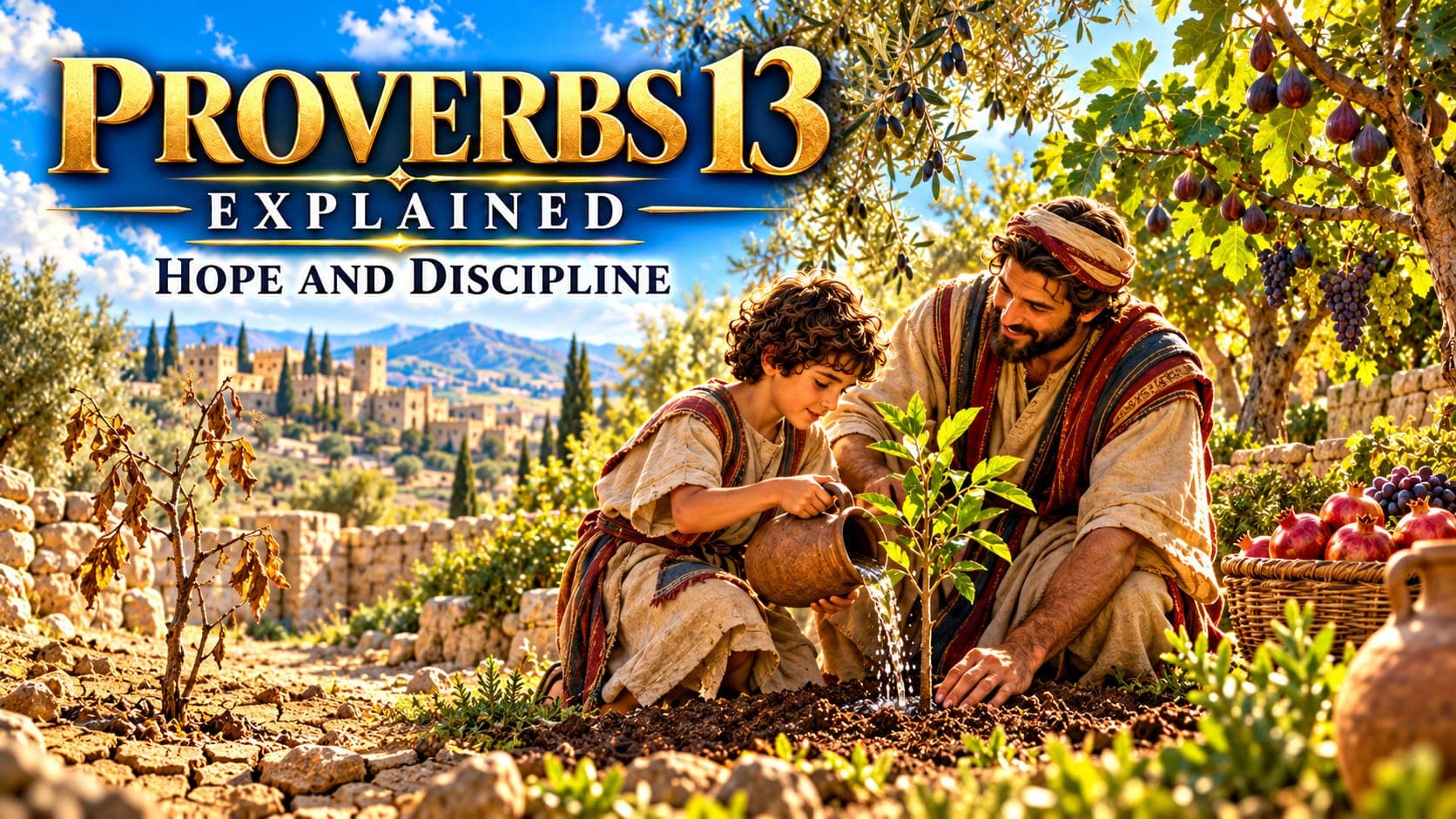
"He that spareth his rod hateth his son: but he that loveth him chasteneth him betimes."
📌 "Betimes" means early, not constantly. The verse is not measuring how often a parent corrects a child. It is measuring whether correction starts while it can still shape him, instead of being withheld until the habits are already set. The same Hebrew word translated rod here also describes a shepherd's staff elsewhere in Scripture, the tool used to guide and protect a flock, not only to strike it. Whatever the verse pictures in a parent's hand, its whole point is that withholding correction is named here as a failure to love, not an act of kindness.
"The righteous eateth to the satisfying of his soul: but the belly of the wicked shall want."
📌 The chapter opened on a son who either listens to his father or does not, and it closes on a father who either corrects his son or does not. Twenty five verses about mouths, riches, patience, and company all sit inside that frame, one generation handing something real to the next, for better or for worse.
Hard Questions Proverbs 13 Raises
Does verse 24 command parents to physically beat their children? The text says plainly that sparing the rod is a failure to love, and that loving a son means correcting him early. Christians have read the specific method two main ways. Some take the rod literally, as a call for physical discipline applied carefully and never in anger. Others point out that the same Hebrew word for rod describes a shepherd's staff in places like Psalm 23, a tool mainly used to guide and protect the flock, and read the verse as teaching that real love corrects a child early rather than specifying one exact method. What the verse itself will not allow is the third option neither side takes: ignoring a child's wrong direction and calling that kindness.
How can verse 7 call the same kind of person both rich and poor? It is not describing one man. It is describing two different patterns, someone who performs wealth he does not have, and someone who quietly holds wealth he does not show. The verse is making an observation about appearance versus reality, not proposing a riddle to be solved into a single meaning.
Does verse 8 mean rich people are safer than poor people? It says the opposite is also true in its own way. Riches can function as a ransom, something worth paying to get a man back, but that same value is exactly what makes a rich man a target in the first place. A poor man escapes that specific danger only because he has nothing worth taking. Neither condition is presented as simply safer than the other.
Does verse 22 promise that a good man's grandchildren will always inherit his wealth? The verse states a general pattern this book repeats often: character tends to build something lasting, and what the wicked accumulate has a way of ending up in other hands. Proverbs describes how life usually works, not an unconditional guarantee for every single family in every single case.
Practical Tips From Proverbs 13
Twenty five short verses, most of them aimed at something you can act on this week.
- Guard your mouth like you would guard anything valuable. Verse 3 ties keeping your lips to keeping your own life. Notice the moments you open wide instead of holding back.
- Check whether your wanting has ever turned into working. Verse 4 contrasts the sluggard's desire, which produces nothing, with the diligent soul, which actually gets filled.
- Ask whether your appearance matches your reality. Verse 7 names two kinds of pretending. Make sure you are not performing a life you cannot actually afford.
- Let hope deferred be honest, not denied. Verse 12 does not shame you for a sick heart over a long wait. It simply tells the truth about what waiting costs.
- Take a hard look at who you walk with regularly. Verse 20 is blunt about how much company shapes outcome. Ongoing closeness with foolishness rarely stays contained.
- Do not mistake withheld correction for kindness. Verse 24 names it the other way around. If you love someone under your care, say the hard thing early.
Top 5 Bible Verses From Proverbs 13
1. Proverbs 13:24
"He that spareth his rod hateth his son: but he that loveth him chasteneth him betimes."
One of the most debated verses in the book, and one of its clearest: withholding needed correction is named here as a failure to love, not a gentler form of it.
2. Proverbs 13:12
"Hope deferred maketh the heart sick: but when the desire cometh, it is a tree of life."
An honest line about waiting, naming the sickness of delay without pretending patience is painless, then promising real life on the other side of it.
3. Proverbs 13:20
"He that walketh with wise men shall be wise: but a companion of fools shall be destroyed."
A flat statement about sustained company, not a single bad conversation. Who you keep walking with eventually shapes what you become.
4. Proverbs 13:3
"He that keepeth his mouth keepeth his life: but he that openeth wide his lips shall have destruction."
Your own words are tied here to your own outcome, not just to how someone else feels about them.
5. Proverbs 13:7
"There is that maketh himself rich, yet hath nothing: there is that maketh himself poor, yet hath great riches."
A reminder that appearance and reality are not the same thing, whether the subject is money or almost anything else about a life.

Frequently Asked Questions About Proverbs 13
What is Proverbs 13 about?
It continues the book's collection of short, stand alone proverbs, weighing the mouth, diligence, the paradox of riches, patience, good company, and a parent's responsibility to correct a child.
What does Proverbs 13:24 mean by "spare the rod"?
It warns that withholding a child's correction is a failure to love him, not a kinder choice. Christians differ on whether the rod describes literal physical discipline or uses shepherding imagery for correction more broadly, but the verse itself insists that real love corrects early.
What does "betimes" mean in Proverbs 13:24?
It means early, while correction can still shape a child, not constantly or harshly. The verse is about timing, starting before bad habits set in, not frequency.
How can Proverbs 13:7 call a man both rich and poor?
It is describing two different people, not one riddle. One performs wealth he does not have. The other quietly holds wealth he does not display. The verse is about the gap between appearance and reality.
What does it mean that "the poor heareth not rebuke" in verse 8?
Riches made a man a target worth threatening or holding for ransom in the ancient world. A poor man escaped that specific danger simply because he had nothing worth taking from him.
Does Proverbs 13:22 guarantee a good man's grandchildren will inherit his wealth?
It states a general pattern the book repeats often, that character tends to build something lasting. It describes how life usually works rather than promising the same outcome for every family without exception.
What does Proverbs 13:3 mean by keeping your mouth?
It pictures guarding your words the way you would guard anything valuable, deliberately and with attention. The verse ties that habit directly to your own outcome, calling the opposite, talking without restraint, a path toward your own destruction.
Why does Proverbs 13:20 say a companion of fools shall be destroyed?
"Walketh with" describes sustained, ongoing company, not a single conversation. The verse warns that who you consistently spend time with eventually shapes what you become, whether you intend it to or not.
What is the main lesson of Proverbs 13?
That things are frequently not what they look like on the surface, a mouth that seems harmless can destroy, a poor man can be genuinely wealthy, and withheld correction can masquerade as kindness while actually doing harm.
Final Thoughts
Proverbs 13 keeps asking the same question in different clothes: is this what it looks like.
📌 A rich appearance can hide an empty hand, and a plain one can hide a full one. Verse 7 will not let you judge a life by what it shows on the surface alone.
📌 Withheld correction is not love wearing a softer face. It is named here as its opposite. Verse 24 puts the harder truth plainly: real love speaks up early.
📌 Your own mouth feeds you something, good or violence, depending on what comes out of it. Verses 2 and 3 tie your words to your own outcome, not just to someone else's feelings.
So here is your one next step.
Find the one place in your life right now where appearance and reality do not match, and tell someone the truth about it before this week ends.
That single honest sentence is worth more than years of managing how things look.