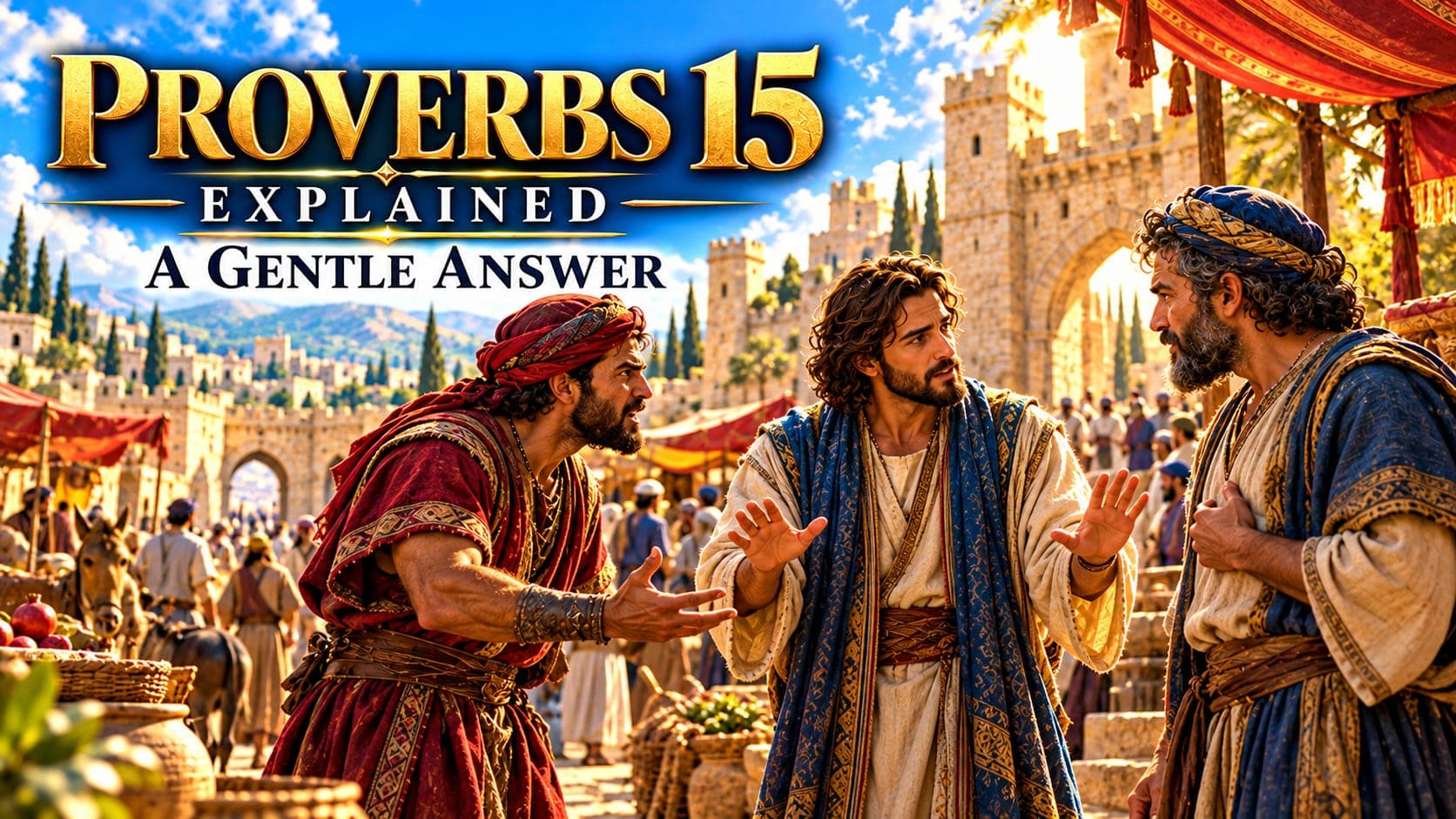
📖 Proverbs 15 Explained: A Soft Answer and a Watching God
One word can calm a room. The next word can wreck it.
Proverbs 15 explained opens on that exact fork, then spends thirty three verses showing how much of your life actually runs through your mouth, your heart, and the fact that God is watching both the whole time. This chapter has more direct statements about the LORD than almost any other stretch of Proverbs so far.
Maybe you have read verse 1 a hundred times and never once asked what it costs you.
- ❓ Does a soft answer mean you can never say anything hard?
- ❓ What does it mean that the eyes of the LORD are in every place?
- ❓ Does verse 25 mean God always rescues a widow from poverty?
- ❓ Why does this chapter say the days of the afflicted are evil?
📌 This chapter names the LORD by name nine times in thirty three verses, tying Proverbs 3 for the most of any chapter in the book so far. Every chapter in between this one and that one used the name four times or fewer.
This walkthrough covers all thirty three verses in order, grouped by what each cluster is actually weighing: the tongue, worship and correction, what God already sees, a list of things that beat more money, counsel and timing, and finally greed, prayer, and the humility that comes before honor.
Read it slowly. Several of these lines are quoted constantly and rarely finished.
What Happened Just Before This Chapter
Proverbs 14 closed on a king whose favor rests on a wise servant and whose wrath falls on one who causes shame, right after naming the person slow to wrath as having great understanding. Proverbs 15 opens as if it heard that last line and decided to test it immediately.
"A soft answer turneth away wrath: but grievous words stir up anger."
📌 Chapter 14 told you slowness to wrath was wise. Chapter 15 opens by telling you exactly how that slowness sounds out loud. Wrath is not defused by being right. It is defused, or lit, by the specific words chosen in the first few seconds of a tense conversation.
Proverbs 15 Explained Verse by Verse
1. The Soft Answer and the Watching God (verses 1 to 4)
Verse 1 is quoted above. The chapter keeps circling back to the same organ.
"The tongue of the wise useth knowledge aright: but the mouth of fools poureth out foolishness."
Poureth out pictures something with no filter on it, spilling freely rather than being measured and placed. The wise are not shown knowing more facts than the fool. They are shown using what they know carefully, at the right time, instead of dumping it all out at once.
"The eyes of the LORD are in every place, beholding the evil and the good."
💡 This verse does not single out the wicked for surveillance. It says the evil and the good are both beheld, in every place, with no exceptions carved out for a private room or a quiet moment. The soft answer of verse 1 and the pouring mouth of verse 2 are both being watched by the same eyes.
"A wholesome tongue is a tree of life: but perverseness therein is a breach in the spirit."
📌 A tree of life is a strong claim for one tongue to carry. Proverbs 9 used that same picture for wisdom herself. Here it describes something as ordinary as how you talk to people, while its opposite is called a breach, a torn opening in the spirit rather than a small flaw.
2. Correction, Worship, and a Father's Word (verses 5 to 10)
The chapter turns from speech in general to how a person receives being told something they do not want to hear.
"A fool despiseth his father's instruction: but he that regardeth reproof is prudent. In the house of the righteous is much treasure: but in the revenues of the wicked is trouble."
Verse 6 does not promise the righteous more money than the wicked. It compares what kind of house holds treasure and what kind of income carries trouble baked into it, a quieter way of saying wealth gotten wrongly costs something that eventually comes due.
"The lips of the wise disperse knowledge: but the heart of the foolish doeth not so."
"The sacrifice of the wicked is an abomination to the LORD: but the prayer of the upright is his delight. The way of the wicked is an abomination unto the LORD: but he loveth him that followeth after righteousness."
📌 Verse 8 does not say the wicked man's sacrifice is unwelcome because he brought the wrong animal. It is an abomination because of who is bringing it. Worship was never a transaction that could cover for a life lived against God. A prayer from someone actually trying to follow Him is called His delight, with no mention of how polished the words were.
"Correction is grievous unto him that forsaketh the way: and he that hateth reproof shall die."
💡 This verse does not promise that every person who dislikes being corrected drops dead on the spot. Proverbs regularly uses death the way it used it in Proverbs 14, as the name for where an uncorrected path ends up, not only the moment it ends there. A person who treats reproof as unbearable has removed the one thing that could have turned him off that road before it ran out.
3. Nothing Hidden From the LORD (verses 11 to 15)
The chapter widens the watching from verse 3 into territory most people assume is sealed off.
"Hell and destruction are before the LORD: how much more then the hearts of the children of men?"
📌 The Hebrew words behind "Hell and destruction" here are Sheol and Abaddon, the realm of the dead and the place of ruin, not the final judgment Jesus describes in the Gospels. If even the deepest, most hidden place is laid open before God, the verse argues, how much more easily does He see straight into an ordinary human heart sitting in plain daylight. Readers curious about what the Bible actually means by hell will find this verse is using an older word for the grave, not the lake of fire.
"A scorner loveth not one that reproveth him: neither will he go unto the wise."
Notice the second half. A scorner does not only resist correction when it is offered. He will not even go near the people likely to offer it, avoiding the room instead of risking the conversation.
"A merry heart maketh a cheerful countenance: but by sorrow of the heart the spirit is broken. The heart of him that hath understanding seeketh knowledge: but the mouth of fools feedeth on foolishness."
"All the days of the afflicted are evil: but he that is of a merry heart hath a continual feast."
⚠️ Read on its own, this verse can sound like it is blaming hard circumstances on a bad attitude. The chapter is not promising that cheerfulness erases real affliction, and Proverbs elsewhere is honest about suffering that a person did nothing to deserve. The contrast is between a heart that has nothing steady to stand on and one that does, a continual feast available even inside days that are genuinely hard, not a claim that hard days are only ever a choice.
4. Better Than More (verses 16 to 20)
The chapter runs two short, deliberate "better is" sayings back to back.
"Better is little with the fear of the LORD than great treasure and trouble therewith. Better is a dinner of herbs where love is, than a stalled ox and hatred therewith."
📌 Both verses weigh a small, plain thing against a large, impressive one, and both times the small thing wins because of what travels with it. A stalled ox is a fattened animal kept for a feast, the richest meal available in that world. The verse does not say the ox is bad. It says hatred at that table ruins it faster than a bowl of herbs eaten where love is actually present.
"A wrathful man stirreth up strife: but he that is slow to anger appeaseth strife. The way of the slothful man is as an hedge of thorns: but the way of the righteous is made plain."
Verse 18 returns to the opening theme of the chapter from a new angle. It is not enough to avoid starting a fight. The slow to anger person is shown actively ending ones already in progress. Verse 19 pictures a lazy man's own road as blocked with thorns he never bothered to clear, while the righteous find the same ground made plain, not because the ground is different but because the walking habits are.
"A wise son maketh a glad father: but a foolish man despiseth his mother."
This exact line, almost word for word, already opened Proverbs 10. Its return here is not an accident of a collection running out of new material. It is a reminder that this entire stretch of the book keeps measuring wisdom by its effect on the people closest to it.
5. Counsel, Timing, and the Widow's Defender (verses 21 to 26)
The chapter turns to decisions, and who a person lets weigh in on them.
"Folly is joy to him that is destitute of wisdom: but a man of understanding walketh uprightly. Without counsel purposes are disappointed: but in the multitude of counsellors they are established."
💡 Verse 22 is not telling you that more opinions always produce a better plan. It is naming a specific failure, a purpose attempted entirely alone, with nobody else allowed to check it before it moves forward. Plans die quietly in isolation long before they fail loudly in public.
"A man hath joy by the answer of his mouth: and a word spoken in due season, how good is it!"
📌 The same words can land as exactly what someone needed or as noise nobody asked for, and the only difference is timing. "Due season" is doing all the work in this verse. A true word said too early or too late loses most of what made it good.
"The way of life is above to the wise, that he may depart from hell beneath."
Like verse 11, "hell beneath" here reads naturally as the grave, the low and final place a wrong direction leads, set against a way of life pictured as rising. Proverbs is not drawing a map of the afterlife. It is drawing a direction for a life still being lived.
"The LORD will destroy the house of the proud: but he will establish the border of the widow."
📌 A border marked a widow's actual land, the boundary a greedy neighbor could quietly move in by one stone at a time if nobody with power stepped in. The law given through Moses already named widows as people God watches with particular care. This verse pairs that same defenseless woman against the proud household strong enough, in every human sense, to take whatever it wanted from her.
"The thoughts of the wicked are an abomination to the LORD: but the words of the pure are pleasant words."
This closes the cluster exactly where verse 11 opened it. Nothing is hidden, not Sheol, not a human heart, not even a private thought that never makes it to speech.
6. Greed, Prayer, and Humility Before Honor (verses 27 to 33)
The chapter closes by weighing what a person wants against what a person becomes.
"He that is greedy of gain troubleth his own house; but he that hateth gifts shall live. The heart of the righteous studieth to answer: but the mouth of the wicked poureth out evil things."
Verse 27 does not say greed only hurts strangers the greedy man takes advantage of. It troubles his own house first, the people nearest him paying for an appetite he never learned to close. Verse 28 echoes verse 2 from earlier in the chapter, the righteous heart studying an answer before it is spoken, while the wicked mouth, once again, simply pours.
"The LORD is far from the wicked: but he heareth the prayer of the righteous."
This is the flip side of verse 3. God sees every place with no exceptions, but hearing a prayer is pictured here as something closer, a nearness the wicked have put distance on through their own direction, not through God moving away first.
"The light of the eyes rejoiceth the heart: and a good report maketh the bones fat."
"The ear that heareth the reproof of life abideth among the wise. He that refuseth instruction despiseth his own soul: but he that heareth reproof getteth understanding."
💡 Verse 32 states the cost of refusing instruction more sharply than almost any verse before it in this chapter. It is not framed as missing out on advice. It is framed as despising your own soul, the harshest possible description for turning down a word meant to help you.
"The fear of the LORD is the instruction of wisdom; and before honour is humility."
📌 The chapter opened on a soft answer and closes on humility, two different names for the same refusal to grab for more than the moment actually calls for. Honor is not removed from the sentence. It simply has to wait its turn behind humility, every time.

Hard Questions Proverbs 15 Raises
Does a soft answer mean you should never say anything hard or confrontational? No. The same chapter that praises a soft answer in verse 1 also praises reproof, correction, and a word spoken plainly throughout the rest of it. "Soft" here describes the manner of the words, gentle rather than grievous, not whether the content is ever allowed to be difficult. A hard truth said gently is exactly what this chapter keeps describing.
What does "Hell and destruction are before the LORD" actually mean in verse 11? The underlying words are Sheol and Abaddon, ancient names for the realm of the dead and the place of ruin, not the eternal judgment Jesus later describes in the Gospels. The verse is making an argument from the extreme case: if even the deepest hidden place lies open before God, an ordinary human heart is certainly not concealed from Him either.
Does verse 25 promise that God will always financially rescue every widow? The verse states a pattern rooted in God's character and in the law He gave Israel, which repeatedly singled out widows for protection against people powerful enough to take advantage of them. It describes who God is and whose side He takes, not a formula guaranteeing a specific financial outcome for every widow in every circumstance.
Why does verse 15 say the days of the afflicted are evil, when verse 13 praises a merry heart? The two verses are not contradicting each other. Verse 15 names affliction honestly as evil, a real hardship, not an illusion to be positive thinking away. The continual feast promised to a merry heart sits inside that same honesty, a steadiness available even during days the verse already admits are genuinely bad.
Does verse 10 mean everyone who dislikes being corrected dies immediately? Proverbs consistently uses death as the destination a wrong path eventually reaches, not only the instant it happens. Hating reproof removes the one warning system most likely to turn a person off that road early, which is exactly why the verse states the danger so bluntly.
Practical Tips From Proverbs 15
Thirty three verses, most of them aimed at something you can test before the day ends.
- Choose your first sentence on purpose. Verse 1 ties an entire conversation's direction to the opening words. Notice which kind you reach for first when you are already upset.
- Remember you are watched in every room, not only in public ones. Verse 3 leaves no private exception. Let that shape what you actually say when no one else is listening.
- Bring an honest prayer instead of a performance. Verse 8 calls the prayer of the upright God's delight, with no mention of polish. Say what is actually true before Him today.
- Let a small, loving meal outrank an impressive, tense one. Verse 17 ranks herbs with love over a feast with hatred. Check which one your own table actually serves this week.
- Say the true thing, but wait for the right season. Verse 23 ties the goodness of a word partly to its timing. A true word too early can cost as much as a false one.
- Take correction as care for your soul, not an attack on it. Verse 32 names refusing instruction as despising your own soul. Let reproof in before it has to get that blunt with you.
Top 5 Bible Verses From Proverbs 15
1. Proverbs 15:1
"A soft answer turneth away wrath: but grievous words stir up anger."
One of the most quoted verses in Proverbs, and one of the hardest to actually practice in the first ten seconds of a real argument.
2. Proverbs 15:3
"The eyes of the LORD are in every place, beholding the evil and the good."
No room is exempted and no moment is private. The verse names both evil and good, with nothing hidden from either account.
3. Proverbs 15:13
"A merry heart maketh a cheerful countenance: but by sorrow of the heart the spirit is broken."
What is happening inside a person rarely stays hidden for long. It eventually shows up on the face, one way or the other.
4. Proverbs 15:17
"Better is a dinner of herbs where love is, than a stalled ox and hatred therewith."
The richest meal available in that world loses to a plain bowl of vegetables the moment hatred sits down at the table instead of love.
5. Proverbs 15:33
"The fear of the LORD is the instruction of wisdom; and before honour is humility."
The chapter's closing line, pairing reverence for God with humility as the two things that have to come first, honor or not.

Frequently Asked Questions About Proverbs 15
What is Proverbs 15 about?
It continues the book's collection of short, stand alone proverbs, weighing the tongue, correction, worship, counsel, and the fact that God sees everything, down to a private thought that never becomes a word.
What does "a soft answer turneth away wrath" mean?
It means the way you respond in the first moments of a tense exchange can calm it or escalate it. The verse is about manner and tone, not about avoiding hard or honest content.
What does Proverbs 15:3 mean about the eyes of the LORD?
It means nothing is hidden from God, whether good or evil, in any place at all. There is no private room where a person's actions or words go unseen.
What does "Hell and destruction" mean in Proverbs 15:11?
It translates Sheol and Abaddon, old Hebrew names for the realm of the dead and the place of ruin, not the eternal judgment described later in the New Testament. The verse argues that if even that hidden place is open before God, a human heart certainly is too.
Does Proverbs 15:25 mean God always protects widows financially?
It describes God's character and whose side He takes, consistent with the law of Moses specifically protecting widows from being taken advantage of. It is not a guaranteed financial outcome promised to every widow in every situation.
Why does Proverbs 15 say the days of the afflicted are evil?
Verse 15 names affliction honestly as a real hardship rather than denying it. The merry heart in the same verse is not proof that hardship was never real, but a steadiness that can exist inside days the verse already admits are genuinely difficult.
What does Proverbs 15:17 mean about a dinner of herbs?
It contrasts a plain, simple meal shared in love with an expensive feast shared in hatred. The verse says the plain meal wins, because what surrounds a meal matters more than what is actually served.
Does hating reproof actually cause death, according to Proverbs 15:10?
Proverbs regularly uses death as the eventual destination of an uncorrected path rather than an instant consequence. Hating reproof removes the warning most likely to change that direction before it runs out.
What does "before honour is humility" mean in Proverbs 15:33?
It means humility has to come first, ahead of any honor that might follow it. The verse does not reject honor outright. It simply refuses to let honor arrive before humility does.
What is the main lesson of Proverbs 15?
That the tongue and the heart are never private, God sees and hears both, and the smallest choices, a soft answer, an honest prayer, a word spoken in season, matter more than they first appear to.
Final Thoughts
Proverbs 15 keeps pointing at the same two things: what comes out of your mouth, and the fact that you are never unseen while it happens.
📌 The first words out of your mouth decide more than the argument itself. Verse 1 says a soft answer turns wrath away before it ever gets started.
📌 Nothing is hidden, not a public act, not a private thought. Verses 3, 11, and 26 say the same thing three different ways, on purpose.
📌 Humility is not a detour on the way to honor. It is the road itself. Verse 33 puts it last in the chapter because it comes first in a life.
So here is your one next step.
Before your next hard conversation today, choose your opening sentence before you walk into the room, not during it.
That one choice is the whole chapter, practiced in real time.