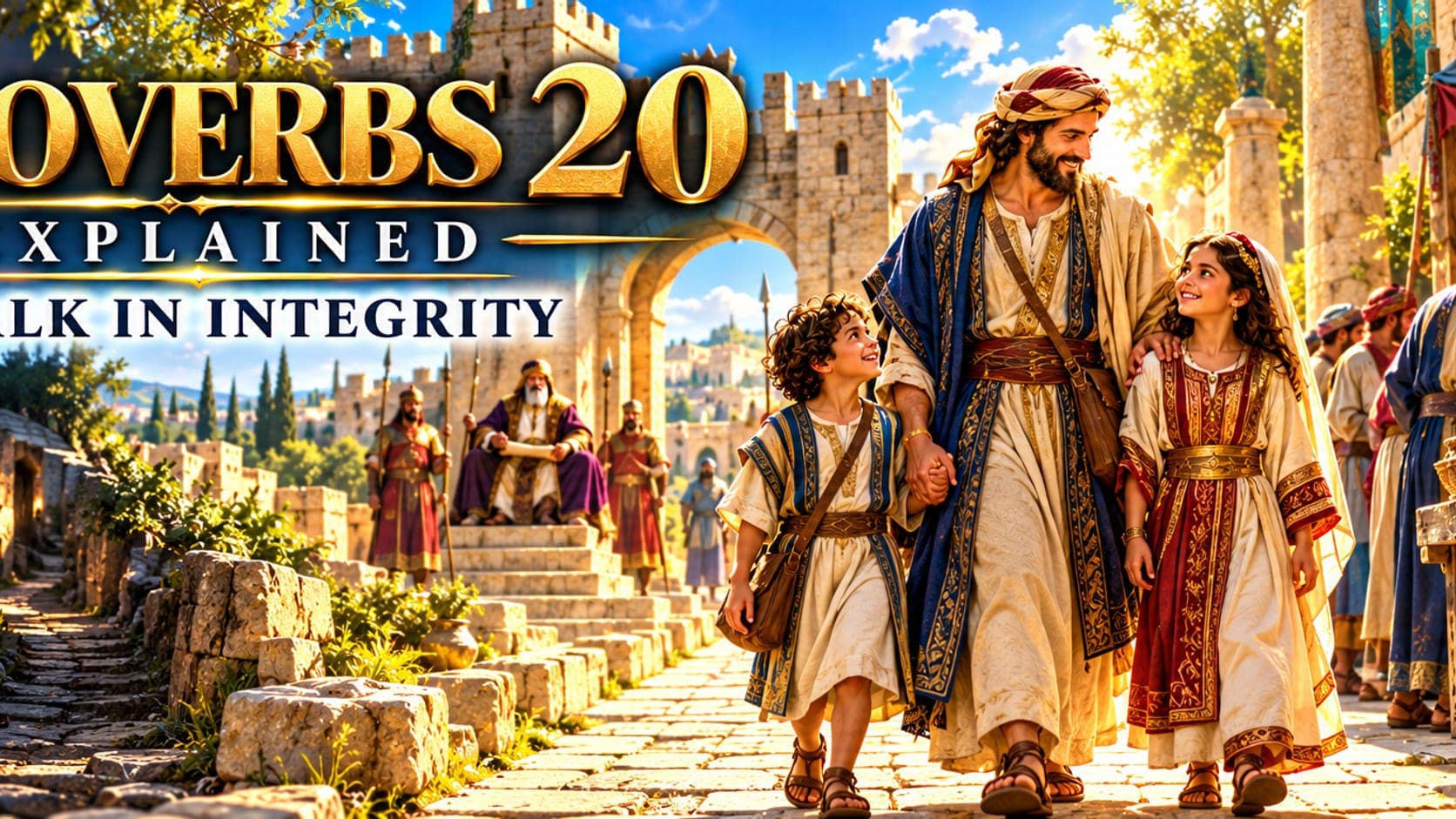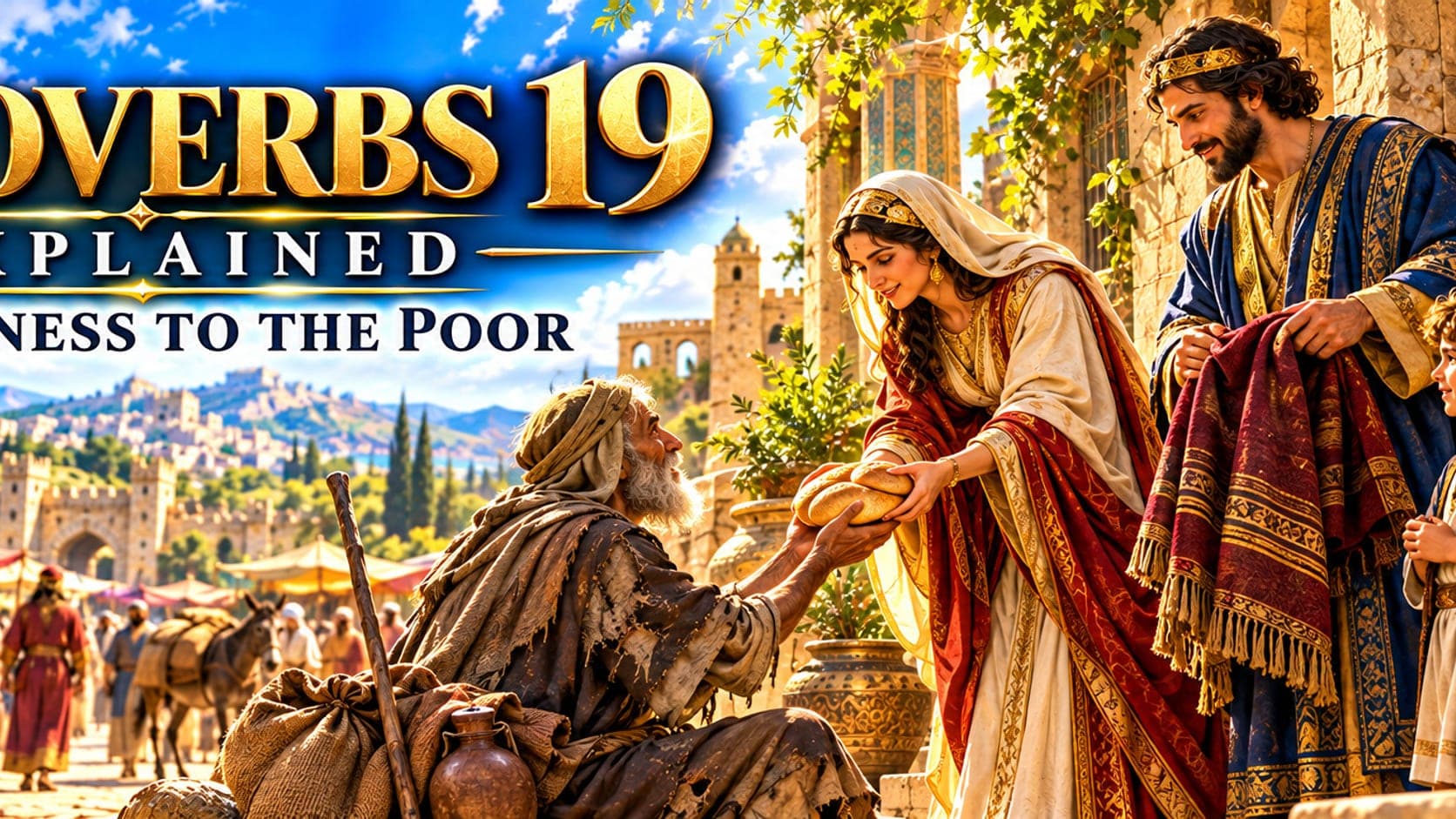
📖 Proverbs 19 Explained: The Counsel of the LORD That Stands
A poor man who tells the truth. A rich man who tells lies. Set them side by side and most of the world still picks the money.
Proverbs 19 explained is twenty nine verses that refuse to pick the money. It opens ranking a poor man's integrity above a fool's clever lips, then spends the rest of the chapter testing that ranking from a dozen different angles: wealth and friendship, a lying witness warned about twice, a king's court, a nagging wife, a lazy hand, a disciplined son, and a plan that feels settled right up until it meets the LORD's own counsel.
Maybe you have watched someone cut corners and come out ahead, at least for a while.
- ❓ Why does this chapter warn about a false witness twice, almost word for word?
- ❓ Does verse 10 contradict what Proverbs 17 already said about a servant and an inheritance?
- ❓ What does "let not thy soul spare for his crying" actually mean in verse 18?
- ❓ Is it wrong to feel the way verse 3 describes, upset with God over a mess you made yourself?
📌 Verse 21 is the hinge the whole chapter swings on: a man's heart holds many devices, but the counsel of the LORD is what actually stands.
This walkthrough moves through all twenty nine verses in the order Solomon set them down, grouped by what each cluster is actually testing: integrity against cleverness, wealth against a witness who lies, a king's court against a nagging wife, sloth against mercy, many plans against one counsel, and finally a scorner against the stripes reserved for him.
Read it slowly. More than one of these verses will land closer to home than you expect.
What Happened Just Before This Chapter
Proverbs 18 closed on friendship, insisting that a friend who shows himself friendly can stick closer than a brother. Proverbs 19 opens on a much blunter comparison, and it is not a comfortable one.
"Better is the poor that walketh in his integrity, than he that is perverse in his lips, and is a fool."
Nobody is asked to admire poverty here. The verse ranks two specific people against each other, a poor man who actually walks straight and a man whose mouth is twisted, and says plainly which one comes out ahead. The rest of the chapter keeps testing that same ranking against money, power, and a lying tongue.
Proverbs 19 Explained Verse by Verse
1. Integrity Over Cleverness, and a Heart That Frets Against God (verses 1 to 3)
Verse 1 is already quoted above. The next verse widens the warning past just a perverse mouth.
"Also, that the soul be without knowledge, it is not good; and he that hasteth with his feet sinneth."
💡 Two separate failures, paired on purpose. A soul without knowledge is slow trouble, drifting into wrong because it never learned better. Feet that hasten are fast trouble, rushing into a decision before knowledge has a chance to catch up. The verse does not rank one above the other. It names both as sin.
"The foolishness of man perverteth his way: and his heart fretteth against the LORD."
📌 Watch the order of this verse carefully. A man's own foolishness twists his path first. Only after that does his heart start fretting against the LORD, as if God were the one who bent the road. The verse never says God caused the mess. It says a man who made his own mess still finds a way to be angry at someone other than himself.
2. Wealth, False Friends, and a Witness Who Will Not Go Unpunished (verses 4 to 9)
From one man's twisted path, the chapter turns to what money and lies actually buy a person.
"Wealth maketh many friends; but the poor is separated from his neighbour."
Proverbs 14 already observed that a poor man can be avoided even by his own neighbor while a rich man collects friends easily. Verse 4 restates the same plain fact from a fresh angle, and this chapter is not finished with it yet.
"A false witness shall not be unpunished, and he that speaketh lies shall not escape."
"Many will intreat the favour of the prince: and every man is a friend to him that giveth gifts."
⚠️ Verse 6 is not a compliment to the generous man. It is a flat observation about how easily a gift buys attention, the same way money changes what people think they owe you. Crowds show up for a prince who gives gifts. They do not necessarily show up for the man himself.
"All the brethren of the poor do hate him: how much more do his friends go far from him? he pursueth them with words, yet they are wanting to him."
Verse 7 takes verse 4 and makes it worse. Not just a stranger's neighbor this time, but a poor man's own brothers growing distant, and friends who put even more space between themselves than family did. He calls after them with words, and the verse says plainly those words find nothing there.
"He that getteth wisdom loveth his own soul: he that keepeth understanding shall find good."
Right in the middle of a hard run of verses about poverty and false friends, one quiet reminder about what actually holds up.
"A false witness shall not be unpunished, and he that speaketh lies shall perish."
📌 Verse 9 is almost the exact same sentence as verse 5, four verses earlier, in the same chapter. The first half is identical. Only the ending changes, from "shall not escape" to "shall perish." That repetition, this close together, is worth the fuller look it gets further down in Hard Questions.
3. A King's Court, a Nagging Wife, and a Wife Who Is a Gift (verses 10 to 14)
The chapter narrows from money and lies to a question of who actually belongs in charge.
"Delight is not seemly for a fool; much less for a servant to have rule over princes."
⚠️ Read on its own, this sounds like it is ranking people by birth. It is worth holding loosely until the fuller picture comes together in Hard Questions, because this is not the last word this book has on a servant and a position of rule.
"The discretion of a man deferreth his anger; and it is his glory to pass over a transgression."
"The king's wrath is as the roaring of a lion; but his favour is as dew upon the grass."
💡 A lion's roar and dew on grass are about as far apart as two pictures can get, and verse 12 puts both of them in the same king. Verse 11 just finished saying a wise man can choose to defer his own anger. A king who cannot do the same becomes the lion half of his own verse, not the dew.
"A foolish son is the calamity of his father: and the contentions of a wife are a continual dropping."
"Continual dropping" pictures water leaking through a roof, not a flood all at once but a drip that never stops and slowly ruins everything underneath it. The verse is not describing an argument. It is describing an argument that never actually ends.
"House and riches are the inheritance of fathers: and a prudent wife is from the LORD."
📌 Verse 13 and verse 14 sit back to back on purpose, naming the exact same relationship two ways. A house and money can be passed down by any father. A wife of good judgment, the kind who is the opposite of verse 13's continual dropping, is named a gift only the LORD actually gives.
4. Sloth, Mercy to the Poor, and a Son Disciplined While There Is Hope (verses 15 to 19)
From a household's peace, the chapter turns to the habits that quietly build or wreck a life.
"Slothfulness casteth into a deep sleep; and an idle soul shall suffer hunger."
"He that keepeth the commandment keepeth his own soul; but he that despiseth his ways shall die."
Laziness is pictured here as something that puts a person to sleep rather than simply wasting his time. Verse 16 then widens the same warning from one habit to an entire pattern of living, calling the stakes exactly what they are.
"He that hath pity upon the poor lendeth unto the LORD; and that which he hath given will he pay him again."
📌 This verse turns charity into a transaction with God himself, not with the poor man directly. Whatever actually leaves your hand to help someone in need, the verse says plainly the LORD counts it a loan made to him, and promises he will pay it back. Mercy to the poor stops being a loss the moment this verse is believed.
"Chasten thy son while there is hope, and let not thy soul spare for his crying."
⚠️ This verse deserves real care, and it gets the fuller treatment it deserves further down in Hard Questions, rather than a quick read here.
"A man of great wrath shall suffer punishment: for if thou deliver him, yet thou must do it again."
A man with a great temper, this verse warns, keeps generating the same crisis. Rescue him once and the same mess shows up again, because a temper left unaddressed does not run out of trouble to cause on its own.
5. Many Plans, One Counsel That Stands (verses 20 to 24)
The chapter turns to the verse everything so far has quietly been building toward.
"Hear counsel, and receive instruction, that thou mayest be wise in thy latter end."
"There are many devices in a man's heart; nevertheless the counsel of the LORD, that shall stand."
📌 This is the verse the whole chapter has been quietly circling. "Devices" pictures real scheming, real planning, a man genuinely working something out in his own head. The verse does not call that worthless. It simply says that whatever that planning produces, only the LORD's own counsel is the thing that actually holds its ground when the two disagree.
"The desire of a man is his kindness: and a poor man is better than a liar."
"The fear of the LORD tendeth to life: and he that hath it shall abide satisfied; he shall not be visited with evil."
💡 Verse 22 returns, one more time, to the same ranking verse 1 opened with: an honest poor man beats a liar, whatever the liar actually has. Verse 23 then names the one thing that keeps a person satisfied through all of it, not wealth and not cleverness, but the fear of the LORD.
"A slothful man hideth his hand in his bosom, and will not so much as bring it to his mouth again."
Verse 15 already named sloth a kind of sleep. Verse 24 makes it almost comic: a man too lazy to finish lifting his own hand to his own mouth to actually eat. Laziness, the verse suggests, can get so settled in that it works against a person's most basic needs.
6. Scorners, a Shameful Son, and the Stripes Reserved for Fools (verses 25 to 29)
The chapter closes by returning to correction, and to the people who refuse to take it.
"Smite a scorner, and the simple will beware: and reprove one that hath understanding, and he will understand knowledge."
One verse, two completely different people, two completely different responses. A scorner needs a hard consequence before anyone nearby learns anything from it. A person who already has understanding needs only a spoken reproof, because the lesson actually lands there.
"He that wasteth his father, and chaseth away his mother, is a son that causeth shame, and bringeth reproach."
"Cease, my son, to hear the instruction that causeth to err from the words of knowledge."
📌 Verse 27 is not telling a son to stop learning. It is telling him to stop listening to a specific kind of instruction, the kind built to pull him away from actual knowledge. Not every voice calling itself teaching deserves a hearing.
"An ungodly witness scorneth judgment: and the mouth of the wicked devoureth iniquity."
"Judgments are prepared for scorners, and stripes for the back of fools."
The chapter ends exactly where verses 5 and 9 already pointed. A lying witness and a mouth that swallows wrongdoing like food are not loose ends left hanging. Judgment is already prepared, waiting on the very people who assumed it never would be.

Hard Questions Proverbs 19 Raises
Why does verse 9 repeat verse 5 almost word for word, in the very same chapter? Most repeated lines in Proverbs show up chapters apart. This one happens twice inside twenty nine verses, and the second half is the difference worth noticing: verse 5 says a liar "shall not escape," verse 9 says he "shall perish." Read together, the repetition is not careless duplication. It is an escalation, naming the same warning twice so a reader cannot mistake it for a one time remark, and raising the stakes the second time it is said.
Does verse 10 contradict what Proverbs 17 already said about a servant? Proverbs 17:2 said a wise servant could end up with rule over a son who brought shame, and even share in an inheritance. Verse 10 here calls it unseemly for a servant to rule over princes. The two are not actually opposed. Proverbs 17:2 describes a household correcting itself when a son disgraces the family and a servant proves faithful instead. Proverbs 19:10 describes something else: a position being handed over on nothing but delight or appetite, without the character or training that position actually requires. One is competence replacing disgrace. The other is appetite replacing qualification. The book is consistent. It is the specific situation that changes.
What does "let not thy soul spare for his crying" actually mean in verse 18? The verse is about timing, not cruelty. "While there is hope" is the operative phrase. A child can be corrected while he is still young enough to actually be shaped by it. Wait too long, Proverbs 13:24 already said something similar, and correction becomes far harder to land. What the second half describes, not softening discipline because a child protests it in the moment, has been read very differently across Christian history. Some read it as specific instruction about physical correction, in line with other verses in this book. Others read the deeper principle as what carries forward today, that real love sometimes requires a hard decision a child will cry against, without that meaning every application looks the same in every home. Both readings agree on this much: the verse is warning a parent against caving to tears instead of actually parenting, not instructing cruelty for its own sake.
Does verse 3 mean it is always wrong to feel upset with God? The verse describes a very specific sequence: a man's own foolishness twists his path, and only afterward does his heart start fretting against the LORD, as if God caused what the man's own choices actually caused. That is different from the honest lament voiced throughout the Psalms, where people bring real pain to God directly and are never rebuked for the asking. Verse 3 is not condemning honest grief brought to God. It is naming the specific move of blaming God for a mess your own foolishness built.
Practical Tips From Proverbs 19
Twenty nine verses, most of them aimed at something you can actually check against your own week.
- Choose integrity over cleverness, even when cleverness looks like it is winning. Verse 1 ranks an honest poor man above a smooth liar. Do not let someone else's shortcut talk you out of the long way.
- Check who you are actually angry at before you decide God is the problem. Verse 3 shows a man's own foolishness bending his path, and only then his heart turning on the LORD. Trace the anger back to its real source first.
- Treat help to someone poor as a loan made directly to God. Verse 17 names it that plainly. Give the next time with that promise in mind, not a tally of what it costs you.
- Defer your anger on purpose instead of venting it on impulse. Verse 11 calls that discretion a man's own glory, not a weakness. Practice the pause before the reaction.
- Actually listen to counsel instead of only hearing it. Verse 20 ties receiving instruction directly to being wise later on. The benefit is in the receiving, not just the hearing.
- Hold your own plans loosely. Verse 21 says many devices form in a man's heart, but only the LORD's counsel actually stands. Plan carefully, and still leave room for it to change.
- Do not let laziness dress itself up as rest. Verse 24 pictures a man too idle to feed his own mouth. Name the task you are currently avoiding and finish it today.
Top 5 Bible Verses From Proverbs 19
1. Proverbs 19:21
"There are many devices in a man's heart; nevertheless the counsel of the LORD, that shall stand."
The verse the whole chapter has been quietly building toward. Real planning is real, and still answers to something stronger than itself.
2. Proverbs 19:17
"He that hath pity upon the poor lendeth unto the LORD; and that which he hath given will he pay him again."
Mercy to the poor reframed as a loan to God himself, with a direct promise attached to the payback.
3. Proverbs 19:1
"Better is the poor that walketh in his integrity, than he that is perverse in his lips, and is a fool."
The ranking that opens the chapter and quietly governs everything that follows it: character over cleverness, every time.
4. Proverbs 19:11
"The discretion of a man deferreth his anger; and it is his glory to pass over a transgression."
Deferring anger called glory, not weakness. A real strength, not just the absence of a reaction.
5. Proverbs 19:23
"The fear of the LORD tendeth to life: and he that hath it shall abide satisfied; he shall not be visited with evil."
A satisfaction this chapter never finds in wealth or in friends bought by gifts, found here instead.

Frequently Asked Questions About Proverbs 19
What is Proverbs 19 about?
It continues the book's collection of short, stand alone sayings, mostly testing one ranking from a dozen angles: integrity against cleverness, wealth against a lying witness, a king's court against a nagging wife, sloth against mercy, and many human plans against the one counsel of the LORD that actually stands.
What does Proverbs 19:21 mean?
It means a person genuinely plans, and that planning is real, but when a man's own devices and the LORD's own counsel disagree, the verse says plainly which one actually holds its ground.
Why does Proverbs 19 warn about a false witness twice?
Verses 5 and 9 are nearly identical, with one word changed at the very end: "shall not escape" becomes "shall perish." Repeating the warning that close together, with the stakes raised the second time, makes it impossible to mistake for a passing remark.
What does Proverbs 19:17 mean about lending to the LORD?
It means mercy shown to a poor person is treated by God as a loan made directly to him, with his own promise to pay it back. Generosity toward someone in need stops being a simple loss once this verse is taken seriously.
Does Proverbs 19:18 support physical discipline of children?
The verse's main point is timing, correcting a child while he is still young enough to be shaped by it, rather than letting the moment pass. Christians have read the specific method it describes differently, but the verse is clearly warning against caving to a child's tears instead of actually parenting, not commanding cruelty.
Does Proverbs 19:10 contradict Proverbs 17:2 about a servant?
No. Proverbs 17:2 describes a faithful servant replacing a son who brought the family shame, competence answering disgrace. Proverbs 19:10 describes a position handed over on appetite alone, with no character behind it. The two describe different situations rather than contradicting each other.
What does Proverbs 19:3 mean about a heart that frets against the LORD?
It describes a man whose own foolishness twists his path, who then turns his frustration toward God instead of toward the choices that actually caused it. It is not condemning honest grief brought to God, which the Psalms model throughout Scripture, only the specific move of blaming him for a mess someone else made themselves.
Why does Proverbs 19 talk so much about wealth and friends?
Verses 4, 6, and 7 all observe how easily money attracts people and how quickly poverty loses them, even among family. The chapter states this plainly as how the world often works, while still ranking an honest poor man above a wealthy liar in verse 1 and verse 22.
What is the main lesson of Proverbs 19?
That integrity, mercy, and patience outweigh wealth, cleverness, and a quick temper every time they are actually tested, and that whatever a person plans for himself still answers to a counsel bigger than his own, from the ranking in verse 1 to the stripes waiting for scorners in verse 29.
Final Thoughts
Proverbs 19 keeps testing the same ranking from a new angle every few verses: character against cleverness, and whose counsel actually stands.
📌 An honest poor man outranks a wealthy liar. Verse 1 says so before the chapter has made a single other point, and verse 22 says it again on the way out.
📌 A lying witness does not quietly escape. Verse 5 and verse 9 say it twice, raising the stakes the second time, so no reader mistakes it for a passing remark.
📌 You plan. The LORD's counsel is what actually stands. Verse 21 will not let you forget which one wins when the two disagree.
So here is your one next step.
Take the plan you are currently most sure of, and hold it the way verse 21 already told you to, loosely enough to let it change.
Whatever actually stands after that was never only up to you in the first place.