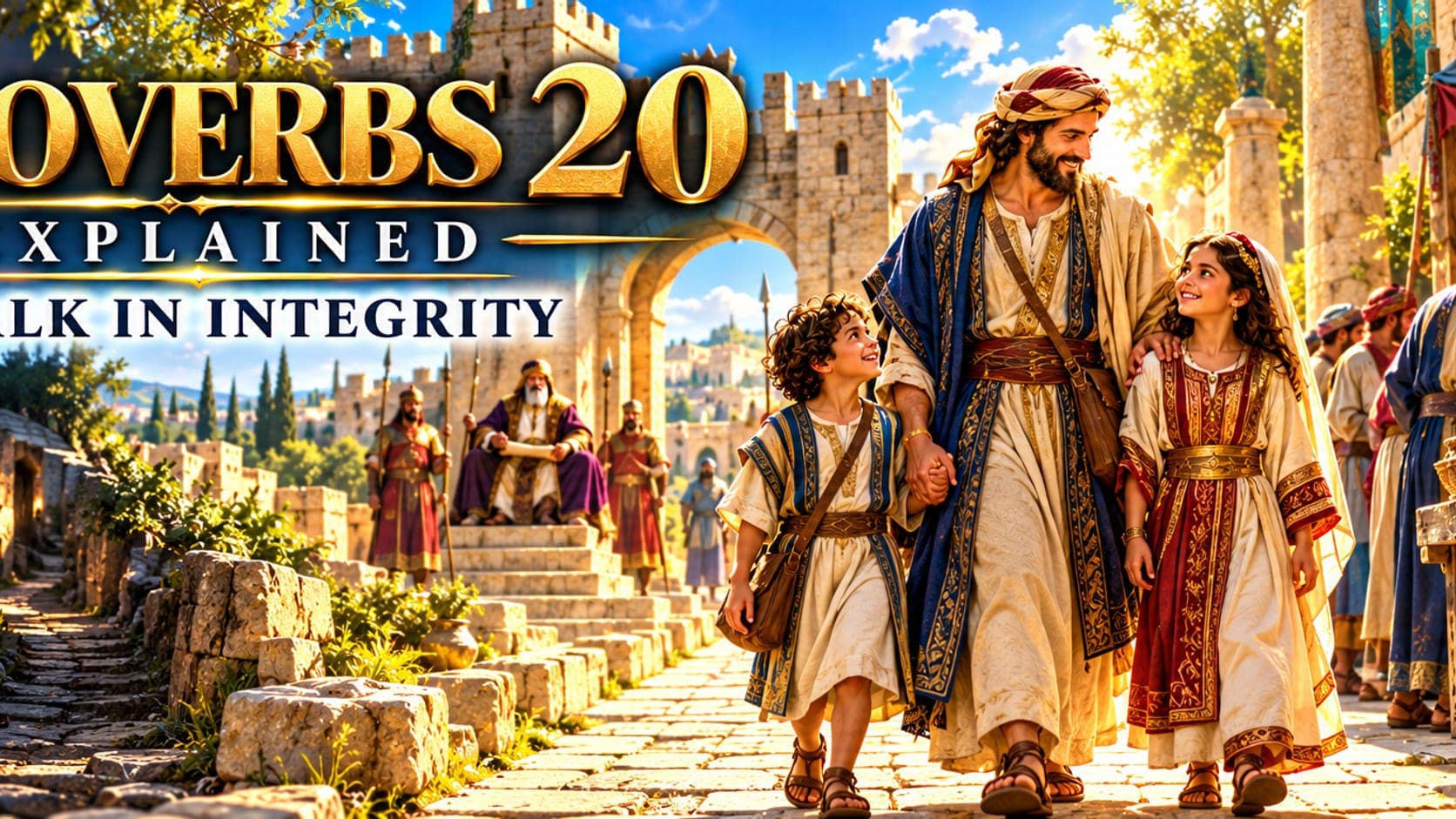
📖 Proverbs 20 Explained: The Candle of the LORD
You probably think you know your own heart. This chapter says otherwise.
Proverbs 20 explained is thirty verses that keep circling back to the same uncomfortable claim: a man cannot fully see himself, weigh himself, or clear himself. Wine fools the drinker, a buyer lies about the price while he is haggling, and a man who swears his own heart is clean is simply wrong. Only one set of eyes in this chapter actually sees straight through to the bottom.
Maybe you have been sure you were right about something, right up until the truth came out.
- ❓ Can anyone honestly say their own heart is clean, the way verse 9 asks?
- ❓ What does it mean to take someone's garment as a pledge in verse 16?
- ❓ Why such harsh language for cursing a parent in verse 20?
- ❓ What does Solomon mean calling the human spirit a candle in verse 27?
📌 Proverbs 20 names a heart, a set of scales, a king's motive, and a man's own road, and says the same thing about every one of them: you cannot fully judge it yourself.
This walkthrough goes through all thirty verses in the order Solomon set them down, grouped by what each cluster is actually testing: a king's anger and a sluggard's excuses, deep counsel and a rare faithful man, a clean heart no one can honestly claim, honest weights and an honest ear, the risk of standing surety, a cursed parent and a hasty inheritance, and finally the candle that searches every hidden room in a person.
Read it slowly. This chapter is less interested in your actions than in what is underneath them.
What Happened Just Before This Chapter
Proverbs 19 closed with judgment already prepared for scorners and stripes waiting for the back of fools. Proverbs 20 opens on a different kind of self-inflicted trouble, one that does not need a judge to hand it down.
"Wine is a mocker, strong drink is raging: and whosoever is deceived thereby is not wise."
The verse does not simply call drunkenness foolish. It calls the drink itself a mocker, something that makes a fool of the very person who thought he was in control of it. Nobody plans to be deceived. Verse 1 warns that this particular deception does not ask permission first.
Proverbs 20 Explained Verse by Verse
1. A King's Wrath, a Quiet Honor, and a Sluggard's Excuse (verses 2 to 4)
From a mocking drink, the chapter turns to a different danger: provoking the wrong person.
"The fear of a king is as the roaring of a lion: whoso provoketh him to anger sinneth against his own soul."
A king in Solomon's world held real power over life and property, so provoking one on purpose was not bravery. The verse calls it sin against your own soul, meaning the damage lands first and hardest on the person foolish enough to do the provoking.
"It is an honour for a man to cease from strife: but every fool will be meddling."
💡 Most cultures treat winning an argument as the honor. Verse 3 reverses it. Walking away from a fight is named the honorable move, while staying in it, meddling long after there was any reason to, is simply what a fool does by habit.
"The sluggard will not plow by reason of the cold; therefore shall he beg in harvest, and have nothing."
⚠️ The excuse sounds reasonable in the moment. Cold weather is a real discomfort, not an invented one. But the verse does not weigh the excuse against the comfort it bought. It weighs it against the harvest that never came, and a man begging for food he could have grown himself.
2. Deep Counsel, a Rare Faithful Man, and a Blessed Inheritance (verses 5 to 7)
The chapter moves from a frozen field to something buried deeper than any plow can reach.
"Counsel in the heart of man is like deep water; but a man of understanding will draw it out."
A deep well does not refuse water to everyone. It just requires a longer rope than most people bother to lower. Verse 5 pictures real counsel sitting far down in a person, reachable, but only by someone patient enough to actually draw it out instead of judging by whatever sits near the surface.
"Most men will proclaim every one his own goodness: but a faithful man who can find?"
📌 Notice the gap the verse points at. Announcing your own goodness costs nothing and nearly everyone does it. Actually being faithful, proving reliable over time rather than describing yourself that way, is rare enough that the verse treats finding one as a genuine search.
"The just man walketh in his integrity: his children are blessed after him."
Set right after verse 6, this reads like an answer to the question just asked. A faithful man is rare, but here is what he actually looks like: not a man who talks about integrity, but one who walks in it long enough that the blessing outlives him in his own children.
3. A King Who Sifts Evil, and a Clean Heart No One Can Claim (verses 8 and 9)
From a just man's walk, the chapter turns to a just man's seat, and then asks a question no one in the room can answer.
"A king that sitteth in the throne of judgment scattereth away all evil with his eyes."
A good king did not need to chase down every wrong in his kingdom personally. The verse pictures his presence on the bench alone doing real work, scattering what could not survive being looked at directly.
"Who can say, I have made my heart clean, I am pure from my sin?"
📌 The question is not rhetorical filler. It expects exactly one honest answer: nobody. Right after describing a king who can see through everyone else, the chapter turns the same question on the reader, and nobody in the room, including the king himself, gets to claim a clean exemption.
4. Honest Weights, a Child's Doings, and the Ear and Eye the LORD Made (verses 10 to 12)
The chapter moves from an unseen heart to something that was supposed to be checkable in the open: the marketplace scale.
"Divers weights, and divers measures, both of them are alike abomination to the LORD."
"Divers weights" means two different sets of stones used on the same scale, a heavier set for buying and a lighter one for selling, so every transaction quietly cheated whoever was on the other end. This book already named honest scales the LORD's own business in Proverbs 16, which called every weight in the bag his work. Verse 10 names the opposite practice for what it is.
"Even a child is known by his doings, whether his work be pure, and whether it be right."
💡 A cheating scale hides its true weight. A child, this verse says, does not hide nearly as well. Character shows up early and plainly in what a person actually does, long before age gives anyone the skill to disguise it the way a rigged scale can.
"The hearing ear, and the seeing eye, the LORD hath made even both of them."
A plain, short claim placed right in the middle of a chapter about dishonest scales and hidden hearts: the very organs a person uses to detect dishonesty were made by the one whose eyes see further than either of them ever will.
5. Sleep, Deceit, and the Risk of Standing Surety (verses 13 to 18)
Six verses in a row about things a person is tempted to do carelessly, until the cost actually lands.
"Love not sleep, lest thou come to poverty; open thine eyes, and thou shalt be satisfied with bread."
"It is naught, it is naught, saith the buyer: but when he is gone his way, then he boasteth."
⚠️ Verse 14 is a small, almost funny picture of ordinary dishonesty. The same man complains the goods are worthless while he is haggling, then brags about the deal the moment he is out of earshot. Nothing illegal happens here, just an everyday little lie nobody thinks to call one.
"There is gold, and a multitude of rubies: but the lips of knowledge are a precious jewel."
Gold and rubies were about as valuable as this culture could picture. The verse ranks them, then ranks something else above them entirely. What a knowledgeable person says is called rarer than a whole pile of the real jewels just mentioned.
"Take his garment that is surety for a stranger: and take a pledge of him for a strange woman."
📌 This is blunt, almost harsh-sounding advice, and it is aimed at the lender, not the fool. If someone was reckless enough to guarantee a stranger's debt, the kind of careless move Proverbs 17 already warned against, take his coat as collateral without hesitation, because a man that careless with his own future will not be careful with your money either.
"Bread of deceit is sweet to a man; but afterwards his mouth shall be filled with gravel."
Gain from a lie tastes good going down. The verse does not deny that. It simply tells you what is waiting on the other side of the sweetness, a mouthful of gravel where real bread should have been.
"Every purpose is established by counsel: and with good advice make war."
A closing line for this cluster that doubles as a warning about everything just listed. Careless words, careless deals, careless loans: none of them survive the discipline this verse recommends even for something as serious as going to war. Get counsel first.
6. A Talebearer, a Cursed Parent, and Vengeance Left to the LORD (verses 19 to 22)
From careless business, the chapter turns to careless speech, and then to a verse most readers wish was not in the Bible at all.
"He that goeth about as a talebearer revealeth secrets: therefore meddle not with him that flattereth with his lips."
A person who gossips about others will gossip about you the moment you are not in the room. The verse connects two habits that usually travel together, loose talk about others and smooth flattery to your face, and tells you to stay clear of both.
"Whoso curseth his father or his mother, his lamp shall be put out in obscure darkness."
⚠️ A lamp going out in total darkness was one of the bleakest images available to this culture, no household fire, no future, nothing left burning. The verse never explains how that darkness arrives. It simply names cursing a parent as the kind of wrong that ends in exactly that image, with no light left anywhere in the picture.
"An inheritance may be gotten hastily at the beginning; but the end thereof shall not be blessed."
Grabbing an inheritance early, by pressure, by impatience, or by cutting a parent out of the process entirely, produces money without producing blessing. The verse separates the two on purpose. Getting the funds and getting the favor are not the same event.
"Say not thou, I will recompense evil; but wait on the LORD, and he shall save thee."
Revenge promises a shortcut to justice. This verse closes the cluster by naming a slower path instead, handing the actual recompense to the LORD and waiting for him to act rather than acting first yourself.
7. False Balances, a Man's Own Way, and the Candle of the LORD (verses 23 to 30)
The chapter returns to the scale it raised in verse 10, then widens out to the last, deepest thing this chapter says the LORD alone can see.
"Divers weights are an abomination unto the LORD; and a false balance is not good."
📌 Verse 23 is nearly the same sentence as verse 10, thirteen verses earlier in this same chapter. Proverbs rarely circles back to its own wording this closely inside one chapter. Saying it twice, almost the same way, is the chapter insisting this particular dishonesty is serious enough to name more than once.
"Man's goings are of the LORD; how can a man then understand his own way?"
💡 This is the same conviction Proverbs 19 landed on when it said a man's own devices cannot outlast the LORD's counsel. Verse 24 pushes it one step further. A man cannot even fully understand his own way while he is walking it, let alone control where it leads.
"It is a snare to the man who devoureth that which is holy, and after vows to make enquiry."
A hard verse, treated more fully further down in Hard Questions. In short, it warns against making a vow quickly and only afterward stopping to ask what it is actually going to cost.
"A wise king scattereth the wicked, and bringeth the wheel over them."
An echo of verse 8, a king's presence doing real work against evil, now pictured as a threshing wheel that separated grain from husk. Wickedness under a wise king does not simply get noticed. It gets processed and removed.
"The spirit of man is the candle of the LORD, searching all the inward parts of the belly."
📌 Here is the verse the whole chapter has been building toward. A candle does not create what it reveals. It only exposes what was already sitting in the dark. The human spirit, this verse says, works the same way for the LORD, a light he placed inside a person that reaches rooms no amount of self examination from verse 9 could ever fully open alone.
"Mercy and truth preserve the king: and his throne is upholden by mercy."
"The glory of young men is their strength: and the beauty of old men is the grey head."
Two different seasons of life, each given its own honor rather than being measured against the other. Strength is not called better than grey hair, and grey hair is not called a consolation prize. Each one simply gets named for what it actually is.
"The blueness of a wound cleanseth away evil: so do stripes the inward parts of the belly."
The chapter closes on a hard, physical picture. Sometimes a real consequence, something that actually marks a person, reaches a stubborn heart in a way words alone never did. The verse is not celebrating pain. It is naming what it can occasionally accomplish when nothing gentler has worked.
Hard Questions Proverbs 20 Raises
Does verse 9 mean no one can ever have a clean heart before God? Taken on its own in the Old Testament, the question expects the answer nobody, and 1 John later agrees from the other side of the cross.
"If we say that we have no sin, we deceive ourselves, and the truth is not in us."
The very next verse in John's letter is where the real answer to Proverbs 20:9 finally shows up: confession, not self-declared purity, is what actually cleanses. The question in Proverbs stands unanswered for nine hundred years, waiting for a solution outside of simply trying harder to be clean.
What does it mean to take a garment as surety for "a strange woman" in verse 16? "Strange" here means outside your own household or covenant, a foreigner or a woman with no legitimate claim on the arrangement. The verse is not making a statement about women generally. It is warning a lender that guaranteeing a debt tied to someone entirely outside your normal responsibility is exactly the kind of reckless deal Proverbs 17 already called a mark of a man who has not thought things through, and tells the lender to collect collateral without delay.
Why such severe language about cursing a parent in verse 20? Mosaic law treated this as a capital offense, not a figure of speech.
"And he that curseth his father, or his mother, shall surely be put to death."
Proverbs 20:20 is not softening that law into a metaphor. It is applying the same weight in wisdom language, a lamp snuffed out in total darkness, to make the stakes felt rather than simply recited. The honor owed to parents sat near the center of this culture's whole moral order, and both passages treat an attack on it as something that reaches all the way to the roots.
What does verse 25 mean about devouring that which is holy and asking afterward? It pictures someone making a vow to God quickly, maybe even eagerly, and only later stopping to count what fulfilling it will actually cost. Ecclesiastes makes the same warning from the opposite direction.
"Better is it that thou shouldest not vow, than that thou shouldest vow and not pay."
Both passages agree on the same fix. Count the cost before you speak the vow, not after, because a promise made to God is a snare the moment it is made carelessly and only questioned once it is already binding.
Practical Tips From Proverbs 20
Thirty verses, most of them aimed at something you can actually check against your own week.
- Walk away from the argument you do not need to win. Verse 3 calls that an honor, not a retreat. Let the fool keep meddling without you.
- Stop excusing the work you are avoiding. Verse 4 names the sluggard's cold weather for what it is, a reasonable-sounding excuse that still ends in an empty harvest.
- Stop declaring your own goodness and start proving your faithfulness. Verse 6 says the second one is rare precisely because the first one is so easy.
- Drop the question verse 9 asks, and stop trying to answer it yourself. No one gets to claim a clean heart on their own authority. Bring the real one to God instead of performing one for everyone else.
- Count the real cost before you promise anything. Verse 25 warns against vowing first and counting later. Decide what a commitment actually requires before your mouth commits you to it.
- Get counsel before the decision, not after. Verse 18 says even war plans need good advice first. Your smaller decisions deserve the same discipline.
- Let verse 27 change how you think about being alone. You are never actually unsupervised. The light searching your own inward parts was placed there on purpose.
Top 5 Bible Verses From Proverbs 20
1. Proverbs 20:27
"The spirit of man is the candle of the LORD, searching all the inward parts of the belly."
The verse the whole chapter has been building toward. A light placed inside a person, reaching rooms no self examination alone could ever fully open.
2. Proverbs 20:9
"Who can say, I have made my heart clean, I am pure from my sin?"
A question with exactly one honest answer, asked centuries before the New Testament finally supplies the real fix for it.
3. Proverbs 20:1
"Wine is a mocker, strong drink is raging: and whosoever is deceived thereby is not wise."
A warning about deception nobody plans to fall for, opening a chapter that never stops naming what a person cannot see clearly on their own.
4. Proverbs 20:24
"Man's goings are of the LORD; how can a man then understand his own way?"
A sober limit on how well anyone, including the person living it, can actually read their own path while they are still walking it.
5. Proverbs 20:6
"Most men will proclaim every one his own goodness: but a faithful man who can find?"
The gap between what people say about themselves and what they actually prove over time, named plainly in one short question.

Frequently Asked Questions About Proverbs 20
What is Proverbs 20 about?
It continues the book's collection of short, stand alone sayings, mostly testing how well a person can actually see and judge themselves: their own heart, their own scales, their own way, and their own excuses, against the LORD who alone sees all of it clearly.
What does "wine is a mocker" mean in Proverbs 20:1?
It means strong drink makes a fool of the very person who thought he had it under control. The verse is less interested in condemning the drink itself than in warning how easily it deceives someone who assumed he was the one in charge.
What does Proverbs 20:9 mean, "who can say I have made my heart clean"?
It is a question with one honest answer: no one. Nobody can honestly claim to have purified their own heart or cleared themselves from sin by their own effort, a problem 1 John 1:9 later answers with confession rather than self-declared innocence.
What does "divers weights" mean in Proverbs 20:10 and 23?
It means keeping two different sets of weighing stones, a heavier set for buying and a lighter one for selling, so the same scale cheats whoever is on the other side of the deal. The chapter names this twice, thirteen verses apart, because it takes the dishonesty that seriously.
What does Proverbs 20:27 mean about the spirit being the candle of the LORD?
It pictures the human spirit as a light the LORD placed inside a person specifically to search the inward parts, the motives and intentions a person might hide even from themselves. A candle does not create what it finds. It only exposes what was already there in the dark.
What does it mean to take a garment as surety in Proverbs 20:16?
It means collecting a coat as collateral from someone who recklessly guaranteed a stranger's debt. The verse is advice to the lender, not a statement about the borrower's character alone: secure something real now, because a man careless enough to make that promise will likely be careless about keeping it too.
Does Proverbs 20:20 mean cursing your parents deserves the death penalty?
Exodus 21:17 did make this a capital offense under Mosaic law. Proverbs 20:20 is not issuing a separate legal ruling, but applying the same seriousness in the language of wisdom, a lamp going out in total darkness, to make sure the weight of the command is actually felt, not just filed away as a technical rule.
What does Proverbs 20:24 mean, "how can a man understand his own way"?
It means a person's own path is governed by the LORD in ways that outrun that person's own understanding of it, even while they are the one walking it. It echoes Proverbs 19:21, which already said a man's own plans cannot outlast the LORD's counsel.
Does Proverbs 20:30 endorse physical punishment?
The verse observes that a real, physical consequence sometimes reaches a hardened person in a way words never could, "the inward parts of the belly" meaning it changes something deeper than the surface. It is describing what a hard consequence can accomplish on a stubborn heart, not issuing a general command for how every wrong should be addressed.
What is the main lesson of Proverbs 20?
That a person cannot fully see or judge their own heart, their own gains, or their own path, and that the LORD who made the ear and the eye is also the one whose light searches every inward part a person cannot search alone.
Final Thoughts
Proverbs 20 keeps asking the same question in different costumes: can you actually see yourself clearly?
📌 No one gets to declare their own heart clean. Verse 9 asks the question and leaves no honest answer except nobody.
📌 What you cannot see yourself, the LORD still searches. Verse 27 names the human spirit itself as the candle he uses to do it.
📌 Honest weights, honest words, and an honest heart all answer to the same standard. Verse 23 repeats verse 10 on purpose, because this chapter will not let dishonesty hide behind a single mention.
So here is your one next step.
Stop trying to clear your own heart the way verse 9 says you cannot, and let the candle of verse 27 find whatever you have been keeping in the dark.
That light was placed there to be used, not avoided.