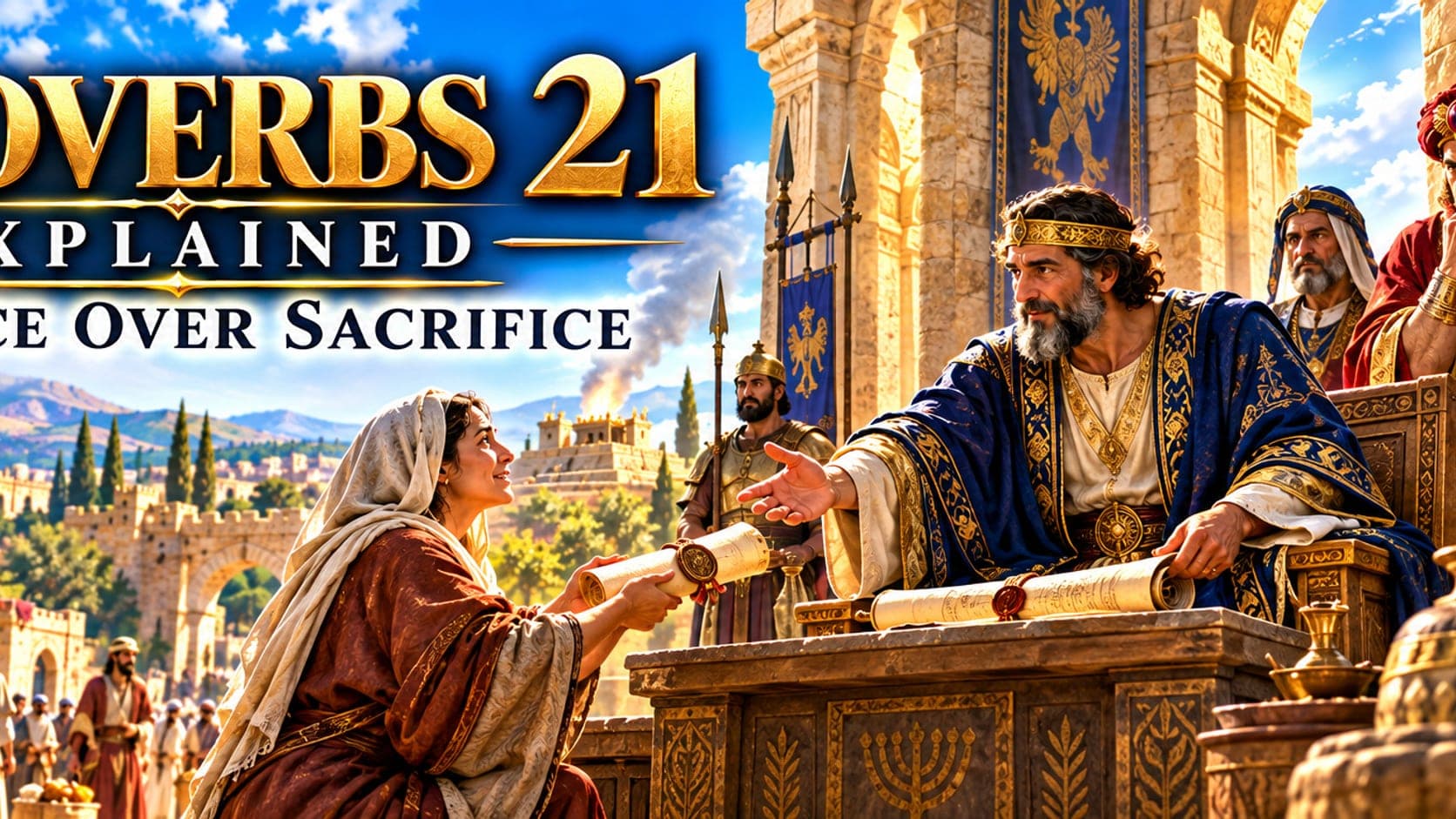
📖 Proverbs 21 Explained: The King's Heart and the LORD Who Weighs It
A king thinks he rules his own kingdom. This chapter says someone else is steering him.
Proverbs 21 explained is thirty one verses that keep circling back to one claim: you may feel certain your own way is right, but the LORD is the one weighing hearts, directing kings, and deciding what actually counts as safety. Twice in this chapter, ten verses apart, Solomon pictures the exact same choice, a cramped corner of a roof or an empty stretch of wilderness, each one weighed against a house ruled by a woman who will not stop fighting.
Maybe you have been so sure your own plan was right, right up until it was not.
- ❓ What does it mean that the king's heart is "in the hand of the LORD"?
- ❓ Why does Solomon mention the same quarrelsome woman twice in one chapter?
- ❓ What does it mean that "the wicked shall be a ransom for the righteous" in verse 18?
- ❓ Is verse 31 saying there is no point preparing for anything?
📌 Proverbs 21 names a king's heart, a lying tongue, a stopped ear, and a war horse, and says the same thing about every one of them: the LORD is already governing what you think only you control.
This walkthrough goes through all thirty one verses in the order Solomon set them down, grouped by what each cluster is actually testing: a king's heart and the heart the LORD weighs, diligence against a lying tongue, a housetop corner against a brawling woman, joy in judgment against the congregation of the dead, a city scaled by wisdom against a slothful man's own greed, and finally a false witness against the safety that belongs only to the LORD.
Read it slowly. More than one of these verses will land closer to your own plans than you expect.
What Happened Just Before This Chapter
Proverbs 20 ended with a candle: the human spirit as a light the LORD uses to search every hidden room in a person. Proverbs 21 opens by turning that same searching light on the most powerful person in the room, a king.
"The king's heart is in the hand of the LORD, as the rivers of water: he turneth it whithersoever he will."
A river in this part of the world did not run wherever it pleased. Farmers cut small channels to direct water exactly where a field needed it, and the water had no say in the matter. Verse 1 says a king's heart, the one heart in the kingdom that answered to no one else, still moves exactly like that water in the LORD's hand.
Proverbs 21 Explained Verse by Verse
1. The King's Heart, and a Heart the LORD Weighs (verses 1 to 4)
From the one heart no one else can command, the chapter turns to a claim about every heart in the room.
"Every way of a man is right in his own eyes: but the LORD pondereth the hearts."
📌 Nobody wakes up planning to do wrong. That is exactly the problem verse 2 names. A person's own judgment of their own motives is the least reliable measure available, because it is the one measure that already agrees with whatever they already decided to do. The LORD's weighing is the only scale in the room that is not rigged by the person standing on it.
Verse 3 then names what that weighing is actually looking for.
"To do justice and judgment is more acceptable to the LORD than sacrifice."
This is not Solomon dismissing worship. It is Solomon ranking it. A sacrifice could be brought by someone who had cheated a neighbor an hour earlier. Doing justice cannot be faked the same way, because it costs something real to the person doing it, in a way that bringing an animal to the altar does not.
"An high look, and a proud heart, and the plowing of the wicked, is sin."
⚠️ The surprise in this verse is the last item. A high look and a proud heart sound like sins already. "The plowing of the wicked" does not sound like one at all; plowing is just farm work. Verse 4 names it as sin anyway, because the point is not the plowing itself, it is whose hands are doing it and what heart is behind the plow. Ordinary, honest looking work is not automatically clean work.
2. Diligence, a Lying Tongue, and a Robber's Own Trap (verses 5 to 8)
From a plow in the wrong hands, the chapter moves to two different ways of getting ahead.
"The thoughts of the diligent tend only to plenteousness; but of every one that is hasty only to want."
"The getting of treasures by a lying tongue is a vanity tossed to and fro of them that seek death."
💡 "Vanity" here means a vapor, something that looks like it has weight and is gone the moment you try to hold it. Wealth gained by lying is pictured as exactly that, tossed back and forth like fog in the wind, belonging to no one for long. This verse is worth sitting with longer; it gets the full treatment further down in Hard Questions.
"The robbery of the wicked shall destroy them; because they refuse to do judgment."
A robber plans for the theft. He rarely plans for what the theft does to him afterward. Verse 7 says the very thing he stole with becomes the thing that destroys him, not as poetic justice from outside, but as the direct result of a life built on refusing to do what is right.
"The way of man is froward and strange: but as for the pure, his work is right."
"Froward" means stubborn and twisted, bent away from the straight path on purpose. The verse closes this cluster with a plain contrast: one path is crooked by nature, the other is simply right, and nothing in between is on offer.
3. A Housetop Corner, a Stopped Ear, and a Secret Gift (verses 9 to 14)
The chapter now gives its first picture of the brawling woman it will repeat later.
"It is better to dwell in a corner of the housetop, than with a brawling woman in a wide house."
Flat rooftops in this culture were real living space, but a corner of one is cramped, exposed to weather, and nobody's idea of comfort. Verse 9 ranks it above a wide, comfortable house anyway, because the house comes with constant fighting attached to it. Square footage was never the thing actually being measured.
Proverbs 17 already made the same trade with a dry crust of bread instead of a rooftop corner: a dry morsel with quiet beats a house full of feasting with strife. Verse 9 is that same bargain, just priced in square feet instead of meals.
"The soul of the wicked desireth evil: his neighbour findeth no favour in his eyes."
"When the scorner is punished, the simple is made wise: and when the wise is instructed, he receiveth knowledge."
Two very different people learn two very different ways. The simple person needs to watch someone else pay a price before the lesson lands. The wise person can simply be told. Verse 11 is not flattering the wise; it is just naming how much cheaper their education turns out to be.
"The righteous man wisely considereth the house of the wicked: but God overthroweth the wicked for their wickedness."
"Whoso stoppeth his ears at the cry of the poor, he also shall cry himself, but shall not be heard."
📌 This verse is a mirror, not just a warning. It does not say the person who ignores the poor will simply be punished some other way. It says the exact same thing will happen to them: a cry that goes nowhere, into an ear that has stopped listening. Whatever you refuse to hear now is modeling what you can expect to receive later.
"A gift in secret pacifieth anger: and a reward in the bosom strong wrath."
This proverb describes how anger actually behaves among people, a private gift can cool even strong wrath, rather than commanding that bribery is right. Read next to verse 13, it draws a line: generosity that opens an ear is commended; a bribe that closes a judge's eyes is condemned elsewhere in this same book. The method looks similar. The purpose behind it is not.
4. Joy, Judgment, and the Congregation of the Dead (verses 15 to 20)
The chapter widens from one stopped ear to a whole way of living, and names where that way ends.
"It is joy to the just to do judgment: but destruction shall be to the workers of iniquity."
"The man that wandereth out of the way of understanding shall remain in the congregation of the dead."
⚠️ "The congregation of the dead" is one of the bleaker pictures in this book, a gathering you join simply by wandering off the path, not by any single dramatic sin. Nobody plans to end up there. Verse 16 says the drifting itself, left uncorrected, is enough to arrive.
"He that loveth pleasure shall be a poor man: he that loveth wine and oil shall not be rich."
"The wicked shall be a ransom for the righteous, and the transgressor for the upright."
This strange trade gets its full explanation further down in Hard Questions. In short, it is not a statement about the cross; it is Solomon noticing a pattern, trouble meant for the righteous has a way of landing on the wicked instead.
"It is better to dwell in the wilderness, than with a contentious and an angry woman."
📌 Here is the second half of the pairing the chapter opened with in verse 9. A rooftop corner traded empty wilderness this time, but the other side of the scale has not moved at all: constant conflict still outweighs any amount of comfortable walls around it. Solomon rarely repeats a point this closely within one chapter, which is its own signal that he thought it needed saying twice.
"There is treasure to be desired and oil in the dwelling of the wise; but a foolish man spendeth it up."
The same house, stocked the same way, produces opposite results depending on who lives in it. Wisdom keeps what it is given. Folly spends it faster than it ever arrives.
5. Scaling a City, and a Slothful Man's Own Desire (verses 21 to 26)
From a house that cannot keep its own treasure, the chapter turns to what actually finds life.
"He that followeth after righteousness and mercy findeth life, righteousness, and honour."
"A wise man scaleth the city of the mighty, and casteth down the strength of the confidence thereof."
A fortified city trusted its walls. Verse 22 pictures one wise man taking it anyway, not through more soldiers or a bigger ram, but through wisdom outmaneuvering whatever the defenders were confident in. The city does not fall because it was weak. It falls because its confidence was misplaced.
"Whoso keepeth his mouth and his tongue keepeth his soul from troubles."
"Proud and haughty scorner is his name, who dealeth in proud wrath."
"The desire of the slothful killeth him; for his hands refuse to labour."
💡 Notice what actually kills the sluggard in verse 25. It is not laziness as an abstract flaw. It is his own desire, wanting results his hands refuse to work for. The gap between what he wants and what he will do for it is the thing that finally destroys him.
"He coveteth greedily all the day long: but the righteous giveth and spareth not."
Two full days, lived back to back. One spent entirely wanting more. The other spent giving without holding back. Verse 26 puts them side by side and lets the contrast make its own case.
6. A False Witness, and the Safety That Belongs to the LORD (verses 27 to 31)
The chapter closes by circling back to where it started: who is actually in control.
"The sacrifice of the wicked is abomination: how much more, when he bringeth it with a wicked mind?"
Verse 3 already ranked justice above sacrifice. Verse 27 goes further: a sacrifice from a wicked person is not neutral, it is offensive, and worse still when the person bringing it knows exactly what they are doing.
"A false witness shall perish: but the man that heareth speaketh constantly."
"A wicked man hardeneth his face: but as for the upright, he directeth his way."
A hardened face is a face set to not be moved, not by correction, not by truth, not by anyone. The upright person's face is not mentioned at all; instead, what gets named is a direction. One person is frozen in place. The other is actually going somewhere.
"There is no wisdom nor understanding nor counsel against the LORD."
"The horse is prepared against the day of battle: but safety is of the LORD."
📌 The chapter that opened with a king's heart in the LORD's hand closes with a war horse in the same hand. A trained horse was the best military technology this culture owned. Verse 31 does not say the horse is useless; armies still prepared one. It says the actual safety at the end of the battle was never the horse's to give.

Hard Questions Proverbs 21 Raises
What does verse 6 mean, riches by a lying tongue are "a vanity tossed to and fro of them that seek death"? The first half is the easier part: wealth built on lies has no real weight, it is vapor, a thing that drifts rather than something solid you can keep. The second half is harder, and the honest answer is that the Hebrew here is genuinely difficult, which is why older and newer translations render it slightly differently. The main idea that survives across them is this: chasing gain through deceit does not just risk losing the money. It puts a person on a path where death, not wealth, is what is actually being pursued, whether they realize it or not.
What does verse 18 mean, "the wicked shall be a ransom for the righteous"? This is not describing substitutionary atonement the way Christ's death is described in the New Testament. It is Solomon naming a pattern he had watched play out: trouble aimed at a righteous person sometimes lands on a wicked one instead, as if the wicked person's own schemes paid the price that was coming for someone else. Esther's book is the clearest Old Testament picture of this exact shape, a death sentence built for one man ending up on the very gallows he built.
Why does Solomon repeat the brawling woman in verses 9 and 19? Proverbs rarely circles back to nearly the same wording twice in one chapter, so when it does, the repetition is the point. A cramped rooftop and an empty wilderness are two different pictures of the same bottom line: no amount of comfort, space, or supply makes constant conflict worth staying for.
Is verse 31 saying preparation itself is pointless? No. Soldiers still trained the horse, and Scripture elsewhere praises wise preparation. The verse is narrower than that: it ranks where real safety actually comes from. Prepare the horse. Just do not mistake the horse for the source of the safety it helps carry.
Practical Tips From Proverbs 21
Thirty one verses, most of them aimed at something you can check against your own week.
- Stop trusting your own read of your own motives. Verse 2 says every way looks right to the person walking it. Ask someone who loves you enough to tell you the truth.
- Let justice cost you something before you call it worship. Verse 3 ranks doing right above bringing a gift. Make the hard phone call before you make the donation.
- Question the shortcut before it becomes a habit. Verse 6 calls fast money built on lies a vapor. Read what the Bible actually says about wanting money before that vapor turns into your own plan.
- Pick the quiet corner over the comfortable fight. Verses 9 and 19 say it twice on purpose. Peace is worth more square footage than you think.
- Build the habit verse 23 names before you need it. Learning real self control now is cheaper than the trouble a loose tongue causes later.
- Name the gap between your wants and your work. Verse 25 says desire without labor is what actually kills the sluggard, not the desire alone.
- Prepare the horse, but trust the LORD for the battle. Verse 31 is not against planning. It is against putting your final confidence in the plan instead of in Him.
Top 5 Bible Verses From Proverbs 21
1. Proverbs 21:1
"The king's heart is in the hand of the LORD, as the rivers of water: he turneth it whithersoever he will."
The most powerful heart in the kingdom still answers to a hand above it. Whatever power you are watching nervously this week answers to that same hand.
2. Proverbs 21:3
"To do justice and judgment is more acceptable to the LORD than sacrifice."
A ranking, not a rejection of worship. What you do for someone else this week outweighs what you bring to the altar on Sunday.
3. Proverbs 21:13
"Whoso stoppeth his ears at the cry of the poor, he also shall cry himself, but shall not be heard."
A mirror, not a punishment handed down from outside. Whatever cry you refuse to hear now is the pattern you are teaching the world to use on you later.
4. Proverbs 21:23
"Whoso keepeth his mouth and his tongue keepeth his soul from troubles."
A small discipline with an outsized payoff. Most of the trouble you will face this month arrives through your own mouth first.
5. Proverbs 21:31
"The horse is prepared against the day of battle: but safety is of the LORD."
The closing word of the chapter, and its whole argument in one line. Prepare everything you can. Trust something bigger than the preparation.
Frequently Asked Questions About Proverbs 21
What is Proverbs 21 about?
It is a collection of short, stand alone sayings built around one repeated claim: a person's own sense of being right, even a king's, does not settle the matter. The LORD weighs hearts, directs kings, and decides what counts as real safety.
What does "the king's heart is in the hand of the LORD" mean in Proverbs 21:1?
It pictures a king's heart being directed the way a farmer directs a stream of water into a field, fully under someone else's control even though the king himself answered to no human authority. Whatever power looks unaccountable to you is still accountable to the LORD.
What does Proverbs 21:3 mean, "to do justice and judgment is more acceptable than sacrifice"?
It ranks treating people rightly above bringing an offering, because justice costs the one doing it in a way a sacrifice does not always require. It is not dismissing worship, only refusing to let worship substitute for it.
What does Proverbs 21:6 mean about riches gotten by a lying tongue?
It pictures wealth gained through deceit as a vapor, something that looks solid and is gone the moment it is grasped. The verse's second half is genuinely difficult in the original language, but it warns that the pursuit itself leads toward death, not just toward disappointment.
Why does Proverbs 21 mention a brawling woman in both verse 9 and verse 19?
The repetition, close in wording and only ten verses apart, is Solomon's way of underlining a point he thought was worth saying twice: ongoing conflict in a home outweighs any amount of space, comfort, or supply that home can offer.
What does Proverbs 21:18 mean, "the wicked shall be a ransom for the righteous"?
It is not describing the cross. It is naming a pattern Solomon had observed, where trouble meant for a righteous person ends up landing on a wicked one instead, often through the wicked person's own scheming. Esther's story is the clearest biblical example of exactly this shape.
What does the congregation of the dead mean in Proverbs 21:16?
It pictures the end point of simply wandering off the path of understanding, no single dramatic sin required. Drifting, left uncorrected, is enough on its own to arrive there.
What does Proverbs 21:30 mean, "there is no wisdom nor understanding nor counsel against the LORD"?
It means no human plan, however clever, ultimately outlasts what the LORD has determined. It sets up the final verse of the chapter, where even a trained war horse cannot supply the safety only He can give.
Is Proverbs 21:31 against preparing for difficult things?
No. The horse was still prepared, and Scripture elsewhere commends wise preparation. The verse simply ranks where real safety actually comes from, refusing to let good preparation get mistaken for the source of the outcome.
Does Proverbs 21:14 endorse bribery?
It describes how anger actually behaves, a private gift can cool even strong wrath, rather than issuing a moral command to bribe people. Read next to verse 13's warning about ignoring the poor, the chapter clearly commends generosity that opens ears, not payoffs that close them.
What is the main lesson of Proverbs 21?
That the LORD governs what feels entirely under human control, a king's heart, a person's own sense of being right, even the outcome of a battle, and that real safety, real wisdom, and real judgment ultimately trace back to Him rather than to human confidence.
Final Thoughts
Proverbs 21 keeps aiming at the same target from different angles: who is actually steering?
📌 Your own certainty is not the final word. Verse 2 says every way looks right to the person walking it, which is exactly why it needs checking against something outside yourself.
📌 Peace is worth more than the space you give up for it. Verses 9 and 19 say the same thing twice because it is easy to forget once.
📌 Prepare everything you can, then trust what you cannot control. Verse 31 closes the chapter by refusing to let a war horse take credit for a safety that was never its to give.
So here is your one next step.
Name one place this week where you have been trusting your own preparation the way verse 31 warns against, and hand the actual outcome back to the LORD.
The horse still gets prepared. The safety was always coming from somewhere else.