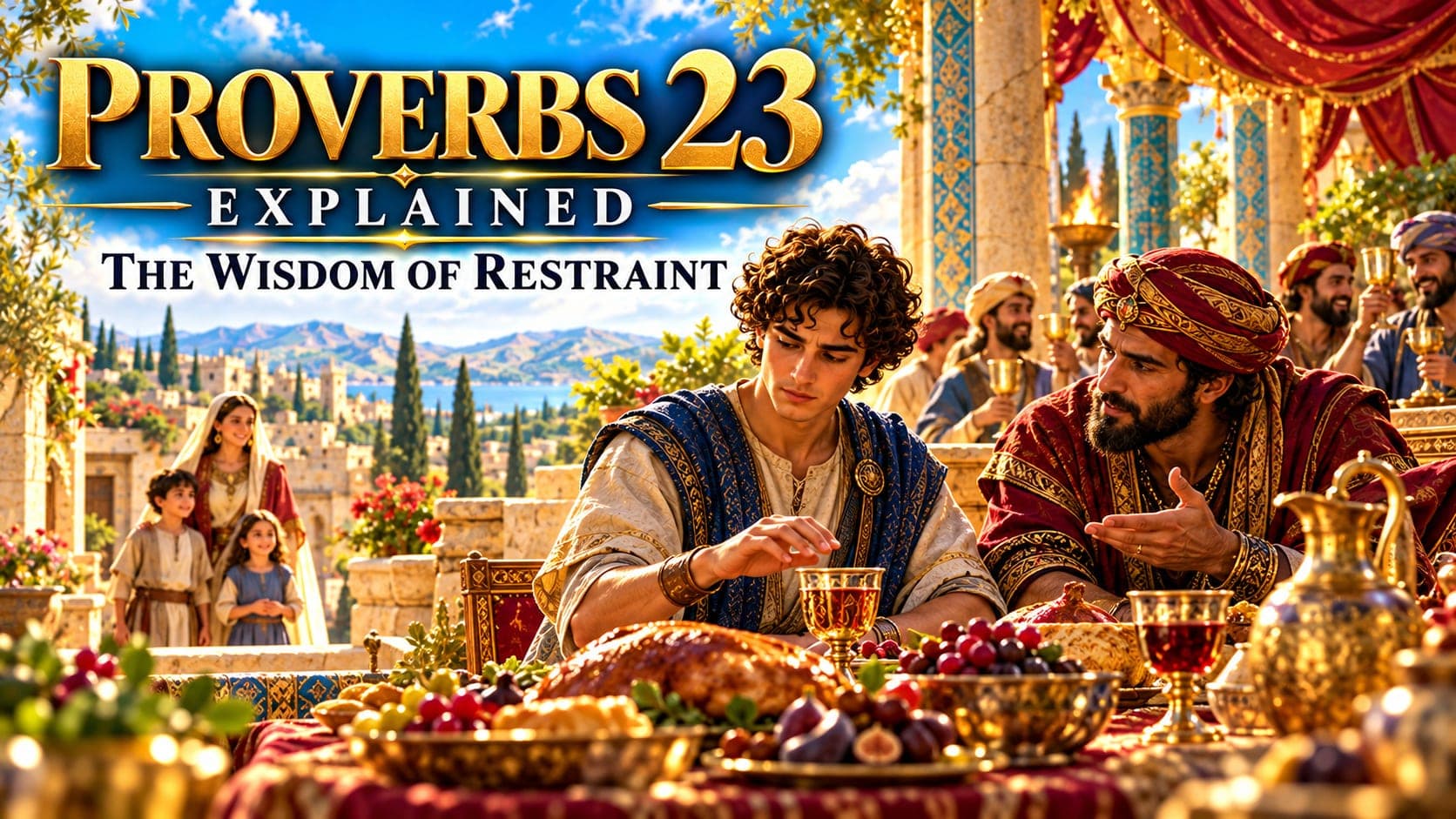
📖 Proverbs 23 Explained: The Wine That Bites Like a Serpent
You sit down at a powerful man's table and he hands you something sweet. The next verse tells you to put a knife to your own throat.
Proverbs 23 explained is thirty five verses that move from a dinner table to a courtroom, from a child under correction to a father bursting with pride, and finally into the longest, most physical description of drunkenness anywhere in this book. Solomon keeps asking what you are actually feeding yourself, food, money, words, wine, and whether you are swallowing something that will come back up.
Maybe you have taken something that looked good going down and felt sick about it later.
- ❓ Why does Solomon tell you to put a knife to your own throat in verse 2?
- ❓ Does verse 13 really tell parents to beat a child with a rod?
- ❓ What does it mean that correction will "deliver his soul from hell"?
- ❓ Is verse 31 a command never to drink wine at all?
📌 Proverbs 23 keeps returning to one test: does the thing in front of you hold up once you have actually swallowed it, or does it fly away, turn to poison, or bite back like a snake?
This walkthrough goes through all thirty five verses in the order Solomon set them down, grouped by what each cluster is actually weighing: self control at a ruler's table against riches that grow wings, a stingy host's bread against words wasted on a fool, an ancient landmark and a fatherless child against a rod that saves a son from ruin, a father's joy against envy you must starve, winebibbers and honoring your parents against truth worth buying, and finally a deep ditch against a drunkard who cannot stay awake to his own danger.
Read it slowly. More than one of these verses asks what you reached for the last time something looked good.
What Happened Just Before This Chapter
Proverbs 22 closed on a diligent man standing before kings. Proverbs 23 opens with that exact scene, except now you are the one sitting across from someone powerful, and the chapter wants to know what you do with your own appetite once you are there.
"When thou sittest to eat with a ruler, consider diligently what is before thee: And put a knife to thy throat, if thou be a man given to appetite."
The knife is not a literal instruction. It is the sharpest image in the chapter for self control, a graphic way of saying cut off the appetite before it embarrasses you or obligates you to someone who does not have your good in mind.
Proverbs 23 Explained Verse by Verse
1. Self Control at a Ruler's Table, and Riches With Wings (verses 3 to 5)
From the knife at your own throat, the chapter explains exactly what it is protecting you from.
"Be not desirous of his dainties: for they are deceitful meat."
📌 "Deceitful meat" is the key phrase. The food on a ruler's table is not poisoned, it is political. Accepting it can quietly cost you an independence you did not know you were trading away.
"Labour not to be rich: cease from thine own wisdom. Wilt thou set thine eyes upon that which is not? for riches certainly make themselves wings; they fly away as an eagle toward heaven."
💡 From a dangerous dinner to a dangerous chase. Riches are not condemned here, labouring for them as the goal of your own cleverness is. The picture is deliberately absurd, money sprouting wings and flying off like a bird the instant you think you have caught it. What you worked to grip does not stay gripped.
Wanting money is not automatically sinful, but verse 4 is specific about what is: leaning on your own wisdom to get it, as if you could outsmart how uncertain riches actually are.
2. The Stingy Host, and Words Wasted on a Fool (verses 6 to 9)
The chapter returns to a table, but this time the danger is the host himself.
"Eat thou not the bread of him that hath an evil eye, neither desire thou his dainty meats: For as he thinketh in his heart, so is he: Eat and drink, saith he to thee; but his heart is not with thee."
📌 Verse 7 is one of the most quoted lines in Proverbs, and it is almost always quoted out of its own context. It gets used as a general line about positive thinking shaping your identity. Here it is doing something narrower and sharper: describing a host whose hospitality is only skin deep. His mouth says "eat," but what he actually thinks about you, stingy, calculating, unwilling, is the truer measure of the man, not his words at the table.
"The morsel which thou hast eaten shalt thou vomit up, and lose thy sweet words."
Once you realize what the meal actually cost you, even the polite compliments you offered your host come back up with it. Nothing about the evening was free.
"Speak not in the ears of a fool: for he will despise the wisdom of thy words."
⚠️ A short, blunt close to the cluster. Wisdom offered to someone who has already decided to scorn it is not wasted because the wisdom was weak, it is wasted because the ears receiving it were never open.
3. The Landmark, the Fatherless, and the Rod That Saves a Child (verses 10 to 14)
Proverbs 22 already warned against moving an ancient landmark. Here the warning returns, aimed at the one group with no one else to defend their land.
"Remove not the old landmark; and enter not into the fields of the fatherless: For their redeemer is mighty; he shall plead their cause with thee."
A fatherless child in this culture had no family elder to argue a property line in the gate. Verse 11 says that gap is not actually empty. Their redeemer, a legal term for the family member obligated to defend them, is described as mighty enough to plead the case himself when no human relative will.
"Apply thine heart unto instruction, and thine ears to the words of knowledge."
A single verse pivots from defending the fatherless to training a child, and the next two verses explain exactly what that training looks like when it is resisted.
"Withhold not correction from the child: for if thou beatest him with the rod, he shall not die. Thou shalt beat him with the rod, and shalt deliver his soul from hell."
⚠️ This is the hardest pair of verses in the chapter, and it deserves more than a quick read. What the words themselves claim, and what Christians today do and do not take from them, are addressed fully in Hard Questions below.
4. A Father's Joy, and the Envy You Must Starve (verses 15 to 18)
From the hardest verses in the chapter, Solomon pivots to the reward correction is actually aimed at.
"My son, if thine heart be wise, my heart shall rejoice, even mine. Yea, my reins shall rejoice, when thy lips speak right things."
💡 The correction in verses 13 and 14 was never the point of the relationship, this is. A wise heart in the child produces real, physical joy in the father, named twice over, heart and reins, the innermost parts of a man moved by his son's growth.
"Let not thine heart envy sinners: but be thou in the fear of the LORD all the day long. For surely there is an end; and thine expectation shall not be cut off."
📌 Envy is named as a heart problem, not just a thought. Watching sinners seem to get away with it is one of the oldest tests of faith in Scripture. The answer is not to argue yourself out of what you are seeing, it is to stay in the fear of the LORD long enough to reach the end the verse promises, an end envy can never see from where it is standing.
5. Winebibbers, Honoring Your Parents, and Buying the Truth (verses 19 to 25)
A direct appeal opens this cluster, "hear thou, my son," the second of three times this chapter addresses the reader by that name.
"Hear thou, my son, and be wise, and guide thine heart in the way. Be not among winebibbers; among riotous eaters of flesh: For the drunkard and the glutton shall come to poverty: and drowsiness shall clothe a man with rags."
Drunkenness and gluttony are paired on purpose, both are appetite given the final word over judgment. Verse 21 does not threaten a dramatic ruin, it describes a slow one, poverty arriving through drowsiness, one missed morning at a time.
"Hearken unto thy father that begat thee, and despise not thy mother when she is old."
"Buy the truth, and sell it not; also wisdom, and instruction, and understanding."
📌 Verse 23 is the hinge of the whole chapter. Everything else here, dainties, riches, wine, a fool's scorn, is something you are warned not to grasp at. Truth is the one thing Solomon tells you to spend everything on and never let go of again, once it is actually yours.
"The father of the righteous shall greatly rejoice: and he that begetteth a wise child shall have joy of him. Thy father and thy mother shall be glad, and she that bare thee shall rejoice."
Rejoicing shows up four separate times across this chapter, and two of those four sit right here, back to back. Buying the truth is not only your own gain. It becomes a joy your own parents get to share in.
6. Give Me Thine Heart: The Deep Ditch and the Drunkard Who Cannot Wake Up (verses 26 to 35)
The chapter's third and final "my son" appeal opens its longest, most vivid section.
"My son, give me thine heart, and let thine eyes observe my ways."
"For a whore is a deep ditch; and a strange woman is a narrow pit. She also lieth in wait as for a prey, and increaseth the transgressors among men."
A ditch and a pit are not traps that chase a man down, they are hazards already in the ground, waiting for someone to wander toward them. The danger described here is not an ambush. It is a direction a heart chooses to walk in.
"Who hath woe? who hath sorrow? who hath contentions? who hath babbling? who hath wounds without cause? who hath redness of eyes? They that tarry long at the wine; they that go to seek mixed wine."
💡 Six short questions fired one after another, then answered by a single cause. Nothing else in Proverbs builds suspense quite like this before naming the culprit: time spent lingering over wine, going out of your way to seek a stronger mix of it.
"Look not thou upon the wine when it is red, when it giveth his colour in the cup, when it moveth itself aright. At the last it biteth like a serpent, and stingeth like an adder."
⚠️ The warning starts before the first sip, at the look. What is honestly beautiful going into the cup is described as a serpent by the time it finishes doing its work. Both halves of that comparison are meant to be felt, the real appeal and the real bite.
"Thine eyes shall behold strange women, and thine heart shall utter perverse things. Yea, thou shalt be as he that lieth down in the midst of the sea, or as he that lieth upon the top of a mast."
A man riding out a storm at sea or clinging to the top of a mast should be gripped by fear for his life. Drunkenness pictured here is the opposite, lying down as if none of that danger is real, numb to a threat that would terrify a sober man.
"They have stricken me, shalt thou say, and I was not sick; they have beaten me, and I felt it not: when shall I awake? I will seek it yet again."
📌 The chapter ends without resolving the problem it just described. The man feels nothing, remembers being struck without any pain attached to it, and the very next thought in his head is not regret, it is a plan to go find more wine. Proverbs rarely ends a section this bleakly. It is written this way on purpose, so the reader feels the trap instead of being told about it from a safe distance.

Hard Questions Proverbs 23 Raises
Does Proverbs 23:13 and 14 command parents to beat a child with a literal rod? The text plainly describes physical correction, using a rod, as something Solomon tells a parent not to withhold. That is what the words say, and it should not be softened into meaning something else entirely. Where Christians genuinely differ is on application today. Some take the verse as a direct, ongoing instruction for physical discipline. Others read Hebrew wisdom literature as describing a cultural practice of its time to make a deeper point, that correction must be real and decisive, not that a specific method is commanded for every parent in every culture forever. What both views agree on is what the text does not say: it never licenses anger, cruelty, or harm. Whatever a parent decides about method, the aim stated in the very next verses is a wise heart and a father's joy, not pain for its own sake.
What does "deliver his soul from hell" mean in verse 14? The Hebrew word behind "hell" here is sheol, the Old Testament word for the grave or the realm of the dead in general, not the New Testament word used for final judgment. Read that way, the verse is promising that real correction can save a child from the kind of life, and the kind of early, ruinous death, that unchecked folly leads to. It is not a stand alone statement about a specific child's eternal destiny. The Bible uses more than one word that gets translated "hell", and knowing which one is in front of you changes what a verse is actually claiming.
Is verse 31 a command never to drink any wine at all? The verse itself targets a specific moment, looking at wine with desire while it is being poured and admired in the cup, not the existence of wine in general. The chapter's larger target is the behavior described from verse 29 onward, tarrying long at it, seeking it out, ending up numb to real danger. Christians land in different places on this, some choosing total abstinence as the safest way to honor the warning, others allowing moderate use while taking the warning against drunkenness with full seriousness. What the text will not support is treating verse 31 as silent on the matter either way. It names a real danger and tells you exactly where to stop looking before it starts.
Is Proverbs 23:7, "as he thinketh in his heart, so is he," a general statement about mindset shaping identity? That is how it circulates today, usually detached from its chapter entirely. In context it describes one specific man, a stingy host whose spoken invitation does not match what he is actually thinking about his guest. The verse is accurate as far as it goes, what is in a heart does show up in a person, but its original target is narrower and more pointed than a general principle about positive thinking.
Practical Tips From Proverbs 23
Thirty five verses, most of them testing something you will actually face again this week.
- Name the cost before you accept the invitation. Verse 3 calls a tempting offer deceitful meat. Ask what you would owe later for what looks free right now.
- Stop chasing what keeps growing wings. Verse 5 is blunt about riches you labor for in your own strength. Hold them open handed instead of gripping tighter.
- Watch what someone thinks, not just what they say. Verse 7 is about a stingy host, and the same test applies anywhere kind words do not match a watchful heart.
- Defend whoever has no one else defending them. Verse 10 names the fatherless by property line. Look for the modern version of that same gap.
- Buy truth and refuse to resell it for comfort. Verse 23 ranks it above wisdom, instruction, and understanding, named in the same breath.
- Stop looking before the look becomes a reach. Verse 31 warns at the color in the cup, long before the drinking even starts.
- Ask what you would seek again the morning after. Verse 35 ends on a man planning his next drink instead of his recovery. Let that question catch you earlier than it caught him.
Top 5 Bible Verses From Proverbs 23
1. Proverbs 23:7
"For as he thinketh in his heart, so is he: Eat and drink, saith he to thee; but his heart is not with thee."
One of the most quoted lines in the book, usually stripped of its original target. Here it exposes a host whose hospitable words do not match his actual thoughts about his guest.
2. Proverbs 23:13 and 14
"Withhold not correction from the child: for if thou beatest him with the rod, he shall not die. Thou shalt beat him with the rod, and shalt deliver his soul from hell."
The hardest verses in the chapter. Real correction, not withheld out of fear or comfort, aimed at saving a child from a ruinous path rather than at causing pain for its own sake.
3. Proverbs 23:18
"For surely there is an end; and thine expectation shall not be cut off."
The answer to envy named two verses earlier. Sinners who seem to be winning are not the end of the story, even when their ending is the only part you can currently see.
4. Proverbs 23:23
"Buy the truth, and sell it not; also wisdom, and instruction, and understanding."
The one thing in this entire chapter Solomon tells you to spend everything on, and then never let go of again once it belongs to you.
5. Proverbs 23:31 and 32
"Look not thou upon the wine when it is red, when it giveth his colour in the cup, when it moveth itself aright. At the last it biteth like a serpent, and stingeth like an adder."
A warning placed at the look, not the swallow. What is genuinely beautiful in the cup is described as a snake by the time it finishes its work.

Frequently Asked Questions About Proverbs 23
What is Proverbs 23 about?
It is a chapter of short sayings and direct appeals, addressed three times to "my son," built around what is actually worth taking into yourself: a ruler's food, a stingy host's bread, correction, truth, and finally wine, ending in the most detailed picture of drunkenness anywhere in Proverbs.
What does "put a knife to thy throat" mean in Proverbs 23:2?
It is a vivid, non literal image for self control, cutting off an appetite before it leads you to overstep at someone else's table, especially someone powerful whose hospitality may come with an unspoken cost.
What does "riches certainly make themselves wings" mean in Proverbs 23:5?
It pictures wealth as something that cannot actually be held onto by human effort alone, flying off like an eagle the instant you think your own wisdom has secured it.
What does "as he thinketh in his heart, so is he" mean in Proverbs 23:7?
In context it describes a stingy host whose invitation to eat does not match what he actually thinks about his guest. It is often quoted as a general statement about mindset, but its original target is one specific, two faced kind of hospitality.
Does Proverbs 23:13 and 14 command physical punishment of children?
The text plainly describes physical correction and tells a parent not to withhold it. Christians differ on how directly that instruction applies today, but all agree the verses never license anger or cruelty, only correction aimed at a child's good.
What does "deliver his soul from hell" mean in Proverbs 23:14?
The underlying Hebrew word is sheol, meaning the grave or the realm of the dead generally, not the New Testament word for final judgment. The promise is rescue from a ruinous, early end, not a stand alone statement about one child's eternal destiny.
What does "buy the truth, and sell it not" mean in Proverbs 23:23?
It means truth is worth any price to get and should never be traded away afterward, for comfort, convenience, or anyone else's approval, once it genuinely belongs to you.
Does Proverbs 23:31 forbid Christians from drinking any alcohol?
The verse specifically warns against looking at wine with desire as it is poured, inside a passage about tarrying long at it and ending up numb to danger. Christians apply that warning differently, some through total abstinence, others through moderation that takes drunkenness seriously, but the text clearly names a real danger either way.
What does "it biteth like a serpent, and stingeth like an adder" mean in Proverbs 23:32?
It describes the delayed harm of wine that looked harmless or even beautiful going in. What seemed appealing in the cup is pictured turning venomous by the time its full effect is felt.
What is the main lesson of Proverbs 23?
That what you take into yourself, food, riches, correction, truth, or wine, is never as neutral as it looks going in, and that self control exercised early is far cheaper than the ruin described at the chapter's end.
Final Thoughts
Proverbs 23 keeps asking the same question in different rooms: what did you just swallow, and are you sure it is safe?
📌 Appetite needs a knife at its throat before it needs anything else. Verse 2 names self control as the first move, not the last resort, whether the test is a ruler's table or a cup of wine.
📌 Truth is the one thing worth every price and never worth reselling. Verse 23 stands apart from everything else in this chapter you are warned not to grasp at.
📌 The chapter ends without a rescue on purpose. A man numb to his own danger, already planning his next drink, is left exactly there so the reader feels the weight of stopping long before that point.
So here is your one next step.
Pick the one appetite in your own life that has been getting the final word over your judgment, and put the knife to it today, before you reach the look in verse 31 instead of just the swallow in verse 35.
The ditch in this chapter was never a surprise. It was always right there, waiting on whoever stopped looking away from it.