📖 Proverbs 24 Explained: The House Wisdom Builds and the Field Folly Loses
One man is building a house. Another man let the wall around his field fall down. Same chapter, same book of Proverbs, two completely different endings.
Proverbs 24 explained is thirty four verses that keep testing what you are actually building and what you are quietly letting fall apart. It moves from the pull of wanting to be near people who are winning by cheating, through a house built on wisdom, a duty to step toward someone being dragged to ruin, a warning about gloating over an enemy's fall, and finally a walk past an overgrown vineyard that belonged to a man who thought a little more sleep could not possibly cost him anything.
Maybe you have watched someone else's life fall into disorder and told yourself that could never be you.
- ❓ Why does Solomon tell you not to even want to be near evil men in verse 1?
- ❓ Does verse 18 mean God will let your enemy off the hook if you celebrate their fall?
- ❓ Is verse 21 putting the king on the same level as God?
- ❓ Does verse 29 contradict the eye for eye law in Exodus?
📌 Proverbs 24 keeps asking the same question from different angles: are you building something that can hold weight, or are you one small neglect away from a wall that falls down on its own?
This walkthrough goes through all thirty four verses in the order Solomon set them down, grouped by what each cluster is actually testing: envy of evil men against a house built by wisdom, a fool shut out of the gate, a soul too small for adversity against the sweetness wisdom still offers, an ambush on the righteous against gloating over an enemy's fall, fearing the LORD and the king, favoritism in judgment against a right answer that earns respect, and finally a field prepared before a house, a vengeance you are told to leave alone, and the ruined vineyard of a man who kept choosing a little more sleep.
Read it slowly. More than one of these verses is quietly describing something in your own house right now.
What Happened Just Before This Chapter
Proverbs 23 ended with a drunkard who could not stop planning his next drink, numb to his own danger. Proverbs 24 opens with a different appetite entirely, not for wine, but for the company of people who seem to be doing well by doing wrong.
"Be not thou envious against evil men, neither desire to be with them. For their heart studieth destruction, and their lips talk of mischief."
The warning is not only about envying their results. It is about wanting their company. "Studieth destruction" pictures something deliberate, a mind working at harm the way a student works at a lesson, not an accident that happens to fall out of an otherwise decent life.
Proverbs 24 Explained Verse by Verse
1. Envy of Evil Men, and the House Wisdom Builds (verses 3 to 6)
From a mind studying destruction, the chapter turns to a mind studying something that actually lasts.
"Through wisdom is an house builded; and by understanding it is established: And by knowledge shall the chambers be filled with all precious and pleasant riches."
📌 Three different words, three different jobs. Wisdom builds the house. Understanding establishes it, the part that keeps it standing under pressure. Knowledge fills the rooms once the structure can actually hold what gets put inside it. A house raised in the wrong order does not hold, no matter how good the furniture is.
"A wise man is strong; yea, a man of knowledge increaseth strength. For by wise counsel thou shalt make thy war: and in multitude of counsellors there is safety."
Strength here has nothing to do with muscle. A man of knowledge is called strong the same way a well built house is called strong, able to carry weight without collapsing. Verse 6 widens that strength past one man alone: a decision tested against more than one honest voice survives pressure a single opinion usually cannot.
2. Wisdom Too High for a Fool (verses 7 to 9)
From a house built by wisdom, the chapter turns to someone wisdom never gets to build anything in.
"Wisdom is too high for a fool: he openeth not his mouth in the gate."
The gate was where a city's elders settled disputes and made decisions that affected everyone. A fool's silence there is not humility. It is simply that he has nothing worth bringing into a room where real matters get decided, and on some level even he knows it.
"He that deviseth to do evil shall be called a mischievous person. The thought of foolishness is sin: and the scorner is an abomination to men."
⚠️ Notice where sin is located in verse 9. Not in the act, in the thought. Scripture does not wait for foolishness to turn into a decision before it counts it. The planning stage is already the problem, long before anything gets carried out.
3. A Soul Too Small for Trouble, and the Sweetness Wisdom Still Offers (verses 10 to 14)
The chapter now tests what is actually inside a person once the pressure arrives.
"If thou faint in the day of adversity, thy strength is small."
📌 Adversity does not create weakness. It only shows weakness that was already there. A strength you only discover you lack in the middle of a crisis was never really built in a quiet season.
"If thou forbear to deliver them that are drawn unto death, and those that are ready to be slain; If thou sayest, Behold, we knew it not; doth not he that pondereth the heart consider it? and he that keepeth thy soul, doth not he know it? and shall not he render to every man according to his works?"
This is a command to act, not just to feel sorry for someone in danger. Claiming "we knew it not" is named as a defense that fails, because the LORD who weighs a heart already knows whether that ignorance was honest or convenient. Esther risked her own life to intervene for a people already marked for slaughter, the exact shape of what this verse is asking for.
"My son, eat thou honey, because it is good; and the honeycomb, which is sweet to thy taste: So shall the knowledge of wisdom be unto thy soul: when thou hast found it, then there shall be a reward, and thy expectation shall not be cut off."
💡 After two heavy verses about duty and danger, Solomon pivots to pleasure. Wisdom is not only an obligation you grit your teeth through. It is compared here to honey, something genuinely sweet to taste, not just good for you in the way a bitter medicine is good for you.
4. An Ambush on the Righteous, and Gloating Over an Enemy's Fall (verses 15 to 18)
The chapter turns and speaks directly to someone it has not addressed yet: the wicked man himself.
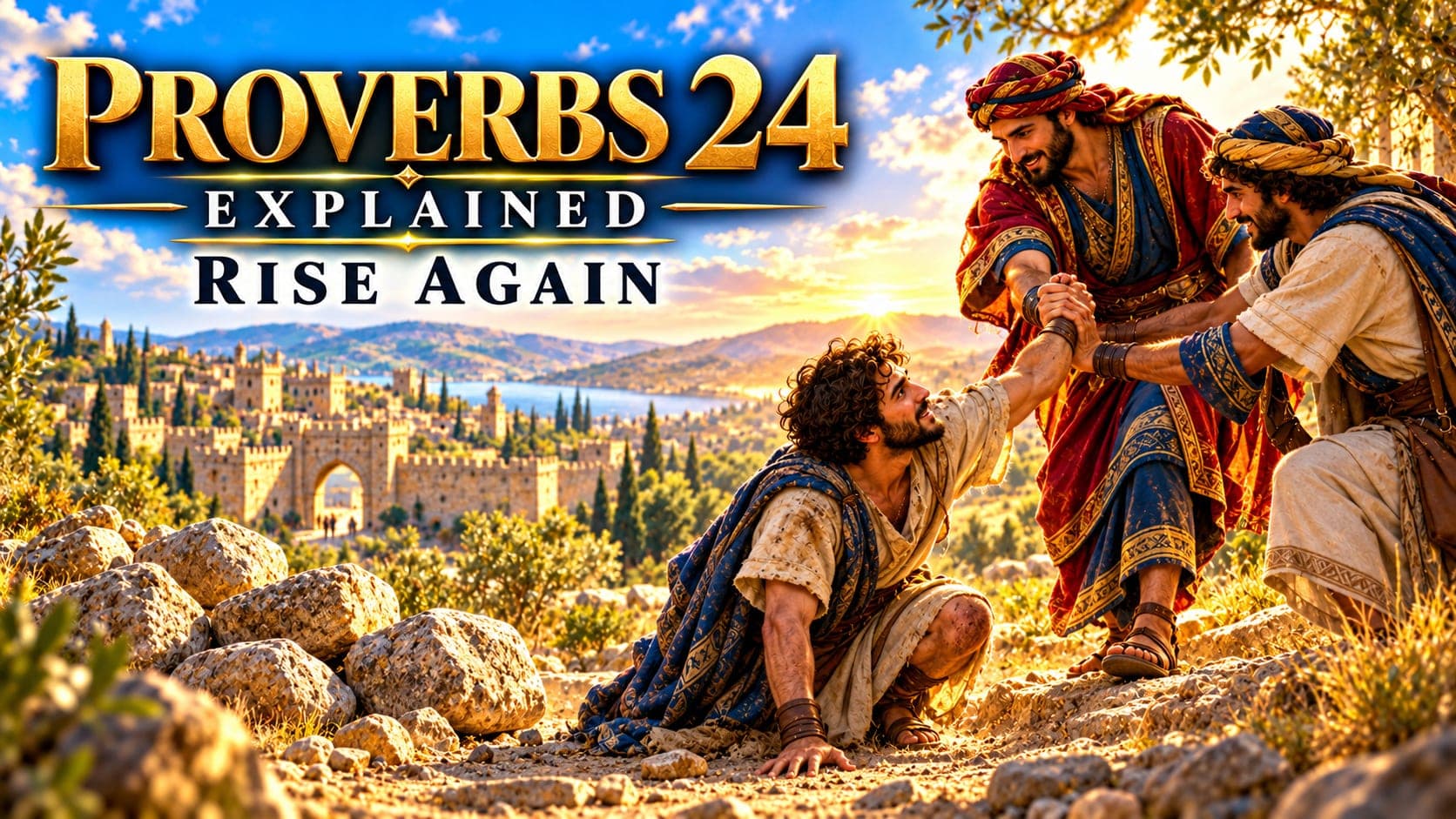
"Lay not wait, O wicked man, against the dwelling of the righteous; spoil not his resting place: For a just man falleth seven times, and riseth up again: but the wicked shall fall into mischief."
📌 The difference between the just man and the wicked man is not how many times either one falls. It is what happens next. Seven falls followed by seven rises is still a man standing. One fall into mischief, for the wicked, is simply where he lands.
"Rejoice not when thine enemy falleth, and let not thine heart be glad when he stumbleth: Lest the LORD see it, and it displease him, and he turn away his wrath from him."
⚠️ This is the hardest pair of verses in the chapter, and it gets the full treatment further down in Hard Questions. For now, notice what the warning is actually aimed at: not your enemy's fate, but your own heart's reaction to it.
5. Fretting Over the Wicked, and Fearing the LORD and the King (verses 19 to 22)
Solomon circles back to almost the exact words he opened the chapter with.
"Fret not thyself because of evil men, neither be thou envious at the wicked; For there shall be no reward to the evil man; the candle of the wicked shall be put out."
Solomon rarely repeats himself this closely within one chapter, which makes the repeat worth noticing. Verse 1 warned against wanting to be near evil men. Verse 19 warns against being unsettled by watching them. The same wicked man who looks unstoppable is pictured here as a candle that has already started burning down, the same image Proverbs 20 used for the human spirit, now turned against the very people who seemed to be winning.
"My son, fear thou the LORD and the king: and meddle not with them that are given to change: For their calamity shall rise suddenly; and who knoweth the ruin of them both?"
"Them that are given to change" pictures people who stir up constant political upheaval. Verse 22 is a practical warning more than a theological one: standing too close to a sudden overthrow tends to get you caught in whatever ruin follows it, whether or not you started the trouble yourself.
6. Favoritism in Judgment, and the Man Who Gives a Right Answer (verses 23 to 26)
A short heading verse introduces a cluster aimed specifically at anyone who judges disputes between people.
"These things also belong to the wise. It is not good to have respect of persons in judgment."
"He that saith unto the wicked, Thou art righteous; him shall the people curse, nations shall abhor him: But to them that rebuke him shall be delight, and a good blessing shall come upon them."
📌 Calling a guilty person righteous is not pictured as a small kindness. It earns a curse from the very people it was supposed to protect, because a judgment that will not name wrong as wrong leaves everyone less safe, not more comfortable.
"Every man shall kiss his lips that giveth a right answer."
A kiss on the lips was an ordinary greeting of affection in this culture, not a strange image. Honesty, even the kind that costs the speaker something, is pictured earning more real affection in the end than flattery ever manages to.
7. A Field Before a House, a Vengeance Left Alone, and a Vineyard Gone to Ruin (verses 27 to 34)
The chapter closes by circling back to the house it opened with, and then showing exactly what happens when nobody builds one at all.
"Prepare thy work without, and make it fit for thyself in the field; and afterwards build thine house."
Verse 3 said wisdom builds a house. Verse 27 gets practical about the order that actually takes: secure the field, the source of income, before you build the house that depends on it. A home built ahead of its own provision is a house with nothing behind it.
"Be not a witness against thy neighbour without cause; and deceive not with thy lips. Say not, I will do so to him as he hath done to me: I will render to the man according to his work."
📌 Verse 12 already said the LORD is the one who will render to every man according to his works. Verse 29 forbids a person from quietly taking that exact job for themselves. Rendering back exactly what was done to you is reserved for God, not handed out to whoever feels wronged enough to collect it personally. Joseph held the power to do exactly that to the brothers who sold him, and chose not to.
"I went by the field of the slothful, and by the vineyard of the man void of understanding; And, lo, it was all grown over with thorns, and nettles had covered the face thereof, and the stone wall thereof was broken down."
Solomon speaks here as an eyewitness, an unusual personal touch in a book mostly built from short, general sayings. The broken stone wall is the exact opposite of the established house from verse 4, proof that neglect builds something too, just not anything worth having.
"Then I saw, and considered it well: I looked upon it, and received instruction. Yet a little sleep, a little slumber, a little folding of the hands to sleep: So shall thy poverty come as one that travelleth; and thy want as an armed man."
💡 Two pictures of poverty, back to back on purpose. First it arrives like a traveler, unhurried, covering ground a little at a time until it is simply there. Then it arrives like an armed man, forceful and impossible to argue with once it finally shows up. The sleep that caused it never felt like either one while it was happening.

Hard Questions Proverbs 24 Raises
Does Proverbs 24:17 and 18 mean God will let your enemy off the hook if you celebrate their downfall? The verse does not promise that. It warns about what gloating does to you, not what it does for your enemy. Scripture elsewhere is clear that wrongdoing does not go unanswered simply because someone failed to feel glad about the consequences. What verse 18 names is a real danger in your own heart: taking pleasure in someone else's ruin reveals something closer to the wicked man's own heart than to the LORD's justice, which is never described anywhere in Scripture as gleeful. Wanting justice done is not the same thing as delighting in a person's pain.
Is Proverbs 24:21 putting an earthly king on the same level as the LORD? Pairing two things in one sentence is not the same as equating them. Solomon is telling his son to respect two different kinds of authority, one absolute and one delegated, without claiming they are the same kind of authority. Scripture keeps this same pairing later, fearing God and honoring whatever government is in place, while never losing track of which authority outranks the other whenever the two actually conflict.
Who exactly are "them that are drawn unto death" in verse 11? The text does not name a specific group, and that is likely deliberate. It could describe someone facing an unjust court sentence, someone being led toward physical danger, or anyone else whose life is genuinely at risk while bystanders look away. The command does not narrow to one scenario because the obligation it names, not standing by while someone is dragged toward ruin, does not narrow either.
Does Proverbs 24:29 contradict the eye for eye law given in Exodus? They are not addressing the same person. The law in Exodus instructed judges administering public justice on behalf of a community, with limits built in precisely so punishment could not spiral past what actually happened. Proverbs 24:29 is aimed at a private individual deciding to personally repay a neighbor for a wrong done to him. One is a court setting a boundary. The other is a person being told that boundary is not theirs to set for themselves.
Practical Tips From Proverbs 24
Thirty four verses, most of them pointing at something you can check against your own week.
- Watch who you want to be near, not only who you are afraid of. Verse 1 names desire for evil company as the actual danger, not just the risk of being harmed by it.
- Build in the right order. Verse 3 and 4 put wisdom first, understanding second, and knowledge last. Skipping the order gets you a house that looks furnished but will not stand.
- Test your strength before the crisis, not during it. Verse 10 says adversity only reveals what was already true about you.
- Step toward someone being dragged to ruin instead of looking the other way. Verse 11 will not accept "we knew it not" as an excuse later.
- Make rising the point, not the number of falls. Verse 16 is not a promise you will not fail. It is a promise about what happens after.
- Check your own heart before you enjoy someone else's collapse. Verse 17 and 18 are not asking you to feel bad for your enemy. They are asking you to examine why their fall feels so good.
- Leave the rendering to God. Verse 29 tells you exactly what you are not in charge of collecting yourself.
Top 5 Bible Verses From Proverbs 24
1. Proverbs 24:3 and 4
"Through wisdom is an house builded; and by understanding it is established: And by knowledge shall the chambers be filled with all precious and pleasant riches."
The order a life is built in matters as much as the materials. Wisdom builds, understanding establishes, knowledge fills, in that order and no other.
2. Proverbs 24:10
"If thou faint in the day of adversity, thy strength is small."
Trouble does not manufacture weakness. It only shows you weakness that was quietly already there before the trouble ever arrived.
3. Proverbs 24:16
"For a just man falleth seven times, and riseth up again: but the wicked shall fall into mischief."
The righteous life pictured here is not a life without falling. It is a life that keeps getting back up, every single time.
4. Proverbs 24:17 and 18
"Rejoice not when thine enemy falleth, and let not thine heart be glad when he stumbleth: Lest the LORD see it, and it displease him, and he turn away his wrath from him."
A warning aimed entirely at your own heart's reaction, not at your enemy's fate. Wanting justice and enjoying someone else's pain are not the same desire.
5. Proverbs 24:33 and 34
"Yet a little sleep, a little slumber, a little folding of the hands to sleep: So shall thy poverty come as one that travelleth; and thy want as an armed man."
Poverty here arrives two ways, slow like a traveler covering ground and sudden like an armed man forcing entry. Neither one announces itself while the sleep is still happening.
Frequently Asked Questions About Proverbs 24
What is Proverbs 24 about?
It is a collection of short sayings built around what gets built and what gets neglected: a house raised by wisdom, a duty to rescue someone in danger, a warning against gloating over an enemy, and a ruined vineyard that belonged to a man who kept choosing sleep over work.
What does "through wisdom is an house builded" mean in Proverbs 24:3?
It pictures a life being constructed in stages. Wisdom lays the foundation, understanding makes the structure able to hold weight, and knowledge is what finally fills the rooms once there is somewhere sturdy to put it.
What does Proverbs 24:10 mean, "if thou faint in the day of adversity, thy strength is small"?
It means a crisis does not create weakness, it only exposes weakness that was already present before the crisis arrived. Real strength is built in ordinary, unwatched seasons, not discovered for the first time under pressure.
Who are "them that are drawn unto death" in Proverbs 24:11?
The text does not name one specific group, which likely keeps the command broad on purpose. It applies to anyone whose life is genuinely at risk while someone who could help chooses to look away instead.
What does "a just man falleth seven times, and riseth up again" mean in Proverbs 24:16?
It means righteousness is not measured by never failing. It is measured by what happens after each fall. The number seven pictures repetition, not a limit, as if to say the getting up matters every single time.
Does Proverbs 24:17 and 18 mean God will spare my enemy if I celebrate their downfall?
No. The verse is not a promise about your enemy's outcome. It is a warning about what delighting in someone else's ruin reveals about your own heart, which the LORD sees and is displeased by regardless of what happens to the person who fell.
Does Proverbs 24:21 put the king on the same level as God?
No. Naming two kinds of authority in the same sentence does not make them equal. The verse calls for respecting a delegated human authority alongside the LORD's ultimate authority, without ever suggesting the two are interchangeable.
Does Proverbs 24:29 contradict the eye for eye law in Exodus?
No, because the two are addressed to different people. The law in Exodus limits what a court can impose as public justice. Proverbs 24:29 tells a private individual that personally repaying a neighbor's wrong is not a decision that belongs to them.
What does "a little sleep, a little slumber" mean in Proverbs 24:33?
It describes how neglect actually arrives, in small, easily excused increments rather than one obvious bad decision. Each nap feels harmless on its own, which is exactly how the overgrown field in the verses before it got that way.
What is the main lesson of Proverbs 24?
That a life, like a house or a field, is always being either built or neglected, and that the small choices named in this chapter, who you want to be near, what you do with a dangerous situation, whether you let yourself rest one more time, decide which one is actually happening.
Final Thoughts
Proverbs 24 keeps circling back to the same two pictures: a house that holds weight and a wall that fell down from neglect.
📌 Strength is tested, not created, by hard days. Verse 10 says adversity only shows what was already true about you, which means the real work happens before the hard day ever arrives.
📌 Rendering back what was done to you is not your job. Verse 12 and verse 29 both say the same thing from different angles, that is work reserved for the LORD alone.
📌 Neglect never announces itself. The man with the ruined field never decided to ruin it. He just kept choosing a little more sleep, one small folding of the hands at a time.
So here is your one next step.
Walk past your own field today, honestly, the way Solomon walked past his. Look for the first broken stone before the whole wall is down.
The house in this chapter did not build itself, and neither did the field that fell apart.