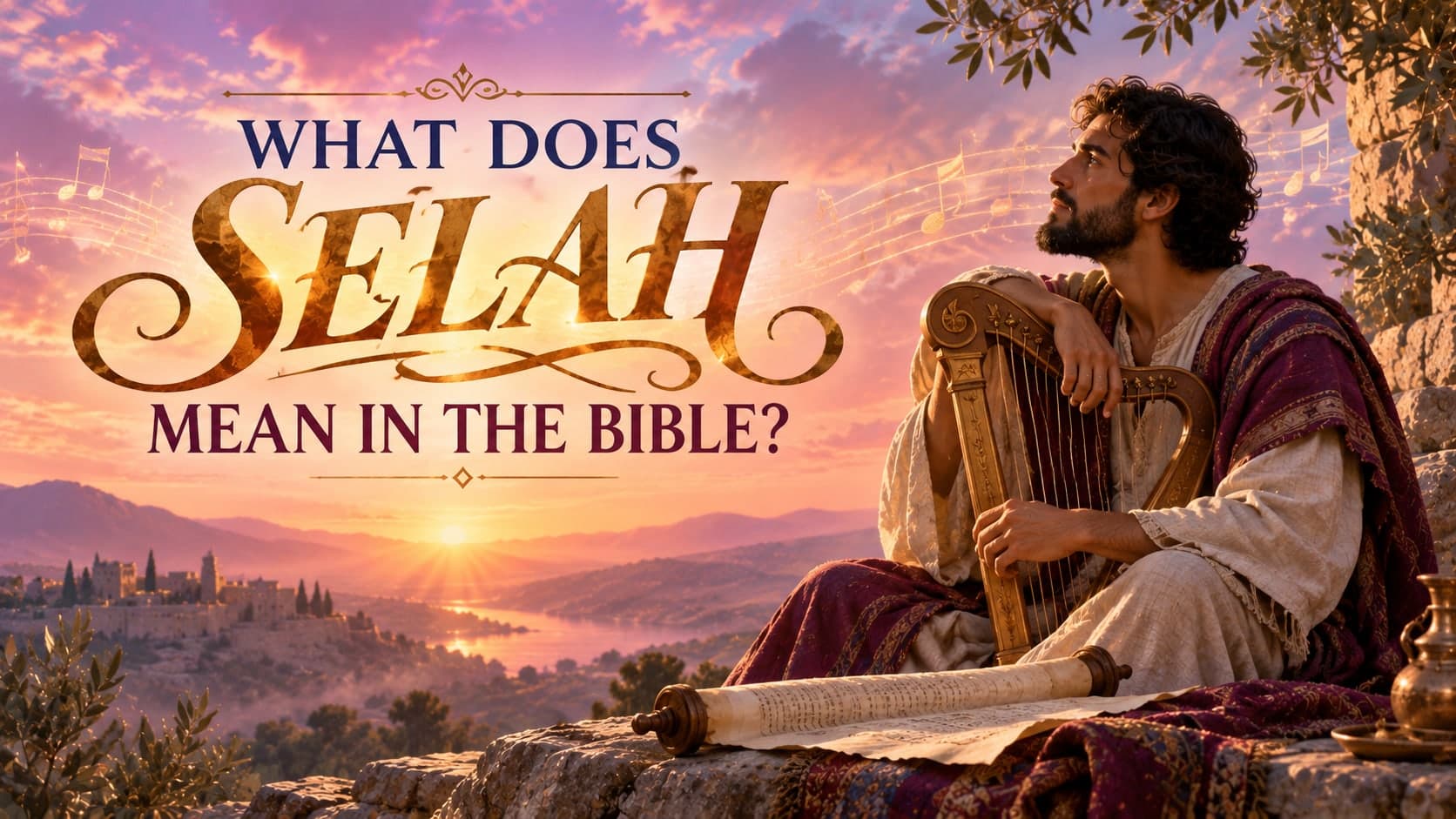
📖 What Does Selah Mean in the Bible?
You are reading through the Psalms.
The words are landing. Your heart is following along.
Then you hit it.
Selah.
It sits there at the end of the verse, alone, with no explanation.
So you do what most readers do. You skip it and keep going.
📌 But that little word is not a typo and it is not filler. It shows up 74 times in Scripture, and every single time, it is asking you to do something.
If you have ever wondered what Selah means in the Bible, you are in good company.
Even the scholars who have studied it for centuries do not agree on every detail.
But they agree on the main thing, and the main thing is enough to change how you read.
Selah is a pause.
A breath. A place to stop and let what you just read actually reach you.
In a life that trains you to scroll past everything, that small word carries a quiet rebuke and a quiet gift.
This guide walks through where Selah appears, what it most likely means, why it was placed exactly where it was, and how you can start practicing the habit it points to every time you open your Bible.
Slow down. Let this one take its own advice.
Why This Matters for Your Faith
You live in a world built to move fast.
Notifications. Autoplay. The next tab already open before you finished the last one.
That habit does not stay outside your Bible reading. It follows you in.
You can read a whole chapter of Scripture with your eyes and never let a single verse land on your heart.
📌 Selah is God's own built in interruption to that habit.
It shows up in the middle of some of the most honest, desperate, worshipful moments in the Bible, right when the writer needed the reader to stop and feel the weight of what was just said.
That matters for your faith because reading is not the same thing as receiving.
You can check the box that says you read your Bible today and still walk away unchanged, because you never stopped long enough to let it change you.
Selah is proof that even Scripture itself values the pause. Not just the information.

What Selah Actually Means
1. Where Selah Shows Up in Scripture
Selah appears 74 times in the Old Testament.
71 of those times, it is sitting inside the Psalms.
The other three are in one place: Habakkuk's prayer in chapter 3.
"God came from Teman, and the Holy One from mount Paran. Selah. His glory covered the heavens, and the earth was full of his praise."
Notice something already. Selah never shows up in the middle of ordinary narrative, the kind of storytelling you find in Genesis or Exodus.
📌 It only appears in worship and prayer. Songs, laments, cries for help, bursts of praise.
That tells you Selah belongs to a certain kind of reading. Not information gathering. Encounter.
The Psalms sit right in the middle of your Bible for a reason. If you have never looked at what the Bible actually is and how a book of songs and prayers fits next to the history and the letters, it helps explain why a word like Selah only shows up here and nowhere else.
2. What the Word Selah Most Likely Means
Here is where honesty matters.
Nobody alive today can tell you with total certainty what Selah meant to the original readers.
The word never gets defined anywhere in Scripture. It is simply used.
But scholars have narrowed it down to two strong possibilities, and they are not far apart.
- 🎵 A musical direction. Many Psalms were written to be sung, likely with instruments, and Selah may have marked a spot for the music to swell, pause, or shift. Think of it like a notation in sheet music rather than a word to be read aloud.
- 🙌 A word rooted in lifting up or pausing. The Hebrew root behind Selah connects to ideas like "lift up" or "pause and consider." Some scholars connect it to lifting your voice in praise. Others connect it to lifting your eyes off the page and thinking.
Both readings point in the same direction.
💡 Stop. Let this sink in. Lift your heart toward God before you move on.
You do not need to resolve every scholarly debate to receive what Selah is offering you. The instruction survives the uncertainty.
3. Why Selah Was Never Meant to Be Skipped
Most Bible readers treat Selah the way you treat a footnote number.
Eyes slide right past it. On to the next verse.
But the placement of Selah is never random.
Look at where it lands in Psalm 3, a psalm David wrote while running for his life from his own son.
"Many there be which say of my soul, There is no help for him in God. Selah."
David just named the worst thought pressing in on him. That God will not help.
Right there, before he answers it, the text says: Selah. Stop. Sit in that for a moment.
Then two verses later:
"I cried unto the LORD with my voice, and he heard me out of his holy hill. Selah."
He answered the lie with a testimony, and then he stopped again. Let that answer settle too.
📌 Selah is not decoration. It is placed exactly where the writer needed the reader to feel something before rushing to the next line.
Skip it, and you might still get the facts of the psalm. You just miss the weight of it.
4. A Psalm Where Selah Changes Everything
Psalm 46 is the clearest example in the whole Bible.
It opens with a promise for a shaking world:
"God is our refuge and strength, a very present help in trouble."
The psalm moves through mountains falling into the sea and nations in an uproar. Real chaos. Then it lands here, one of the most quoted lines in Scripture:
"Be still, and know that I am God: I will be exalted among the heathen, I will be exalted in the earth."
"The LORD of hosts is with us; the God of Jacob is our refuge. Selah."
"Be still" and Selah are practically the same instruction, one inside the poem and one attached at the end of it.
Stillness is not a suggestion tucked into a chaotic psalm by accident. It is the whole point. If your mind runs anxious the way the mountains and nations do in this psalm, the path back to peace is the same path David pointed to here. If you have never worked through how the two connect, it is worth reading what the Bible says about anxiety alongside this one.
Selah is the closing bell on a psalm about refusing to panic.
5. Selah and the Discipline of Pausing With God
Selah is not only about Bible reading. It is about a whole way of walking with God.
Look at Psalm 4, written for the end of a hard day:
"Stand in awe, and sin not: commune with your own heart upon your bed, and be still. Selah."
Commune with your own heart. Before you fall asleep, before the next thing pulls your attention, be honest with yourself in front of God.
📌 That is a Selah moment outside the pages of Scripture. A deliberate stop in the middle of an ordinary day to notice what is actually going on inside you and bring it to God.
Most of us never build that pause into our lives on purpose.
We move from task to task, feeling to feeling, without ever stopping long enough to commune with our own heart the way the psalmist describes.
Selah is an invitation to build that stop back in, even outside the moments you have your Bible open.
6. What Selah Teaches You About Reading the Bible Itself
Here is the bigger lesson hiding inside one small word.
Speed is the enemy of understanding Scripture.
You cannot rush your way to depth. You cannot skim your way into a changed heart. The Word of God was never built to be consumed the way you consume a headline.
If you want a practical way to slow down and actually take in what you are reading rather than just finishing it, it helps to have a plan for how to read the Bible with understanding instead of just checking a box.
Selah is the Bible teaching you its own reading pace, right there inside the text, 74 times over.
📌 Every Selah is a small sign that says: this part matters, do not rush it.
The question is whether you will actually stop when you see it.
7. Selah Marks Joy As Much As It Marks Sorrow
It is easy to assume Selah only belongs to the sad psalms. The ones written in caves and battlefields.
Psalm 24 proves that wrong. It is a psalm of celebration, picturing a triumphant procession up to the temple:
"Lift up your heads, O ye gates; even lift them up, ye everlasting doors; and the King of glory shall come in. Who is this King of glory? The LORD of hosts, he is the King of glory. Selah."
No fear here. No enemies closing in. Just full, unhurried celebration, and the writer still stops to say Selah.
📖 Psalm 68 does the same thing in the middle of pure gratitude:
"Blessed be the Lord, who daily loadeth us with benefits, even the God of our salvation. Selah."
💡 We are quick to rush through good news the same way we rush through bad news.
A blessing gets a quick thank you, and then attention moves on to the next thing. Selah says do not do that here either. Let the good gift actually register before you move on.
That is part of why Bible study feels hard for so many of us. We treat every page, joyful or heavy, at the exact same rushed speed. Selah interrupts that pattern on purpose, in both directions.

Practical Tips: How to Practice Selah in Your Own Reading
Understanding Selah is one thing. Practicing it is another.
Here are eight simple ways to build the pause back into your time with God.
- Actually stop when you see the word Selah. Do not read past it. Close your eyes for three seconds and let the verse before it settle before you continue.
- Read the Psalm out loud. Hearing your own voice slows you down in a way silent reading never does, and it turns Selah into a natural breath instead of a word on a page.
- Write one line at every Selah. Keep a notebook nearby and jot down what just landed on you. A simple habit like this pairs well with a simple highlighting system for marking the verses that stop you.
- Build a Selah moment into your morning. Before you check your phone, take sixty seconds of real silence with God. Let that be your daily Selah before the noise of the day starts.
- Use Selah as a prayer pattern. Say a truth about God out loud, then stop and let it be true in your heart before you move to the next request.
- Slow down at the hardest verses, not just the beautiful ones. Psalm 3 pauses right after naming despair. Do not rush past your own hard moments either.
- Set aside a longer block for it. If you want a full framework for slowing down with God rather than squeezing Him into five rushed minutes, a guide like how to spend one hour with God builds the Selah habit into an entire hour.
- Do not force a feeling. Some pauses will feel powerful. Others will feel quiet and plain. Selah is not about a spiritual high. It is about giving God room, every time, whether you feel anything or not.
You do not need all eight at once.
Pick one. Practice it this week. Let it become a habit before you add another.
Top 5 Bible Verses With Selah
Selah appears 74 times, but these five moments show its purpose most clearly.
1. Psalm 46:10 and 11
"Be still, and know that I am God: I will be exalted among the heathen, I will be exalted in the earth. The LORD of hosts is with us; the God of Jacob is our refuge. Selah."
The most famous stillness verse in the Bible, capped off with Selah, in a psalm about a world falling apart around a people who refuse to be shaken.
2. Psalm 4:4
"Stand in awe, and sin not: commune with your own heart upon your bed, and be still. Selah."
A nightly invitation to honesty. Before sleep takes you, let your heart be still and honest before God.
3. Psalm 62:8
"Trust in him at all times; ye people, pour out your heart before him: God is a refuge for us. Selah."
Pour out your heart, and Selah stands right after, telling you to let the pouring out actually happen instead of rushing to the next thought.
4. Habakkuk 3:3
"God came from Teman, and the Holy One from mount Paran. Selah. His glory covered the heavens, and the earth was full of his praise."
The only Selah verse outside the Psalms, right at the start of a desperate prayer, where Habakkuk stops to remember the greatness of God before he asks for anything.
5. Psalm 3:2 to 4
"Many there be which say of my soul, There is no help for him in God. Selah. But thou, O LORD, art a shield for me; my glory, and the lifter up of mine head. I cried unto the LORD with my voice, and he heard me out of his holy hill. Selah."
David's honest fear, framed by two Selahs, showing that the pause belongs in your hardest moments just as much as your best ones.

Frequently Asked Questions About Selah
What does the word Selah actually mean?
Nobody knows for certain, since the Bible never defines it directly. Most scholars connect it to a musical pause or a word meaning to lift up, likely a signal for the reader or singer to stop and reflect on what was just said. Either reading points to the same practice: stop and let the verse land.
Why does Selah appear so often in Psalms?
The Psalms were written as songs and prayers, meant to be sung or prayed aloud rather than silently skimmed. Selah likely marked places in that performance where the music or the reader needed to pause, which explains why it clusters inside worship and prayer instead of narrative books like Genesis or Exodus.
Should I say Selah out loud when reading?
You do not have to speak the word itself. What matters is doing what it points to. Stop for a few seconds, let the verse before it settle in your heart, and then continue. Whether you say it out loud or simply pause in silence, the point is the same.
Is Selah a musical instruction?
That is one of the two leading theories, and many scholars consider it the strongest one. Since the Psalms were sung with instruments in ancient Israel, Selah may have functioned like a notation in sheet music, marking a pause, a shift, or a rise in the music.
Does Selah appear anywhere outside the Psalms?
Yes, three times, all in Habakkuk chapter 3, which is itself written as a prayer set to music. Outside of Psalms and Habakkuk 3, the word does not appear anywhere else in Scripture, which reinforces that it belongs to worship and prayer specifically.
Why do some Bible translations leave Selah untranslated?
Because translators are not fully certain what it means, most versions, including the King James Version, simply transliterate the Hebrew word rather than guess at an English equivalent. Leaving it as Selah is actually the more honest choice.
Is it okay that scholars do not agree on what Selah means?
Yes. Scripture does not require you to solve every mystery before you obey what it clearly teaches. Even without a final answer on the exact meaning, the pattern of where Selah appears makes the invitation clear: slow down and let this part matter.
Can I use Selah in my own prayers?
You do not need to use the word itself, but you can absolutely borrow the practice. State a truth about God, then stop and let it be true in your heart before you rush to the next request. That is the habit Selah is teaching, and it works just as well today.
What is the difference between Selah and Amen?
Amen means "so be it" or "let it be true," usually placed at the close of a prayer to affirm what was just said. Selah is different. It appears in the middle of a psalm, not just at the end, and it calls for a pause rather than a final agreement.
Does skipping over Selah change how I understand a Psalm?
You can still understand the facts of a psalm without stopping at Selah, but you will likely miss its weight. The word marks the exact spots the writer wanted you to feel something, not just read it, so skipping it trades depth for speed.
Final Thoughts
If you remember nothing else from this guide, remember these three things.
📌 Selah is a pause, not a typo. It appears 74 times in Scripture, always inside worship and prayer, always right where the writer needed the reader to stop and feel the weight of what was just said.
📌 Nobody knows the exact meaning, and that is okay. Whether it points to a musical direction or a call to lift your heart, both readings land on the same instruction. Stop. Reflect. Let it sink in.
📌 Selah is bigger than one word in the Psalms. It is an invitation to slow down your whole life with God, from how you read Scripture to how you pray to how you end your day.
You do not need to master a Hebrew word to start living this out.
The next time you read your Bible, or the next time a hard thought presses in on you the way it pressed in on David, try this.
Stop. Breathe. Let God be as real to you in that moment as He was to the people who wrote these words.
Selah.