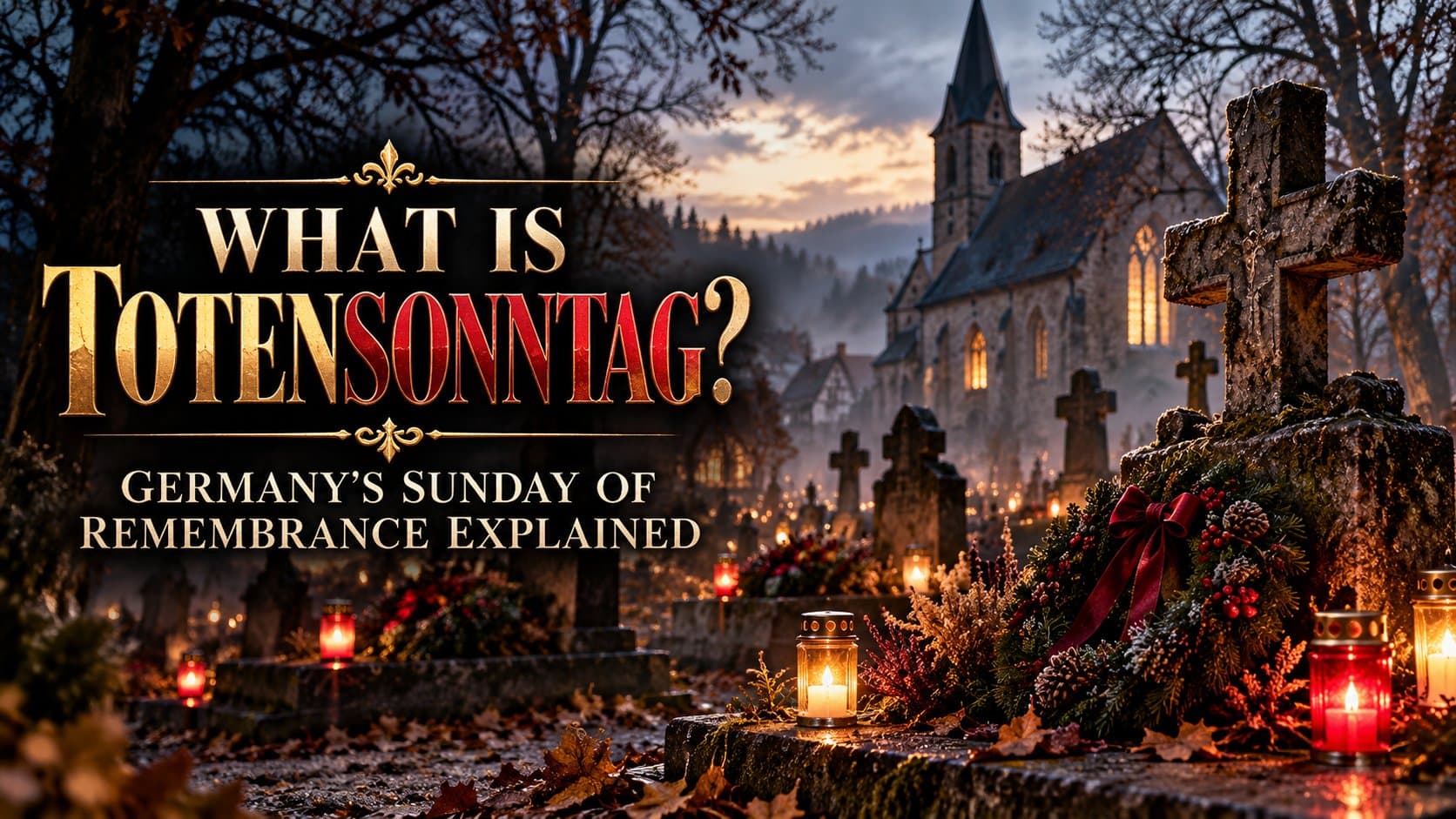
📖 What Is Totensonntag? Germany's Sunday of Remembrance Explained
A German friend tells you she cannot come out tonight.
She says it is Totensonntag, and the word means nothing to you yet.
📌 Here is the plain answer. Totensonntag means "Sunday of the Dead." It is the last Sunday of the church year in German speaking Protestant churches, and it is the day set aside every year to remember everyone who died in the last twelve months.
Maybe you grew up in a German Lutheran family and you already know the quiet streets and the candles. Maybe you have only ever seen the word on a calendar and wondered what it actually asks of a Christian.
Either way, this guide meets you exactly where you are.
We will walk through where Totensonntag came from, why a Prussian king created it in 1816, what the Bible readings behind it actually say, what happens inside a church on this Sunday, why German law still protects it as a quiet day, and how it compares to the Catholic observances kept the very same week.
Every historical claim below is sourced, so you can go check it yourself.
Why This Matters for Your Faith
It is easy to file Totensonntag under foreign custom, a German thing that has nothing to do with your own walk with God.
⚠️ That misses what the day is actually built on. Most of us spend the whole year avoiding the subject of death. We fill every quiet moment with noise so the question never gets a chance to land.
Scripture does the opposite. It asks you to look straight at your own mortality on purpose.
"So teach us to number our days, that we may apply our hearts unto wisdom."
📌 That is the real invitation underneath this Sunday. Not a morbid dwelling on grief, but an honest reckoning that leads to wisdom. A year where you never stop to count your own days can slip by without you noticing what actually matters.
💡 Remembering the people you have lost, and remembering that your own days are numbered too, is not weak faith. It is the kind of faith that takes God's promises about eternity seriously enough to actually need them.

Where Totensonntag Comes From and What It Means
1. What Totensonntag Actually Is and When It Falls
Start with the plain facts. Totensonntag is the last Sunday of the church year, the Sunday right before Advent begins, in German speaking Protestant churches.
Wikipedia's entry on the day describes it as falling on the final Sunday of the church year in the Evangelical Church in Germany and in Protestant churches in the Netherlands as well. The Local, an English language German news site, adds that Switzerland keeps a version of the same day, usually under its other name, and that Austria, parts of Scandinavia, and the Netherlands mark a similar observance.
📌 So this is not a single local custom. It is a shared Protestant tradition across several countries, built around the same closing Sunday of the church calendar.
2. Why King Friedrich Wilhelm III Created It in 1816
Totensonntag is newer than most people assume. Wikipedia records that in 1816, King Friedrich Wilhelm III of Prussia ordered Lutheran churches across Prussian territory to keep the last Sunday before Advent as what the decree called a general day of remembrance for the dead.
⚠️ Sources give slightly different reasons for why he acted when he did, and a good guide says so plainly. The Local reports that the king wanted to honor the soldiers Prussia had lost in the War of Liberation against Napoleon in 1813, and also to remember his own wife, Queen Luise, who had died in 1810. Wikipedia's own account simply records the decree without stating his personal motive.
Either way, the timing lines up with a country that had just come out of years of war, and a king who had buried both soldiers and his own queen. Other German Lutheran regional churches took up the custom gradually in the years after, until the name Totensonntag became the one that stuck.
3. Totensonntag or Ewigkeitssonntag: Two Names for the Same Sunday
You will see this day under two different German names, and the difference is not just spelling. It is a choice about where to put the emphasis.
Totensonntag means Sunday of the Dead. Ewigkeitssonntag means Eternity Sunday. The German Protestant news site evangelisch.de explains that some regional churches prefer the second name on purpose, so the day points toward resurrection and eternal life rather than sitting only on death and loss.
💡 Both names describe the same service. One names what the day grieves. The other names what the day hopes for. A Christian understanding of death needs both halves held together, not just one.
4. The Scripture Behind the Last Sundays of the Church Year
This Sunday did not appear in a vacuum. Wikipedia's account traces its roots to a much older pattern in the medieval church calendar, where the last few Sundays before Advent were already built around what theology calls the last things: death, judgment, and eternity.
In that older pattern, the third from last Sunday focuses on death itself. The second from last turns to the Last Judgment. The final Sunday, Totensonntag itself, turns toward eternal life. The traditional Gospel reading appointed for that final Sunday is the parable of the ten virgins.
"Then shall the kingdom of heaven be likened unto ten virgins, which took their lamps, and went forth to meet the bridegroom. And five of them were wise, and five were foolish."
Jesus ends the parable with a single command, and it is the whole point of the reading.
"Watch therefore, for ye know neither the day nor the hour wherein the Son of man cometh."
📌 Notice what the reading is not about. It is not a story about who earned a place at the wedding. It is a warning to stay ready, because nobody gets to choose their own timing. That is exactly the posture a day about remembering the dead is meant to put you in.
5. What Actually Happens in Church on Totensonntag
Walk into a German Protestant service on Totensonntag and here is roughly what you would see. Evangelisch.de describes congregations writing the names of those who died that year into a memorial book, and those names are read aloud and prayed for during the service. Some churches now also offer this through an online memorial site called trauernetz.de.
The Local adds that many families use the day to visit graves, and some light one candle in church for each person they are remembering. It compares the practice loosely to the Day of the Dead kept in Mexico, though the German version happens in daylight rather than through a night of celebration.
✅ None of this is private grief kept to yourself. The names get spoken out loud, in front of the whole congregation. Grief that gets named together is lighter than grief carried alone.
6. Why German Law Still Protects This Day as Quiet
Totensonntag is not only a church custom in Germany. It carries legal weight.
The Local reports that every German state except Hamburg legally designates it a silent day, with rules that restrict public dancing and live music in bars and venues. Wikipedia points to Hamburg's own 1953 holiday law as one example of how a state actually writes this protection into statute, describing the day as one of mourning, remembrance, and quiet.
⚠️ It is worth saying plainly that this is a state protection, not a church doctrine. The law tells businesses what they cannot schedule. It does not tell any individual German how to grieve, and plenty of Germans who are not Protestant, or not religious at all, simply experience the day as an unusually quiet Sunday.
7. Totensonntag's Catholic and Protestant Neighbors on the Calendar
Totensonntag does not sit alone on the German calendar. Several related days surround it, and keeping them straight helps more than blending them together.
Wikipedia notes that the Roman Catholic Church keeps the very same last Sunday of the church year as the Feast of Christ the King. The two observances share a Sunday and a theme, the end of the church year pointing toward what comes after this life, even though one looks at a king and the other looks at the grave.
Catholics keep a separate day earlier in November, All Souls' Day, on a fixed date rather than a moving Sunday. Wikipedia and the Local both call Totensonntag the Protestant counterpart to that older Catholic observance.
A third day, Volkstrauertag, falls on the Sunday one week before Totensonntag. The Local explains it is a separate, state level remembrance for victims of war and violence, observed since 1952, with its own ceremony in the German parliament. It is not a church holiday at all, even though German media often mentions the two Sundays together.
Right after Totensonntag comes the quietest irony of the German calendar. The next Sunday opens the season of Advent, so a Sunday built entirely around endings turns, within a week, into the season built entirely around waiting for a beginning.

Practical Tips for Keeping a Day Like This Well
You do not need to be German or Lutheran to let this Sunday shape how you remember your own dead.
- Say the names out loud, even in private. Write down who you have lost this year and read the list to God. You do not need a church service to borrow this practice.
- Pray Psalm 90:12 this week. Ask God to teach you to number your own days, not just remember someone else's.
- Visit a grave if you can get to one. German families treat this as ordinary, not morbid. Standing at a grave on purpose is an old, healthy habit most modern calendars have quietly dropped.
- Let a quiet day actually stay quiet. Turn off one screen this week and sit with a memory instead of scrolling past it.
- Learn the real difference between Totensonntag, All Souls' Day, and Volkstrauertag. Now you know one is Protestant, one is Catholic, and one is a state memorial for war dead, not a church service at all.
- Read the whole parable of the ten virgins, not just the ending. Matthew 25 is short enough to read in five minutes and it carries the entire point of this Sunday.
- Hold grief and hope in the same sentence. The day is called both Totensonntag and Ewigkeitssonntag for a reason. Let your own prayer carry both names.
Key Bible Verses Behind Totensonntag
These five verses carry the whole weight of this Sunday, from mortality to resurrection.
1. Matthew 25:13
"Watch therefore, for ye know neither the day nor the hour wherein the Son of man cometh."
This is the traditional Gospel reading for Totensonntag, and it closes the parable of the ten virgins. The command is not to live in fear of the hour. It is to live ready for it, whenever it comes.
2. Ecclesiastes 3:1 and 2
"To every thing there is a season, and a time to every purpose under the heaven: A time to be born, and a time to die; a time to plant, and a time to pluck up that which is planted;"
Death gets named here in the very same breath as birth. Scripture never treats death as an unspeakable topic to dance around. It names it as part of the ordinary rhythm God built into time itself.
3. 1 Thessalonians 4:13 and 14
"But I would not have you to be ignorant, brethren, concerning them which are asleep, that ye sorrow not, even as others which have no hope. For if we believe that Jesus died and rose again, even so them also which sleep in Jesus will God bring with him."
Paul never tells grieving Christians not to feel sorrow. He tells them not to grieve like people with no hope at all. That is the exact difference between Totensonntag and a day of pure mourning. The grief is real. It is not the last word.
4. Revelation 21:4
"And God shall wipe away all tears from their eyes; and there shall be no more death, neither sorrow, nor crying, neither shall there be any more pain: for the former things are passed away."
This is the promise behind the name Ewigkeitssonntag. Not a vague comfort, but a specific end to death itself. The German churches that chose the name Eternity Sunday wanted this verse sitting under the whole service, not just the grief.
5. John 11:25 and 26
"Jesus said unto her, I am the resurrection, and the life: he that believeth in me, though he were dead, yet shall he live: And whosoever liveth and believeth in me shall never die. Believest thou this?"
Jesus said this standing at a grave, to a grieving sister, right before He raised her brother Lazarus. He did not answer her grief with a theory. He answered it by naming Himself the resurrection. Whatever name you give this Sunday, that claim is what it is really built on.

Frequently Asked Questions About Totensonntag
What does Totensonntag mean?
Totensonntag means Sunday of the Dead in German. It is the day German Protestant churches set aside each year to remember everyone in the congregation who died over the past twelve months.
When is Totensonntag?
It falls on the last Sunday of the church year, which is the Sunday right before the first Sunday of Advent begins. The exact calendar date moves from year to year along with Advent.
Is Totensonntag a public holiday in Germany?
Not in the sense of a day off work. It is legally protected instead as a quiet day in nearly every German state, which means dancing and public music events are restricted, even though offices and shops often stay open.
What is the difference between Totensonntag and Volkstrauertag?
Volkstrauertag comes one Sunday earlier and is a state remembrance for victims of war and violence, with a ceremony in the German parliament. Totensonntag is the church observance that follows it, focused on the congregation's own dead rather than national history.
Why is Totensonntag also called Ewigkeitssonntag?
Some German regional churches prefer the name Ewigkeitssonntag, meaning Eternity Sunday, so the day emphasizes resurrection and eternal life rather than sitting only on loss. Both names describe the exact same Sunday and the same service.
What happens in church on Totensonntag?
Congregations typically read aloud the names of members who died that year, often from a memorial book, and pray for them by name. Many families also visit graves and light candles for those they are remembering.
Is Totensonntag the same as All Souls' Day?
No, though they serve a similar purpose. All Souls' Day is a fixed Catholic observance on November 2. Totensonntag is the Protestant counterpart, kept on a moving Sunday near the end of November instead of a fixed date.
Why did King Friedrich Wilhelm III create Totensonntag?
In 1816 he ordered Prussian Lutheran churches to keep the last Sunday before Advent as a general day of remembrance for the dead. Reporting on the decree also links it to the soldiers Prussia lost fighting Napoleon and to the king's own grief over his late wife, Queen Luise.
Is Totensonntag only observed in Germany?
Germany keeps it most widely, but Switzerland observes a version too, usually under the name Ewigkeitssonntag, and similar observances exist in Austria, the Netherlands, and parts of Scandinavia.
What does the Bible say about remembering the dead?
Scripture never tells you to avoid the subject. Ecclesiastes names death as part of the ordinary rhythm of time, Paul tells grieving believers to mourn with hope rather than without it, and Jesus answers grief at a graveside by calling Himself the resurrection and the life.
Final Thoughts
A Prussian king meant to give his country one quiet Sunday a year to grieve honestly. Two centuries later, that Sunday still shuts down the dance halls in most of Germany, and it still ends with the same old parable about staying ready.
📌 Totensonntag names what you have lost. Ewigkeitssonntag names what you are promised. Neither name works without the other.
You do not need a German passport or a Lutheran church membership to borrow what this Sunday offers. Say the names of the people you have lost this year. Let yourself feel the weight of it. Then let Revelation 21:4 and John 11:25 answer that weight the way they are meant to.
That is not a foreign custom. That is just what honest Christian grief has always looked like, with a Sunday finally set aside to practice it on purpose.
📚 Sources
Every claim in this article traces back to one of these. All links checked 29 October 2026.
- Totensonntag
Wikipedia
The source for the 1816 decree by Friedrich Wilhelm III, the Ewigkeitssonntag and Totenfest names, the medieval roots of the last three Sundays of the church year, the Matthew 25 Gospel reading, the shared date with the Catholic Feast of Christ the King, and Hamburg's 1953 holiday law.
- Totensonntag: Six things to know about Germany's day to remember the dead
The Local Germany · 2023
The source for the War of Liberation and Queen Luise explanation for the 1816 decree, the state by state quiet day restrictions, grave visiting customs, the countries outside Germany that observe the day, and the 1952 origin of Volkstrauertag.
- Totensonntag: Außen still, innen Aufruhr?
evangelisch.de · 2025
The source for the memorial book and name reading practice, the trauernetz.de online memorial service, and why some regional churches prefer the name Ewigkeitssonntag.