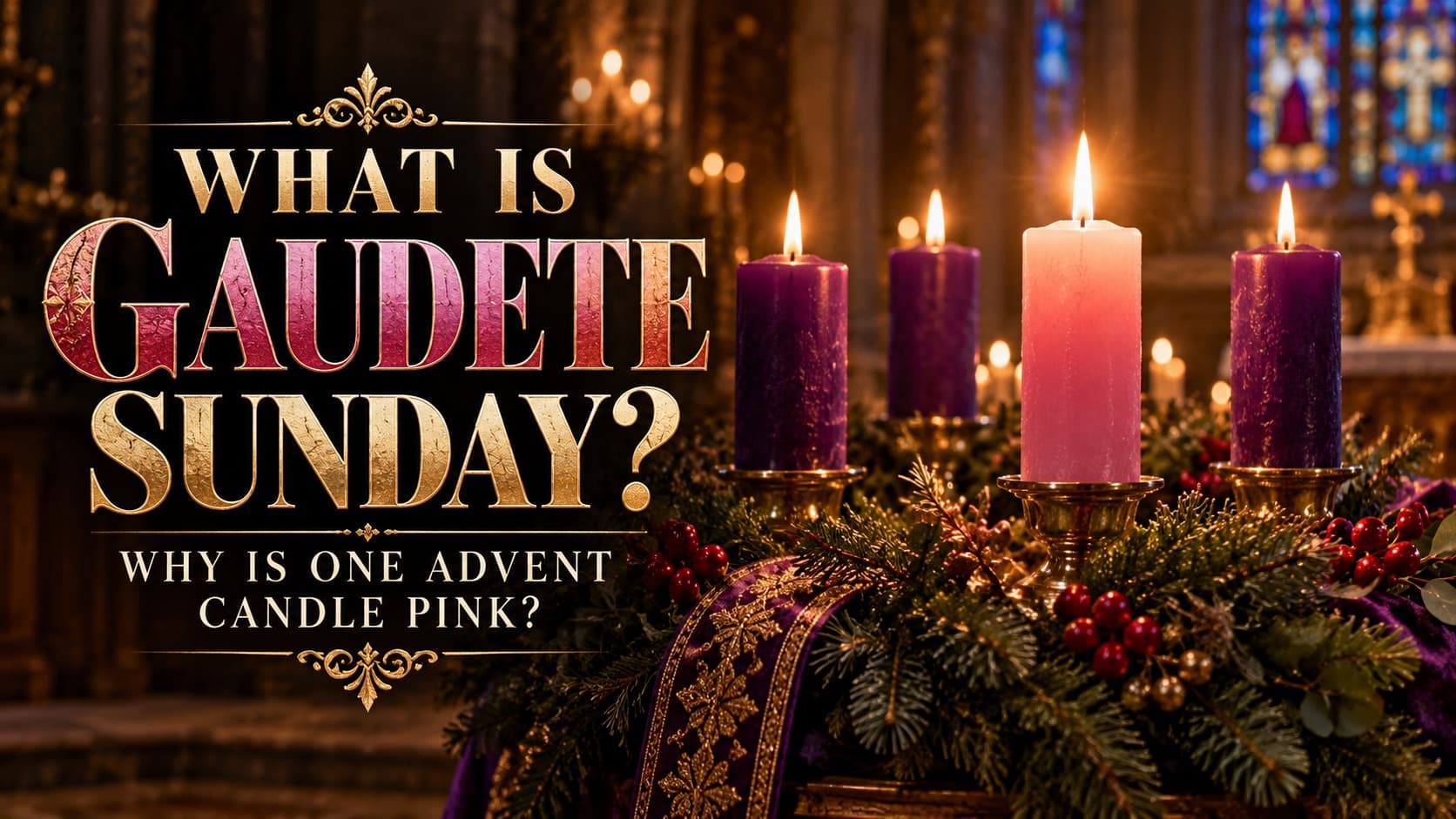
📖 What Is Gaudete Sunday? Why Is One Advent Candle Pink?
The first two purple candles felt right. Quiet. Waiting. A little heavy, even.
Then the third Sunday comes, and the candle is not purple at all.
Nobody in the pew ever gets a reason why. The priest just lights it, and moves on.
📌 Gaudete Sunday is the third Sunday of Advent, the one Sunday the church deliberately breaks its own quiet, waiting mood to tell you plainly to rejoice. The rose candle on the wreath and the rose vestments on the priest both say the same thing: the waiting is more than half finished, and joy is allowed before the answer fully arrives.
This guide walks through where the word Gaudete actually comes from, why the color changes for exactly one Sunday, what the church's own readings for the day say, and how churches outside the Catholic Church mark this same pause in their own way.
Why This Matters for Your Faith
It is easy to file this under trivia. A fun fact about a candle color.
⚠️ But look at what Gaudete Sunday is actually arguing. It is telling you that joy and waiting are not opposites. The church could have made Advent one unbroken month of purple, head down, until Christmas finally arrived. It chose not to.
Most of your own life happens in that same gap. Waiting on the diagnosis. Waiting on the marriage to heal. Waiting on the prayer that still has not been answered.
💡 Gaudete Sunday says you do not have to wait until the answer comes to feel joy again. Joy is allowed to interrupt the waiting, on God's own schedule, before the thing you are hoping for has actually shown up.
Learning why this one Sunday looks different is part of learning what Advent is actually for, instead of only treating it as the slow countdown before the real holiday starts.

What Gaudete Sunday Actually Is
1. The Word Behind the Name
Start with the word itself. Gaudete is Latin, and it is a command, not a description.
📌 It means rejoice. Catholic Extension explains that the day takes its name from the opening word of the Mass's entrance antiphon, the short chant that opens worship that Sunday. Simply Catholic traces that antiphon straight back to Paul's letter to the Philippians.
"Rejoice in the Lord alway: and again I say, Rejoice. Let your moderation be known unto all men. The Lord is at hand."
Paul did not write that line for a calendar. He wrote it from a prison cell, to a church he loved, as a flat command regardless of circumstance. Centuries later, the church took his own opening word, Gaudete, and let it name an entire Sunday.
The Lord is at hand sits right next to the command to rejoice, and that order matters.
💡 The joy is not because the trouble is over. It is because the Lord is near.
2. Why One Candle Breaks the Pattern
Most Advent wreaths carry three purple candles and one that is not. I have written a full guide to everything else the wreath means, so here the focus stays narrow: why does the third candle alone change color.
⚠️ The honest word for that color is rose, not pink. Simply Catholic cites the General Instruction of the Roman Missal, paragraph 346, which states plainly that rose vestments "may be used, where it is the practice," on Gaudete Sunday and on its Lenten counterpart, Laetare Sunday. The candle's color is chosen to match the vestment the priest is already permitted to wear that day.
A note on the word itself. EWTN's own liturgical Q&A is specific here: pink, the article says, "is not counted among the liturgical colors" at all. Rose is its own distinct shade, closer to a pale, faded red than to a nursery pink.
📌 Where a parish has no rose vestments on hand, the same source notes the priest simply wears violet instead. Rose has always been the exception for one Sunday, never the rule.
3. The History Behind the Rose Vestments
Rose did not appear on the church's calendar the way it looks today, all at once.
EWTN's Q&A notes that the earliest Christian vestments were simply white, the everyday formal dress of the ancient world, and that a settled set of rules for which color belonged to which day did not really take hold until around the middle of the sixteenth century. Color coded worship, in other words, grew up slowly, long after the church itself.
Christianity.com's own overview places the custom of a joyful pause inside Advent's penitential season back in the medieval church, once Advent itself had come to be kept with the same kind of seriousness as Lent. A season built that heavy needed its own relief valve.
That relief valve has a twin. Gaudete Sunday's counterpart in Lent is Laetare Sunday, the fourth Sunday of Lent, which gets the identical rose treatment for the identical reason. Both sit inside the church's wider calendar of penitential and festive seasons, and both exist to say the same thing on a single day: keep going, you are not as far from the finish as the color around you usually suggests.
4. What This Year's Own Readings Say
The Mass readings for Gaudete Sunday rotate on a three year cycle, Year A, Year B, and Year C, so the exact passages change depending on where the church calendar lands.
For the Third Sunday of Advent in 2026, falling on December 13, the USCCB's own daily readings list the first reading as Isaiah 61, the prophet speaking as one sent with good news.
"The Spirit of the Lord GOD is upon me; because the LORD hath anointed me to preach good tidings unto the meek; he hath sent me to bind up the brokenhearted, to proclaim liberty to the captives, and the opening of the prison to them that are bound."
In place of the usual psalm, that same USCCB page lists Mary's own song, the Magnificat, as the responsorial for the day.
"And Mary said, My soul doth magnify the Lord, And my spirit hath rejoiced in God my Saviour."
The second reading, from Paul again, makes the command to rejoice almost relentless.
"Rejoice evermore. Pray without ceasing. In every thing give thanks: for this is the will of God in Christ Jesus concerning you."
📌 Notice what is missing from all three readings. Not one of them says the hard season is already over. Isaiah is still speaking to captives. Paul wrote his letter to a young, struggling church. The command to rejoice always arrives before the circumstances finish changing, never after.
In the Year C cycle, the Gospel for this same Sunday moves to Luke 3, where crowds ask John the Baptist what they should actually do, and his answers are plain and practical, not abstract. Advent keeps circling back to people who had to act on partial information, long before the full picture of Christ arrived.
5. How Protestants Keep Their Own Pause
Gaudete Sunday is not only a Catholic observance. Christianity.com's overview names the Anglican Church and Lutheran churches alongside Rome as traditions that keep this same Sunday, often with the same rose coloring in both candle and vestment.
⚠️ Many other Protestant and evangelical churches keep an Advent wreath without ever naming the day Gaudete at all. Instead they usually land on a theme of joy for the third candle inside a wider Hope, Peace, Joy, and Love naming scheme, which I cover in full in the wreath guide linked above, since the names and even the week order shift from church to church.
📌 What stays constant underneath the different names is the same idea Catholics mark with rose. Somewhere in the middle of Advent, the mood turns toward joy on purpose, whatever each tradition happens to call that week.
Practical Ways to Keep Gaudete Sunday
You do not need a parish or a rose candle to let this Sunday mean something.
- Say out loud why the color changed. If your own church lights a wreath, tell whoever is next to you what the rose candle actually marks, instead of letting it pass unexplained the way it usually does.
- Read Philippians 4:4 and 5 before the day starts. Let Paul's own command set the tone before anything else does.
- Pray 1 Thessalonians 5:16 to 18 as written, in order. Rejoice. Pray without ceasing. Give thanks. The three commands build on each other on purpose.
- Let one bright thing interrupt a heavy week. Gaudete Sunday is not asking you to pretend the hard season is finished. It is asking you to let joy in before it is.
- Teach a child the real reason, not a guess. If someone younger asks why the candle is a different color, give them the actual answer instead of leaving it mysterious for another year.
- Hold the joy and the waiting together. Do not rush past Advent to get to Christmas, and do not let the waiting crowd out the one Sunday built for rejoicing in the middle of it.

Key Verses Behind Gaudete Sunday
1. Philippians 4:4 to 7
"Rejoice in the Lord alway: and again I say, Rejoice. Let your moderation be known unto all men. The Lord is at hand. Be careful for nothing; but in every thing by prayer and supplication with thanksgiving let your requests be made known unto God. And the peace of God, which passeth all understanding, shall keep your hearts and minds through Christ Jesus."
This is the exact passage the whole Sunday is named after.
📌 Paul does not say rejoice because everything is fine. He says rejoice because the Lord is at hand, and then hands you what to do with every anxious thing underneath that joy. Prayer. Thanksgiving. A peace that stands guard over what you cannot control.
2. 1 Thessalonians 5:16 to 18
"Rejoice evermore. Pray without ceasing. In every thing give thanks: for this is the will of God in Christ Jesus concerning you."
Three short commands, stacked on top of each other with no room to argue.
💡 Notice the word evermore. Not on the good days. Not once the circumstances improve. This is Paul telling a young, struggling church that joy is meant to be constant, which is exactly the claim Gaudete Sunday makes about one Sunday in the middle of a quiet season.
3. Isaiah 61:1 and 2
"The Spirit of the Lord GOD is upon me; because the LORD hath anointed me to preach good tidings unto the meek; he hath sent me to bind up the brokenhearted, to proclaim liberty to the captives, and the opening of the prison to them that are bound; To proclaim the acceptable year of the LORD, and the day of vengeance of our God; to comfort all that mourn."
This is the reading the USCCB assigns for Gaudete Sunday this year, and it is good news aimed squarely at people who are still captive, still bound, still mourning.
Jesus later reads this exact passage out loud in His home synagogue and says it is about Him.
📌 The good tidings were never for people whose troubles were already solved.
4. Luke 1:46 and 47
"And Mary said, My soul doth magnify the Lord, And my spirit hath rejoiced in God my Saviour."
Mary sings this while the promise inside her is still completely invisible to anyone looking at her from the outside.
💡 Her joy runs ahead of the evidence, the same way Gaudete Sunday asks the whole church to let joy run ahead of whatever is still unfinished in December.

Frequently Asked Questions About Gaudete Sunday
What does Gaudete mean?
Gaudete is Latin for rejoice. It is the first word of the entrance antiphon sung or recited at the start of Mass on the third Sunday of Advent, a line drawn from Philippians 4:4, where Paul commands the church to rejoice in the Lord always.
Why is one Advent candle pink instead of purple?
The third candle is colored rose to match the rose vestments the priest is permitted to wear that same Sunday, under paragraph 346 of the General Instruction of the Roman Missal. It marks the one deliberate break in Advent's usual purple, signaling that the season is now more than halfway finished.
What color are the vestments on Gaudete Sunday?
Rose, where that is the local practice, in place of the violet worn on every other Sunday of Advent. Where a parish has no rose vestments, the priest simply wears violet instead, since rose has always been an option rather than a requirement.
Is Gaudete Sunday the same thing as Laetare Sunday?
No, but they are a matched pair. Gaudete Sunday is the third Sunday of Advent. Laetare Sunday is the fourth Sunday of Lent, and it gets the identical rose treatment for the same reason, a brief, deliberate pause of joy inside a penitential season.
What is the Bible reading for Gaudete Sunday?
It changes with the church's three year cycle. For December 13, 2026, the USCCB lists Isaiah 61, the Magnificat from Luke 1 as the responsorial, 1 Thessalonians 5:16 to 24, and John 1:6 to 8 and 19 to 28. In the Year C cycle the Gospel instead comes from Luke 3, where John the Baptist answers the crowd's question about what to do.
Do Protestants celebrate Gaudete Sunday?
Some do by that exact name, including Anglican and Lutheran churches, which keep rose vestments and candles of their own. Many other Protestant churches keep a joy themed candle on the third week of Advent without using the word Gaudete at all.
Is Gaudete Sunday a holy day of obligation?
No. It is simply the regular Sunday Mass for the third week of Advent, kept with a different optional color. Every Sunday already carries its own obligation for Catholics, and Gaudete Sunday does not add anything beyond that.
Is pink the correct word for the candle's color?
Not officially. EWTN's own liturgical guidance states plainly that pink is not counted among the church's liturgical colors at all. The correct term is rose, a paler, more muted shade than ordinary pink.
Why does Advent get a joyful Sunday in the middle of a penitential season?
Because Advent, treated with the same seriousness as Lent since the medieval church, needed a built in reminder that the waiting has a limit. Gaudete Sunday marks that the season is more than half over, and it lets joy arrive before the final answer does, not only after.
Final Thoughts
Strip away the Latin and the vestment rules, and one plain claim is left standing.
📌 Gaudete Sunday says joy does not have to wait for the waiting to end. One Sunday, in the middle of a quiet, penitential season, the church puts on a different color and says it plainly: rejoice, the Lord is at hand.
📌 That claim did not start with a candle. It started with Paul, writing from a prison cell, commanding a church he loved to rejoice always, long before any wreath existed to put the command on display.
Whatever is still unfinished in your own life this Advent, the waiting is heading somewhere real, and it does not have to stay silent until it arrives.
❓ Is there a hard, unfinished thing in your own life right now that joy could still interrupt before it is resolved?
📌 Rejoice in the Lord always. Not because everything is finished. Because the Lord is at hand.
📚 Sources
Every claim in this article traces back to one of these. All links checked 4 November 2026.
- Rose-Colored Vestments on Gaudete Sunday
Fr. Edward McNamara, via EWTN (originally ZENIT)
The source for the General Instruction of the Roman Missal, paragraph 346, the history of vestment colors, the statement that pink is not a liturgical color, and the fallback to violet where rose vestments are unavailable.
- What is Gaudete Sunday?
Catholic Extension
The source for the name coming from the Mass's entrance antiphon and the day's place in the middle of Advent.
- Why Do We Light a Pink Candle?
Simply Catholic
The source for GIRM 346's exact wording on rose vestments and the entrance antiphon's text from Philippians 4:4.
- Daily Readings for December 13, 2026
United States Conference of Catholic Bishops (USCCB)
The source for this year's assigned Mass readings for the Third Sunday of Advent: Isaiah 61, Luke 1 as the responsorial, 1 Thessalonians 5, and John 1.
- What is Gaudete Sunday? Meaning, History, and Traditions
Christianity.com
The source for the custom's medieval roots, the list of traditions that observe Gaudete Sunday including Anglican and Lutheran churches, and the day's Latin derivation from the Mass introit.