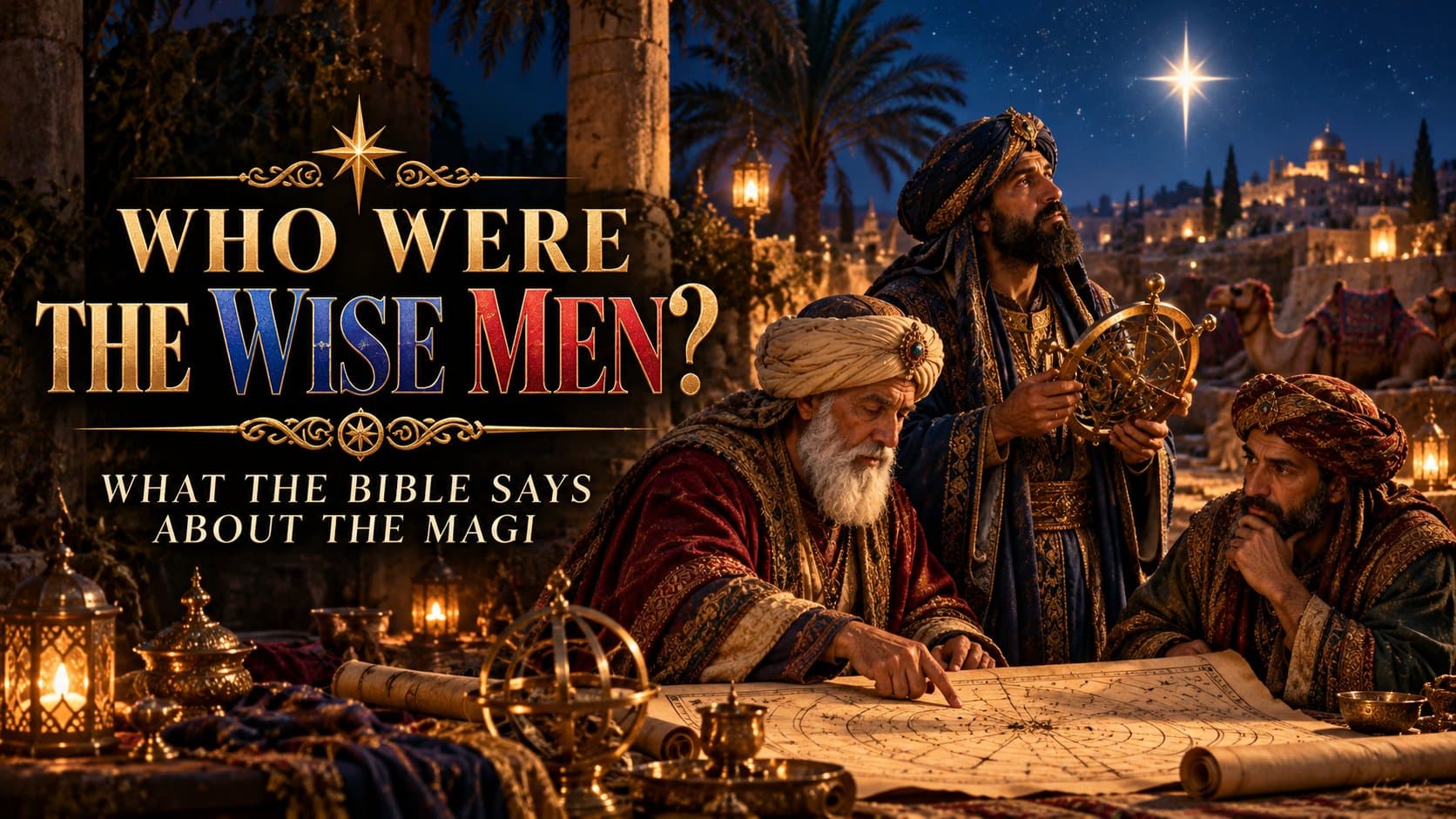
📖 Who Were the Wise Men? What the Bible Says About the Magi
Every nativity set has them. Three men in robes, crowns on their heads, kneeling by the manger right next to the shepherds.
That picture is on half the Christmas cards you will get this year.
Almost none of it is actually in the Bible.
📌 Here is the plain answer. Matthew 2 calls them magi, not kings, and never gives a number. They did not kneel at a manger on the night Jesus was born. They followed a star to a house, sometime after His birth, possibly as much as two years later, and gave Him gold, frankincense, and myrrh before a dream warned them to go home another way.
Herod the king heard about them too. What he did next is the part most nativity sets leave out entirely.
This guide walks through what Matthew 2 actually says about the wise men, who they most likely were, what the gold, frankincense, and myrrh really meant, and which parts of the familiar story, the number three, the names, the crowns, came from centuries after the apostles were gone.
Every historical claim below links back to a named source, so you can check it yourself.
Who the Wise Men Were
Matthew is the only Gospel that mentions them. Not Mark, not Luke, not John.
He calls them magi, a Greek word for a priestly class tied to astrology, found across Persia, Babylon, and parts of Arabia in the centuries around Christ's birth.
📌 Their entire story fits inside twelve verses, Matthew 2:1 through 12.
Matthew never says how many of them there were.
He never gives their names.
He never calls them kings.
💡 The early church writer Tertullian, writing around the year 200, called them "wellnigh kings," his own careful way of saying close to royalty, not actually royal.
What Matthew does say is specific. They came from the east, they followed a star, and they came looking for a newborn king to worship.
⚠️ That is already a strange detail if you stop and notice it. The first people in Matthew's Gospel to recognize Jesus as a king were not priests in Jerusalem. They were foreign astrologers who had never read Moses.
The Story of the Wise Men
1. Astrologers From a Land Matthew Never Names
"The east" is as specific as Matthew gets.
The early church fathers argued about exactly where. Some said Babylon. Some said Persia. Some said Arabia.
📌 All three answers point to the same thing. The magi were outsiders to Israel, from a world built on reading the sky for signs, not on reading the Torah for promises.
Scholars today lean toward Persia and the old Parthian Empire, centered in what is now Iran, where a Zoroastrian priesthood also called magi studied the stars as part of their religion.
💡 That background matters. These were not wandering mystics. They were trained specialists in exactly the kind of observation their own story required.
EBSCO's research entry adds one more layer. Old Testament passages like Isaiah 60 and Psalm 72 already pictured distant nations, naming regions such as Sheba, Midian, and Ephah, bringing tribute to Israel's king one day. Nobody can prove the magi had read those exact words, but a world that had already imagined this kind of visit makes the magi's own journey a little less strange.
2. A Star They Could Not Explain Away
Something in the sky convinced trained sky watchers to leave home and travel hundreds of miles.
"Now when Jesus was born in Bethlehem of Judaea in the days of Herod the king, behold, there came wise men from the east to Jerusalem, Saying, Where is he that is born King of the Jews? for we have seen his star in the east, and are come to worship him."
📌 Notice what they actually say. Not "we think" or "we wonder." "We have seen his star" and "are come to worship him."
⚠️ Exactly what that star was is one of the oldest open questions in Christian history, and honesty matters more than a tidy answer here.
Some have proposed a comet. Origen, writing in the third century, suggested it first.
Others point to a conjunction of planets. In 1614, the astronomer Johannes Kepler calculated that Jupiter and Saturn lined up three separate times in 7 BC, and argued that such a conjunction could have produced a bright new light. Modern calculations show the two planets stayed nearly a full degree apart even at their closest, which is far too wide a gap to have looked like one blazing star.
Still others point to a nova or comet, a sudden new light in the sky, recorded by Chinese and Korean observers around 4 or 5 BC and visible for weeks.
⚠️ None of those fully fits what Matthew describes a few verses later, a star that "went before" the magi and then "stood over" one specific house. Fixed stars, comets, and conjunctions do not move and stop like that.
💡 That gap between the natural explanations and the text is exactly why some scholars conclude the star, whatever it was built from, worked more like a sign given to the magi than an ordinary event anyone else would have noticed.
3. The King Who Panicked in His Own City
The magi's first stop was not Bethlehem. It was Jerusalem, Herod's own capital.
That single choice set off the whole second half of the story.
"When Herod the king had heard these things, he was troubled, and all Jerusalem with him."
Herod was not a king by birth. Rome had installed him, and he spent much of his reign killing anyone he suspected of wanting his throne, including members of his own family.
📌 A rumor of a newborn king was never going to sit quietly with a man like that.
He called in the chief priests and the teachers of the law, the very people who should have recognized the moment first, and asked them one question. Where was the Christ supposed to be born.
They had the answer instantly.
"And they said unto him, In Bethlehem of Judaea: for thus it is written by the prophet, And thou Bethlehem, in the land of Juda, art not the least among the princes of Juda: for out of thee shall come a Governor, that shall rule my people Israel."
⚠️ Notice what they did with that answer. They knew exactly where. They did not go.
📌 Having the right information is never the same thing as responding to it.
4. The Star Stood Still Over Bethlehem
Herod sent the magi on to Bethlehem privately, and asked them to report back once they found the child. He had no plans to worship anyone.
"When they had heard the king, they departed; and, lo, the star, which they saw in the east, went before them, till it came and stood over where the young child was. When they saw the star, they rejoiced with exceeding great joy."
💡 Whatever that star was, it did exactly what Herod's own scribes could not. It led outsiders straight to the one place in Judea they needed to be.
"And when they were come into the house, they saw the young child with Mary his mother, and fell down, and worshipped him: and when they had opened their treasures, they presented unto him gifts; gold, and frankincense, and myrrh."
📌 Notice the order. They saw the child. They fell down. They worshipped. Only then did they open their treasures. Matthew also calls this a house, not the stable most nativity sets still picture, which fits a visit that happened well after the night Jesus was born.
Gold made sense for a king. Frankincense was an expensive incense burned in temple worship. Myrrh was used for anointing, and later, for burial.
⚠️ It is worth saying plainly that Matthew never tells you what the gifts were supposed to mean. The church has proposed royalty, divinity, and death ever since, and some of those readings are genuinely old and worth holding loosely. None of them come from the magi's own mouths.
5. A Warning, a Flight, and a Massacre
The visit did not end quietly.
"And being warned of God in a dream that they should not return to Herod, they departed into their own country another way."
They never went back to Herod.
📌 A pagan king's dream produced the obedience that Jerusalem's own priests never managed.
Herod waited, realized he had been outwitted, and responded the way a frightened tyrant responds.
"Then Herod, when he saw that he was mocked of the wise men, was exceeding wroth, and sent forth, and slew all the children that were in Bethlehem, and in all the coasts thereof, from two years old and under, according to the time which he had diligently enquired of the wise men."
⚠️ That is the part most nativity scenes leave entirely off the table. The visit that fills a nativity set also sits right next to the murder of an unknown number of small children in one town.
Joseph, warned in his own dream, had already fled with Mary and Jesus into Egypt by then.
💡 The timing in that decree, "two years old and under," is itself a clue. Herod was not guessing at a baby born that same week. He was accounting for a window of time that had already passed, which is one of several details the actual Christmas story gets right that most retellings skip.

Lessons From the Wise Men's Example
1. God speaks to the people you would not expect
The magi were not Jewish. They had never read the Torah. By every insider measure, they were the last people who should have recognized Israel's king first.
They did anyway.
❓ Who in your own life seems like an unlikely candidate to point you back to God?
2. Information without obedience changes nothing
The chief priests and scribes in Jerusalem could quote the prophecy about Bethlehem on command.
Not one of them walked the six miles to go check.
⚠️ Knowing where God is does not move you an inch closer to Him. Only going does.
3. Real worship gives something up
The magi crossed a desert and opened their most valuable possessions before they ever asked for anything in return.
📌 Worship that costs you nothing is usually just admiration wearing worship's clothes.
4. The same news brings joy to one person and terror to another
The star that filled the magi with exceeding great joy is the same star that troubled Herod and all of Jerusalem a few verses earlier.
💡 The gospel has never once been neutral news. It is either the best thing you have heard or a direct threat to whatever throne you are protecting.
5. A long, uncertain journey is not proof God is absent
A trip from Persia or Babylon to Judea on foot or by camel took months, through territory the magi had never crossed, toward a king they had never met.
Nothing in the text says the star stayed visible the entire way. Matthew only mentions it again once they left Jerusalem for Bethlehem.
⚠️ They may well have traveled through long stretches with no sign at all, holding onto what they had already seen once.
📌 That is usually how faith actually works. You rarely get the sign refreshed every single day. You remember the one you already got, and you keep walking.
Key Verses From the Wise Men's Story
1. Matthew 2:1 and 2
"Now when Jesus was born in Bethlehem of Judaea in the days of Herod the king, behold, there came wise men from the east to Jerusalem, Saying, Where is he that is born King of the Jews? for we have seen his star in the east, and are come to worship him."
The whole journey starts with a question asked in the wrong city, to the wrong king, by travelers who already believed the answer before they arrived.
2. Micah 5:2
"But thou, Bethlehem Ephratah, though thou be little among the thousands of Judah, yet out of thee shall he come forth unto me that is to be ruler in Israel; whose goings forth have been from of old, from everlasting."
Written roughly seven hundred years before Herod's scribes quoted it back to him in Matthew 2:6. The prophecy was never hidden. It was simply ignored by the people closest to it.
3. Matthew 2:9 and 10
"When they had heard the king, they departed; and, lo, the star, which they saw in the east, went before them, till it came and stood over where the young child was. When they saw the star, they rejoiced with exceeding great joy."
Trained astrologers, men paid to read the sky calmly, rejoiced with exceeding great joy. That is not the language of professional curiosity. It is the language of people who knew exactly what they were looking at.
4. Matthew 2:11
"And when they were come into the house, they saw the young child with Mary his mother, and fell down, and worshipped him: and when they had opened their treasures, they presented unto him gifts; gold, and frankincense, and myrrh."
A house, not a stable. Worship, then gifts, in that order. The whole familiar image of the manger scene is quietly corrected by one verse most people have never read closely.
5. Matthew 2:16
"Then Herod, when he saw that he was mocked of the wise men, was exceeding wroth, and sent forth, and slew all the children that were in Bethlehem, and in all the coasts thereof, from two years old and under, according to the time which he had diligently enquired of the wise men."
The verse the Christmas pageant never performs. The same visit that fills a nativity set with gold and incense also sits one page away from a massacre.
Established and Unsettled
✅ What is established
- Matthew 2:1 to 12 says magi from the east followed a star to Jerusalem and then Bethlehem, worshipped Jesus, gave gold, frankincense, and myrrh, and were warned in a dream not to return to Herod.
- Herod questioned the chief priests and scribes, who answered with the prophecy in Micah 5:2, and Herod's resulting decree, killing children "two years old and under," implies the magi's visit happened well after the night Jesus was born, not on it.
- Ancient writers including Tertullian and Clement of Alexandria describe the magi as a priestly class tied to astrology in Persia, Babylon, or Arabia. Matthew himself never names their homeland.
- No astronomical theory, comet, planetary conjunction, or nova, fully matches a star Matthew describes as moving ahead of the magi and then standing still over one house, which is why some scholars treat the star as outside purely natural explanation.
⚠️ What is still uncertain
- Matthew never gives their number. The tradition of exactly three appears to come from the three gifts rather than from the text itself, and early Christian art shows anywhere from two to eight figures.
- The names Caspar, Melchior, and Balthasar come from an eighth century Latin source, centuries after Matthew wrote. Other ancient traditions give entirely different names.
- Whether the magi were kings is tradition, not Matthew's wording. The idea grew later, tied to readings of Psalm 72 and Isaiah 60, and reformer John Calvin rejected it outright.
- What the three gifts symbolized. The church has proposed royalty, divinity, and death for centuries, but Matthew records no explanation from the magi themselves.

Frequently Asked Questions About the Wise Men
Were the wise men kings?
Matthew never calls them kings. He calls them magi, a term for a priestly class tied to astrology. The idea that they were kings grew later, connected to Old Testament passages about kings bringing tribute, and was widely accepted by about the fifth century.
How many wise men were there?
Matthew never gives a number. The tradition of three seems to come from the three gifts, gold, frankincense, and myrrh, rather than from any verse stating a count. Early Eastern Christian tradition often said twelve instead.
What were the wise men's names?
The Bible gives no names at all. Caspar, Melchior, and Balthasar first appear together in an eighth century Latin text, roughly seven hundred years after Matthew wrote. Eastern Christian traditions preserve entirely different names for the same figures.
Where did the wise men come from?
Matthew says only "the east." Ancient writers argued for Babylon, Persia, or Arabia. Most scholars today favor Persia or the old Parthian Empire, where a priestly class called magi practiced astrology as part of their religion.
What was the star of Bethlehem?
Nobody knows for certain. Proposed explanations include a comet, a conjunction of Jupiter and Saturn or Jupiter and Venus, and a nova recorded in Chinese records around 5 BC. None of these fully matches a star that moved ahead of the magi and then stood still over one house.
Did the wise men visit Jesus in the manger on Christmas night?
No. Matthew 2:11 says they came into "the house," not a stable, and Herod's later decree targeted children up to two years old. Most readers place the magi's visit well after the night the shepherds came, likely months or up to roughly two years later.
What do the gifts of gold, frankincense, and myrrh mean?
Matthew records the gifts without explaining them. The church has long read gold as fitting a king, frankincense as fitting temple worship, and myrrh as pointing toward burial, but these are later interpretations, not the magi's own stated reasons.
Why does the church celebrate the wise men on a different day than Christmas?
Western churches honor the visit of the magi on January 6, the Feast of the Epiphany, sometimes called Three Kings Day, twelve days after Christmas. Orthodox churches that still follow the older Julian calendar keep the same feast later, since their whole calendar runs about thirteen days behind the one most Western churches use.
How far did the wise men actually travel?
Nobody can say exactly, since Matthew never names their homeland precisely. If they came from Babylon or Persia, the distance to Jerusalem runs somewhere around five hundred to nine hundred miles, depending on the route, a journey of weeks or months on foot or by camel in the ancient world.
What happened to the wise men after they returned home?
The Bible never says. Matthew 2:12 is the last verse that mentions them, and no other book of the New Testament brings them up again. Later legends gave them elaborate endings, but none of those stories can be checked against Scripture or any contemporary record.
Is the story of the wise men historically true?
Matthew presents it as a real event involving a real ruler, Herod, who is well documented outside the Bible. Some modern scholars treat the account as theological storytelling rather than strict history, but nothing in the text itself marks it as legend the way later additions, like the names and the number three, clearly are.
Final Thoughts
Strip away the crowns, the names, and the fixed number three, and the real story is still remarkable.
📌 Outsiders with no claim on Israel's promises were the ones who went looking. Insiders who knew the prophecy by heart stayed home.
📌 The gifts came after the worship, not before it. They gave because they had already recognized who He was.
📌 The same news divided a city the moment it arrived. Great joy for the travelers. Trouble for the throne.
You do not need the right number of wise men, or their legendary names, to take something real from this story. It is still the same child the rest of the Christmas story points to. The only real question the magi leave you with is the one they already answered for themselves. Having seen Him, will you go, and will you worship before you ever ask what it costs?
📚 Sources
Every claim in this article traces back to one of these. All links checked 2 November 2026.
- Magi
Catholic Encyclopedia, New Advent
The source for the early church fathers' disagreement over the magi's homeland, Tertullian calling them "wellnigh kings," the uncertain number and names, and the argument that only a miraculous phenomenon fits the star's described movement.
- Magi
EBSCO Research Starters
The source for the magi as a Persian priestly caste linked to astrology and Zoroastrianism, and the Old Testament regions sometimes proposed for "the east."
- Biblical Magi
Wikipedia
The source for the eighth century Excerpta Latina Barbari as the first appearance of the names Melchior, Caspar, and Balthazar, the later development of the kings tradition tied to Psalm 72 and Isaiah 60, John Calvin's rejection of it, and the Western Feast of the Epiphany on January 6.
- Star of Bethlehem
Wikipedia
The source for Johannes Kepler's 1614 Jupiter and Saturn conjunction theory, the modern calculation that the planets stayed nearly a degree apart, the Chinese and Korean records of a nova or comet around 4 to 5 BC, and the lack of scholarly consensus on any single explanation.