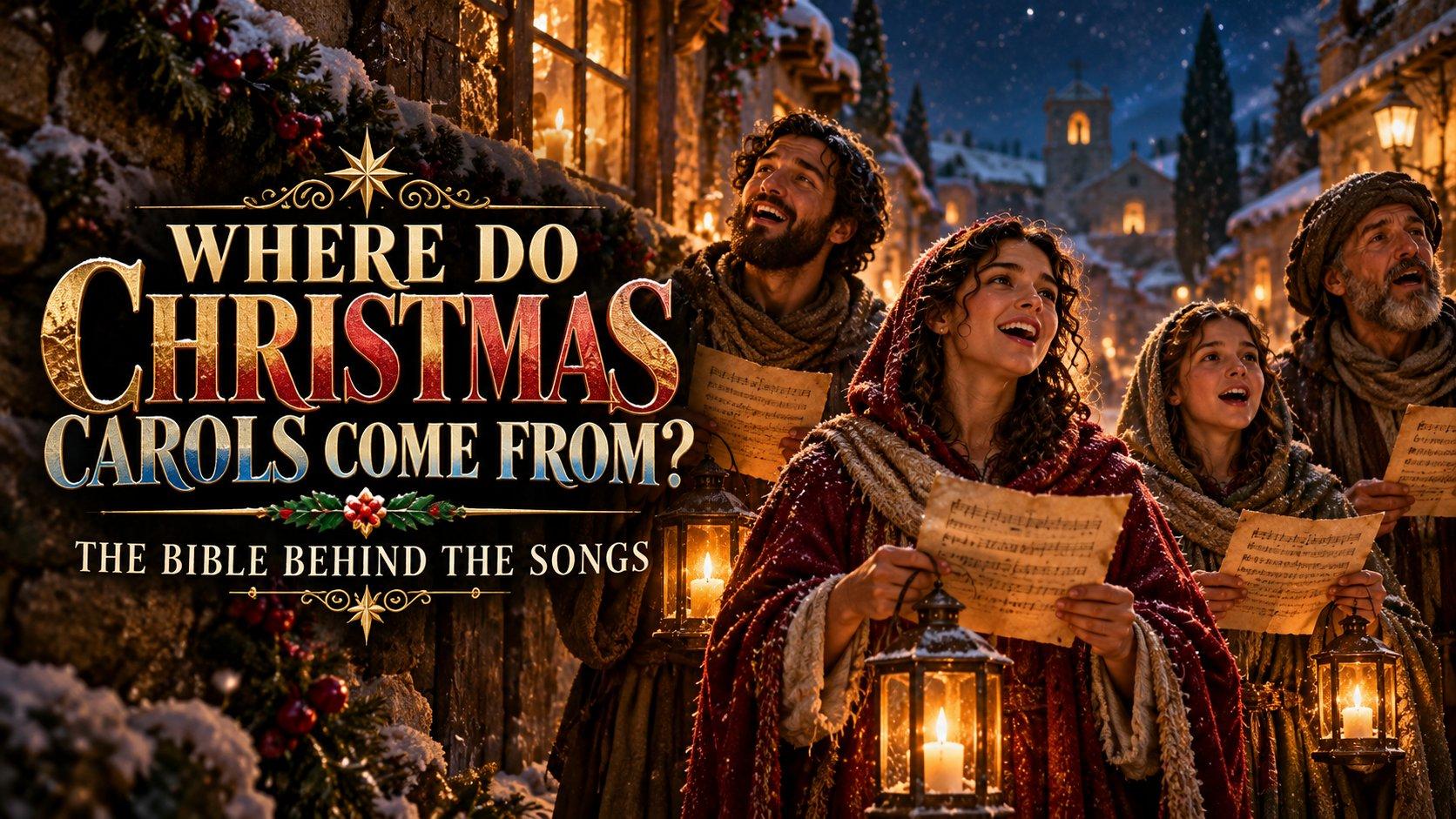
📖 Where Do Christmas Carols Come From? The Bible Behind the Songs
You hum them before you even decide to.
A store speaker plays four notes and your whole body already knows what comes next.
Silent Night. Joy to the World. Hark the Herald Angels Sing.
You have probably sung some of these since you were small enough to stand on a pew next to your mother.
📌 Here is the question almost nobody stops to ask. Where do Christmas carols actually come from?
Maybe a relative once told you every carol is secretly a coded Catholic catechism, smuggled past persecutors one gift at a time. Maybe someone else told you caroling started as a pagan ritual the church never fully Christianized. Maybe you have just always assumed these songs showed up fully formed, the way the manger scene seems to appear in your living room every November.
None of that is quite right.
The real story starts earlier than any hymn book. Before a single carol was written down, Scripture already had people bursting into song the moment Christ arrived. Mary sang. A multitude of angels sang.
📖 The first Christmas songs are not folk tunes. They are in your Bible.
This guide walks through those biblical songs first, then the documented history behind the carols you actually sing: where the word "carol" came from, why one country banned Christmas singing by law, and the true stories behind four carols you will sing again this December. Every historical claim below links to a named source you can check.
Why This Matters for Your Faith
It would be easy to treat carol trivia as a harmless party game.
Which one is older. Which legend is true. Which verse got cut from the version everyone sings now.
⚠️ But Christians are called to tell the truth, especially about their own history. A faith that needs an invented legend to feel significant is quietly admitting the real story is not enough. It is enough.
Here is what is actually at stake. Every Christmas carol worth singing does one thing Scripture already did first: puts words in your mouth for something too big to say in your own.
Mary did not compose her song because she was a poet looking for a subject. She sang because what had just happened to her had no other size of response.
📌 That is what a real carol is for. Not decoration for December. A way to say something your ordinary sentences cannot hold.
Dressing up a party game as secret resistance literature, or turning a hymn writer's honest grief into myth, does not make the season holier. It makes Christians careless with facts the next time someone checks one.
💡 The Incarnation does not need help from a legend. God became a baby, named by an angel, announced to shepherds, worshipped by strangers from the east. That is already the first Christmas worth singing about. Everything else is commentary.

The Real Story Behind the Songs You Sing
1. The Bible Already Has the First Christmas Songs
Before Isaac Watts, before Charles Wesley, before a single hymnal existed, Luke's Gospel had already recorded people breaking into song over the birth of Christ.
Mary sings first, the moment she realizes what God has actually done through her.
"And Mary said, My soul doth magnify the Lord, And my spirit hath rejoiced in God my Saviour. For he hath regarded the low estate of his handmaiden: for, behold, from henceforth all generations shall call me blessed."
That is the Magnificat, sung by a teenage girl in a relative's house, months before the first Christmas even happened.
Then, the night Christ is actually born, the sky itself joins in. A multitude of angels tells a field of shepherds what no carol since has improved on.
"Glory to God in the highest, and on earth peace, good will toward men."
📌 Say that plainly. The first Christmas carol on record was sung by angels, not by anyone with a hymnal.
Every carol written since, folk song or four part harmony, is a human being trying to catch up to that one.
2. Where the Word "Carol" Actually Comes From
Here is a detail most people singing carols every December have never once wondered about. The word did not start out meaning a Christmas song at all.
The Online Etymology Dictionary traces "carol" back to the Old French word carole, meaning a kind of ring dance accompanied by singers. English writers were already using the word that way by around 1300, a full two centuries before anyone attached it to Christmas specifically.
⚠️ A carol started life as a dance, not a hymn. The sense of "Christmas hymn of joy" only shows up around the year 1500, layered on top of a much older word for people holding hands in a circle and singing.
Wikipedia's entry on the Christmas carol notes that by the thirteenth century, popular Christmas songs in everyday language had developed in France, Germany, and especially Italy, under the influence of Francis of Assisi, whose Nativity scenes gave ordinary people a reason to sing about Christ's birth in their own tongue instead of church Latin.
💡 Francis did not invent the carol. He helped make room for one, turning Christmas into something ordinary people sang, not just watched priests observe.
That dance origin is also why some early carols carried echoes of older midwinter custom alongside the Christian words, a dance repurposed rather than invented from nothing.
3. Martin Luther Put Christmas Songs in the People's Own Language
For centuries, congregations in the West mostly listened to Latin chant rather than singing it themselves. The Reformation changed that on purpose.
Martin Luther wrote "Vom Himmel hoch, da komm ich her," known in English as "From Heaven Above to Earth I Come," published with its own melody in Joseph Klug's hymnal in 1535. A popular story says he wrote it for his own five year old son's Christmas Eve, but no record from Luther's own lifetime confirms that, so hold it loosely as legend rather than fact.
📌 What is well documented is the intent behind it. Luther wanted ordinary German families singing Scripture's own Christmas story in their own tongue, not watching it performed in a language they could not follow. That sat right alongside the larger project of the Reformation itself, putting God's word directly into people's hands and mouths. The English version most churches know, Catherine Winkworth's "From Heaven Above to Earth I Come," is a translation from 1855, three centuries after Luther's original.

4. England Banned Christmas Carols by Law for Thirteen Years
This is the part of carol history most people never hear, and it is not a legend. It is an actual act of Parliament.
On 8 June 1647, England's Parliament passed what is formally known as An Ordinance for Abolishing of Festivals, recorded by the Institute of Advanced Legal Studies at the University of London. It abolished Christmas, Easter, and Whitsun outright, and celebrating any of them became a punishable offense.
⚠️ Singing a carol in public could have landed you in legal trouble. Parliament's Puritan majority saw Christmas revelry, caroling included, as an unscriptural holiday dressed up as worship.
Wikipedia's entry on the Christmas carol records that carols survived anyway, sung privately in homes and at semi-clandestine services. The ban did not end caroling. It only pushed it indoors.
Enforcement did not go smoothly everywhere. Riots broke out in Canterbury on Christmas Day 1647 when residents defied the ordinance. The ban lasted until the monarchy was restored in 1660, thirteen years after it began.
💡 Carols did not survive those thirteen years because a law allowed them. They survived because people kept singing them anyway, quietly, in rooms nobody could legislate.
5. Victorian Collectors Rescued Carols That Were Already Dying Out
Jump forward almost two centuries, and most of England's old folk carols were fading out of living memory, kept alive only by older villagers who had learned them by ear, never from print.
A Cornish scholar named Davies Gilbert published Some Ancient Christmas Carols in 1822, eight carols with their tunes, drawn from his own memory of Christmas in Cornwall. A Gresham College lecture on the carol's nineteenth century history quotes Gilbert saying he was "desirous of preserving them in their actual forms," exactly as villagers had sung them.
📌 That same lecture credits Gilbert with setting "the wheels of the carol revolution in motion." Eleven years later, a London solicitor named William Sandys published Christmas Carols, Ancient and Modern, eighty carol texts and eighteen tunes, holding the earliest known printed tunes for "The First Nowell" and "I Saw Three Ships," carols that might otherwise have died with the last people who remembered them by heart.
Neither man was a trained musician, and critics have pointed out real mistakes in their printed tunes. That does not erase what they did. A real share of the carols still sung today would have no written record without them. A further collection in 1871, Christmas Carols New and Old by Bramley and Stainer, carried the revival into the hymnals churches still use.
The way another famous Christmas song's real history also shows, the documented story here never needed a legend layered on top to be worth telling.
6. The True Stories Behind Four Carols You Already Know
Four familiar carols, and what actually happened behind each one.
Silent Night. Joseph Mohr, a young Austrian priest, wrote the words as a poem in 1816. Franz Xaver Gruber, a schoolmaster nearby, composed the music in 1818, and the two performed it together that Christmas Eve at St. Nicholas Church in Oberndorf. A popular legend says a broken organ forced them to use a guitar instead. That detail is not confirmed. Wikipedia notes flooding may have affected the organ, but the famous mouse-eaten version of the story traces only to a fictional 1930s American account, not to Mohr or Gruber themselves.
O Holy Night. French poet Placide Cappeau wrote "Minuit, Chrétiens" in 1847, and composer Adolphe Adam set it to music the same year. John Sullivan Dwight, an American Unitarian minister and committed abolitionist, translated it into English in 1855. Per America Magazine's history of the carol, Dwight's third verse departs sharply from Cappeau's French original, describing Christ breaking every chain and calling the enslaved person "our brother." The English version became especially popular in the American North during the Civil War years that followed.
Hark! The Herald Angels Sing. Charles Wesley published the original text in 1739, intending it sung to the same tune as his Easter hymn "Christ the Lord Is Risen Today." George Whitefield rewrote the opening lines in 1753, giving the hymn its familiar words. The tune almost everyone knows was never written for it at all. Felix Mendelssohn composed it in 1840 for a cantata marking the printing press's four hundredth anniversary. Organist William Hayman Cummings fitted that melody to Wesley's words in 1855, more than a century later.
Joy to the World. Isaac Watts published the text in 1719 as a Christian reading of Psalm 98, with no mention of Christmas at all. The tune called "Antioch" is usually credited to American composer Lowell Mason, who published his 1848 arrangement labeled "from Handel," pointing to a resemblance with the opening of Handel's Messiah. Handel scholars question that link, and similar tunes existed before Mason's. Watts was writing about Christ's coming kingdom, not Bethlehem, which is exactly why congregations folded it into Christmas anyway.
💡 Notice what all four have in common. None needed an embellished legend. A poem turned into a Christmas Eve performance, a translator's abolitionist conviction, a tune borrowed from a printing anniversary, a psalm set to music a century late, are already remarkable on their own.

Practical Tips for Singing Carols With Your Eyes Open
You do not need to become a hymnology scholar to let this history actually change how you sing this year.
- Read Mary's whole song out loud this Advent. Luke 1:46 to 55 is a carol in its own right. Reading it as one, slowly, is a different experience than skimming past it on the way to the manger.
- Check a legend before you repeat it. If a Christmas story sounds too perfectly symbolic, a secret code, a mouse chewing an organ, look it up before you forward it to the family group chat.
- Learn one real carol history this year, not just the tune. Pick a favorite and find out who actually wrote it and why. It will change how you sing it.
- Teach your kids the Bible behind the song, not only the melody. A child who knows Luke 2:14 will hear "Glory to God in the highest" differently next time it plays.
- Thank God for the people who kept these songs alive. A Cornish scholar with a good memory and a London solicitor with a notebook are why you still have some of these carols at all.
- Sit with one line instead of singing on autopilot. Pick a phrase, like "let every heart prepare him room," and let it land before moving on.
- Let Psalm 98's command shape your singing, not just your playlist. Scripture does not just permit Christmas music. It commands a new song for what God has done.
- Sing the verses that make you uncomfortable, not only the easy ones. A carol about chains breaking, not just a baby in straw, is doing real theological work. Do not skip to the chorus.
Top Bible Verses Behind Christmas Carols
These five passages are where the whole tradition of carol singing actually starts.
1. Luke 2:13 and 14
"And suddenly there was with the angel a multitude of the heavenly host praising God, and saying, Glory to God in the highest, and on earth peace, good will toward men."
This is the oldest Christmas carol on record, and no human composer wrote a single note of it.
Every "Hark" and every "Gloria" sung since is a human choir trying to join a song that started in heaven first.
2. Luke 2:10 and 11
"And the angel said unto them, Fear not: for, behold, I bring you good tidings of great joy, which shall be to all people. For unto you is born this day in the city of David a Saviour, which is Christ the Lord."
Before the angels ever sing, one of them makes an announcement, and "good tidings of great joy" is the phrase almost every joyful carol since has been trying to put into new words.
This is the verse behind the joy, long before anyone set it to a tune.
3. Luke 1:46 to 48
"And Mary said, My soul doth magnify the Lord, And my spirit hath rejoiced in God my Saviour. For he hath regarded the low estate of his handmaiden: for, behold, from henceforth all generations shall call me blessed."
A teenage girl, newly pregnant and far from home, is the first person on record to sing about the Incarnation.
Her song still outlasts most of what has been written since.

4. Psalm 98:1
"O sing unto the LORD a new song; for he hath done marvellous things: his right hand, and his holy arm, hath gotten him the victory."
Isaac Watts read this psalm and heard Christ's coming kingdom inside it, which is how a seven hundred year old Hebrew command to sing something new became "Joy to the World."
📌 God has always wanted a new song for a new thing He has done. Every genuine carol is an answer to that command, not just a December decoration.
5. Colossians 3:16
"Let the word of Christ dwell in you richly in all wisdom; teaching and admonishing one another in psalms and hymns and spiritual songs, singing with grace in your hearts to the Lord."
Paul puts singing right next to teaching, not beneath it.
A carol that gets its theology right is not simply nice background music. It is one believer teaching another, set to a tune you cannot help humming.
Frequently Asked Questions About Christmas Carols
Where do Christmas carols come from?
The tradition traces back to Luke's Gospel, where Mary and a multitude of angels break into song around Christ's birth. The word "carol" itself started as a term for a circle dance and only picked up its Christmas meaning around 1500, and the actual songs people sing today were written, banned, nearly lost, and rescued across centuries of documented history.
What is the oldest Christmas carol?
If you count the angels' own song in Luke 2:14, the oldest carol is in Scripture itself. Among carols written by named people, vernacular Italian Christmas songs from the thirteenth century, under the influence of Francis of Assisi, are among the earliest still studied today.
Who wrote Silent Night?
Joseph Mohr wrote the words in 1816, and Franz Xaver Gruber composed the music in 1818. They first performed it together on Christmas Eve 1818 at a church in Oberndorf, Austria. The popular story about a broken organ forcing them to use a guitar is not confirmed by any record from either man.
Why were Christmas carols banned in England?
England's Puritan controlled Parliament passed An Ordinance for Abolishing of Festivals on 8 June 1647, making Christmas celebration, caroling included, a punishable offense. The ban lasted until the monarchy was restored in 1660, though people kept singing carols privately the whole time.
What is the difference between a carol and a hymn?
A hymn is any song of praise to God, written for worship in general. A carol is more specific, a joyful song tied to a season, most often Christmas, and it often has folk roots rather than starting life in a church hymnal. Many favorites, like "Joy to the World," are really hymns that became carols by popular use.
Did Martin Luther write Christmas carols?
Yes. Luther wrote "Vom Himmel hoch, da komm ich her," published in 1535, so that German families could sing the Christmas story in their own language instead of only hearing it chanted in Latin. The English version, "From Heaven Above to Earth I Come," is a much later 1855 translation.
What does the word "carol" actually mean?
It comes from the Old French word carole, a ring dance performed with singing. The word meant that dance for roughly two centuries in English before it picked up the sense of a Christmas hymn, around the year 1500.
Who wrote O Holy Night?
Placide Cappeau wrote the original French poem in 1847, and Adolphe Adam set it to music the same year. John Sullivan Dwight, an American abolitionist minister, translated it into English in 1855, adding language about breaking chains and calling the enslaved "our brother" that is not in the original French.
Was "Joy to the World" written as a Christmas song?
No. Isaac Watts published it in 1719 as a paraphrase of Psalm 98 about Christ's coming kingdom, with no reference to Christmas at all. Congregations later adopted it as a Christmas carol because its picture of a King arriving fit the season so well.
Why do Christians sing carols at Christmas?
Because Scripture started the pattern. Mary sang, angels sang, and Paul later told believers to teach each other through psalms, hymns, and spiritual songs. Caroling continues a response to the Incarnation the Bible already records happening on the first Christmas.
Final Thoughts
Strip away the legends, and three things remain true about where Christmas carols actually come from.
📌 The Bible sang first. Mary and a multitude of angels were already bursting into song over Christ's arrival long before anyone wrote a carol.
📌 The real history needs no embellishment. A banned holiday, a rescued oral tradition, a priest's simple poem, a translator's conviction about slavery. Every one of those stories is already remarkable without a single invented detail added.
📌 Singing was never meant to be passive. Colossians 3:16 calls it teaching, set to a melody you cannot help carrying with you out of the sanctuary.
Whatever carol gets you this year, the one that catches in your throat before you expect it to, you can sing it for what it actually is. Not a coded legend. Not just a December habit. A small human attempt to join a song that started in heaven, over one specific birth, on one specific night.
Go ahead and sing it loud this year. Heaven already did.
📚 Sources
Every claim in this article traces back to one of these. All links checked 8 November 2026.
- Carol
Online Etymology Dictionary
The source for the word's origin in Old French carole, a ring dance accompanied by singing, its English use from around 1300, and its Christmas hymn sense only appearing around 1500.
- Christmas carol
Wikipedia
The source for vernacular Christmas songs developing in thirteenth century Italy under the influence of Francis of Assisi, and for carols surviving privately and at semi-clandestine services during England's Puritan ban.
- On this day, 25 December 1647: Christmas was cancelled
IALS Blog, Institute of Advanced Legal Studies, University of London · 2021
The source for the exact 8 June 1647 date of An Ordinance for Abolishing of Festivals, its abolition of Christmas, Easter and Whitsun, and the Canterbury riots that followed.
- Vom Himmel hoch, da komm ich her
Wikipedia
The source for Luther's carol being published in Joseph Klug's 1535 hymnal, the unconfirmed legend about his son, and Catherine Winkworth's 1855 English translation.
- The 19th-century Taming of the Christmas Carol, from St Erth to Truro
Gresham College
The source for Davies Gilbert's 1822 collection and his own words about preserving the carols' actual forms, for Gilbert 'setting the wheels of the carol revolution in motion,' and for William Sandys's 1833 collection holding the earliest known tunes for 'The First Nowell' and 'I Saw Three Ships.'
- Silent Night
Wikipedia
The source for Joseph Mohr's 1816 text, Franz Xaver Gruber's 1818 music, their Christmas Eve 1818 performance at Oberndorf, and the unconfirmed broken organ legend tracing to a 1930s fictional account.
- How 'O Holy Night' Became an Anthem Against Slavery
America Magazine · 2023
The source for Placide Cappeau's 1847 French poem, Adolphe Adam's music, and John Sullivan Dwight's 1855 English translation and its abolitionist third verse.
- Hark! The Herald Angels Sing
Wikipedia
The source for Charles Wesley's 1739 text, George Whitefield's 1753 revision, Felix Mendelssohn's 1840 cantata melody, and William Hayman Cummings fitting the tune to the words in 1855.
- Joy to the World
Wikipedia
The source for Isaac Watts's 1719 text as a paraphrase of Psalm 98, and Lowell Mason's 1848 'Antioch' tune and its disputed connection to Handel.