📖 Deuteronomy 25 Explained: An Ox, a Widow's Duty, and Honest Weights
A beating with a number attached before it starts. An ox eating while it still works. A widow walking to the city gate because her husband's brother will not do his duty.
Deuteronomy 25 explained is nineteen verses that keep landing in the same unexpected place: a limit. A limit on how far a court can go punishing a guilty man. A limit on withholding food from a working animal. A limit on letting a family's name quietly disappear. A limit on cheating someone with a rigged scale. Even the closing verses, about a vicious enemy, come with a limit: a command to remember exactly what was done so it never happens again unnoticed.
You may have skimmed this chapter and filed the stranger parts, a loosened shoe, a spit in the face, a severed hand, under rules harsher than almost anything else in Deuteronomy.
- ❓ Why does Paul quote a verse about an ox twice in the New Testament?
- ❓ Why would a widow want her brother in law publicly shamed?
- ❓ Is Deuteronomy 25:11 and 12 really commanding someone's hand cut off?
- ❓ What does Amalek have to do with any of this?
📌 Deuteronomy 25 is Moses setting a limit on nearly everything Israel could do to someone else: a court to a guilty man, a creditor to a debtor, a brother to a widow, a merchant to a customer, even a nation at war.
Walk through it slowly. A few of these verses sound stranger out of context than they do once you see exactly what each one is actually protecting.
What Happened Just Before This Chapter
Deuteronomy 24 closed on a field, with grain, olives, and grapes left behind on purpose, every single harvest, for the stranger, the fatherless, and the widow.
Deuteronomy 25 keeps that same widow in view for its first major law, then widens the subject again and again. Instead of one owner's duty toward a poor neighbor, this chapter covers a judge handing down a sentence, a farmer working beside his own ox, a family's name on the edge of disappearing, two people in a street fight, a merchant's scale, and a nation Israel is told never to forget. Different settings, same Moses, still drawing a line between what someone is allowed to take from another person and what must be left alone.

Deuteronomy 25 Explained Verse by Verse
1. Judges, Justice, and a Beating Measured in Advance (verses 1 to 3)
The chapter opens in a courtroom, with two men and a dispute neither side will drop on its own.
"If there be a controversy between men, and they come unto judgment, that the judges may judge them; then they shall justify the righteous, and condemn the wicked."
"Justify" here does not mean excuse. It means the judge formally declares the righteous party innocent and the wicked party guilty, a verdict stated plainly before any punishment follows. Only after that verdict does Moses describe what the sentence can actually look like.
"And it shall be, if the wicked man be worthy to be beaten, that the judge shall cause him to lie down, and to be beaten before his face, according to his fault, by a certain number. Forty stripes he may give him, and not exceed: lest, if he should exceed, and beat him above these with many stripes, then thy brother should seem vile unto thee."
📌 The judge has to watch the punishment happen in front of him, and the number of blows is capped before the first one lands. Forty is a ceiling, not a standard sentence, since "according to his fault" means a lesser crime gets fewer stripes. The reason given for the cap has nothing to do with the crime itself. It is about what the man remains afterward, "thy brother," refusing to let a legal punishment strip a guilty neighbor of basic standing in front of the whole community watching.
💡 Centuries later, Paul describes exactly this limit still shaping how it was carried out.
"Of the Jews five times received I forty stripes save one."
Jewish courts by Paul's time capped lashings at thirty nine, one short of Moses's forty, as a safeguard against a miscount ever crossing the line God had set. Paul carried the marks of a law written here more than a thousand years before he was born, still being carefully obeyed.
2. The Ox That Was Never Muzzled (verse 4)
One verse, with no stated connection to anything around it.
"Thou shalt not muzzle the ox when he treadeth out the corn."
An ox walked in circles over cut grain to separate it from the stalk, surrounded the entire time by the food it was producing. Muzzling it would stop the animal eating while it worked a full day for someone else's harvest. 📌 One sentence, and it still reaches further than the chapter it sits in. Paul quotes this exact verse twice, applying it to people rather than animals.
"For it is written in the law of Moses, Thou shalt not muzzle the mouth of the ox that treadeth out the corn. Doth God take care for oxen?"
Paul's question is rhetorical. He is not debating the welfare of oxen. He is arguing that if God legislated fair treatment for a working animal, the same God expects fair pay for a minister living off the gospel he preaches. He makes the identical argument, with the identical verse, in a letter to Timothy.
"For the scripture saith, Thou shalt not muzzle the ox that treadeth out the corn. And, The labourer is worthy of his reward."
💡 Deuteronomy 25:4 becomes, in Paul's hands, the Old Testament backing for paying a pastor. A command about one animal's feed turns out to carry a principle wide enough to fund centuries of ministry.

3. A Brother's Duty, Refused in Public (verses 5 to 10)
From an ox, Moses turns straight to a family line about to disappear.
"If brethren dwell together, and one of them die, and have no child, the wife of the dead shall not marry without unto a stranger: her husband’s brother shall go in unto her, and take her to him to wife, and perform the duty of an husband’s brother unto her."
Scholars call this custom levirate marriage, from the Latin word for a husband's brother. It existed to keep a dead man's name and inheritance alive inside his own family, instead of letting both vanish along with him.
"And it shall be, that the firstborn which she beareth shall succeed in the name of his brother which is dead, that his name be not put out of Israel."
The first son born to that marriage counts as the dead brother's heir, not the living brother's own. That is the entire point. The living brother is not gaining a second family for himself. He is keeping his brother's family from disappearing. Moses then gives the widow a real option if the brother refuses.
"And if the man like not to take his brother’s wife, then let his brother’s wife go up to the gate unto the elders, and say, My husband’s brother refuseth to raise up unto his brother a name in Israel, he will not perform the duty of my husband’s brother."
📌 The widow is not left to simply accept a refusal. She can take her case to the elders herself, in public, and force the brother to answer for it face to face. If he still refuses once they have spoken to him, the law hands her a ceremony carrying real social weight.
"Then shall his brother’s wife come unto him in the presence of the elders, and loose his shoe from off his foot, and spit in his face, and shall answer and say, So shall it be done unto that man that will not build up his brother’s house. And his name shall be called in Israel, The house of him that hath his shoe loosed."
⚠️ The humiliation is the point, and the text does not soften it. A removed shoe and a public spit turned a private refusal into a permanent nickname, "the house of him that hath his shoe loosed," carried by that family from then on. Generations later, a very similar shoe custom shows up again, with the opposite outcome.
"Now this was the manner in former time in Israel concerning redeeming and concerning changing, for to confirm all things; a man plucked off his shoe, and gave it to his neighbour: and this was a testimony in Israel."
In Ruth's story, a different kinsman voluntarily hands his own shoe over to Boaz, stepping aside instead of being forced to by shame. It is a related but not identical custom, redeeming land and a widow's future rather than this chapter's strict duty of a brother. Same gesture, two very different hearts behind it.

4. A Hand in a Fight That Went Too Far (verses 11 and 12)
Then, without warning, the chapter turns to a street fight between two men.
"When men strive together one with another, and the wife of the one draweth near for to deliver her husband out of the hand of him that smiteth him, and putteth forth her hand, and taketh him by the secrets: Then thou shalt cut off her hand, thine eye shall not pity her."
This is the hardest verse in the chapter to read plainly, and it gets the honest look the Hard Questions section below gives it, rather than a quick pass here.
5. Weights That Could Not Lie (verses 13 to 16)
From one violent moment, Moses turns to something far quieter: a merchant's scale.
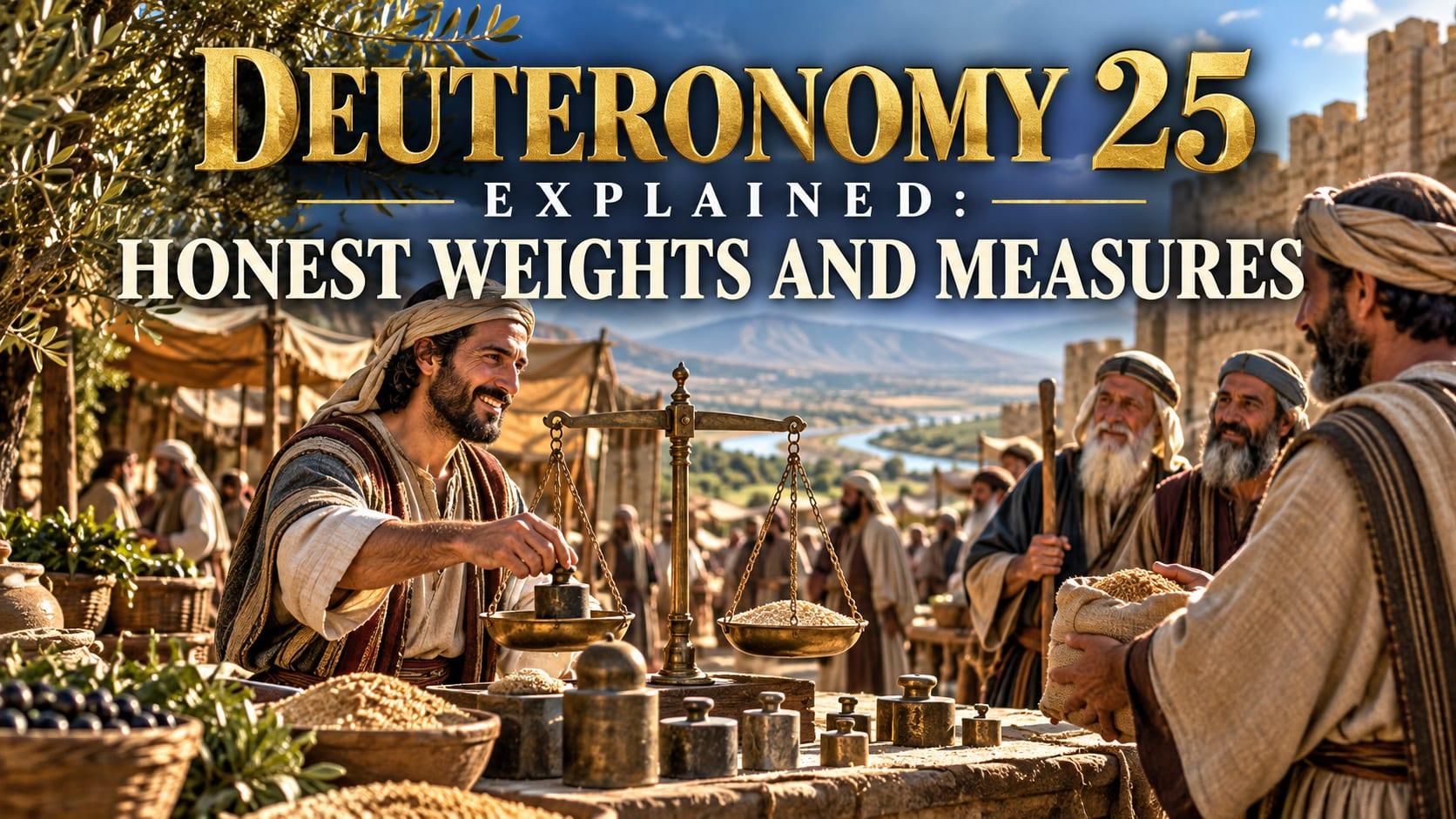
"Thou shalt not have in thy bag divers weights, a great and a small. Thou shalt not have in thine house divers measures, a great and a small. But thou shalt have a perfect and just weight, a perfect and just measure shalt thou have: that thy days may be lengthened in the land which the LORD thy God giveth thee."
A merchant keeping two sets of weights, a heavier one for buying grain and a lighter one for selling it, could cheat every customer who ever walked up to his table without speaking a single lie out loud. 📌 The theft never required one spoken falsehood, only a rigged scale nobody thought to check. Moses does not treat this as a small matter of business.
"For all that do such things, and all that do unrighteously, are an abomination unto the LORD thy God."
"Abomination" is the same word Deuteronomy 24 already used for a marriage circled back the wrong way. A crooked scale earns the identical verdict. Leviticus 19 had already commanded the same honest weights years earlier, and Solomon later turned the same conviction into a proverb of his own.
"A false balance is abomination to the LORD: but a just weight is his delight."
💡 A false scale offends God the same way a false court verdict does. Both are a trusted measure quietly rigged against whoever cannot check it for themselves.
6. A Debt Israel Was Told Never to Forget (verses 17 to 19)
The chapter ends on history, not law.
"Remember what Amalek did unto thee by the way, when ye were come forth out of Egypt; How he met thee by the way, and smote the hindmost of thee, even all that were feeble behind thee, when thou wast faint and weary; and he feared not God."
Amalek, a nation descended from Esau's grandson, did not meet Israel in open battle, the first time the two fought. Here Moses recalls a different wrong: Amalek attacked the stragglers at the back of the column, the faint and weary ones who could not keep up, while Israel was still exhausted from Egypt. "He feared not God" names the real charge, not just cruelty, but cruelty aimed at the weakest people in the whole camp, by someone who answered to no one.
"Therefore it shall be, when the LORD thy God hath given thee rest from all thine enemies round about, in the land which the LORD thy God giveth thee for an inheritance to possess it, that thou shalt blot out the remembrance of Amalek from under heaven; thou shalt not forget it."
📌 "Blot out the remembrance" and "thou shalt not forget it" sit in the same verse on purpose. Israel is told to erase Amalek's future while never erasing the memory of what Amalek did. A prophecy already on record names a king called Agag from Amalek's own royal line, a name that resurfaces centuries later in Esther's story. Scripture introduces the court official who tries to destroy every Jew in Persia as Haman the Agagite, a descendant of the very nation this verse commands Israel to remember. The grudge did not end with Moses.

Hard Questions Deuteronomy 25 Raises
Does Deuteronomy 25:11 and 12 really command cutting off a woman's hand? The text states the penalty plainly, without softening it, and it deserves an honest answer rather than an evasive one. Jewish and Christian interpreters have read it in two different directions. Some take it as the literal and highly unusual corporal penalty the plain words describe, unusual because women are rarely assigned an active role deserving court punishment anywhere else in this Law, and because mutilation is almost never used as a sentence for anything short of murder. Others, including a long rabbinic tradition, read "cut off her hand" the way other injury laws in the Law get read, as compensation measured against the harm rather than a literal amputation actually carried out. Scripture never records this sentence being executed, which is true of several of the harshest penalties in Deuteronomy. What both readings agree on is the reason behind the severity: grabbing a man's genitals in a fight risked his ability to father children at all, in a culture with no way to undo that kind of injury, which is why this one act drew a sharper response than an ordinary blow between two men.
Why does the law cap corporal punishment instead of forbidding it outright? Scripture does not abolish corporal punishment for crime in this period of Israel's history, but Deuteronomy 25:3 does something unusual for its time: it names a hard ceiling and gives a reason that has nothing to do with the crime itself. "Lest thy brother should seem vile unto thee" protects the onlooker's own conscience as much as the guilty man's body, refusing to let a legal punishment strip a person of basic standing in front of the community watching it happen.
Is the levirate marriage law in verses 5 to 10 fair to the widow? The law gives her something most ancient codes did not: a path forward if the brother refuses, instead of being left with no children, no protector, and a vanished inheritance. She is the one who walks to the gate, names the refusal in public, and carries out the ceremony herself. The shame in this passage lands entirely on the man who would not do his duty, never on the widow who exposed him for failing to.
Does remembering Amalek forever sound like holding a grudge God should have let go? Verses 17 and 18 name a specific sin, attacking stragglers too weak to defend themselves, from a nation that "feared not God." The command to remember is never framed as revenge for Israel's own sake. It is framed the same way Israel is told to remember its own slavery in Egypt, as a refusal to let cruelty against the weak quietly disappear from memory.
Top Verses From Deuteronomy 25
1. Deuteronomy 25:4
"Thou shalt not muzzle the ox when he treadeth out the corn."
One sentence about an animal's feed that Paul later uses twice to argue that those who labor in the gospel deserve to be paid for it.
2. Deuteronomy 25:3
"Forty stripes he may give him, and not exceed: lest, if he should exceed, and beat him above these with many stripes, then thy brother should seem vile unto thee."
A punishment with a ceiling, and a reason for the ceiling that protects the guilty man's standing as a brother, not just his body.
3. Deuteronomy 25:7
"And if the man like not to take his brother’s wife, then let his brother’s wife go up to the gate unto the elders, and say, My husband’s brother refuseth to raise up unto his brother a name in Israel, he will not perform the duty of my husband’s brother."
A widow given real legal standing to call out a brother who will not do his duty, in front of the elders, rather than being left to simply accept his refusal.
4. Deuteronomy 25:15
"But thou shalt have a perfect and just weight, a perfect and just measure shalt thou have: that thy days may be lengthened in the land which the LORD thy God giveth thee."
Honesty with a scale tied directly to Israel's own days in the land, the same weight Moses gives to far larger sins elsewhere in this book.
5. Deuteronomy 25:19
"Thou shalt blot out the remembrance of Amalek from under heaven; thou shalt not forget it."
A command to erase an enemy's future while refusing to erase the memory of what that enemy actually did to the weakest people in the camp.
Frequently Asked Questions About Deuteronomy 25
What is Deuteronomy 25 about?
Deuteronomy 25 covers a limit on corporal punishment in court, a law against muzzling a working ox, the duty of a brother to marry his dead brother's widow, a law about an injury during a fight, honest weights and measures, and a command to remember what Amalek did to Israel in the wilderness.
Why does Deuteronomy 25:4 say not to muzzle an ox?
An ox treading grain worked surrounded by its own feed, and muzzling it would stop the animal eating while it labored. Paul quotes this verse twice in his New Testament letters, arguing that a person who labors in ministry deserves to be paid, not just an animal doing physical work.
What is levirate marriage in the Bible?
Levirate marriage, named for the Latin word for a husband's brother, required a man to marry his dead brother's widow if the brother died without a son, so the dead man's name and inheritance did not disappear from Israel.
How does Deuteronomy 25 connect to the story of Ruth?
Ruth 4 uses a related shoe custom, a kinsman removing his own shoe to hand off his right to redeem Boaz, instead of having it forced off him in shame. It is not the identical situation this chapter describes, but the same gesture carries the weight in both stories.
Does Deuteronomy 25 really command cutting off a hand?
Verses 11 and 12 state that penalty for a specific act during a fight. Some readers take it as a literal, highly unusual punishment; a long rabbinic tradition reads it instead as compensation measured against the harm, similar to other injury laws in the Law. Scripture never records the sentence actually being carried out.
What does "forty stripes" mean in the Bible?
Forty stripes was the maximum number of lashes a court could order under Deuteronomy 25:3. By the New Testament era, Jewish courts capped the real number at thirty nine, as Paul's own account in 2 Corinthians 11:24 shows, to guard against ever crossing the line Moses set.
Why did Israel have to remember what Amalek did?
Amalek attacked Israel's weakest stragglers in the wilderness while showing no fear of God. Deuteronomy 25:19 commands Israel to end Amalek's future while never forgetting the cruelty itself, the same way Israel is told elsewhere never to forget its own slavery in Egypt.
What does Deuteronomy 25 say about honest weights and measures?
Verses 13 to 16 forbid keeping two different sets of weights, one for buying and a different one for selling, calling a rigged scale an abomination to the LORD, the same word used elsewhere in the chapter for the worst offenses.
Does Paul quote Deuteronomy 25 in the New Testament?
Yes, twice. Paul quotes the ox muzzling law in 1 Corinthians 9:9 and again in 1 Timothy 5:18, both times arguing that if God provided for a working ox, He expects His people to provide for those who labor in ministry.
Why was the man publicly shamed for refusing to marry his brother's widow?
His refusal left his dead brother without a name or an heir in Israel. The shoe removal and the public statement in verses 9 and 10 named that failure out loud, in front of the elders, so the community held him accountable rather than letting the widow simply absorb the loss alone.
Final Thoughts
Deuteronomy 25 jumps between a courtroom, a field, a family, and a battlefield, but every stop asks the same thing.
📌 A limit on power is not weakness. It is what keeps power from becoming cruelty. A capped beating, an unmuzzled ox, a widow with real legal standing, and an honest scale all answer the same question: how far is Israel allowed to go, even when it has every right to go further.
📌 Memory and mercy are not opposites in this chapter. Israel is told to forget nothing about Amalek's cruelty while still being commanded to deal honestly with the next ox, the next widow, and the next customer who walks up to the scale.
You are not standing before a judge counting out stripes this week, but you probably have someone working for you or around you right now, an employee, a contractor, a sitter, someone whose labor benefits you directly.
So here is your one next step.
Look honestly at how you pay or treat that person, and ask whether they get to eat from what their own work is producing.