📖 Deuteronomy 26 Explained: Firstfruits, a Tithe, and a Sealed Covenant
Say it out loud. That is the one instruction that runs through this entire chapter.
Deuteronomy 26 explained is nineteen verses that close out a long stretch of law, from chapter twelve all the way to this point, with something different than another rule. A farmer stands in front of a priest with a basket of fruit and speaks a confession out loud, word for word, naming his family's whole history from a wandering ancestor to a land flowing with milk and honey. A giver stands before God a different year and declares exactly what he did with a tithe, down to the detail of what he did not eat. And the chapter ends with Israel and God each making a statement about the other, out loud, in the same breath.
You may have read past this chapter thinking it was just more harvest law.
- ❓ Why does Israel have to say a whole family history out loud over a basket of fruit?
- ❓ Why does the text call Jacob "a Syrian"?
- ❓ Does "peculiar people" mean God's people are supposed to be strange?
- ❓ What does it even mean for Israel to avouch God and God to avouch Israel?
📌 Deuteronomy 26 is Moses teaching Israel that gratitude and loyalty do not stay private. They get spoken, in specific words, in front of witnesses.
Walk through it slowly. The confession in the middle of this chapter is some of the oldest, most carefully worded speech in the whole Bible, and it was never meant to be read silently.
What Happened Just Before This Chapter
Deuteronomy 25 closed on a command to remember what Amalek did in the wilderness, a nation judged by how it treated the weakest people in Israel's camp.
Deuteronomy 26 closes something much bigger. Chapters twelve through twenty five have been one long law code, covering worship, courts, war, marriage, lending, and justice. This chapter is the hinge. It takes everything Israel has just been commanded to do and turns it into two acts of speech, a confession over a basket and a declaration over a tithe, before sealing the whole relationship in one final exchange of words between Israel and God.

Deuteronomy 26 Explained Verse by Verse
1. A Basket of Firstfruits Brought to the Place God Chose (verses 1 to 4)
The chapter opens once Israel is finally settled, not still wandering.
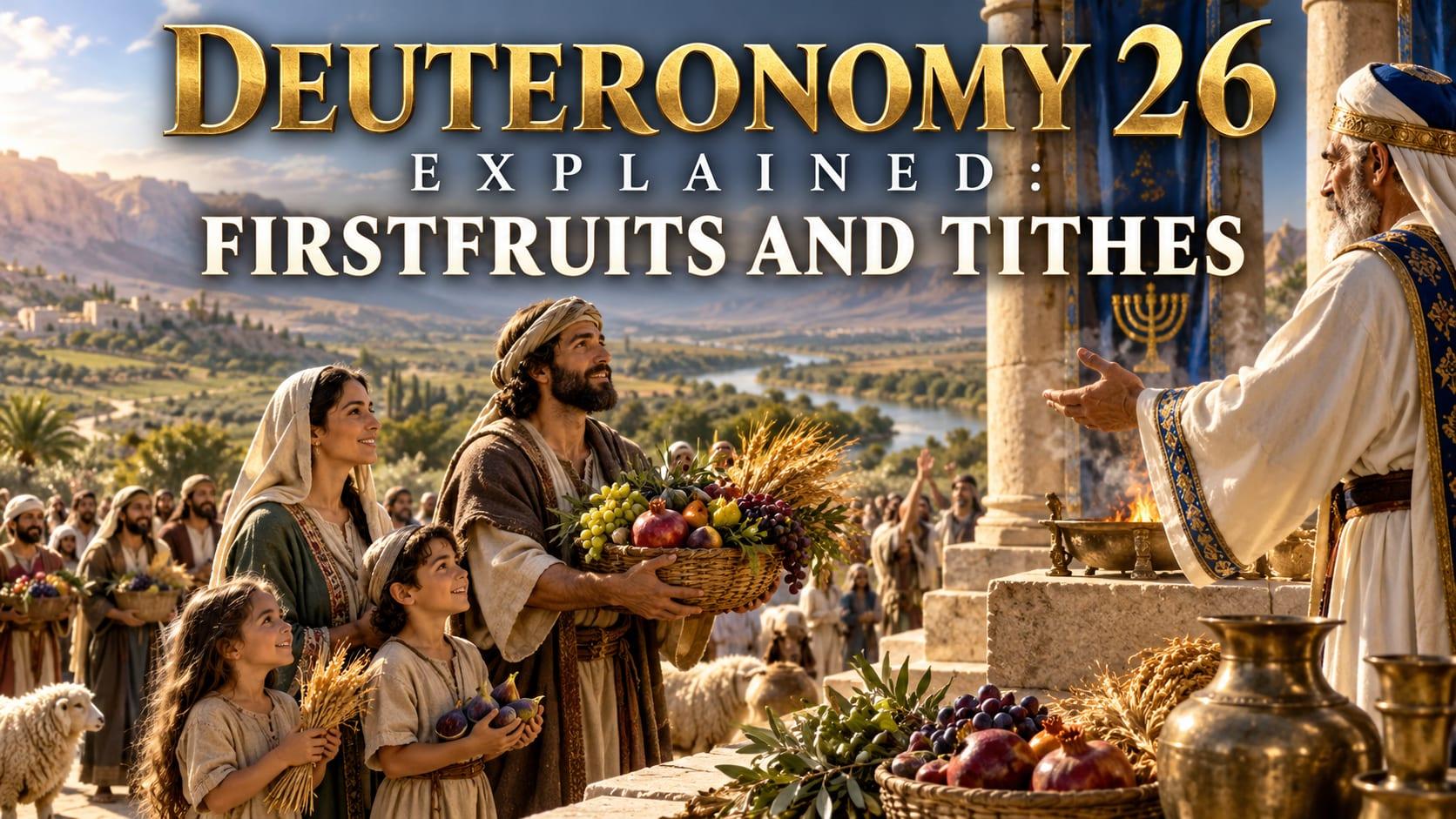
"And it shall be, when thou art come in unto the land which the LORD thy God giveth thee for an inheritance, and possessest it, and dwellest therein; That thou shalt take of the first of all the fruit of the earth, which thou shalt bring of thy land that the LORD thy God giveth thee, and shalt put it in a basket, and shalt go unto the place which the LORD thy God shall choose to place his name there."
📌 The very first fruit off the very first harvest in the Promised Land goes into a basket and leaves the farmer's hands before he gets to enjoy any of it. Not the leftovers. Not a percentage worked out later. The first and the best, carried to wherever God had chosen to put His name.
The farmer does not hand the basket to just anyone.
"And thou shalt go unto the priest that shall be in those days, and say unto him, I profess this day unto the LORD thy God, that I am come unto the country which the LORD sware unto our fathers for to give us. And the priest shall take the basket out of thine hand, and set it down before the altar of the LORD thy God."
"I profess this day" is the farmer's own voice opening the ceremony. He is the one who speaks first, not the priest. The basket only becomes an offering once a living person stands there and claims, out loud, that the land in his hand is the land God promised.
2. Israel's Ancient Creed: Low Beginnings to a Land of Milk and Honey (verses 5 to 9)
Now comes the part the farmer has to say, and Moses writes it out for him word for word.
"And thou shalt speak and say before the LORD thy God, A Syrian ready to perish was my father, and he went down into Egypt, and sojourned there with a few, and became there a nation, great, mighty, and populous:"
"My father" here reaches back to Jacob, who spent twenty years in Mesopotamia under Laban the Syrian before ever setting foot in Egypt. "Ready to perish" is not an exaggeration. Jacob arrived at Laban's door with nothing but a staff, and the whole nation reciting this verse traces its existence back to a man who once had nothing and nearly nothing to his name. Then the confession keeps moving, fast, through centuries in a handful of lines.
"And the Egyptians evil entreated us, and afflicted us, and laid upon us hard bondage: And when we cried unto the LORD God of our fathers, the LORD heard our voice, and looked on our affliction, and our labour, and our oppression: And the LORD brought us forth out of Egypt with a mighty hand, and with an outstretched arm, and with great terribleness, and with signs, and with wonders: And he hath brought us into this place, and hath given us this land, even a land that floweth with milk and honey."
💡 Notice who is doing every verb once the suffering is named. Israel cried. God heard, looked, brought forth, and gave. The farmer standing at the altar is not reciting his own achievement. He is reciting a rescue he did nothing to earn, every single time he brings a basket of fruit he grew with his own hands.

3. Firstfruits Set Down, and a Feast Shared With the Levite and the Stranger (verses 10 and 11)
Only after that whole history is spoken does the basket finally get set down.
"And now, behold, I have brought the firstfruits of the land, which thou, O LORD, hast given me. And thou shalt set it before the LORD thy God, and worship before the LORD thy God:"
📌 The gift comes last in the ceremony, not first. The farmer has to say where the land came from before he ever gets to act generous with what it produced. Then the day turns from confession to celebration.
"And thou shalt rejoice in every good thing which the LORD thy God hath given unto thee, and unto thine house, thou, and the Levite, and the stranger that is among you."
The Levite owned no land of his own to bring a basket from, and the stranger had no inheritance in Israel at all. Both still sit at the same table, eating from the same firstfruits, on the strength of someone else's harvest and someone else's memory of being rescued.
4. The Third Year Tithe, Spoken Out Loud Before God (verses 12 to 15)
The second half of the chapter moves to a different year entirely. Every third year, the tithe already commanded in Deuteronomy 14 stayed home instead of traveling to the sanctuary, distributed locally.
"When thou hast made an end of tithing all the tithes of thine increase the third year, which is the year of tithing, and hast given it unto the Levite, the stranger, the fatherless, and the widow, that they may eat within thy gates, and be filled;"
Once that tithe is fully given, the giver has his own words to say too.
"Then thou shalt say before the LORD thy God, I have brought away the hallowed things out of mine house, and also have given them unto the Levite, and unto the stranger, to the fatherless, and to the widow, according to all thy commandments which thou hast commanded me: I have not transgressed thy commandments, neither have I forgotten them: I have not eaten thereof in my mourning, neither have I taken away ought thereof for any unclean use, nor given ought thereof for the dead: but I have hearkened to the voice of the LORD my God, and have done according to all that thou hast commanded me."
⚠️ This is a detailed accounting, not a vague promise of good intentions. The giver has to specify what he did not do with the tithe: he did not eat it while in mourning, did not use it for anything unclean, did not offer any of it for the dead. Those details only make sense against pagan customs around Israel that used food for the dead in ways Moses will not let a holy gift anywhere near. Then the declaration turns from accounting to request.
"Look down from thy holy habitation, from heaven, and bless thy people Israel, and the land which thou hast given us, as thou swarest unto our fathers, a land that floweth with milk and honey."
💡 Having just reported full obedience, the giver still does not ask God to pay him back. He asks God to bless the whole nation and the whole land, the same request a person with nothing to report could just as easily have prayed.

5. A Covenant Said Out Loud by Both Sides (verses 16 to 19)
The chapter, and the whole law section that started back in chapter twelve, closes with one final exchange.
"This day the LORD thy God hath commanded thee to do these statutes and judgments: thou shalt therefore keep and do them with all thine heart, and with all thy soul."
Then Moses has Israel say its half of the agreement, followed immediately by God's half of it.
"Thou hast avouched the LORD this day to be thy God, and to walk in his ways, and to keep his statutes, and his commandments, and his judgments, and to hearken unto his voice: And the LORD hath avouched thee this day to be his peculiar people, as he hath promised thee, and that thou shouldest keep all his commandments;"
📌 "Avouched" means formally declared, the way a witness avouches a fact in court. Israel declares God to be its God. God declares Israel to be His own people. Neither side leaves the statement implied. Both sides say it.
"And to make thee high above all nations which he hath made, in praise, and in name, and in honour; and that thou mayest be an holy people unto the LORD thy God, as he hath spoken."
That closing promise echoes language God already used at Sinai, long before Israel had kept a single one of these laws. The covenant does not start here in chapter twenty six. It gets spoken out loud and sealed here, after a whole book's worth of law has shown Israel exactly what keeping it would look like.
Hard Questions Deuteronomy 26 Raises
Why does the text call Jacob "a Syrian" when he was born in Canaan? The title points to where Jacob's adult life actually happened, not where he was born. He spent twenty years in the region later called Syria, working for his uncle Laban the Syrian, and the family's roots reach back further still to Abraham's own origin in that same region. Calling the ancestor of Israel a Syrian keeps the humble, foreign start of the nation in view, right at the moment Israel is standing in a land of its own.
Is the confession in verses 5 to 10 really one of the oldest statements of faith in the Bible? A number of Old Testament scholars, most notably Gerhard von Rad, have pointed to this passage as an early, tightly structured summary of Israel's core story, cited as evidence of how far back Israel was already rehearsing its own history in fixed words. Not every scholar agrees on exactly how old the wording is. What is not in dispute is what the passage itself does: it compresses Israel's entire identity, from a nobody in Mesopotamia to a nation in its own land, into nine verses meant to be memorized and spoken by name over a basket of fruit.
Does "peculiar people" in verse 18 mean God wanted Israel to seem odd or strange? In the English of the King James translators, "peculiar" meant belonging exclusively to someone, a private possession, not eccentric. God had already used the same idea at Sinai.
"Now therefore, if ye will obey my voice indeed, and keep my covenant, then ye shall be a peculiar treasure unto me above all people: for all the earth is mine: And ye shall be unto me a kingdom of priests, and an holy nation."
Centuries later Peter applies the same word to the church.
"But ye are a chosen generation, a royal priesthood, an holy nation, a peculiar people; that ye should shew forth the praises of him who hath called you out of darkness into his marvellous light:"
💡 A peculiar people is a people set apart for one owner, not a people made strange on purpose.
Why does any of this have to be said out loud at all? Isn't the act of giving enough? Moses never treats the gift as the whole transaction. A basket handed over in silence could mean gratitude, or it could mean a man quietly fulfilling a quota he resents. The spoken words force the giver to say, specifically, why he is giving and what the land cost God to provide. A ritual without the confession would let the heart behind it stay hidden. This chapter will not allow that.

Top Verses From Deuteronomy 26
1. Deuteronomy 26:5
"A Syrian ready to perish was my father, and he went down into Egypt, and sojourned there with a few, and became there a nation, great, mighty, and populous:"
The opening line of Israel's oldest rehearsed confession, naming a nearly destitute ancestor before naming anything great.
2. Deuteronomy 26:8
"And the LORD brought us forth out of Egypt with a mighty hand, and with an outstretched arm, and with great terribleness, and with signs, and with wonders:"
Every verb in the rescue belongs to God. The farmer reciting this verse contributed nothing to his own deliverance except the crying out.
3. Deuteronomy 26:11
"And thou shalt rejoice in every good thing which the LORD thy God hath given unto thee, and unto thine house, thou, and the Levite, and the stranger that is among you."
Firstfruits were never meant to be celebrated alone. The landless Levite and the stranger sit at the same table on the strength of someone else's harvest.
4. Deuteronomy 26:17 and 18
"Thou hast avouched the LORD this day to be thy God, and to walk in his ways, and to keep his statutes, and his commandments, and his judgments, and to hearken unto his voice: And the LORD hath avouched thee this day to be his peculiar people, as he hath promised thee, and that thou shouldest keep all his commandments;"
A covenant stated out loud from both sides at once, neither party leaving its half of the agreement unspoken.
5. Deuteronomy 26:19
"And to make thee high above all nations which he hath made, in praise, and in name, and in honour; and that thou mayest be an holy people unto the LORD thy God, as he hath spoken."
The closing line of the whole law section that began back in chapter twelve, promising Israel is finally sealed as what God already called it at Sinai.
Frequently Asked Questions About Deuteronomy 26
What is Deuteronomy 26 about?
Deuteronomy 26 covers the ceremony of bringing a basket of firstfruits to the priest with a spoken confession of Israel's history, the declaration made after the third year tithe, and the closing exchange where Israel and God each formally declare the other to be theirs.
What is the firstfruits offering in the Bible?
It was the first and best portion of a harvest, brought to the sanctuary before the farmer used any of the rest of his crop for himself, offered as an acknowledgment that the land and its produce came from God.
Why does Deuteronomy 26:5 call Israel's ancestor "a Syrian"?
The title points to Jacob's years working for his uncle Laban the Syrian in Mesopotamia, and to the family's wider roots in that same region through Abraham, keeping Israel's humble, foreign beginnings in view at the exact moment of celebrating a settled land.
What does "peculiar people" mean in Deuteronomy 26:18?
In the King James translators' English, peculiar meant belonging exclusively to someone, not strange or odd. It describes Israel as God's own private possession, the same idea God used at Sinai and Peter later applies to the church.
What was the third year tithe?
Every third year, the tithe stayed local instead of traveling to the sanctuary, given directly to the Levite, the stranger, the fatherless, and the widow within the giver's own town, so they could eat and be filled.
Why did the tithe declaration list what the giver did not do with the tithe?
Specific exclusions, not eating it in mourning, not using it for anything unclean, not offering any for the dead, answered pagan customs around Israel that mixed food with rituals for the dead, keeping a holy gift clearly separated from those practices.
What does it mean that Israel and God "avouched" each other?
Avouched means formally and openly declared, like a witness swearing to a fact in court. Verses 17 and 18 have Israel declare the LORD to be its God and the LORD declare Israel to be His own people, both sides stating the relationship out loud rather than leaving it assumed.
Why does Deuteronomy 26 matter if these exact rituals are not practiced today?
The specific ceremony belonged to Israel's covenant and its land. The principle underneath it, that gratitude gets spoken in specific words rather than assumed in the heart, carries straight into how the New Testament calls believers to confess their faith openly rather than silently.
Is Deuteronomy 26:5 to 9 connected to any Jewish holiday today?
This same passage is read aloud at the Passover Seder as part of the Haggadah, the retelling of the Exodus, making it one of the most repeated short passages in Jewish worship across the centuries.
Final Thoughts
Deuteronomy 26 keeps circling back to one plain demand: say it.
📌 Gratitude that stays silent is easy to fake. Gratitude spoken in specific words, naming exactly what was given and where it came from, is much harder to fake. The farmer at the altar could not bring a basket and stay vague about why.
📌 A covenant said out loud by both sides is sturdier than one only assumed by either side. Verses 17 and 18 do not let Israel's loyalty or God's promise sit unspoken.
Here is your assignment from this chapter, not a feeling to work up but a sentence to actually say out loud this week.
Name one specific thing God has done for you, the way the farmer named Egypt and the mighty hand that brought him out, and say it to someone instead of just thinking it.