📖 Deuteronomy 28 Explained: Fourteen Verses of Blessing, Fifty Four of Curse
Count the verses before you read a single word of either list.
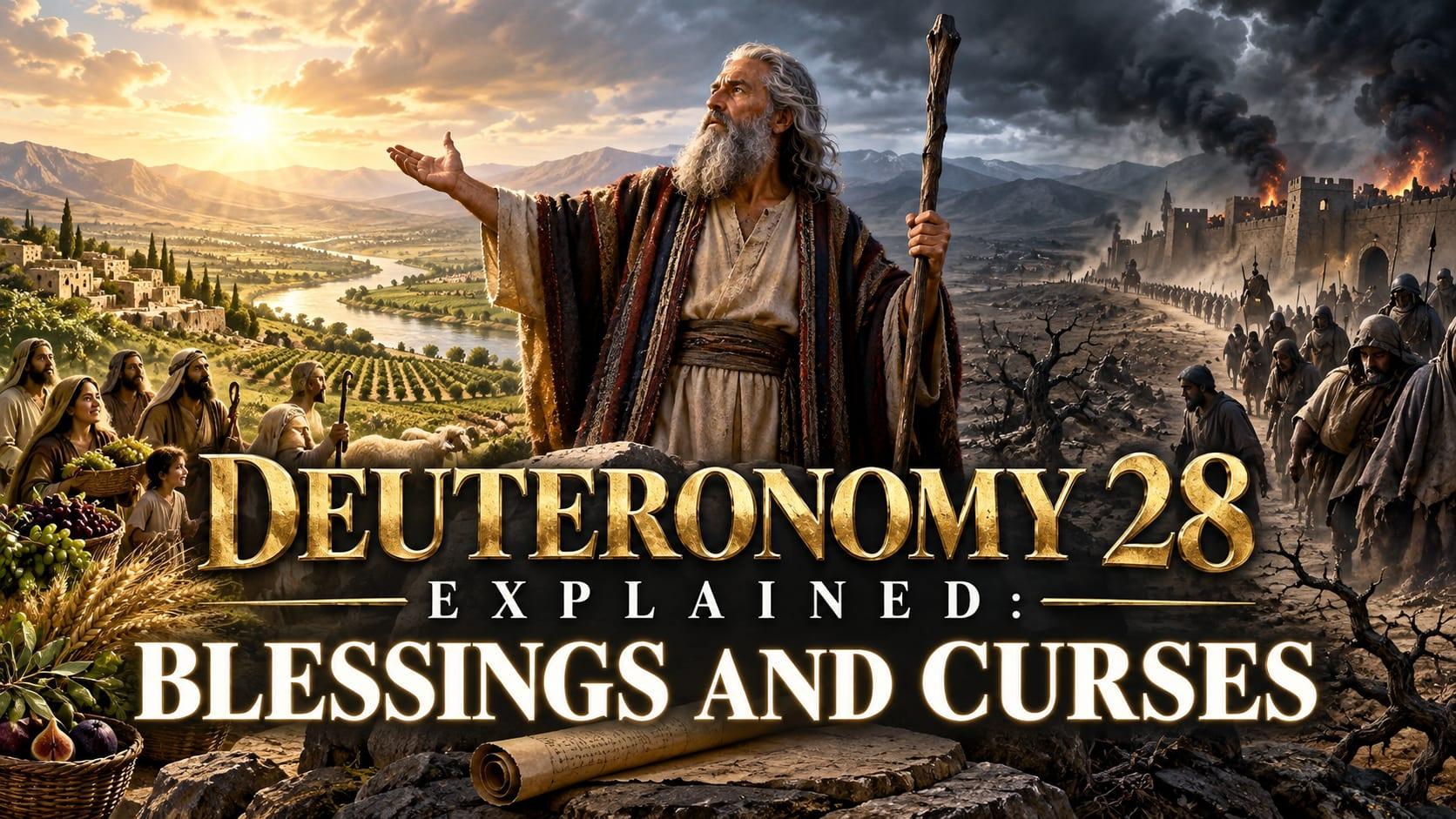
Deuteronomy 28 explained is the chapter where Moses finally spells out what Deuteronomy 27 only promised was coming. Blessing gets fourteen verses. Curse gets fifty four. Both lists cover the exact same ground, city and field, basket and body, coming in and going out, but one side of the mirror runs four times longer than the other. By the end of the chapter the warnings have moved past crops and weather into siege, exile, and a return to slavery in the very country Israel was rescued from.
You may know this chapter only as "the long one with all the curses."
- ❓ Why does the blessing list get so much shorter than the curse list?
- ❓ Why do the curses repeat the exact same words as the blessings, just flipped?
- ❓ Did any of this actually happen to Israel, or is it only a warning?
- ❓ How does a chapter this heavy end up connected to grace in the New Testament?
📌 Deuteronomy 28 is not two separate speeches. It is one sentence, "if you listen" against "if you will not," played out to its full length.
Walk through it slowly. The reversal in the middle of this chapter, where the blessing and the curse trade places word for word, is the detail most readers skip past on their way to the scarier verses.
What Happened Just Before This Chapter
Deuteronomy 27 set up two mountains, Gerizim for blessing and Ebal for curse, and twelve tribes split six on each side. It wrote out the twelve curses the Levites would shout and the nation would answer with Amen, but it never wrote out the matching blessings. The text simply said Israel would speak a blessing from Gerizim and left the words for later.
Deuteronomy 28 is later. This is the chapter that finally delivers what chapter 27 only promised, and it does something chapter 27 never did: it lets the blessings and the curses run long enough to show exactly where obedience leads and exactly where turning away leads, all the way out to exile.

Deuteronomy 28 Explained Verse by Verse
1. The Blessings, If Israel Will Listen (verses 1 to 14)
The whole chapter hangs on one word in its opening line.
"And it shall come to pass, if thou shalt hearken diligently unto the voice of the LORD thy God, to observe and to do all his commandments which I command thee this day, that the LORD thy God will set thee on high above all nations of the earth: And all these blessings shall come on thee, and overtake thee, if thou shalt hearken unto the voice of the LORD thy God."
If. Not a guarantee with no condition attached, and not a reward Israel earns by birth. The blessing is real, but it is tied to one thing, hearkening to God's voice, stated twice in two verses so no one misses it.
Then the list begins, and it reaches into ordinary life on purpose.
"Blessed shalt thou be in the city, and blessed shalt thou be in the field. Blessed shall be the fruit of thy body, and the fruit of thy ground, and the fruit of thy cattle, the increase of thy kine, and the flocks of thy sheep. Blessed shall be thy basket and thy store. Blessed shalt thou be when thou comest in, and blessed shalt thou be when thou goest out."
👀 Notice the pairs. City and field. Body and ground and cattle. Basket and store. Coming in and going out. Every pair covers a whole category by naming its two ends, a common way to say "everywhere, completely" without listing every single place in between. Keep that shape in your head. It comes back later in this chapter wearing the opposite word.
The blessing then moves from the home to the battlefield and the economy.
"The LORD shall open unto thee his good treasure, the heaven to give the rain unto thy land in his season, and to bless all the work of thine hand: and thou shalt lend unto many nations, and thou shalt not borrow. And the LORD shall make thee the head, and not the tail; and thou shalt be above only, and thou shalt not be beneath; if that thou hearken unto the commandments of the LORD thy God, which I command thee this day, to observe and to do them:"
📌 Lending instead of borrowing, leading instead of following, both get stated as blessing. A nation that depends on no one and gets looked to by everyone is what obedience was supposed to buy Israel in the land. Verse 14 closes the list with the one way to lose it: going aside, even slightly, after other gods.
2. The Same List, Said in Reverse (verses 15 to 19)
Moses does not write a new curse list from scratch. He takes the blessing list apart and rebuilds it with one word changed.
"But it shall come to pass, if thou wilt not hearken unto the voice of the LORD thy God, to observe to do all his commandments and his statutes which I command thee this day; that all these curses shall come upon thee, and overtake thee: Cursed shalt thou be in the city, and cursed shalt thou be in the field. Cursed shall be thy basket and thy store. Cursed shall be the fruit of thy body, and the fruit of thy land, the increase of thy kine, and the flocks of thy sheep. Cursed shalt thou be when thou comest in, and cursed shalt thou be when thou goest out."
⚠️ Every pair from the blessing returns here, word for word, with "blessed" swapped for "cursed." City and field. Basket and store. Body and ground and cattle. Coming in and going out. Moses is not describing two different futures built from different material. He is describing one future that can tip either way, and showing Israel that the exact same categories of life get touched no matter which way it tips.

3. Disease, Drought, and a War That Never Stops (verses 20 to 35)
Past verse 19 the curse section keeps going long after the blessing section already ended, and it starts naming specifics the blessing list never needed to.
"And thy heaven that is over thy head shall be brass, and the earth that is under thee shall be iron. The LORD shall make the rain of thy land powder and dust: from heaven shall it come down upon thee, until thou be destroyed."
💡 A sky that will not open and ground that will not soften is a picture of total drought, nothing coming down and nothing growing up, the exact opposite of the rain promised back in verse 12. Pestilence, fever, and a long list of sicknesses come next, then the curse turns from the body to the mind.
"The LORD shall smite thee with madness, and blindness, and astonishment of heart: And thou shalt grope at noonday, as the blind gropeth in darkness, and thou shalt not prosper in thy ways: and thou shalt be only oppressed and spoiled evermore, and no man shall save thee."
Groping at noon, in full daylight, is worse than groping at night. It means the problem is not the light outside but something broken inside the person stumbling. Then the curses turn personal in a different way, listing the exact things a man works a lifetime toward: a wife he has not yet married, a house he has not yet lived in, a vineyard he has not yet tasted, each one taken from him before he ever gets to enjoy it.
⚠️ Working for something and never getting to keep it is its own kind of curse, separate from losing something you already had. This stretch of the chapter names that exact fear and puts it into words.
4. A King Into Exile, and the Blessings Running Backward (verses 36 to 48)
One detail in this stretch only makes sense once you know Moses had already planned for it years earlier.
"The LORD shall bring thee, and thy king which thou shalt set over thee, unto a nation which neither thou nor thy fathers have known; and there shalt thou serve other gods, wood and stone."
Israel has no king yet. Moses is speaking to a nation led by judges and elders, not a throne. But he had already written the rules for a future king back in Deuteronomy 17, long before Israel ever asked for one. Here that future king gets named as someone who can be carried into exile right alongside everyone else.
Locusts eat the crop before it is gathered. Worms eat the vineyard before it is pressed. Olive trees drop their fruit before it can be used. Then the chapter returns to the exact language of the blessing list, this time running the other direction.
"The stranger that is within thee shall get up above thee very high; and thou shalt come down very low. He shall lend to thee, and thou shalt not lend to him: he shall be the head, and thou shalt be the tail."
📌 Lending instead of borrowing and being the head instead of the tail were the blessing in verses 12 and 13. Here they are handed to the stranger living in Israel's own land, and Israel takes the opposite place. Nothing new gets invented for the curse. The blessing simply changes hands.
Moses then gives the one reason underneath everything that has happened so far.
"Because thou servedst not the LORD thy God with joyfulness, and with gladness of heart, for the abundance of all things; Therefore shalt thou serve thine enemies which the LORD shall send against thee, in hunger, and in thirst, and in nakedness, and in want of all things: and he shall put a yoke of iron upon thy neck, until he have destroyed thee."
💡 The complaint is not that Israel broke a rule somewhere. It is that abundance was given and received without joy. Service without gladness toward God becomes service with nothing but hunger toward an enemy. The word "yoke" describes the heavy wooden bar laid across an ox's neck to force its labor, and Moses uses it here for the exact thing Israel will end up wearing.

5. The Siege That Outlasts Everything (verses 49 to 57)
The chapter now narrows from a long list of troubles to one specific disaster.
"The LORD shall bring a nation against thee from far, from the end of the earth, as swift as the eagle flieth; a nation whose tongue thou shalt not understand; A nation of fierce countenance, which shall not regard the person of the old, nor shew favour to the young:"
A foreign language, a foreign speed, and no mercy for age in either direction. This nation besieges every city Israel has, until the walls everyone trusted finally fall. What happens inside the siege is the hardest verse in the chapter to read.
"And thou shalt eat the fruit of thine own body, the flesh of thy sons and of thy daughters, which the LORD thy God hath given thee, in the siege, and in the straitness, wherewith thine enemies shall distress thee:"
⚠️ Moses does not stop with the men of the city. Verses 54 to 57 spell out the same horror reaching the most careful, tender people in the whole society, parents who had never known hunger, driven by starvation to this. This is not a threat invented to frighten. It is answered plainly in the Hard Questions section below, because it did not stay theoretical.
6. Scattered, Trembling, and Sold Back Into Egypt (verses 58 to 68)
The last stretch of the chapter widens out from one siege to the whole nation's future.
"And ye shall be left few in number, whereas ye were as the stars of heaven for multitude; because thou wouldest not obey the voice of the LORD thy God."
📌 "As the stars of heaven" is not a random comparison. It is the exact promise God gave to Abraham when he had no children at all, that his family would one day be too many to count, the way Moses tells it back in Genesis 15. Here the promise itself gets undone, not cancelled by God changing His mind but by the generation standing in front of Moses refusing to obey. The curse that follows spreads the few who are left everywhere at once.
"And the LORD shall scatter thee among all people, from the one end of the earth even unto the other; and there thou shalt serve other gods, which neither thou nor thy fathers have known, even wood and stone."
A trembling heart, failing eyes, and a mind with no rest follow in the next few verses, down to a single couplet that captures the whole feeling in one breath: a person so afraid of each new day that evening and morning both become something to dread rather than welcome. The chapter's very last verse closes the whole book of curses on its most bitter line.
"And the LORD shall bring thee into Egypt again with ships, by the way whereof I spake unto thee, Thou shalt see it no more again: and there ye shall be sold unto your enemies for bondmen and bondwomen, and no man shall buy you."
⚠️ Egypt was where this whole story started, and the exodus was supposed to be a door closed for good. This verse threatens a return through that same door, now by sea instead of on foot, ending not in slavery someone pays for but in slavery no one will even bother to buy. A nation once worth rescuing becomes a nation no one wants.

Hard Questions Deuteronomy 28 Raises
Why does the curse list run four times longer than the blessing list? The text does not explain the ratio directly, and ancient treaties between a king and a weaker nation commonly spent far more space on penalties for breaking the agreement than on rewards for keeping it, a pattern scholars of the ancient Near East have long noted in documents outside the Bible as well. Inside Deuteronomy itself there is a simpler reason too: obedience is one path, but turning away can happen in far more ways, through far more doors, and each one gets its own line.
Did the siege described in verses 53 to 57 actually happen to real people? Yes, more than once. Scripture records it plainly, not as rumor but as eyewitness testimony.
"And the king said unto her, What aileth thee? And she answered, This woman said unto me, Give thy son, that we may eat him to day, and we will eat my son to morrow. So we boiled my son, and did eat him: and I said unto her on the next day, Give thy son, that we may eat him: and she hath hid her son."
"The hands of the pitiful women have sodden their own children: they were their meat in the destruction of the daughter of my people."
2 Kings 6 happened during a siege of Samaria by Syria, and Lamentations 4 mourns the siege of Jerusalem by Babylon, two different sieges, centuries apart, both matching what this chapter described in advance. Many Bible teachers also connect verses 49 and 50, a nation from far away, swift as an eagle, whose language Israel could not understand, to Rome's invasion of Judea generations later, since the eagle was the standard carried by Roman legions. That connection is a widely held reading rather than something the text names outright, but the earlier sieges recorded in 2 Kings and Lamentations are not in question.
How can a chapter built entirely on curses connect to grace? Through one verse that answers this exact list by name.
"Christ hath redeemed us from the curse of the law, being made a curse for us: for it is written, Cursed is every one that hangeth on a tree:"
📌 Paul is not describing a different curse than the one in Deuteronomy 28. He is describing what happened to the one curse every Israelite under this chapter had already failed to avoid. The yoke of iron in verse 48 and the slavery with no buyer in verse 68 describe exactly where disobedience leads, and Galatians 3:13 says Christ stepped into that place Himself so no one else would have to stay there.
Top Verses From Deuteronomy 28
1. Deuteronomy 28:1 and 2
"And it shall come to pass, if thou shalt hearken diligently unto the voice of the LORD thy God, to observe and to do all his commandments which I command thee this day, that the LORD thy God will set thee on high above all nations of the earth: And all these blessings shall come on thee, and overtake thee, if thou shalt hearken unto the voice of the LORD thy God."
The condition for the entire chapter, stated twice before a single blessing is even named. Everything that follows, in both directions, grows out of this one word.
2. Deuteronomy 28:13
"And the LORD shall make thee the head, and not the tail; and thou shalt be above only, and thou shalt not be beneath; if that thou hearken unto the commandments of the LORD thy God, which I command thee this day, to observe and to do them:"
The blessing of leading instead of following, repeated and reversed later in the chapter almost word for word once Israel stops listening.
3. Deuteronomy 28:47 and 48
"Because thou servedst not the LORD thy God with joyfulness, and with gladness of heart, for the abundance of all things; Therefore shalt thou serve thine enemies which the LORD shall send against thee, in hunger, and in thirst, and in nakedness, and in want of all things: and he shall put a yoke of iron upon thy neck, until he have destroyed thee."
The one line in the whole chapter that names the real root of the problem: not a missed rule, but service to God given without joy.
4. Deuteronomy 28:62
"And ye shall be left few in number, whereas ye were as the stars of heaven for multitude; because thou wouldest not obey the voice of the LORD thy God."
The promise made to Abraham, undone in a single generation's disobedience, a reminder that God's promises are real but the path to losing their benefit is just as real.
5. Deuteronomy 28:67
"In the morning thou shalt say, Would God it were even! and at even thou shalt say, Would God it were morning! for the fear of thine heart wherewith thou shalt fear, and for the sight of thine eyes which thou shalt see."
A single couplet that says more about living in fear than a whole paragraph could, every hour of the day turned into something to dread rather than welcome.
Frequently Asked Questions About Deuteronomy 28
What is Deuteronomy 28 about?
Deuteronomy 28 lists the blessings Israel would receive for obeying God in the promised land and the curses that would follow disobedience. The blessings take fourteen verses, the curses take fifty four, ending in disease, siege, exile, and a return to slavery.
Why are the curses so much longer than the blessings in Deuteronomy 28?
The text does not state the reason directly. Ancient treaties commonly gave far more space to penalties than rewards, and within the chapter itself obedience is one path while turning away can happen through many different ones, each named on its own.
Did the curses in Deuteronomy 28 actually happen to Israel?
Yes. 2 Kings 6:28 and 29 and Lamentations 4:10 both record the exact siege horror described in verses 53 to 57, during two separate sieges centuries apart, and 2 Kings 25 records the Babylonian exile that fulfilled the scattering described later in the chapter.
What does Deuteronomy 28:13 mean, that Israel would be the head and not the tail?
It describes Israel leading other nations rather than depending on them, lending rather than borrowing. Verses 43 and 44 later hand this exact position to the foreigner living in the land once Israel stops obeying.
Why does Deuteronomy 28:36 mention a king when Israel did not have one yet?
Moses had already written the law for a future king in Deuteronomy 17, long before Israel asked for one in 1 Samuel 8. Deuteronomy 28 assumes that king will exist by the time exile comes, and history later confirms kings of Israel and Judah were carried into exile along with their people.
What does "the stars of heaven for multitude" mean in Deuteronomy 28:62?
It points back to God's promise to Abraham in Genesis 15 that his descendants would be too numerous to count. Deuteronomy 28:62 describes that same promise reversed through one generation's disobedience, Israel reduced to a remnant instead of a multitude.
Does Deuteronomy 28:68 mean Israel would literally return to Egypt?
The verse threatens being sold back into slavery by ships, reversing the exodus itself, rather than predicting one specific future event in Egypt. The point is the reversal: the nation God rescued by hand becomes a nation sold with no buyer willing to take it.
How does Deuteronomy 28 relate to Galatians 3:13?
Galatians 3:13 says Christ redeemed believers from the curse of the law by becoming a curse Himself. Deuteronomy 28 is the curse Paul has in mind, the full weight of disobedience this chapter describes, which Christ bore so those under it would not have to.
What was the real cause behind the curses in Deuteronomy 28:47 and 48?
Moses names it directly: Israel did not serve God with joy and gladness despite having abundance. The curse that follows, service to an enemy in hunger and want, mirrors that joyless obedience back onto the nation in its harshest form.
Is Deuteronomy 28 still relevant to Christians today?
The specific covenant curses were tied to Israel's possession of the promised land under the law given at Sinai. The deeper pattern still applies: God's blessing is tied to listening to Him, and Galatians 3:13 teaches that Christ, not personal obedience, is now what rescues anyone from the curse this chapter describes.
Final Thoughts
Deuteronomy 28 is long because disobedience has more doors than obedience does.
📌 The blessing and the curse are built from the same material. City, field, basket, body, coming in, going out. Nothing new gets invented for the curse. The same categories of ordinary life simply run in the other direction.
📌 The root cause this chapter names is not a missed rule but a missing joy. Verse 47 says the real failure was serving God without gladness in the middle of abundance, and everything from there to verse 68 shows where that leads.
You are not under this covenant the way Israel was at the border of the land. But the question this chapter asks has not gone anywhere.
So here is your one next step.
Look at whatever abundance is in front of you right now, and ask honestly whether you are serving God in it with gladness, or only out of duty, because this chapter says that answer matters more than it looks like at first.