📖 Deuteronomy 29 Explained: The Covenant That Reaches the Unborn
Stand still for a second and count who Moses just named as standing in front of him.
Captains. Elders. Officers. Wives. Little children. The stranger living inside the camp. The man who chops the firewood. The woman who carries the water.
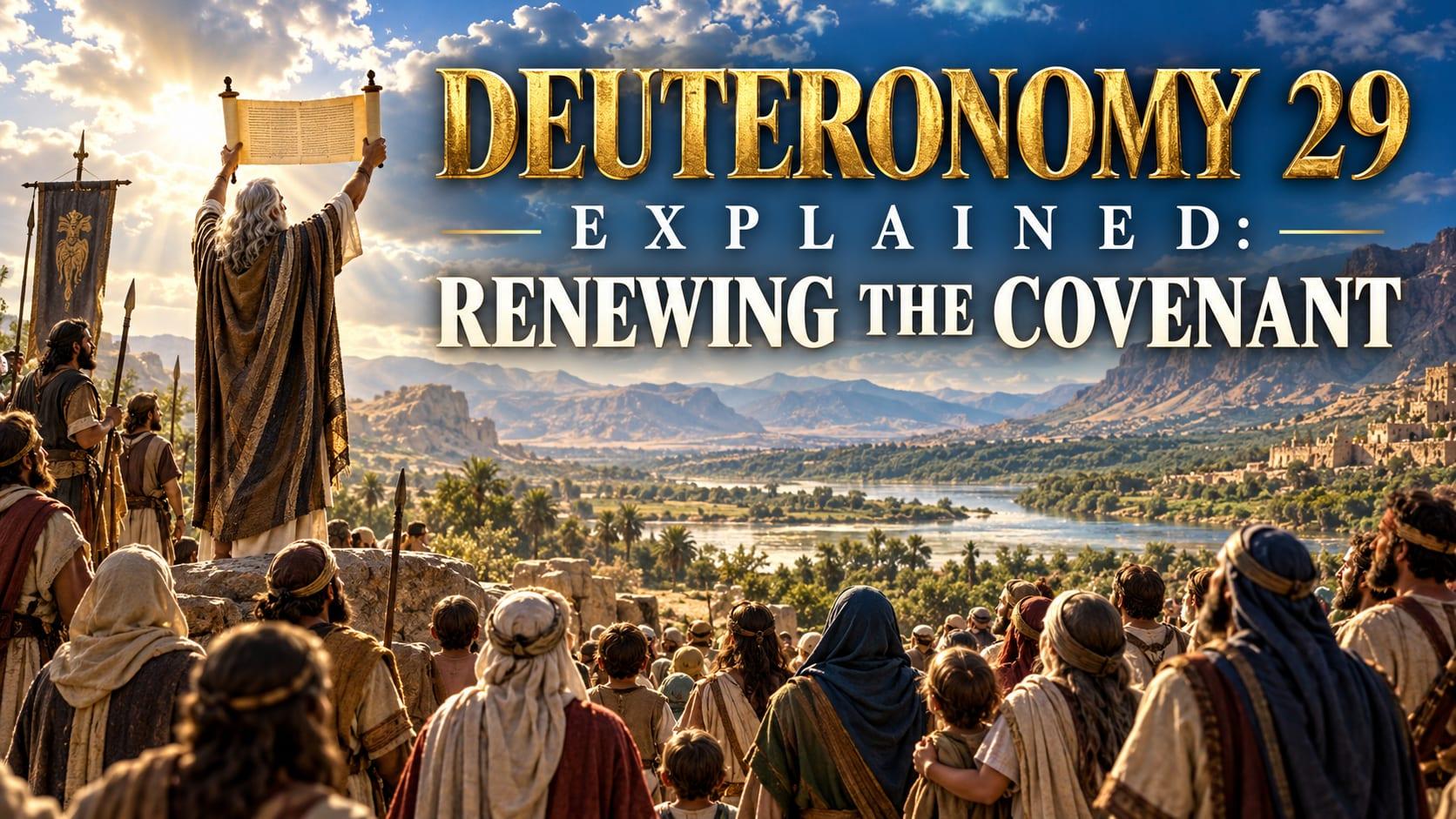
Deuteronomy 29 explained is the chapter where Moses renews the covenant one more time, this time in the land of Moab, and makes sure nobody listening can claim they were too small, too poor, or too foreign to count. Then, a few verses later, he says something even bigger. This covenant is not only with the people standing there that day. It reaches people who had not been born yet.
You may have skimmed this chapter as another rerun of the same old warning.
- ❓ Why does Moses list the woodcutter and the water carrier by name?
- ❓ Can a covenant really bind someone who was not even alive when it was made?
- ❓ What does it mean that God did not give Israel a heart to perceive?
- ❓ What does the famous closing line about secret things actually settle?
📌 Deuteronomy 29 is Moses making sure this covenant has no fine print only insiders can read, and no clause that quietly expires once this generation dies.
Read slowly from here. By the end, even the chapter's most quoted line will mean more than the plaque it usually gets reduced to.
What Happened Just Before This Chapter
Deuteronomy 28 spelled out exactly what obedience and disobedience would cost Israel, blessing running fourteen verses deep and curse running four times longer, ending in siege, exile, and a threatened return to slavery in Egypt by ship.
Deuteronomy 29 does not add another list of consequences. It pauses to renew the covenant itself, one more time, before Moses hands leadership to Joshua and before Israel ever crosses the Jordan. Israel had already entered covenant with God once, at Horeb, the same mountain also called Sinai, a full generation earlier. The people standing in front of Moses now are almost entirely a different set of people. Nearly everyone who stood at Horeb has already died in the wilderness. So the covenant gets renewed here, in the land of Moab, for a nation that is, in practice, brand new.

Deuteronomy 29 Explained Verse by Verse
1. A Second Covenant, Not a Replacement (verses 1 to 3)
The chapter opens by naming exactly what is about to happen, and where.
"These are the words of the covenant, which the LORD commanded Moses to make with the children of Israel in the land of Moab, beside the covenant which he made with them in Horeb."
📌 "Beside" means alongside, in addition to, not instead of. Moses is not announcing a second chance after Horeb failed. He is announcing a renewal, the same relationship stated out loud again for a people who were mostly not present the first time. Then Moses turns the people back to what they themselves watched happen.
"And Moses called unto all Israel, and said unto them, Ye have seen all that the LORD did before your eyes in the land of Egypt unto Pharaoh, and unto all his servants, and unto all his land; The great temptations which thine eyes have seen, the signs, and those great miracles:"
This generation is younger than the exodus itself, but not too young to remember forty years of manna, a pillar of cloud, and two kings already defeated on the near side of the Jordan. Moses is building his whole appeal on evidence they watched with their own eyes, not on evidence handed down secondhand.
2. Eyes That Have Seen, Hearts That Still Could Not Perceive (verses 4 to 6)
Right after listing everything Israel saw, Moses says something that stops the list cold.
"Yet the LORD hath not given you an heart to perceive, and eyes to see, and ears to hear, unto this day."
⚠️ Watching a miracle and understanding a miracle are not the same thing. The wilderness generation saw the sea split and the manna fall every single morning, and they still rebelled against God again and again, including the moment at Kadeshbarnea that barred an entire generation from the land. Moses is warning the new generation that having seen fewer dramatic signs themselves is not actually their biggest danger. Seeing never guaranteed perceiving, not even for people who watched everything firsthand.
Then Moses names the ordinary miracle that has carried them the whole way.
"And I have led you forty years in the wilderness: your clothes are not waxen old upon you, and thy shoe is not waxen old upon thy foot. Ye have not eaten bread, neither have ye drunk wine or strong drink: that ye might know that I am the LORD your God."
💡 "Waxen old" is simply worn out. Forty years of walking and the same clothes and sandals never gave way, and forty years without a single harvest of their own, and nobody starved. That last clause names the point of the whole arrangement outright: not comfort for its own sake, but daily proof, meal by meal, of exactly who was keeping them alive.
3. Victory Already Won, Land Already Divided (verses 7 to 9)
Moses moves from the wilderness to the most recent battles, both already decided.
"And when ye came unto this place, Sihon the king of Heshbon, and Og the king of Bashan, came out against us unto battle, and we smote them: And we took their land, and gave it for an inheritance unto the Reubenites, and to the Gadites, and to the half tribe of Manasseh."
Sihon and Og ruled territory on the near side of the Jordan, and both kingdoms were already conquered and already handed out as inheritance before this covenant ceremony even happens. Two and a half of the twelve tribes are already settled. The land still waiting across the Jordan is not a hope resting on nothing. It is a promise with a partial receipt already in hand.
That receipt is exactly why the next line reads as a reasonable request, not a blind leap.
"Keep therefore the words of this covenant, and do them, that ye may prosper in all that ye do."
"Therefore" ties the command directly back to what was just proven. Obedience is not being asked for on faith alone. It is being asked for on a track record.

4. Everyone Stands Here, Even the Ones Not Born Yet (verses 10 to 15)
Moses now lists exactly who is party to this covenant, from the top of the camp to the bottom.
"Ye stand this day all of you before the LORD your God; your captains of your tribes, your elders, and your officers, with all the men of Israel, Your little ones, your wives, and thy stranger that is in thy camp, from the hewer of thy wood unto the drawer of thy water:"
👀 Captains and elders at the top, then children, wives, the foreigner living among them, and finally the two lowest jobs in the whole camp named specifically, the one who cuts wood and the one who hauls water. Nobody present gets to say the covenant was meant for somebody more important than them.
The purpose of standing there gets stated next.
"That thou shouldest enter into covenant with the LORD thy God, and into his oath, which the LORD thy God maketh with thee this day: That he may establish thee to day for a people unto himself, and that he may be unto thee a God, as he hath said unto thee, and as he hath sworn unto thy fathers, to Abraham, to Isaac, and to Jacob."
Then comes the line that stretches the whole scene further than a single afternoon in Moab.
"Neither with you only do I make this covenant and this oath; But with him that standeth here with us this day before the LORD our God, and also with him that is not here with us this day:"
📌 Moses is not only speaking to the generation he can see. He is speaking to every generation that will ever be born into this family. No one standing in that crowd voted on this agreement, and neither did anyone born after them, and the text says plainly that none of that matters. The same forward reach shows up again centuries later, almost in the same words, when Peter preaches at Pentecost.
"For the promise is unto you, and to your children, and to all that are afar off, even as many as the LORD our God shall call."
💡 God's promises were never built to expire with the generation that first heard them. Moses says it about Moab. Peter says it about the gospel. The pattern does not change.
5. A Root That Poisons the Whole Vine (verses 16 to 19)
Moses now turns from the whole nation to the one person hiding inside it, and names exactly what he is worried about.
"Lest there should be among you man, or woman, or family, or tribe, whose heart turneth away this day from the LORD our God, to go and serve the gods of these nations; lest there should be among you a root that beareth gall and wormwood;"
Gall is a bitter poison named elsewhere in Scripture, and wormwood is an actual bitter desert plant used again and again as a picture of harsh judgment. Paired together, they describe a single root quietly producing fruit that will sicken everyone near it. The danger Moses names is not public rebellion. It is one man, one family, one tribe, turning away in private while everyone around them assumes all is well.
Then Moses describes exactly how that person talks himself into staying quiet about it.
"And it come to pass, when he heareth the words of this curse, that he bless himself in his heart, saying, I shall have peace, though I walk in the imagination of mine heart, to add drunkenness to thirst:"
⚠️ He hears the warning, and talks himself out of it anyway. "Bless himself in his heart" is self assurance with no basis, a private pep talk that everything will still be fine. "Add drunkenness to thirst" pictures a thirsty man reaching for wine instead of water, making his own real problem worse while feeling like he just solved something. That image describes sin piling on top of sin while the sinner mistakes the feeling of relief for the real thing.
6. When the Curses Fall, and the Nations Ask Why (verses 20 to 28)
Moses states the individual consequence for that hidden root in blunt terms.
"The LORD will not spare him, but then the anger of the LORD and his jealousy shall smoke against that man, and all the curses that are written in this book shall lie upon him, and the LORD shall blot out his name from under heaven."
"Blot out his name" is not only death. It is erasure, no memory kept of him among the very people whose covenant he quietly broke. From there the chapter widens out from one hidden man to the whole nation's possible future.
"So that the generation to come of your children that shall rise up after you, and the stranger that shall come from a far land, shall say, when they see the plagues of that land, and the sicknesses which the LORD hath laid upon it; And that the whole land thereof is brimstone, and salt, and burning, that it is not sown, nor beareth, nor any grass groweth therein, like the overthrow of Sodom, and Gomorrah, Admah, and Zeboim, which the LORD overthrew in his anger, and in his wrath:"
📌 That is not a vague comparison. Moses picks the exact disaster everyone listening already knew by name. Sodom and Gomorrah's destruction used the same word Moses reaches for here.
"Then the LORD rained upon Sodom and upon Gomorrah brimstone and fire from the LORD out of heaven; And he overthrew those cities, and all the plain, and all the inhabitants of the cities, and that which grew upon the ground."
Brimstone, burning, nothing left growing. Moses is telling Israel the same ruin is possible for the land they are about to inherit, not only for a city of strangers from an older story. A devastation that severe, Moses says, would leave even outsiders asking a question the text answers immediately.
"Even all nations shall say, Wherefore hath the LORD done thus unto this land? what meaneth the heat of this great anger? Then men shall say, Because they have forsaken the covenant of the LORD God of their fathers, which he made with them when he brought them forth out of the land of Egypt: For they went and served other gods, and worshipped them, gods whom they knew not, and whom he had not given unto them:"
💡 Moses gives Israel the answer before the disaster ever happens, so that if it ever does happen, nobody can call it a mystery. Leviticus 26 lays out the same pattern of blessing and curse years earlier, at Sinai, so this is not a new threat invented for Moab. It is the same warning restated at the border of the land it would actually affect.
7. The Secret Things Belong to the LORD (verse 29)
The chapter closes on the line most people have heard quoted far from its actual context.
"The secret things belong unto the LORD our God: but those things which are revealed belong unto us and to our children for ever, that we may do all the words of this law."
📌 This verse is not a general comment about unanswered questions in life. It is Moses closing one specific chapter full of things he never fully explained: exactly who will turn away, exactly when judgment falls, exactly what it looks like for a name to be blotted out. Those belong to God. What belongs to Israel, and to every generation of their children after them, is the part that was actually written down and handed to them to obey. The verse does not excuse curiosity. It redirects attention from what cannot be known toward what has already been given.
Hard Questions Deuteronomy 29 Raises
Does verse 4 mean God is to blame for Israel's unbelief? The text holds two things together without fully untangling them. It plainly states that a perceiving heart is something only God gives, and it is just as plain elsewhere that Israel's own hardness was their own fault, chosen again and again. Numbers 14 records the specific moment this same generation's parents saw every miracle God worked and still refused to trust Him at the border of the land. Centuries later Jesus says almost the identical thing to His own disciples, men who had watched Him feed thousands with their own eyes.
"And when Jesus knew it, he saith unto them, Why reason ye, because ye have no bread? perceive ye not yet, neither understand? have ye your heart yet hardened? Having eyes, see ye not? and having ears, hear ye not? and do ye not remember?"
Scripture does not resolve the tension between God giving perception and people being held responsible for lacking it. It states both, in both testaments, and leaves the reader to hold them together rather than pick one and drop the other.
Can a covenant really bind people who were not alive to agree to it? In the ancient world, a family or a nation entering covenant bound everyone born into it afterward, the same way a child inherits a family's debts, land, and name without ever signing anything personally. Verses 14 and 15 apply that same logic to Israel's relationship with God. It is worth noticing what changes by the time Peter preaches in Acts 2. The promise still reaches "your children," but it now reaches them through being personally called and personally choosing to repent, not through birth alone. The reach of the promise stays the same. How a person enters it does not.
What exactly does "a root that beareth gall and wormwood" mean, and is it connected to the New Testament's "root of bitterness"? Gall and wormwood were both known in Scripture as bitter, even poisonous, substances, paired here as an idiom for something that produces nothing but harm. Hebrews later warns believers about a very similar danger using very similar language.
"Looking diligently lest any man fail of the grace of God; lest any root of bitterness springing up trouble you, and thereby many be defiled;"
Hebrews is not quoting Deuteronomy 29:18 word for word, but it is clearly drawing on the same picture for the same warning: one person's hidden sin, left unaddressed, does not stay contained to that one person.
Top Verses From Deuteronomy 29
1. Deuteronomy 29:4
"Yet the LORD hath not given you an heart to perceive, and eyes to see, and ears to hear, unto this day."
A blunt reminder that watching God work and understanding what you watched are two different things, true of the wilderness generation and still true today.
2. Deuteronomy 29:14 and 15
"Neither with you only do I make this covenant and this oath; But with him that standeth here with us this day before the LORD our God, and also with him that is not here with us this day:"
The widest verse in the chapter, reaching past everyone physically present to bind generations who had not yet been born, a reach echoed centuries later at Pentecost.
3. Deuteronomy 29:19
"And it come to pass, when he heareth the words of this curse, that he bless himself in his heart, saying, I shall have peace, though I walk in the imagination of mine heart, to add drunkenness to thirst:"
A picture of self deception in one sentence, a man hearing a clear warning and convincing himself it does not apply, while making his own real problem worse.
4. Deuteronomy 29:23
"And that the whole land thereof is brimstone, and salt, and burning, that it is not sown, nor beareth, nor any grass groweth therein, like the overthrow of Sodom, and Gomorrah, Admah, and Zeboim, which the LORD overthrew in his anger, and in his wrath:"
A specific, nameable disaster used as the measuring stick, not a vague threat, warning Israel that the same ruin was possible for the land they were about to inherit.
5. Deuteronomy 29:29
"The secret things belong unto the LORD our God: but those things which are revealed belong unto us and to our children for ever, that we may do all the words of this law."
The chapter's closing line, often quoted alone, actually answering a specific question about what Moses left unexplained, and redirecting Israel to what was not left unexplained.
Frequently Asked Questions About Deuteronomy 29
What is Deuteronomy 29 about?
Deuteronomy 29 covers Moses renewing God's covenant with Israel in the land of Moab, naming everyone bound by it down to the lowest worker in the camp, warning against secret idolatry, and closing with the line about secret things belonging to the LORD.
What does Deuteronomy 29:29 mean?
It means God keeps some things to Himself while giving Israel exactly what it needs to obey. In context it answers why Moses never fully explained who would turn away or when judgment would fall: that was not Israel's business, obeying what was written was.
Why did Moses say the Israelites' hearts, eyes, and ears were not given to perceive?
He was naming the gap between watching miracles and actually trusting God because of them. This same generation's parents saw the exodus firsthand and still rebelled, proving that seeing alone never produces real understanding.
Who was included in the covenant described in Deuteronomy 29?
Everyone in the camp, named specifically: tribal captains, elders, officers, wives, children, the foreigner living among them, and even the lowest laborers, the one who cut wood and the one who drew water.
Does Deuteronomy 29 mean the covenant binds people who were never born yet?
Yes, by its own wording. Verses 14 and 15 state the covenant was made with those present and with those not present that day, extending it to future generations the same way a family inherits an agreement made before any of them existed.
What does "a root that beareth gall and wormwood" mean in Deuteronomy 29:18?
Gall and wormwood were both known as bitter, harmful substances. The image describes one hidden person or family turning away from God and producing bitter consequences that spread to everyone nearby.
What does "add drunkenness to thirst" mean in Deuteronomy 29:19?
It pictures a thirsty man reaching for wine instead of water, making his real problem worse while feeling satisfied. It describes someone piling sin on top of sin instead of actually dealing with it.
Why does Deuteronomy 29 compare Israel's possible future to Sodom and Gomorrah?
Moses picks a disaster his audience already knew in detail, brimstone and total desolation, to make the warning concrete rather than vague. The same wording used for Sodom's overthrow in Genesis 19 is used here to describe what covenant breaking could bring on Israel's own land.
What is the difference between the covenant at Horeb and the covenant in Moab?
They are not two different agreements. Verse 1 calls the Moab covenant something made "beside," meaning alongside, the Horeb covenant. Horeb was given to the generation that left Egypt. Moab renews the same relationship for the generation about to enter the land.
Why does Deuteronomy 29 mention the stranger and the woodcutter specifically?
Naming the lowest workers and the foreigners living in the camp, alongside captains and elders, makes clear the covenant left no one out by rank, wealth, or birth. Nobody standing there could claim the agreement was meant for someone more important than them.
Final Thoughts
Deuteronomy 29 keeps widening the circle the longer it goes.
📌 A perceiving heart is a gift, not a reward for having watched enough miracles. The generation that saw the exodus firsthand still needed God to open their eyes, and so does every generation after them.
📌 This covenant was built to outlast everyone currently breathing. Verses 14 and 15 reach past the crowd standing in Moab to every child born into that family afterward, the same reach Peter later gives the gospel itself.
📌 The real danger this chapter names is not ignorance. It is self deception. Verse 19 describes a man who hears the warning clearly and talks himself into peace anyway.
Here is your one next step from this chapter.
Read Deuteronomy 29:29 again, but this time ask honestly whether you have been spending your attention on secret things that were never yours to know, instead of the revealed things you already have in front of you to actually do.