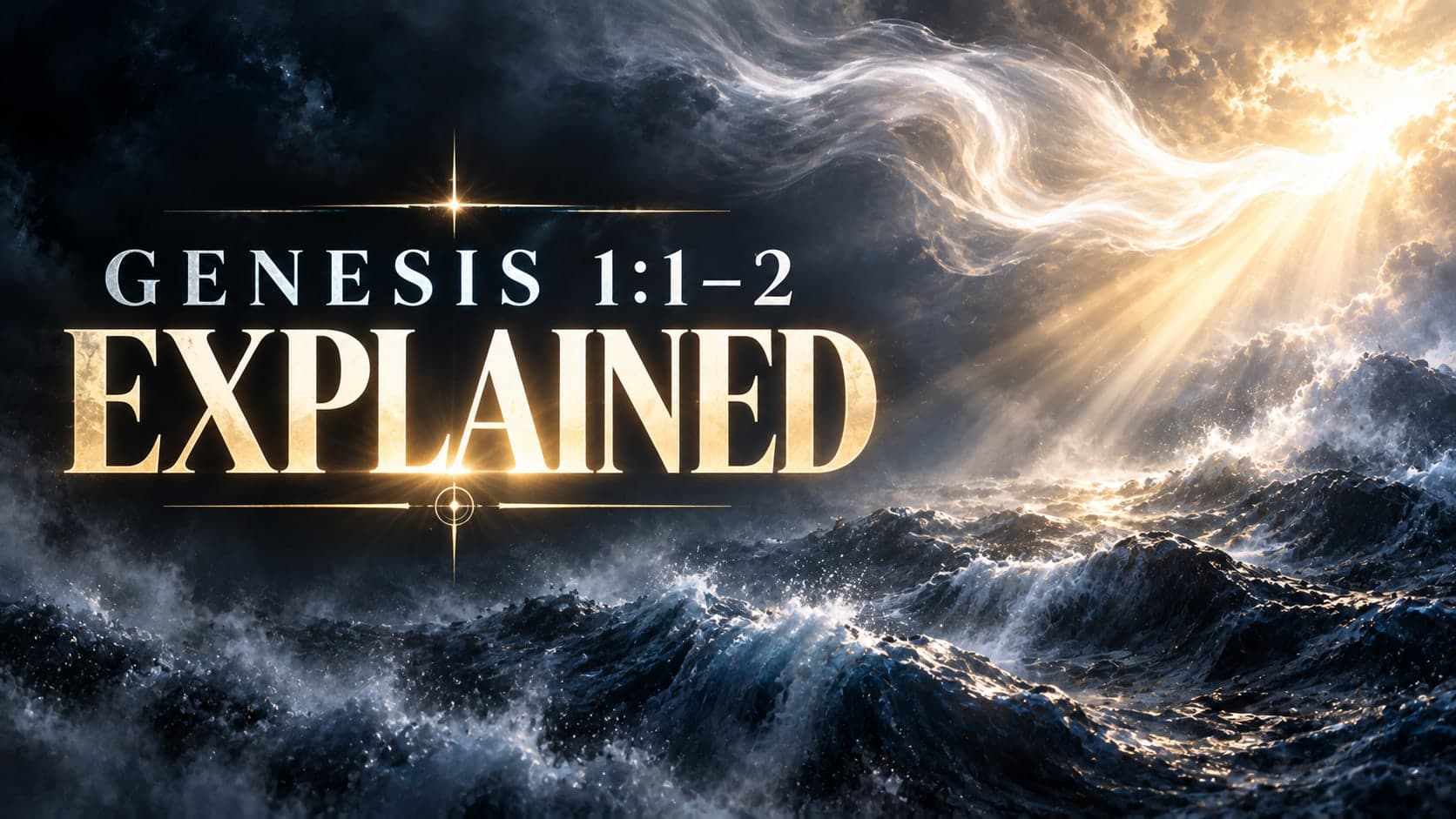
📖 Genesis 1:1-2 Explained
Genesis 1:1 and Genesis 1:2 are only two verses.
But together, they introduce everything.
- ❓ Who created the world?
- ❓ What existed before creation?
- ❓ Why was the earth covered in darkness and water?
- ❓ And where was God before He ever said "Let there be light"?
If you have ever searched for the Genesis 1:1 meaning late at night, you already know these questions do not stay theoretical for long.
They turn personal fast.
Because most people do not open Genesis 1 to study ancient history.
They open it because their own life feels like verse two right now.
📌 Unformed. Empty. Dark. Not finished yet.
Maybe that is a relationship that has not taken shape. A calling you cannot see the outline of yet. A diagnosis. A dream still sitting in the dark, waiting on something.
So before you rush to the part everyone quotes, the part where light breaks in, it is worth slowing all the way down.
Most Bible teaching skips straight from "God created the world" to "let there be light," like verse 2 is a throat clearing you can hurry past.
It is not. It might be the most honest verse in the whole chapter.
Let's break down what was happening before the first day of creation.
Not a summary. Not a paraphrase.
The actual two verses. Word by word. In the order they were written.
By the end, you will know exactly what "without form, and void" means, what "the deep" is, why the Spirit of God is described as moving over the water, and why the darkness never once meant God had lost control.
📖 Genesis 1:1-2 is where the whole Bible starts. Take a breath, and let's go back to before there was light.
Why This Matters for Your Faith
It is easy to treat Genesis 1:1-2 as a warm up.
Two quiet verses before the real action starts on day one.
That is a mistake.
📌 Everything you believe about God gets set up right here, before a single day of creation has even started.
Genesis 1:1 tells you who is in charge of existence itself.
Genesis 1:2 tells you what God does with a world that is not finished yet.
That second part matters more than it sounds like it should.
If you have never stopped to ask what the Bible actually is and why its very first page starts this way, Genesis 1:1-2 is the best possible place to start answering that.
Because you are going to spend most of your life somewhere between verse one and verse three. Between the truth that God is Creator, and the moment His plan for you actually comes into the light.
⚠️ If you only believe the Bible when it shows finished, glorious results, your faith will not survive an unfinished season.
And every season is unfinished until it is not. Every calling looks formless before it takes shape. Every prayer feels like it is sitting in the dark before it gets answered.
Genesis 1:1-2 is not just the record of how the physical world began. It is the pattern for how God works, full stop.
He does not need a finished thing to start loving it, shaping it, and showing up for it.
📌 He was already present over the earth before the earth had any shape at all.
That is the God you are trusting with your own unfinished places.
This is also why Genesis 1:1-2 belongs at the foundation of how you defend your faith when someone challenges where the universe came from. It is not a fallback verse. It is the starting claim everything else in Scripture stands on.

What Genesis 1:1-2 Actually Says
Let's walk through the two verses in order.
Slowly. Phrase by phrase.
1. God Created the Heaven and the Earth
"In the beginning God created the heaven and the earth."
Ten words in English. But do not read past them too fast.
"Heaven and earth" is a Hebrew way of saying everything.
Bible scholars call this a merism, a figure of speech where two opposite ends stand in for the whole range in between. Like saying "I searched high and low" to mean you searched everywhere.
📌 "The heaven and the earth" means the heavens, the earth, and every single thing in between.
Angels. Galaxies. Oceans. Atoms. Time itself.
All of it, summed up in one verse.
💡 Here is the part most readers miss. Genesis 1:1 is a summary before it is a play by play.
Verse 1 tells you who created everything. The verses that follow spend an entire chapter explaining how He formed it and filled it.
Think of it like a headline before the article. Genesis 1:1 is the headline. In the beginning, God did this. Everything that follows in the chapter unpacks what that actually looked like, day by day.
That is why Genesis 1:1 answers the biggest question in the universe before you even reach verse two.
- ❓ Did the universe create itself? No.
- ❓ Did it always exist? No.
- ❓ Is it an accident? No.
God created it. On purpose. With intention. Before there was a single witness to see Him do it.
The Hebrew word behind "created" is bara, and it is worth noticing where else it shows up in Scripture.
Bara is used only for God. Never once in the Old Testament is a human being the subject of that word. People make things out of material that already exists. Carpenters build. Bakers form bread. Artists shape clay.
📌 Only God creates out of nothing.
That is the claim sitting inside the very first verb of the Bible. Not that God reorganized existing material like everyone else does. That He is the source everything else came from.
If you want to read Genesis 1 the way it was actually written, verse by verse, you can open the whole chapter for free in the Bible Buddy reader here, and follow along as we keep going.
2. Without Form, and Void: God Forms, Then Fills
"And the earth was without form, and void; and darkness was upon the face of the deep. And the Spirit of God moved upon the face of the waters."
Now the camera zooms in.
Verse 1 gave you the summary. Verse 2 gives you the starting condition.
And it is not pretty.
"Without form, and void" translates two Hebrew words, tohu and bohu, that basically mean unformed and empty.
Unshaped. Uninhabited. Raw material, waiting.
You will see this same phrase worded slightly differently across other translations, which is exactly the kind of thing that makes people wonder why there are so many Bible translations in the first place. The King James wording, "without form, and void," is one of the clearest ways to picture it.
📌 That unfinished earth reveals the pattern of the entire chapter.
Read the rest of Genesis 1 and watch what God does.
First He forms the spaces. Then He fills them.
- 🟢 Day 1, He forms light and separates it from darkness.
- 🟢 Day 4, He fills that light with sun, moon, and stars.
- 🟢 Day 2, He forms sky and sea by separating the waters.
- 🟢 Day 5, He fills sky and sea with birds and fish.
- 🟢 Day 3, He forms dry land.
- 🟢 Day 6, He fills that land with animals and with people.
Form, then fill. Every single time.
💡 Once you notice that pattern, the rest of the creation story makes far more sense.
God is not changing His mind as He goes.
He is not improvising.
He is developing the world step by step, on purpose, the way an artist works.
You do not pour paint on a bare canvas and call it finished. You sketch the outline first. Then you fill it in, layer by layer, until the picture is whole.
That is what verse 2 is showing you. The earth at the outline stage.
Not a mistake. Not a failure. The first honest step of something that is being made.
This pattern shows up everywhere God works, not just on the first page of Genesis. A marriage gets formed on a wedding day, and filled in slowly over years of ordinary mornings. A calling gets formed the moment God plants it in you, and filled in through a long stretch of preparation nobody claps for.
📌 If your life currently looks formed but not filled, or not even formed yet, you are not behind. You are exactly where creation itself started.
3. Darkness Was Upon the Face of the Deep
Look again at the middle of verse 2.
"Darkness was upon the face of the deep."
"The deep" is the great mass of water covering the unformed earth. Not a small pond. Not a lake you could see the far shore of.
An endless, churning expanse of water, and over the top of it, total darkness.
Before God created light, this is what covered everything.
- 🔲 No sunlight.
- 🔲 No dry land.
- 🔲 No life filling the world.
- 🔲 Just darkness, stretching across deep water, as far as it went.
Sit with that image for a moment. Do not rush past it.
Cultures surrounding ancient Israel told stories about the deep as a hostile, dangerous power that had to be fought and conquered. Genesis does something completely different.
It never treats the deep as a rival to God. It never has Him wrestling it into submission. The waters are simply raw material, waiting to be shaped by a God who was never threatened by them for a second.
📌 The darkness in Genesis 1:2 is not a villain in the story. It is a starting line.
⚠️ If you only ever picture Genesis 1 starting with light, you skip the part of the story that speaks to you the most.
Because you have stood in that darkness. Maybe you are standing in it right now. A diagnosis with no timeline yet. A prayer with no answer yet. A season with no visible shape yet. Nothing but deep water and darkness over the top of it.
Here is what verse 2 will not let you forget.
📌 The darkness did not mean God had lost control. It meant He was not finished creating.
Those are two very different things, and it is easy to confuse them.
Darkness feels like absence. It feels like nothing is happening. It feels, some nights, like God has stepped out of the room.
But Genesis 1:2 puts God right there in the middle of it. Actively present. Not absent.
The chapter never says God looked at the darkness and panicked. It never says He was waiting for someone else to fix it. It never says the deep took Him by surprise.
It says the darkness was upon the face of the deep, and God was right there over it.
💡 An unfinished season is not the same thing as an abandoned one.
Genesis 1:2 is proof of that, written on the very first page of the Bible.
You are allowed to still be in the dark part of your story.
You are not allowed to believe that means God has walked away from it.
4. The Spirit of God Moved Upon the Face of the Waters
Now read the last line of verse 2 again, slowly.
"And the Spirit of God moved upon the face of the waters."
Before God ever spoke a word, before a single "let there be", His Spirit was already there.
📌 Presence came before speech. Presence came before light. Presence came before anything visible happened at all.
The word translated "moved" carries the idea of hovering. Some Hebrew scholars connect it to the picture of a bird hovering protectively over its nest.
Watching over. Guarding. Ready.
💡 Like a bird watching over and protecting its young.
It is the same picture Moses later uses in Deuteronomy 32, describing an eagle stirring up her nest and hovering over her young, ready to catch them. The Hebrew word behind "moved" in Genesis 1:2 is ruach, the same word used for breath, wind, and Spirit throughout the Old Testament. God was not just present over the deep. He was actively, personally engaged with it.
Not distant. Not disinterested. Not waiting somewhere else for the world to be ready.
Hovering directly over the darkness and the deep, at the exact moment nothing looked finished yet.
Put the whole picture of verse 2 together now.
- 🌊 The world was dark.
- 🌊 The waters were deep.
- 🌊 Creation was unfinished.
📌 But it was never abandoned.
God was present over everything He had made, before any of it had taken shape.
That is the same Spirit Scripture says is near you now. Not waiting for your life to look finished before He shows up. Hovering over the exact mess you are in, right now, the way He hovered over the deep.
❓ If God's Spirit was already present over an earth that had no shape and no light yet, do you really think He is absent from the unformed parts of your own life?
He was not waiting on the other side of day one. He was already there before it.
5. Then God Spoke: Where Genesis 1:3-4 Begins
So here is where that leaves you.
Before the first light ever appeared, God had already created the heavens and the earth.
The world was unformed and empty.
Darkness covered the deep.
And His Spirit hovered over the waters.
Then, in the very next verse, everything changes.
"And God said, Let there be light: and there was light. And God saw the light, that it was good: and God divided the light from the darkness."
❓ What was that light, before the sun even existed on day four? And why did God look at it and call it good?
That is where Genesis 1:3-4 picks up, and it deserves its own careful reading.
For today, just hold onto this. The light in verse 3 only means something because of the darkness in verse 2.
You cannot skip to the light and understand what it cost, or what it means.
You have to walk through verse 2 first.
Notice too what verse 4 says God did with the light once it existed. He saw it, called it good, and divided it from the darkness.
He did not erase the darkness. He did not pretend it had never been there. He set a boundary around it and gave the light its own place.
💡 God does not always remove every trace of the hard season. Sometimes He simply gives you light to stand next to it.
📌 Every unfinished thing in your life is a page 2 story. The light is coming. It always comes. But it comes after God has already been present in the dark.

Practical Tips: Living Like Genesis 1:1-2 Is True
Genesis 1:1-2 is not just a passage to understand.
It is a pattern to live inside of.
Here are eight ways to put it into practice starting today.
- Name what stage you are in. Are you in a formless stage, waiting to see the shape of something, or a filling stage, waiting for what has already taken shape to get finished off? Both are normal parts of how God builds things. Naming the stage honestly, out loud or on paper, keeps you from panicking over a normal part of the process.
- Stop reading darkness as abandonment. When a season feels dark, ask whether the honest read is "God has left" or "this is not finished yet." Genesis 1:2 says those are two very different situations. Most of the time, what feels like silence from God is really a season still being formed.
- Pray to the God who was already hovering. You do not have to clean up the mess before you bring it to Him. His Spirit moved over the waters while they were still formless. He is not waiting for your life to look presentable first.
- Ask who before you ask how. When you are overwhelmed by a problem you cannot fix, settle who is over it before you demand to know how it gets solved. Genesis 1:1 answers who long before Genesis 1 explains how. Peace usually shows up in that order, not the other way around.
- Read the whole chapter, not just two verses. Genesis 1:1-2 makes the most sense once you see the full form and fill pattern play out across all six days. If you have never actually read it start to finish slowly, this week is a good week to do it.
- Mark the pattern as you read. Underline every time God forms something and every time He fills it. A simple system, like a basic Bible highlighting method, makes patterns like this jump off the page instead of staying invisible.
- Bring the anxious "unfinished" feeling straight to God. An unformed season can stir up real fear about the future. If that is where you are, it helps to also look honestly at what the Bible says about anxiety alongside this passage.
- Do not rush your own light. God let the darkness stay exactly as long as it needed to stay before He spoke. Trust His timing on your unfinished thing the same way, instead of forcing an outcome before it is ready. When you catch yourself demanding an answer today, try thanking Him instead for already being present over it.
Top 5 Bible Verses About God Creating the World
Genesis 1:1-2 does not stand alone.
The rest of Scripture keeps returning to it, from the Gospels to the wisdom books.
Here are five verses that echo it and deepen it.
1. John 1:1-3
"In the beginning was the Word, and the Word was with God, and the Word was God. The same was in the beginning with God. All things were made by him; and without him was not any thing made that was made."
Notice the opening words. "In the beginning."
John is deliberately echoing Genesis 1:1, word for word, on purpose.
He is telling you that the God who created the heaven and the earth is the same God revealed in Jesus Christ.
The Creator in Genesis 1:1 has a name, and John wants you to know it before his Gospel even gets started.
Read Genesis 1:1 and John 1:1 side by side and you are looking at the same claim from two different angles, thousands of years apart, agreeing completely.
2. Psalm 33:6
"By the word of the LORD were the heavens made; and all the host of them by the breath of his mouth."
This verse names the method behind Genesis 1. God spoke, and it happened.
A few verses later the psalmist puts it even more plainly: "he spake, and it was done."
No struggle. No trial and error. Just a word, backed by all the authority of the One saying it.
The same voice that spoke light into the darkness in Genesis 1:3 can still speak into whatever is unformed in your life.
3. Job 38:4
"Where wast thou when I laid the foundations of the earth? declare, if thou hast understanding."
God asks Job this question after Job spent chapters demanding answers about his own suffering.
It is not a put down. It is a reset.
📌 The God who was there for Genesis 1:1, laying foundations before anyone else existed, is not obligated to explain every detail of your unfinished chapter to you.
He is trustworthy because of who He already proved Himself to be back in verse 1.
When your own unfinished season raises questions you cannot answer, this verse is permission to stop demanding a full explanation and rest in who laid the foundations of the earth in the first place.
4. 2 Corinthians 4:6
"For God, who commanded the light to shine out of darkness, hath shined in our hearts, to give the light of the knowledge of the glory of God in the face of Jesus Christ."
Paul reaches straight back to Genesis 1 to describe what happens inside a believer's heart.
The same God who spoke light out of the darkness over the deep does it again, personally, in you.
He uses the exact language of Genesis 1:2 and 1:3 on purpose. Darkness. Commanded light. Shining. Paul wants you to see your own heart as another place the Creator has spoken into.
💡 Whatever felt like darkness upon the deep in your own story, God still specializes in commanding light into exactly that kind of place.
5. Hebrews 11:3
"Through faith we understand that the worlds were framed by the word of God, so that things which are seen were not made of things which do appear."
This verse tells you plainly how to hold Genesis 1:1-2 in your heart. Not first by proving it. By faith.
No one was present to witness the beginning except God Himself. You were not there for verse 1, and you are not always given proof for the unfinished thing you are trusting Him with now either.
📌 Faith is how you understand both. That the visible world came from what could not be seen, and that your own unformed season is being shaped by a God you cannot watch working.
Frequently Asked Questions About Genesis 1:1-2
What does Genesis 1:1 mean?
Genesis 1:1 means God existed before time and matter, and He is the one who created everything, summed up as "the heaven and the earth." It is a summary statement that answers who created the universe before the rest of the chapter explains how He did it, day by day. It is the first sentence of the Bible for a reason. Nothing else makes sense until this is settled.
Who created the heaven and the earth?
God did, according to Genesis 1:1. Not a committee of gods, not chance, not an unexplained force. Scripture consistently credits one God as Creator, and John 1:1-3 identifies that Creator with the eternal Word who became Jesus Christ. Genesis 1:2 adds that His Spirit was present and active in that same act of creation. The Bible never leaves the question of who open for debate.
What was there before God created the world?
The honest answer is that Scripture does not describe a "before" in the way we picture time. Genesis 1:1 opens with "in the beginning," which is when time itself starts. Before that point, only God existed, eternal and uncreated. Hebrews 11:3 says the world was framed by the word of God out of things that do not appear, meaning it was not built from pre-existing material. It is a hard idea to picture, because everything in your daily life had a before. God simply did not.
What does "without form, and void" mean in Genesis 1:2?
It means the earth had no shape yet and nothing living in it yet. The Hebrew words behind the phrase describe raw, unformed material, not a broken or ruined earth. It is the starting condition God works from, not a mistake He has to fix. The rest of Genesis 1 shows Him giving it form and then filling it, one day at a time.
What is "the deep" in Genesis 1:2?
"The deep" refers to the vast body of water covering the unformed earth before dry land existed. It is not a symbol for evil or chaos monsters, despite what some ancient myths claimed about similar imagery. In Genesis, the deep is simply the raw material God shapes on day two, when He separates the waters above from the waters below.
Does the darkness in Genesis 1:2 mean evil or chaos?
No. Genesis never calls the darkness evil, and it never says God was afraid of it or fighting it. Darkness in verse 2 simply describes the absence of light before God created light in verse 3. It represents an unfinished state, not a moral or spiritual battle. Other ancient cultures wrote about the deep as a threat to be defeated, but Genesis never does. God remains fully in control the entire time.
What does it mean that the Spirit of God "moved upon the face of the waters"?
"Moved" carries the sense of hovering, the way a bird hovers protectively over its nest. It pictures the Spirit of God actively present over the unformed, dark earth before God spoke a single word. It shows that God's presence came before His speech, and that He was watching over creation from the very first moment, not waiting somewhere else until it was ready.
Why did God create the earth unfinished before He filled it?
Genesis 1 shows a deliberate pattern of forming spaces and then filling them, across all six days. This was not a limitation on God's power, since He could have spoken a finished world into being instantly. It reveals how He chooses to work, step by step, with intention, developing what He makes rather than rushing it. That same unhurried pattern shows up throughout Scripture, in how God grows a person's faith and character over time rather than all at once.
Is Genesis 1:1 a summary of the whole creation week or the first act of creation?
Many Bible teachers read Genesis 1:1 as a summary heading over the whole chapter, with verse 2 describing the earth's starting condition and verse 3 beginning the actual first day. Others read it as the first event in the sequence. Either way, the verse establishes the same core truth, that God alone is responsible for the existence of the heavens and the earth.
What happens next in Genesis 1:3-4?
God speaks for the first time in Scripture, saying "Let there be light," and light appears. Verse 4 says God saw the light, that it was good, and He divided the light from the darkness. That moment begins the first day of creation and sets the pattern of speaking, seeing, and naming that continues through the rest of the chapter.
Final Thoughts
If you remember nothing else from Genesis 1:1-2, remember these three things.
📌 Verse 1 answers who before the chapter ever explains how. God created the heaven and the earth, everything that exists, on purpose and before any witness saw it happen.
📌 Verse 2 shows a pattern, not a problem. Unformed and empty is a starting point, not a failure. God forms, then He fills, every single time.
📌 Darkness meant unfinished, not abandoned. His Spirit was already hovering over the deep before He ever spoke a word.
Whatever unformed, dark, unfinished thing you are carrying right now, that same Spirit is over it.
Not waiting for it to look presentable. Already present.
You may not be at your "let there be light" moment yet. That is okay. Genesis 1:2 existed before Genesis 1:3 did, and it is still in the Bible on purpose.
God is not in a hurry to skip your unformed season either.
He is in it with you.
So here is your one next step.
Open Genesis 1 and read the rest of the chapter in one sitting.
Watch the pattern play out. Form, then fill. Darkness, then light.
Then ask God, honestly, to show you where you are in your own story right now.
He has never once needed you to be finished before He shows up.
He met the earth in its formless, empty, dark starting condition, and He stayed.
He will do exactly the same with you.
He was already there before day one.